“For you, O Psyche, I fear the worst, for you are mortal, and your beauty is beyond all measure.”
— Venus expressing her jealousy and fear of Psyche's beauty.

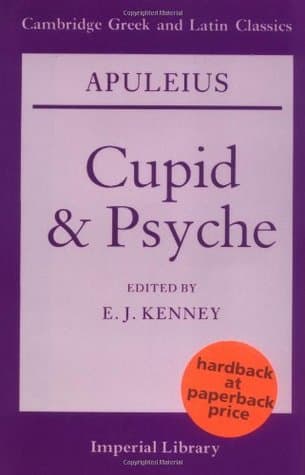
Apuleius (1976)
Genre
Fantasy / Children's / Creativity / Romance
Reading Time
256 min
Key Themes
See below
Sign in to track this book
A mortal princess, cursed by Venus and loved by her son, embarks on a perilous, allegorical quest for her divine husband, enduring impossible trials to unite her soul with love itself.
In a certain city, a king and queen have three daughters, the youngest and most beautiful of whom is Psyche. Her beauty is so extraordinary that mortals begin to worship her as a new Venus, neglecting the altars of the true goddess. This angers Venus, who feels her divine honor is taken by a mortal girl. Consumed by jealousy, Venus calls her son, Cupid, the god of love, and commands him to use his arrows to make Psyche fall in love with the most hideous creature imaginable, humiliating her and restoring Venus's supremacy. Cupid, however, is secretly moved by Psyche's innocence and beauty.
Despite Psyche's beauty, she remains unwed, while her two elder sisters, though less beautiful, find royal husbands. Her parents, distressed by her solitude and fearing divine displeasure, consult the Oracle of Apollo at Miletus. The oracle delivers a terrifying prophecy: Psyche is to marry not a mortal man, but a monstrous, serpent-like creature, feared by gods and men alike. She is to be adorned in bridal attire and left on a desolate mountaintop to await her fated husband. The city mourns, believing Psyche is being sacrificed to a terrible fate.
Following the oracle's decree, Psyche is led in a funereal procession, dressed as a bride for death, to the designated mountaintop. Her parents and the people weep, believing her doomed. As she stands alone, weeping and terrified, the gentle West Wind, Zephyr, lifts her tenderly from the peak and carries her down into a beautiful, green valley. There, she finds a magnificent palace, made not of stone but of light and sound, seemingly built by divine hands. Invisible servants attend to her every need, and an unseen voice welcomes her as the mistress of the house, promising her a husband who will come only in the darkness of night.
In the magnificent palace, Psyche is treated like a queen, waited on by unseen hands and serenaded by invisible choirs. Each night, in the complete darkness, her mysterious husband arrives. He is loving, gentle, and passionate, but strictly forbids her from ever trying to see his face. He warns her that if she attempts to discover his identity, all their happiness will be destroyed, and she will be separated from him forever. Despite his warnings and her growing affection for him, Psyche is filled with human curiosity and a nagging fear of his unknown nature, especially as she begins to suspect she is pregnant.
Psyche, feeling lonely despite her luxurious life, wants to see her family. Her husband, against his better judgment, allows Zephyr to bring her sisters to visit. Upon seeing Psyche's opulent palace and divine wealth, her sisters are consumed by bitter envy, disguised as concern. They question her husband's identity, suggesting he is the monstrous serpent foretold by the oracle, who will devour her and her unborn child. They urge her to defy his command, insisting she must see his face to confirm his true nature, giving her a lamp and a razor to kill the monster.
Tormented by her sisters' words, Psyche gives in to doubt. That night, after her husband has fallen asleep, she lights a lamp and approaches his bed. Instead of a monster, she sees the beautiful, winged god Cupid himself, arrows and quiver by his side. Startled by his divine beauty, she accidentally pricks herself with one of his arrows, falling instantly and irrevocably in love. A drop of oil from the lamp falls onto Cupid's shoulder, waking him. Disappointed and heartbroken by her betrayal of his trust, Cupid flies away without a word, leaving Psyche alone and desolate in the now-empty palace.
Devastated by Cupid's departure, Psyche wanders the earth, searching for her lost love. Meanwhile, Cupid, wounded and angry, returns to his mother, Venus. When Venus discovers that Cupid has not only disobeyed her command but has also fallen in love with Psyche and married her, she is enraged. She vows to punish Psyche severely for daring to love a god and for taking her beauty. Venus actively hunts Psyche down, while Psyche, desperate, eventually surrenders herself to the goddess, hoping to appease her and perhaps find a path back to Cupid.
Venus, holding Psyche captive, subjects her to four seemingly impossible tasks, each designed to break her spirit and ensure her demise. First, Psyche must sort a massive heap of mixed grains (wheat, barley, millet, poppy seeds, lentils, beans) before nightfall. Second, she must retrieve golden fleece from fierce, man-eating sheep. Third, she must collect water from the inaccessible and dangerous source of the Styx and Cocytus rivers. Finally, she must descend into the Underworld to retrieve a box of Proserpina's beauty ointment.
Despite the impossibility of the tasks, Psyche receives unexpected aid. For the first task, a colony of ants, pitying her, sorts the grains for her. For the golden fleece, a green reed advises her to wait until the sheep are tangled in thorny bushes. An eagle, sent by Jupiter at Cupid's plea, collects the Styx water for her. For the Underworld task, a tower provides detailed instructions on how to navigate the realm of the dead, avoid its dangers, and appease its guardians, including Charon and Cerberus, warning her specifically not to open Proserpina's box.
Having successfully completed the perilous journey to the Underworld and retrieved Proserpina's beauty ointment, Psyche, on her way back, gives in to one last temptation. She believes that if she applies some of the divine beauty herself, she might regain Cupid's favor. Disobeying the tower's warning, she opens the box, but instead of ointment, it contains a Stygian sleep that instantly overcomes her. Cupid, now recovered from his wound and desperate to save his beloved, flies to her, awakens her from her slumber, and closes the box.
After reviving Psyche, Cupid flies to Mount Olympus and appeals to Jupiter, the king of the gods, for help. He passionately recounts his love for Psyche and the trials she has endured. Jupiter, moved by Cupid's plea and perhaps weary of Venus's relentless cruelty, agrees to intervene. He summons a council of the gods, including Venus, and declares that Psyche has proven herself worthy of divine status. To make their union legitimate and eternal, Jupiter offers Psyche a cup of ambrosia, the food of the gods, which instantly bestows immortality upon her.
With Jupiter's decree, Venus is finally placated, as Psyche is now a goddess and no longer a rival mortal. Psyche and Cupid are formally married in a grand ceremony on Mount Olympus, attended by all the gods. Apollo plays the lyre, the Muses sing, and Bacchus provides wine. In due course, Psyche gives birth to a daughter, whom they name Voluptas, meaning Pleasure or Delight. Thus, the story concludes with the triumph of love, perseverance, and the ultimate union of the Soul (Psyche) with Love (Cupid), resulting in enduring happiness and bliss.
The Protagonist
From a passive, mortal beauty, Psyche transforms into a resilient, courageous goddess who achieves immortality through suffering and unwavering love.
The Deuteragonist
From a mischievous god who disobeys his mother, Cupid matures into a devoted husband who actively fights for his love and secures Psyche's immortality.
The Antagonist
Venus remains largely static in her cruel nature but is ultimately forced to accept Psyche's divine status by Jupiter's decree.
The Supporting/Minor Antagonists
They remain static in their envy and deceit, leading to their own downfall.
The Supporting
Jupiter, initially impartial, uses his ultimate authority to bring about a just and harmonious resolution.
The Supporting
Zephyr consistently acts as a benign helper, facilitating key movements for Psyche.
The Mentioned
Her birth signifies the story's happy resolution and the enduring nature of love and the soul.
The Mentioned
Her role is static, serving as the source of the final quest item.
The story of Cupid and Psyche is an allegory for the human soul's (Psyche, from the Greek word for soul) journey through suffering, temptation, and purification to achieve divine love and immortality. Psyche's initial isolation, her descent into trials, and her eventual ascension to Olympus mirror the soul's path to enlightenment and union with the divine. Her trials, set by Venus, symbolize the purification process required to shed mortal imperfections and achieve spiritual growth. For example, the task of sorting grains represents the soul's need to distinguish between good and evil, while the journey to the Underworld signifies confronting one's deepest fears and mortality.
“Thus, the Soul, after so many labours and sufferings, finally finds rest and joy in the arms of Love.”
Central to the narrative is the exploration of love in its various forms: passionate, jealous, and enduring. Cupid and Psyche's relationship highlights the importance of trust and faith in love. Cupid's initial demand for unseen love tests Psyche's ability to trust beyond appearances. Her betrayal, prompted by her sisters' malicious doubts, shatters this trust and leads to immense suffering. The subsequent trials become a test for Psyche to prove her unwavering love and dedication, ultimately earning back Cupid's trust and solidifying their bond. This theme emphasizes that true love requires blind faith and perseverance through adversity.
“Oh, most simple Psyche, didst thou not remember the warnings of thy husband?”
Envy is a destructive force throughout the story, driving much of the conflict. Venus's jealousy of Psyche's mortal beauty starts the entire plot, leading her to inflict cruel punishments. Similarly, Psyche's sisters are consumed by envy upon seeing her luxurious palace, leading them to manipulate and betray her. Their malicious advice directly causes Psyche's separation from Cupid. This theme illustrates how envy can corrupt individuals, lead to deceitful actions, and cause immense suffering for both the perpetrator and the victim, highlighting the dangers of unchecked desire and comparison.
“And now, through the envy of her sisters, Psyche was driven to the very edge of ruin.”
Psyche's journey shows the power of perseverance and resilience in the face of overwhelming adversity. Despite being a mortal girl subjected to the wrath of a goddess and set impossible tasks, Psyche never gives up hope of reuniting with Cupid. Her willingness to endure suffering, humiliation, and even a journey to the Underworld shows her unwavering determination. Each time she faces an insurmountable challenge, she finds a way, often with the help of external forces, to overcome it, emphasizing the idea that steadfastness and hope can conquer even the most formidable obstacles.
“And Psyche, though weary and despairing, did not cease her search for her beloved.”
A divine prediction that sets the initial tragic stage for Psyche's fate.
The Oracle of Apollo delivers a prophecy that Psyche is destined to marry a monstrous, serpent-like creature. This device creates immediate tension and foreboding, setting in motion the events that lead Psyche to Cupid's palace. It also serves as a crucial piece of misinformation, as the 'monster' is actually the beautiful Cupid. The prophecy cleverly builds suspense and justifies Psyche's initial fear of her unseen husband, making her subsequent betrayal more understandable, yet tragic.
Divine intervention by gods or natural forces to resolve seemingly impossible situations.
Throughout Psyche's trials, she receives timely and often miraculous help from various sources: ants sort grains, a reed advises on the golden fleece, an eagle retrieves Styx water, and a tower provides instructions for the Underworld. Finally, Cupid and Jupiter intervene directly to save her and grant her immortality. This device highlights the benevolent aspects of the divine world and emphasizes that the soul, though it must strive, is not alone in its journey, often receiving grace or aid when at its lowest point. It also ensures a happy, fantastical resolution.
A rule or secret that, if broken, leads to dire consequences.
Cupid's strict command that Psyche must never look upon his face is the central taboo of their relationship. The breaking of this taboo, driven by curiosity and her sisters' manipulation, directly leads to their separation and Psyche's subsequent suffering. This device explores themes of trust, obedience, and the consequences of violating sacred boundaries. It also serves to heighten the emotional impact of their separation, as it was a self-inflicted wound, and underscores the idea that certain truths are not meant to be known prematurely.
The allegorical representation of Psyche's name and journey.
The name 'Psyche' itself, meaning 'soul' or 'breath' in Greek, is a powerful symbolic device. Her entire journey—from mortal beauty to suffering, purification, and eventual immortal union with Love (Cupid)—is an allegory for the human soul's quest for fulfillment and divine connection. Her trials represent the challenges and temptations the soul faces, while her ultimate apotheosis signifies the soul's potential for spiritual transcendence and eternal happiness. This symbolism elevates the fairy tale into a profound philosophical and religious narrative.
“For you, O Psyche, I fear the worst, for you are mortal, and your beauty is beyond all measure.”
— Venus expressing her jealousy and fear of Psyche's beauty.
“There is no joy in the world, no pleasure, no delight, if you are not there.”
— Cupid speaking to Psyche about his love for her.
“Love cannot exist without trust.”
— A moral lesson learned by Psyche after betraying Cupid's trust.
“For what is life, if not a series of trials and tribulations to be overcome?”
— Psyche facing the seemingly impossible tasks set by Venus.
“But the greatest love is that which transcends all obstacles, all fears, all doubts.”
— A reflection on the enduring nature of Cupid and Psyche's love.
“Even the gods themselves are subject to the whims of fate.”
— A commentary on the power of destiny, even over divine beings.
“Beauty without virtue is like a flower without fragrance.”
— A subtle critique of superficial beauty without inner goodness.
“Do not despise the humblest of creatures, for they may hold the key to your salvation.”
— Psyche receiving help from ants and other creatures during her trials.
“The heart, when truly touched by love, finds strength it never knew it possessed.”
— Psyche's increasing courage and determination fueled by her love for Cupid.
“And so, from the ashes of despair, new hope was born.”
— Psyche's journey through suffering leading to eventual triumph.
“For those who seek with a pure heart, the path will always be revealed.”
— Psyche's unwavering quest to find and reunite with Cupid.
“Love, like a flame, can be rekindled, even after being extinguished.”
— The eventual reunion and renewal of love between Cupid and Psyche.
“Happiness is not a destination, but a journey, filled with both joy and sorrow.”
— A broader philosophical reflection on the nature of happiness within the story.
“The greatest magic lies within the human spirit, capable of enduring all things for love.”
— Psyche's ultimate triumph through her own will and love.
“And thus, a mortal became immortal, by the power of love itself.”
— Psyche's apotheosis and marriage to Cupid, making her a goddess.
Ready to see how well you understood this book? Take our interactive quiz with 10 questions.

Apuleius was a Roman author and philosopher. He is best known for his novel "The Golden Ass," a satirical and fantastical tale that includes the famous myth of "Cupid and Psyche." His work is considered a significant example of Latin prose and a precursor to the picaresque novel.







