“Imaginary friends are like books. We're created, we're enjoyed, we're dog-eared and creased, and then we're tucked away until we're needed again.”
— Crenshaw explains his role as an imaginary friend to Jackson.

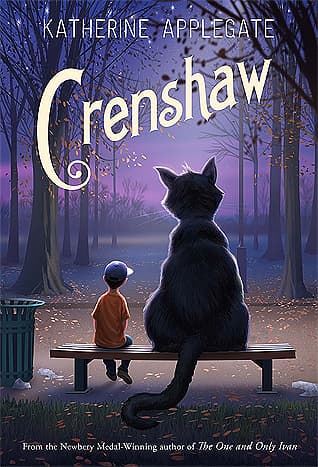
Katherine Applegate (2015)
Genre
Fantasy / Children's
Reading Time
180 min
Key Themes
See below
Sign in to track this book
When 10-year-old Jackson's family faces homelessness again, his giant, imaginary cat, Crenshaw, reappears to help him navigate the harsh realities of poverty and the power of believing in the impossible.
Jackson, a ten-year-old boy, is a self-proclaimed scientist and fact-lover who does not believe in imaginary friends, despite having had one named Crenshaw when he was younger. He has a younger sister, Robin, and a dog, Aretha. His family faces severe financial hardship, indicated by low food supplies and the threat of eviction. Jackson overhears his parents discussing their inability to pay rent, causing him familiar anxiety. One day, Crenshaw, a giant, talking cat who walks on two legs, reappears in Jackson's life. Jackson is resistant and embarrassed by Crenshaw's presence, trying to deny his existence, but Crenshaw insists he is there to help Jackson with a problem.
Jackson's parents try to hide their financial problems from him and Robin, but signs are everywhere. The cereal box is empty, and they eat pancakes for dinner, a sign of low food supplies. Jackson remembers a previous time, when he was seven, that his family had to live in their minivan for several months because they lost their apartment and jobs. This memory is traumatic for him, and he fears it is about to happen again. Crenshaw's reappearance is unsettling for Jackson because it directly connects with these periods of intense stress and uncertainty in his life. Crenshaw continues to offer cryptic advice and observations, to Jackson's annoyance and confusion.
Crenshaw becomes a constant presence in Jackson's life, appearing at school, at home, and even in his dreams. Jackson tries various tactics to get rid of him, from ignoring him to trying to reason with him, but Crenshaw stays. Crenshaw explains that imaginary friends help when you need them, and he sees Jackson's current need. Jackson, however, considers himself logical and factual. He believes in solving problems with his mind and does not want to admit needing an imaginary friend. He is also ashamed of his family's situation and does not want anyone, even an imaginary cat, to see his vulnerability. He tries to understand why Crenshaw is back, but cannot accept his simple explanation.
Jackson's parents continue to shield the children from the full truth, but the evidence of their poverty becomes clear. Jackson learns that his little sister, Robin, also has an imaginary friend named a 'Jellyfish,' a tiny, sparkly creature she carries everywhere. This revelation makes Jackson feel more isolated, realizing he is not the only one with an imaginary companion during difficult times. He overhears his parents talking about selling their belongings and the increasing chance of having to live in their minivan again. The weight of this information, combined with Crenshaw's presence, pushes Jackson to confront the truth he has been trying to avoid.
To lift spirits, Jackson's parents take the family to the beach for a day. It is a bittersweet experience; they have fun, but the underlying anxiety about their impending homelessness is clear for Jackson. During the trip, Crenshaw continues to offer his unique commentary and support. Jackson tries to enjoy the day, but he cannot shake the feeling of dread. He observes his parents, noting their efforts to appear strong and hopeful, even as their faces show worry. This day shows the family's strength and their love for each other, even under immense pressure, but it does not solve their problems.
The day Jackson fears most arrives. His parents gather him and Robin to tell them the truth: they have to move out of their apartment and will be living in their minivan. Jackson, though he suspected it, is devastated. Robin is confused but seems to take it in stride, perhaps shielded by her youth and her Jellyfish. Jackson is angry and frustrated, feeling his parents have failed them again. He struggles to understand why this keeps happening, despite his parents' explanations about job loss and medical bills. Crenshaw is present during this difficult conversation, observing silently, giving Jackson quiet, supportive presence.
After the devastating news, Jackson confronts Crenshaw, asking why he is here and what good an imaginary friend can do. Crenshaw explains that his purpose is not to solve the family's financial problems, but to help Jackson cope with the emotional weight of their situation. He tells Jackson that it is okay to be scared, sad, and angry, and that sometimes, what you need most is someone to listen. Crenshaw encourages Jackson to acknowledge his feelings and to understand that needing help does not make him weak. This conversation marks a turning point for Jackson, as he begins to accept Crenshaw's unique support.
The night before they are set to move into the minivan, Jackson is overwhelmed with fear and sadness. He cannot sleep. Crenshaw is there, offering comfort and prompting Jackson to speak his truth. Jackson finally goes to his parents' room and confesses how scared and angry he is about the situation, recalling the trauma of the previous time they lived in the minivan. His parents are heartbroken to hear his pain. This open and honest conversation, prompted by Crenshaw's influence, allows for an emotional release and strengthens the family bond, as they acknowledge the difficulty together.
After Jackson's confession, his parents explain their plan: they have secured a temporary job for his dad, and they will be staying with his mom's sister, Aunt Janet, in a nearby town until they can get back on their feet. This news is a huge relief for Jackson. While they still face challenges, the immediate threat of living in the minivan is averted, and they have a concrete plan. With Jackson's emotional burden lifted and the immediate crisis averted, Crenshaw senses his work is done. He tells Jackson it is time for him to leave, but reassures him that he will always be there if Jackson needs him again. Jackson accepts this, grateful for Crenshaw's help.
The family packs up their belongings and moves to Aunt Janet's house. It is a new beginning, still challenging, but with more hope. Jackson no longer sees Crenshaw, but he carries the lessons learned. He understands now that imaginary friends are not just for little kids, and that sometimes, the most logical thing to do is to allow yourself to feel and to accept help. He reflects on his family's strength and the importance of honesty and communication. The experience has changed him, making him more empathetic and less afraid to acknowledge his own vulnerabilities, recognizing the strength found in admitting need.
The Protagonist
Jackson learns to accept his emotions and vulnerability, understanding that imaginary friends can provide necessary emotional support, and that it's okay to need help.
The Supporting
Crenshaw fulfills his purpose by guiding Jackson to acknowledge and express his fears, then departs when Jackson no longer needs his direct support.
The Supporting
Robin remains a source of childlike innocence and resilience, adapting to changes with the help of her imaginary friend.
The Supporting
She navigates the emotional and practical challenges of poverty, ultimately finding a temporary solution and reconnecting with her son through honest communication.
The Supporting
He struggles with financial instability, but his perseverance and love for his family lead him to find a temporary solution, alleviating immediate crisis.
The Supporting
Aretha remains a steadfast, comforting presence throughout the family's struggles.
The Mentioned
Aunt Janet provides a safe haven for the family, offering a temporary solution to their housing crisis.
The Mentioned
Jellyfish serves as a constant, comforting companion for Robin, embodying her innocent way of coping with family stress.
The novel explores how imaginary friends, like Crenshaw and Jellyfish, are coping mechanisms for children facing difficult realities. Crenshaw is not just a whimsical character; he is a manifestation of Jackson's need for emotional support and a safe space to process his fears and anxieties about his family's homelessness. Through Crenshaw, Jackson learns to embrace vulnerability and accept help, showing that imagination is not just for play, but a powerful tool for emotional strength and self-discovery, especially when logical solutions are out of reach.
“"Imaginary friends. They’re like superheroes. Only instead of capes, they wear whatever they want. And instead of saving the world, they save you. From yourself, sometimes. From the things you can’t quite say out loud. From the things you can’t quite believe are happening."”
The book directly addresses childhood poverty and the trauma of homelessness from a child's perspective. Jackson's family struggles with job loss, eviction, and food insecurity, creating stress and fear for him. The story shows the shame and secrecy often associated with poverty, as Jackson's parents try to hide their struggles and Jackson tries to deny his own fears. It portrays the emotional cost on children, showing the cycle of poverty and the constant anxiety of living on the edge. This makes it a clear commentary on economic hardship.
“"The thing about being poor, really poor, is that it's a secret. A secret you don't want to tell anyone. Not your friends, not your teachers. Not even yourself, if you can help it."”
A central theme is Jackson's journey from intellectualizing his problems to being emotionally honest. Initially, Jackson, a 'fact person,' suppresses his feelings of fear, anger, and sadness about his family's situation. Crenshaw's role is to gently encourage him to acknowledge these emotions and express them. The climax is when Jackson finally confides in his parents about his deepest fears, leading to an emotional release and stronger family bonds. The book argues that true strength is not in stoicism, but in the courage to be vulnerable and communicate one's feelings openly.
“"Sometimes, Jackson, the bravest thing you can do is admit you're scared."”
Despite the challenges they face, the theme of family love and strength is clear. Jackson's parents work hard and make sacrifices to protect their children, even as they themselves struggle. The family unit, though strained by poverty, remains strong through their shared experiences and eventual open communication. Their ability to find joy in small moments, like a day at the beach, and their commitment to finding solutions together, shows their deep bond and collective strength. The ending, with the family seeking help from Aunt Janet, reinforces the importance of family support.
“"We're a team, Jackson. Always have been, always will be. And we'll get through this, too. Together."”
Crenshaw's reappearance directly correlates with Jackson's family's financial crisis.
Crenshaw's return is not random; it's directly linked to the resurfacing of Jackson's childhood trauma and anxiety about homelessness. He appears precisely when Jackson's emotional needs are highest, serving as a psychological projection of Jackson's subconscious need for comfort, understanding, and a safe outlet for his unexpressed fears. This device allows the author to explore Jackson's internal world and the coping mechanisms children employ when facing overwhelming stress, making an abstract emotional state tangible through a fantastical character.
The story is told from Jackson's perspective, offering an authentic and immediate view of his experiences.
The entire novel is narrated by Jackson, providing an intimate and authentic perspective on the challenges of poverty and the emotional landscape of a ten-year-old. His voice is characterized by a blend of childlike innocence, scientific curiosity, and growing anxiety. This narrative choice allows readers to deeply empathize with Jackson's fears, confusion, and eventual emotional breakthroughs. It also lends credibility to the existence of Crenshaw within Jackson's reality, blurring the lines between the real and the imaginary from his point of view.
Jackson's recurring memories of past homelessness highlight the cyclical nature of poverty and his trauma.
The novel frequently employs flashbacks to Jackson's previous experience of living in the minivan when he was seven. These recurring memories, often triggered by subtle cues like empty cereal boxes or hushed conversations, serve to underscore the cyclical nature of his family's poverty and the lasting trauma it inflicted. The repetition of these past events builds tension and dread for Jackson, making his fear of history repeating itself palpable for the reader. It demonstrates how past hardships can shape a child's present anxieties and coping mechanisms.
The presence or absence of food and the discussion of selling belongings symbolize the family's economic state.
Throughout the book, the availability of food (or lack thereof, like the empty cereal box or pancakes for dinner) serves as a direct and immediate symbol of the family's financial health. Similarly, the discussion of selling possessions, such as the TV or toys, signifies their desperate situation and the encroaching reality of homelessness. These tangible symbols provide concrete, relatable indicators of poverty for young readers, effectively conveying the family's struggles without needing explicit financial figures, making the abstract concept of 'no money' understandable.
“Imaginary friends are like books. We're created, we're enjoyed, we're dog-eared and creased, and then we're tucked away until we're needed again.”
— Crenshaw explains his role as an imaginary friend to Jackson.
“Sometimes you have to see the magic to believe it. But sometimes, you have to believe it to see the magic.”
— Crenshaw discussing the nature of belief and reality with Jackson.
“I'm here to remind you that you're not alone. Even when you think you are.”
— Crenshaw comforting Jackson during a difficult time.
“The truth doesn't always have to be a sad thing. Sometimes the truth is just the truth.”
— Jackson reflecting on his family's financial struggles.
“You can't make a problem disappear by pretending it isn't there.”
— Jackson's father discussing their family's situation.
“Sometimes you just need a friend who's a little bit magic.”
— Jackson thinking about why Crenshaw has returned.
“Memories are like stones, time and tide wear them down.”
— Crenshaw explaining why Jackson might have forgotten him.
“It's okay to be scared. It's not okay to let being scared stop you from doing what's right.”
— Jackson's mother encouraging him during their move.
“We all need someone who sees the same world we do.”
— Crenshaw explaining the bond between imaginary friends and their creators.
“Home isn't a place. It's a feeling.”
— Jackson contemplating what home means as his family prepares to move.
“Sometimes the bravest thing you can do is ask for help.”
— Jackson learning to reach out during his family's crisis.
“You don't have to be big to be brave.”
— Jackson thinking about facing his fears as a child.
“The best stories are the ones that help us understand our own.”
— Jackson reflecting on why he loves facts and stories.
“Magic is just another way of seeing what's already there.”
— Crenshaw explaining his perspective on reality.
Ready to see how well you understood this book? Take our interactive quiz with 10 questions.

Biography coming soon.







