“Each of us is a book, and when we die, that book is closed.”
— Cyrus Spitama reflecting on life and death, and the finite nature of individual existence.

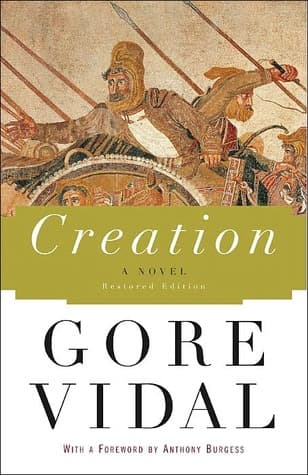
Gore Vidal (1981)
Genre
Historical Fiction / Spirituality / Philosophy
Reading Time
15-20 hours
Key Themes
See below
Sign in to track this book
A Persian diplomat in the 5th century B.C. meets Zoroaster, Buddha, Confucius, and Pericles, searching for truth and understanding the nature of creation.
The novel opens with an elderly Cyrus Spitama, a former Persian ambassador, living in Athens. He dictates his memoirs to his grand-nephew, Charlie, a young American who doubts Cyrus's claims and philosophical thoughts. Cyrus, whose mother was Xerxes I's daughter and whose father followed Zoroaster, begins by describing his unusual upbringing in the Persian Empire. He recounts his early curiosity, his exposure to various teachers and religious figures, and his interest in the world beyond the Persian court, setting the stage for his lifelong search for understanding.
Driven by a desire to understand existence and the divine, Cyrus goes on a diplomatic mission to India. This journey is a turning point in his life. In India, he meets many ascetics, philosophers, and spiritual leaders, but his meetings with Siddhartha Gautama, the Buddha, make the strongest impression. Cyrus sees the Buddha's teachings firsthand, learning about the Four Noble Truths and the Eightfold Path. While he respects the Buddha's wisdom, Cyrus struggles with the idea of detachment and rejecting worldly desires, which conflicts with his own inquisitive nature.
After his time in India, Cyrus's diplomatic duties lead him to the warring states of China. There, he observes the complex political system and social structures. He meets Confucius, who is an elderly, somewhat disillusioned philosopher. Cyrus learns about Confucius's focus on social harmony, filial piety, and moral character through ritual and ethics. He notes the practical, humanistic approach of Chinese philosophy, which differs from the otherworldly focus of Indian thought. Cyrus admires Confucius's dedication to order and good governance, even as he sees the limits of a purely human-centered view.
Throughout his travels, Cyrus stays connected to the Persian Empire, often returning to Susa or Persepolis. He recounts his experiences during the Greco-Persian Wars, especially Xerxes's failed invasion of Greece. Cyrus gives an insider's view of the strategic errors, internal rivalries, and arrogance that led to Persia's defeat. He sees the decadence and cruelty of the Persian court, including the schemes of various eunuchs and queens vying for power. His narrative highlights the difference between the philosophical ideals he encountered abroad and the harsh realities of imperial politics.
Despite his travels and exposure to different belief systems, Cyrus often returns to his Zoroastrian roots. He discusses his father's devotion to Ahura Mazda and the dualistic nature of the universe, where truth and falsehood are in conflict. Cyrus grapples with the practical side of this worldview, trying to reconcile abstract concepts with the often-unjust realities he observes. His understanding of Zoroastrianism evolves, becoming more nuanced as he compares it to the ethical systems of India and China, seeing its strengths and limitations in explaining human suffering and divine purpose.
In his later years, Cyrus spends time in Athens, where he encounters the growing intellectual scene of classical Greece. He describes his discussions with figures such as Anaxagoras, whose focus on natural philosophy offers another view of existence. Cyrus also interacts with political figures like Pericles, observing Athens's democratic ideals and cultural achievements, alongside its flaws and imperial ambitions. He finds the Greek emphasis on reason and debate both stimulating and, at times, frustratingly self-assured, contrasting it with the spiritual depth of India and the social pragmatism of China.
As Cyrus dictates his memoirs, the Peloponnesian War between Athens and Sparta begins. He provides a firsthand account of the growing tensions, political maneuvering, and the eventual start of hostilities that would devastate Greece. Cyrus observes the arrogance and internal divisions within Athens, recognizing patterns of human folly he has seen in other empires. He laments the destructive nature of war, which undermines the ideals of reason and civilization that the Greeks valued. His narrative captures the sense of impending doom and the fragility of even the most advanced societies.
Throughout his narrative, Cyrus tries to reconcile the different philosophical and religious truths he has encountered. He reflects on the nature of God, the meaning of life, and the purpose of human existence, comparing Zoroaster's monotheism, the Buddha's atheism, and the humanism of Confucius and the Greeks. He questions the absolute claims of any single doctrine, suggesting that truth may be multifaceted or even unknowable. His intellectual journey is one of continuous questioning and synthesis, never fully committing to one worldview but always seeking to understand the common threads that connect humanity's spiritual and philosophical quests.
Beyond his diplomatic and philosophical pursuits, Cyrus shares details of his personal life. He speaks of his marriage to Princess Artonis, an intelligent and strong woman, and the complexities of their relationship within the Persian court. He also recounts the joys and sorrows of fatherhood and the pain of losing loved ones, including his son. These personal anecdotes ground his grand narrative in human experience, showing the emotional toll of his travels and the impact of individual relationships on his understanding of the world. His personal losses often fuel his deeper philosophical inquiries.
Interspersed with Cyrus's ancient narrative are the reactions of his American grand-nephew, Charlie. Charlie represents a modern, pragmatic, and often skeptical viewpoint, frequently questioning the truth of Cyrus's stories, his interpretations of historical figures, and his philosophical conclusions. He struggles to fully grasp the world Cyrus describes, often finding it alien to his own time. This dynamic between the ancient sage and the modern youth highlights the novel's themes of cultural difference, the challenges of historical interpretation, and the lasting relevance or irrelevance of ancient wisdom in a changing world.
As his health declines, Cyrus finishes his memoirs, offering his final thoughts on a life spent searching for truth. He acknowledges the limits of human understanding and the vastness of the universe. While he doesn't arrive at a single truth, he emphasizes the importance of the search itself, the continuous quest for meaning and the open-minded engagement with diverse ideas. His legacy, as he sees it, is not in providing answers but in showing the richness of human inquiry across cultures and centuries. He leaves Charlie, and the reader, with a sense of the interconnectedness of history and philosophy.
The Protagonist
Cyrus evolves from a curious youth to a seasoned diplomat and philosopher, constantly questioning and synthesizing diverse worldviews without ever fully committing to a single absolute truth.
The Supporting
Charlie begins as a detached skeptic but slowly becomes more engaged and appreciative of Cyrus's wisdom, albeit still retaining his modern perspective.
The Supporting
The Buddha's character is largely static, representing an achieved state of enlightenment, serving as a beacon of spiritual wisdom for Cyrus.
The Supporting
Confucius's character is presented as largely static, a wise elder whose philosophy has already taken shape, serving as a model of practical ethics.
The Supporting
Xerxes's arc is historical, from ambitious conqueror to defeated ruler, providing a cautionary tale of imperial overreach.
The Supporting
Pericles's arc is tied to the rise and incipient fall of Athens, representing the peak of its democratic power before the Peloponnesian War.
The Supporting
Darius remains a steadfast figure, representing the ancestral faith and moral grounding for Cyrus.
The Supporting
Artonis's arc is tied to her role within the Persian court and her personal relationship with Cyrus, showing her resilience and intelligence.
This is the central theme of the novel, shown by Cyrus's lifelong quest. He travels across continents, engaging with different philosophical and religious systems – Zoroastrianism, Buddhism, Confucianism, and Greek rationalism – to find a unified understanding of existence, divinity, and human purpose. The novel suggests that truth is multifaceted and perhaps ultimately elusive, but the value is in the journey of inquiry itself, in engaging with different perspectives. Cyrus's inability to fully commit to any single doctrine shows the complexity of this search, as when he grapples with the Buddha's detachment versus the worldly engagement of Confucius or the Greeks.
““I have been to the ends of the known world, and I have found many gods and many truths, but no single one that satisfies the whole of me.””
Vidal explores how different cultures develop distinct philosophical and social systems, yet common human experiences and desires underlie these differences. Cyrus acts as a bridge between these civilizations, observing the unique strengths and weaknesses of each – the spiritual depth of India, the social harmony of China, the political power of Persia, and the intellectual rigor of Greece. While he notes the vast differences in customs and beliefs, he also recognizes shared human traits like ambition, love, suffering, and the desire for order. The novel suggests that while specific 'truths' may be culturally bound, the human impulse to seek them is universal.
““Each people has its own truth, as each has its own tongue. But the heart, I think, speaks a language known to all.””
The novel examines the mechanisms and consequences of imperial power, mainly through the Persian Empire and, to a lesser extent, Athens. Cyrus's experiences in the Persian court, seeing the intrigues, opulence, and brutal realities of Xerxes's reign and the Greco-Persian Wars, provide an insider's view of how power corrupts and often leads to self-destruction. The narrative highlights the cyclical nature of empires – their rise, their arrogance, and their inevitable decline – and contrasts the pursuit of political dominance with the more enduring quests for spiritual or philosophical understanding. The Peloponnesian War further illustrates this theme, showing Athens's decline.
““Power, I learned early, is a drug. It excites the mind and makes the heart cold.””
The framing device of Cyrus telling his memoirs to his skeptical grand-nephew, Charlie, highlights the subjective nature of history and memory. Cyrus's narrative is his personal interpretation of events, colored by his own philosophical leanings. Charlie's questions challenge the truth and relevance of these ancient tales, prompting reflection on how history is constructed and transmitted. The novel implicitly asks: Whose story is told? How reliable are historical accounts? And what lessons, if any, can be drawn from the past for the present? It suggests that history is not a static record but a dynamic, often contested, narrative.
““The past is a story we tell ourselves, and like all stories, it changes with the telling.””
The dynamic between Cyrus and Charlie explores the tension between ancient wisdom and modern skepticism. Cyrus represents a world of grand philosophical quests, spiritual depth, and the interconnectedness of human experience across vast empires. Charlie, on the other hand, embodies a more pragmatic, scientifically-oriented, and often cynical modern viewpoint, struggling to find relevance in Cyrus's tales. This contrast allows Vidal to comment on the perceived progress of civilization, the enduring questions that transcend time, and the challenges of cultural understanding between different eras, questioning whether modern society has truly advanced in wisdom.
““You moderns, you think you have discovered everything. But the questions, my dear Charlie, are as old as time itself.””
Cyrus's memoirs are dictated to his grand-nephew, Charlie, in a contemporary setting.
The entire novel is presented as Cyrus Spitama's first-person account of his life and travels, dictated to his American grand-nephew, Charlie. This device allows for a dual perspective: Cyrus's ancient, philosophical worldview, and Charlie's modern, often skeptical, interjections. It creates a dialogue between past and present, enabling Vidal to comment on the enduring relevance of ancient wisdom and the subjective nature of historical storytelling. The frame also provides an opportunity for meta-commentary on the act of writing history and memoir.
Cyrus's role as a diplomat allows him to witness and compare diverse cultures and philosophies.
Cyrus's diplomatic missions serve as a convenient and credible means for him to travel across India, China, and Greece, encountering their leading philosophers and observing their societies firsthand. This device allows the author to present a panoramic view of the 5th century B.C. through the eyes of a single, highly intelligent protagonist. Cyrus's status as an outsider in each culture (though an insider in Persia) grants him a unique vantage point to critically analyze and compare different worldviews without being fully immersed or biased by any one of them.
Cyrus engages in direct and indirect philosophical discussions with historical figures.
Throughout his travels, Cyrus engages in actual or imagined dialogues with historical figures like the Buddha, Confucius, Anaxagoras, and Pericles. These interactions are not merely historical encounters but serve as platforms for exploring and contrasting different philosophical and religious ideas. This device allows Vidal to present complex philosophical concepts in an accessible, narrative-driven manner, showing how these ideas manifest in individual lives and societies, and how Cyrus attempts to synthesize them into his own understanding.
Charlie's modern perspective offers a critical and often humorous counterpoint to Cyrus's ancient narrative.
Charlie's interjections, questions, and footnotes introduce an anachronistic element that juxtaposes the ancient world with a modern, 20th-century sensibility. This device serves multiple functions: it injects humor, grounds the grand historical narrative in a relatable 'present,' and allows for a critical examination of historical claims and philosophical conclusions from a contemporary viewpoint. It highlights the cultural and temporal gap, forcing the reader to consider the enduring or evolving nature of the questions Cyrus poses.
“Each of us is a book, and when we die, that book is closed.”
— Cyrus Spitama reflecting on life and death, and the finite nature of individual existence.
“The gods are only what we imagine them to be. And if we imagine them to be cruel, they will be cruel. If we imagine them to be kind, they will be kind.”
— Cyrus discussing the nature of deities and human perception with Zoroaster.
“History is merely a list of surprises. It can only prepare us to be surprised yet again.”
— Cyrus reflecting on the unpredictable nature of historical events and human affairs.
“To know yourself, you must know your past. But to know your past, you must know the past of the world.”
— Cyrus's philosophical musings on self-knowledge and its connection to universal history.
“There are no truths, only interpretations.”
— A recurring theme in Cyrus's conversations, highlighting the subjective nature of understanding.
“The greatest joy in life is to be used for a purpose recognized by yourself as a mighty one.”
— Cyrus's reflection on finding meaning and purpose in one's life's work.
“Empires rise and fall, but the human spirit endures.”
— Cyrus observing the cyclical nature of political power and the resilience of humanity.
“Wisdom is not knowing all the answers, but knowing which questions to ask.”
— Cyrus's understanding of true wisdom, as opposed to mere accumulation of facts.
“The world is not as it seems, but as we are.”
— A concise statement summarizing the novel's exploration of subjective reality.
“To change the world, you must first change yourself.”
— A principle that guides many of the characters' internal and external journeys.
“Fear is the oldest and strongest emotion of mankind, and the oldest and strongest kind of fear is fear of the unknown.”
— Cyrus contemplating the primal nature of fear and its influence on human behavior.
“The past is never dead. It's not even past.”
— Cyrus's realization that historical events continue to shape the present.
“Life is a journey, not a destination.”
— A common reflection by Cyrus on the process and experiences of living.
“Every man has his own god. And every god has his own man.”
— Cyrus musing on the personal and often unique relationship between individuals and their chosen deities or beliefs.
Ready to see how well you understood this book? Take our interactive quiz with 10 questions.
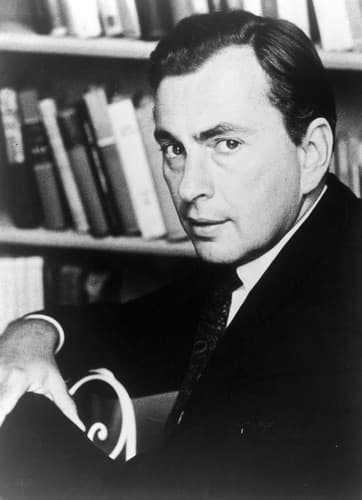
Eugene Luther Gore Vidal was an American writer and public intellectual known for his epigrammatic wit. His novels and essays interrogated the social and cultural sexual norms he perceived as driving American life. Beyond literature, Vidal was heavily involved in politics. He unsuccessfully sought office twice as a Democratic Party candidate, first in 1960 to the U.S. House of Representatives, and later in 1982 to the U.S. Senate.







