“Are you a Crankenstein?”
— The opening line, directly addressing the reader about their mood.

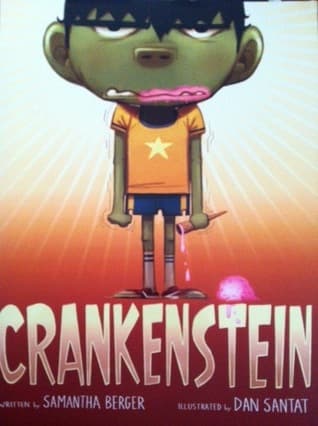
Samantha Berger (2013)
Genre
Children's
Reading Time
5 min
Key Themes
See below
Sign in to track this book
A grumpy boy turns into the monstrous Crankenstein when annoyed by everyday things, finding comfort and a cure for his crabbiness with an unexpected friend.
The story introduces an ordinary young boy who, like many children, gets frustrated and grumpy. For him, these moments cause a big change. When small annoyances happen, such as a sunny day suddenly turning rainy, a popsicle melting too fast, or a favorite toy breaking, he physically twists and complains, becoming the monster Crankenstein. This change is shown with humor, his eyes narrowing, his mouth turning down, and his body slumping into a grumpy pose, along with 'MEHHRRRR!!!' sounds.
Crankenstein's day often starts with morning problems. He might wake up to an alarm clock that is too loud, breakfast cereal that is too soggy, or a shirt that feels 'itchy.' These small irritations are enough to start his grumpy change. He grumbles about the sunlight being too bright, the toast being burnt, or having to get dressed. His morning grumpiness is a daily habit, affecting his interactions and setting a bad mood for his day, making him hard to please and likely to complain more.
Even activities that usually bring joy and play can quickly turn Crankenstein into his grumpy self. A game of hide-and-seek where he is always 'it,' a puzzle with a missing piece, or a swing set that is 'too high' or 'too low' can cause his change. He complains about the rules, the weather, or how unfair everything is. His playmates often do not understand his sudden mood changes, unable to grasp how frustrated he is over what they see as small problems, which makes him even more isolated in his grumpiness.
Mealtime is another chance for Crankenstein to appear. He might say his food is 'too hot,' 'too cold,' 'too green,' or simply 'not what I wanted.' Even a well-made meal can cause an argument. He might refuse to eat, push his plate away, or make loud groans and complaints about the food's texture or taste. These mealtime meltdowns happen often, making eating a difficult and frustrating experience for everyone, as he finds fault with almost everything on his plate.
Trips outside the house, whether to the store or in a car, have many possible Crankenstein triggers. He might complain about traffic being 'too slow,' the car radio being 'too loud,' or having to sit still for 'too long.' Waiting in line at the grocery store, being taken through aisles of things he does not care about, or having to wear a seatbelt can all turn him into a grumbling monster. These public outbursts often embarrass the adult with him and are not pleasant for the boy.
As the day ends, bedtime becomes a big fight for Crankenstein. He grumbles about taking a bath, putting on pajamas, or the idea of going to sleep. The dark might be 'too dark,' the blanket 'too lumpy,' or his bedtime story 'too short.' He fights going to sleep with all his might, finding every reason to complain and make the process longer. This nightly routine often ends with him still grumbling, even as he falls asleep, holding onto his last bits of crankiness.
The story shows that Crankenstein's grumpiness is not rare but happens throughout his day. From morning to night, he finds reasons to complain, changing into his grumpy self many times. The story shows different situations where he becomes Crankenstein, highlighting how often and how strongly he changes. This constant cycle of finding fault and showing displeasure paints a clear picture of a day lived by a constantly grumpy child, struggling with life's small problems.
One day, in the park and feeling especially cranky about a broken swing, Crankenstein sees another child showing similar signs of extreme grumpiness. This 'Cranken-girl' is also moping, grumbling, and acting like Crankenstein. They both look equally unhappy and are clearly in the middle of their own changes. The boy, as Crankenstein, is at first surprised to see someone else showing his kind of monster grumpiness, suggesting a possible change from his usual lonely crankiness.
The boy and the girl, both fully changed into Crankensteins, look at each other. Instead of fighting, they have a moment of understanding. They understand each other's grumbles and frustrations in a way no one else seems to. A shared 'MEHHRRRR!!!' passes between them, a sound of togetherness rather than anger. This shared show of grumpiness creates an unexpected bond, as they both realize they are not alone in their strange problem, and that someone else truly 'gets' what they are feeling.
The shared grumbling and understanding between the two Crankensteins lead to a surprising and good outcome. As they keep 'MEHHRRRR!!!' together, a small smile starts to appear on both their faces. Sharing their grumpiness, having someone else understand their feelings, somehow lessens how strong their crankiness is. The monster changes start to go away, and they slowly return to their normal, happier selves. The shared experience, surprisingly, 'uncranks' them.
After 'uncranking,' the boy and the girl feel connected and have a new friendship. Their shared moment of extreme grumpiness, instead of pushing them apart, has brought them together. They now have a special bond, understanding each other's occasional changes. The story ends with them playing together, no longer Crankensteins, suggesting that even the biggest grumpiness can be overcome and can even lead to good connections when shared and understood.
The Protagonist
The boy learns that sharing his grumpiness can lead to understanding and friendship, helping him 'uncrank' and find joy.
The Supporting
She also 'uncranks' through shared grumbling, finding a friend in the process.
The book shows that feeling grumpy is a common and normal part of childhood. The boy turning into Crankenstein over daily annoyances like a rainy day or a melting popsicle shows that even small frustrations can feel huge to a child. The Cranken-girl reinforces this, showing that the 'Crankenstein' event is not just for one child but a shared experience, making children feel understood and less alone when they are unhappy.
“He may look like any ordinary boy, but when faced with a rainy day, a melting popsicle, or an early bedtime, one little boy transforms into a mumbling, grumbling Crankenstein!”
A main theme is how sharing negative feelings can have good results. Crankenstein's grumpiness is a lonely burden until he meets the Cranken-girl. Their mutual recognition and shared 'MEHHRRRR!!!' create an unexpected bond. This shared expression of frustration, instead of making them grumpier, actually calms it, letting them 'uncrank.' It teaches that finding someone who understands and accepts your feelings can help with loneliness and negativity, leading to connection and friendship.
“When Crankenstein meets his match in a fellow Crankenstein, the results could be catastrophic-or they could be just what he needs to brighten his day!”
While not directly stated, the book explores emotional regulation. The boy's first reaction to frustration is to turn into Crankenstein, a physical sign of his inability to handle small problems. His eventual 'uncranking' through talking with another child suggests that outside acceptance and connection can be a way to cope. It implies that children need to learn healthy ways to deal with and show their negative emotions, and that sometimes, simply having someone understand can be the first step to managing them.
“MEHHRRRR!!! HE'S ALIVE!”
Abstract emotion is made into a physical, monstrous character.
The book uses personification by transforming the abstract emotion of grumpiness into a tangible, albeit temporary, monster called Crankenstein. This device allows young readers to visualize and understand the intense, overwhelming feeling of being cranky. By giving grumpiness a name and physical characteristics, it makes the emotion less abstract and more approachable for children, helping them identify and discuss their own 'Crankenstein' moments in a lighthearted way. It externalizes an internal state, making it easier to process.
Repeated phrases and scenarios emphasize the ongoing nature of grumpiness.
The book heavily utilizes repetition, particularly with the sound 'MEHHRRRR!!!' and the recurring scenarios that trigger Crankenstein's transformation (rainy days, melting popsicles, early bedtimes). This repetition establishes a clear pattern of behavior for Crankenstein and reinforces the idea that grumpiness can strike at any moment over various common annoyances. For young readers, repetition aids in comprehension and memorability, creating a predictable yet humorous rhythm to the narrative and highlighting the pervasive nature of the character's crankiness.
Introduction of a character who perfectly reflects the protagonist's central trait.
The introduction of the 'Cranken-girl' serves as a mirror character to Crankenstein. She embodies the exact same grumpy traits and transformations, reflecting the protagonist's core struggle. This device is crucial for the story's resolution because it allows Crankenstein to see his own behavior from an external perspective. By observing a mirror image of himself, he gains an unexpected sense of understanding and connection, which ultimately leads to his 'uncranking' and the formation of a friendship. It validates his feelings while also providing a pathway out of his solitary grumpiness.
“Are you a Crankenstein?”
— The opening line, directly addressing the reader about their mood.
“When you wake up and it's a Monday...”
— One of the common scenarios that can trigger Crankenstein.
“When your toast falls jam-side down...”
— A classic minor misfortune that can set off a bad mood.
“When your juice is gone and it's just a few ice cubes...”
— A specific example of disappointment over a small thing.
“When your toy is stuck and you can't get it out...”
— A common childhood frustration with an object.
“When your friends are giggling and you don't know why...”
— A moment of feeling left out or confused.
“When your socks feel bumpy...”
— An example of a sensory annoyance that can trigger a cranky mood.
“When your ice cream melts before you can eat it...”
— A classic childhood tragedy.
“When you can't find your favorite book...”
— The frustration of a lost item.
“When you have to wear the scratchy sweater...”
— An example of an uncomfortable clothing item causing distress.
“When you just want to stomp and grumble and growl...”
— Describing the physical and vocal expressions of a Crankenstein.
“When you're a Crankenstein, there's only one thing to do...”
— Leading up to the solution for being a Crankenstein.
“Find another Crankenstein!”
— The proposed solution to feeling cranky – finding someone who understands.
“And grumble and growl and stomp together!”
— The shared activity that helps Crankensteins feel better.
Ready to see how well you understood this book? Take our interactive quiz with 10 questions.

Dan Gemeinhart
4.5

Kate O'Hearn
4.4

Jeanne Birdsall
4.4

Jen Wang
4.4
Wendelin Van Draanen
4.3

John Marsden
4.3

Chris Van Allsburg
4.3
Jennifer A. Nielsen
4.2