“I've always wanted a button!”
— Corduroy realizes he's missing a button on his overalls.

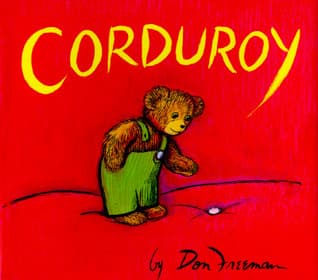
Don Freeman (1968)
Genre
Fantasy / Children's
Reading Time
5 min
Key Themes
See below
Sign in to track this book
Corduroy, a teddy bear, goes on a night adventure in a department store to find his lost button, leading him to a true friend and a home.
A young girl named Lisa and her mother are shopping. In the toy section, Lisa sees a small, green teddy bear in corduroy overalls. She wants to buy him. Her mother, however, sees that a button is missing from his overalls. She tells Lisa they cannot buy a damaged toy and they move on. Corduroy overhears this and feels sad, but also determined.
After the store closes, Corduroy is alone on his shelf. He remembers Lisa wanting him and her mother's reason for not buying him: his missing button. Hoping to find a replacement and become 'whole,' Corduroy decides to leave his shelf. He climbs down carefully, planning to search the store for a button that matches his green overalls, so he can be ready for Lisa's return.
Corduroy begins exploring the large, quiet department store. He sees a moving staircase, an escalator. Never having seen one, he is amazed by its constant motion. He thinks it is a 'great big mountain' and bravely steps onto it. The escalator carries him up, higher into the store, away from the toy department and into new areas.
After his 'mountain' ride, Corduroy gets off the escalator in a different part of the store. He is surrounded by large, soft objects. These are beds and mattresses, but Corduroy sees them as grand, tall structures. He thinks he has found a 'palace' where royalty might live. He looks around this new area, still hoping to find a button.
As Corduroy explores the 'palace' (the furniture department), he sees a round, disc-like object sewn into a mattress. He is excited; it looks just like a button! Thinking he has found the solution, he decides to get it. He climbs onto the large mattress, eager to fix himself and be ready for Lisa.
Corduroy tries to pull the button from the mattress. He tugs hard, but it is sewn on tightly. With a strong pull, he loses his balance. He falls backward off the tall bed, landing softly on the floor. As he falls, he knocks over a lamp, which crashes loudly. The noise echoes through the silent store.
The loud crash of the lamp immediately gets the attention of the night watchman, who is making his rounds. Hearing the noise, he goes to the furniture department. There, he finds the fallen lamp and the little green teddy bear, Corduroy, beside it. Realizing the bear must have fallen, the watchman gently picks him up.
The night watchman carries Corduroy back through the quiet store. He goes to the toy section where Corduroy was. He carefully places the teddy bear back on his shelf with the other toys. Corduroy is back where he started, his button still missing, and his adventure seemingly over. He waits, hoping for another chance, but feeling a bit sad.
The next morning, when the department store opens, Lisa returns. She has thought about Corduroy all night and decided she must have him, even with a missing button. She has emptied her piggy bank, carefully counting her saved coins to make sure she has enough. Determined, she goes straight to the toy department, ready to buy the teddy bear.
Lisa finds Corduroy on the shelf and, without delay, uses her saved money to buy him. She takes him home and immediately gets her sewing kit. With a needle and thread, she carefully sews a new button onto Corduroy's overalls. Corduroy feels a warmth he has never known. Lisa then hugs him, saying he is her bear. Corduroy realizes he has found not just a home, but a true friend, which is all he ever wanted.
The Protagonist
Corduroy transforms from an incomplete, overlooked toy to a cherished companion, realizing that true belonging comes from love, not perfection.
The Supporting
Lisa's determination to acquire Corduroy culminates in her saving her own money and bringing him home, fulfilling her wish and his.
The Supporting
Her initial practical objection is overcome by Lisa's persistent desire, showing her willingness to allow Lisa independence.
The Mentioned
Serves as a plot device to return Corduroy to his original position, resetting the scene for Lisa's return.
Corduroy's journey is shaped by his desire for acceptance and a home. His missing button represents a flaw he believes stops him from being chosen. His brave search through the department store is a direct response to Lisa's mother's comment, showing his wish for completeness and acceptance. Lisa's love and her act of sewing on a new button fulfill his quest, showing that true belonging comes from being loved as you are, flaws included. He realizes, 'This must be home. I must be a friend.'
“'I've always wanted a friend,' said Corduroy. 'Me too!' said Lisa, and she gave him a big hug.”
The story shows the imaginative world of a child and a toy. Corduroy sees the department store's escalator as a 'great big mountain' and the furniture department as a 'palace.' This illustrates how everyday objects can become extraordinary through imagination. This theme encourages readers to see the world with new eyes, highlighting the adventure found in ordinary places. It reflects how children often give their toys and surroundings rich, fantastical stories.
“He stepped onto the first step and up he went! 'Whee!' he cried. 'I've always wanted to ride on a mountain!'”
Both Corduroy and Lisa show strong determination. Corduroy, a small teddy bear, goes on a solo mission to find his missing button, navigating a large and unfamiliar store. His persistence, even after a setback, is key to the plot. Similarly, Lisa's determination to buy Corduroy, despite her mother's initial objection, leads her to save her own money. Their individual resourcefulness and persistence bring them together, showing the power of focused effort to achieve goals.
“Lisa went right to her room, got out her piggy bank, and dumped all the money out on the floor.”
Giving human qualities to inanimate objects.
Corduroy, a teddy bear, is given human-like qualities such as thought, emotion, and the ability to move and speak. This device allows the reader to empathize with Corduroy's quest for belonging and his childlike wonder. His internal monologue and actions drive the narrative, making him a relatable and engaging protagonist. Without personification, the story would lack its emotional core and the adventurous spirit that makes it so appealing to young readers.
A plot element that drives the story forward.
The missing button serves as the primary MacGuffin in 'Corduroy.' It is the initial catalyst for Corduroy's nighttime adventure and the reason Lisa's mother initially rejects him. While the button itself is important, its true significance lies in how it motivates Corduroy's actions and highlights his desire for perfection and acceptance. Ultimately, the button becomes less important than the love and friendship Corduroy finds, showing that his 'flaw' was not a barrier to true belonging.
The audience knows more than the characters.
Dramatic irony is present as the reader understands the true nature of the department store objects (escalator, beds) while Corduroy misinterprets them as a 'mountain' and a 'palace.' This creates a sense of endearing humor and allows the reader to appreciate Corduroy's innocence and imagination. It also subtly emphasizes the difference between the adult, literal world and the rich, imaginative world of a child or toy, drawing the reader into Corduroy's unique perspective.
“I've always wanted a button!”
— Corduroy realizes he's missing a button on his overalls.
“Corduroy climbed carefully down from the shelf.”
— Corduroy begins his nighttime adventure in the department store.
“He stepped onto the floor. Crash!”
— Corduroy knocks over a lamp while exploring the furniture department.
“Are you a lost toy?”
— The night watchman finds Corduroy after the lamp incident.
“You must be one of the toys I saw this morning, thought Lisa. I've always wanted a bear.”
— Lisa sees Corduroy in the department store window and wants him.
“I didn't know I'd lost one.”
— Corduroy responds to Lisa pointing out his missing button.
“We'll go home and I'll mend it for you.”
— Lisa comforts Corduroy and promises to fix his overalls.
“You'll be my very own bear.”
— Lisa brings Corduroy home and makes him her own.
“And Corduroy smiled. He had a home and a friend.”
— Corduroy finds happiness and belonging with Lisa.
“But best of all, he had a button.”
— Corduroy reflects on his new life, including his fixed overalls.
“He tried to get off the bed, but he tumbled headfirst onto the floor.”
— Corduroy's eagerness to explore leads to a small mishap.
“He was a little bear, in a big department store.”
— Describing Corduroy's initial situation and setting.
“He thought, 'This must be a mountain!'”
— Corduroy climbs a stack of mattresses in the furniture department.
“Corduroy was just an ordinary bear.”
— Introducing Corduroy before his adventure.
Ready to see how well you understood this book? Take our interactive quiz with 10 questions.

Don Freeman was a celebrated American author and illustrator, best known for his beloved children's book "Corduroy." Published in 1968, the story of a button-loving bear has charmed generations of young readers. Freeman's warm, accessible illustrations and gentle storytelling defined his enduring legacy in children's literature.







