“Coraline was not a name that most people could get right.”
— Early in the book, Coraline reflects on people mispronouncing her name.

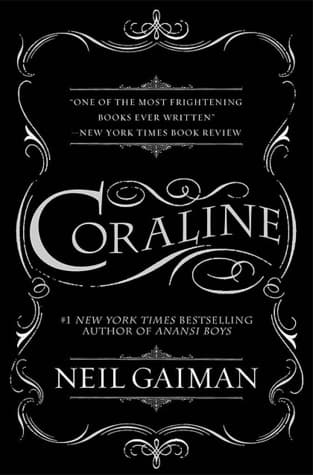
Neil Gaiman (2002)
Genre
Fantasy / Children's / Young Adult
Reading Time
150 min
Key Themes
See below
Sign in to track this book
Coraline unlocks a mysterious door and finds a seemingly perfect alternate reality with an 'Other Mother' who has buttons for eyes. This Other Mother wants to keep Coraline forever, so Coraline must fight for her freedom and the souls of other trapped children.
Coraline Jones and her parents move into a new flat in an old house divided into apartments. Her parents are often busy with work, leaving Coraline to entertain herself. She explores the house and its garden, meeting her neighbors: Miss Spink and Miss Forcible, two retired actresses, and the Crazy Old Man Upstairs, who says he trains a mouse circus. One rainy day, Coraline counts the doors in their flat and finds a locked one in the drawing-room. Her mother opens it with a rusty key, showing only a brick wall. Coraline's mother explains the door connects to the empty flat next door.
Later that night, Coraline wakes up to a noise and finds her mother's black key. She unlocks the drawing-room door again, but this time, there is a dark, long corridor instead of a brick wall. Coraline crawls through the passage and enters a flat identical to her own, but with subtle differences. The 'Other Mother' greets her, looking exactly like her real mother but taller, thinner, with long, dark red fingernails, and unsettling black buttons for eyes. The 'Other Father,' also with button eyes, is more cheerful and attentive than her real father. The food is delicious, the toys are magical, and everything seems more exciting.
Coraline spends a pleasant evening in the other world, where the 'Other Mother' and 'Other Father' give her much attention and magical entertainment. The 'Other Miss Spink' and 'Other Miss Forcible' perform an endless show, and the 'Other Old Man Upstairs' has a wonderful, performing mouse circus. The other world seems to give her all the fun and attention she wants. However, when it is time to leave, the 'Other Mother' suggests Coraline stay forever, but only if she allows them to sew buttons into her eyes, like theirs. Coraline is horrified and immediately refuses, saying she wants her real parents.
Coraline crawls back through the passage, relieved to be home, but finds her parents are gone. She searches the house, calling for them, but only finds a note from her mother saying they have visited Miss Spink and Miss Forcible, which Coraline knows is not true. She feels uneasy. The next morning, she finds a message written on the mirror in green, gloopy writing: 'HELP US.' Coraline realizes her parents have been kidnapped by the 'Other Mother' and are trapped in the other world. She talks to the black cat, who speaks to her for the first time, warning her of the danger and telling her to be brave and smart.
Determined to rescue her parents, Coraline returns to the other world, with the black cat, who can move between both worlds and speaks only in the other. This time, the other world looks less bright and more sinister. The food is bland, the 'Other Father' is sad and distant, and the 'Other Mother' is increasingly threatening, showing her true nature. The cat reveals the 'Other Mother' is an old, evil being known as the 'Beldam' or 'Other Mother,' who lures children into her world, traps them, and eventually consumes their souls after sewing buttons into their eyes.
The 'Other Mother' punishes Coraline for refusing her offer by locking her in a small, dark room behind a mirror. There, Coraline meets three ghost children previously trapped by the 'Other Mother.' They tell her their stories, how they were lured and tricked, and ask her to find their eyes so they can be free. Coraline realizes she must defeat the 'Other Mother' and free her parents and these ghost children. She proposes a game to the 'Other Mother': if Coraline can find her parents and the three lost children's eyes, they will all be set free. If she fails, Coraline will stay forever and have buttons sewn into her eyes.
The 'Other Mother' reluctantly agrees to the game, but makes it clear she will cheat. Coraline, using her wits and the cat's advice, begins her search. She first visits the 'Other Miss Spink' and 'Other Miss Forcible,' whose performance is now a grotesque mess. She finds the first ghost child's eye, a marble, among the decaying props in their flat. Next, she goes to the 'Other Old Man Upstairs,' whose mouse circus is now a collection of rat skeletons. With the cat's help, she finds the second ghost eye, a button, in a rat's nest.
Coraline returns to her 'other' home, where the 'Other Mother' is becoming more monstrous and the house is falling apart. She tricks the 'Other Father,' who is now a puppet, into telling her where the third ghost child's eye is hidden in the garden. She gets it, a small, green button. With all three eyes collected, Coraline faces the 'Other Mother.' The 'Other Mother' reveals Coraline's real parents are trapped inside a snow globe on the mantelpiece, a miniature version of their home, where they do not know their situation.
Coraline, using her cleverness, throws the black cat at the 'Other Mother,' distracting her. In the confusion, Coraline grabs the snow globe with her parents and races back to the connecting door. As she crawls through the passage, the 'Other Mother' tries to grab her, but Coraline slams the door shut, severing the 'Other Mother's' hand. The door disappears, leaving only the brick wall again. Coraline returns to her real home, exhausted but victorious, her parents safe but still confused from their ordeal. The ghost children appear, briefly visible, to thank her before fading away, finally free.
Coraline's parents return to normal, with no memory of their time in the other world. Coraline, however, knows the danger is not over. The 'Other Mother's' severed, crawling hand, a monstrous, spider-like entity, has followed her back and wants to get the black key. Coraline suspects it needs the key to reopen the door or trap more children. Coraline plans: she lures the hand to an old, deep well in the garden, covers the well with a blanket, and then tricks the hand into falling into it, securing it with a large stone. The key, which the hand wanted, falls into the well with it, finally ending the threat from the other world.
The Protagonist
Coraline transforms from a slightly bored and overlooked child into a courageous hero, realizing the value of her own world and the love of her real parents.
The Antagonist
Her true, monstrous form is gradually revealed as Coraline defies her, culminating in her defeat and the loss of her hand.
The Supporting
The cat remains largely static in its wisdom, serving as a constant source of guidance and a symbol of resistance against the Other Mother's control.
The Supporting
She remains largely unchanged, serving as a symbol of Coraline's normal life and the object of her rescue.
The Supporting
He remains largely unchanged, serving as a symbol of Coraline's normal life and the object of her rescue.
The Supporting
He deteriorates from a lively entertainer to a broken, sorrowful puppet, reflecting the Other Mother's decaying world.
The Supporting
They remain quirky and a source of both amusement and minor aid, their warnings proving prescient.
The Supporting
He remains a quirky, slightly mad neighbor whose seemingly nonsensical pronouncements prove to hold truth.
The Mentioned
They are freed from their eternal torment by Coraline's success, finally able to move on.
The 'other world' first offers an escape from Coraline's ordinary life and inattentive parents, with magic, attention, and delicious food. But this escape quickly turns sinister, showing the 'Other Mother's' true, evil intentions. The theme explores how what seems like a perfect solution to loneliness or boredom can hide dark, manipulative motives. It shows that true happiness and safety come from facing reality, even if it is imperfect, rather than giving in to false, appealing illusions.
“''We're not like your mum and dad,' said the other mother. 'We love you.'”
Coraline's journey shows true courage, which is not being unafraid but acting despite fear. She is a young girl facing an old, powerful evil, yet she never gives up. Her resourcefulness is clear in how she uses her wits, the cat's advice, and even small objects (like a stone with a hole) to outsmart the 'Other Mother.' This theme highlights that bravery and cleverness are not limited by age or size and are needed to overcome big problems.
“'Because,' she said, 'when you're scared but you still do it anyway, that's brave.'”
At first, Coraline feels ignored by her busy, ordinary parents. The 'other world' offers a 'better' version of everything. But through her experience, Coraline learns to value her real parents, her real home, and her real life, despite its flaws. The 'Other Mother's' world, though appealing at first, is a decaying, dangerous facade. This theme shows that real love and safety exist in the real, sometimes messy, world, and that things are not always better elsewhere, especially when 'better' is a trap.
“'I don't want whatever I want. Nobody does. Not really. What kind of fun would it be if I just got everything I ever wanted? Just like that, and it didn't mean anything. What then?'”
Coraline's journey makes her face who she is and what she values. She is not just 'Coraline, who never listens to her parents,' but Coraline, the brave and clever girl who saves her family. By facing the 'Other Mother,' Coraline finds her inner strength and her ability to be a hero. Choosing to reject the 'Other Mother's' offer of a 'perfect' but false life strengthens her true identity and her connection to her real family, solidifying her sense of self.
“'I'm Coraline,' said Coraline. 'Not Caroline. Coraline.'”
A portal between the mundane and the magical, symbolizing temptation and transition.
The locked door and the subsequent passage serve as the central plot device, literally and metaphorically. It's the gateway to the 'other world' and the catalyst for the entire story. Initially, it represents mystery and forbidden knowledge, then becomes a symbol of the dangerous allure of escapism. Its transformation from a brick wall to a tunnel highlights the 'Other Mother's' deceptive power. The act of entering and exiting this passage marks Coraline's transitions between her ordinary life and her extraordinary challenges.
A chilling symbol of control, conformity, and loss of individuality.
The button eyes of the 'Other Mother' and all her creations are a profoundly unsettling symbol. They represent the 'Other Mother's' desire to possess and control, to strip away individuality and emotion, replacing true sight and soul with a manufactured, unseeing facade. For the ghost children, having buttons sewn into their eyes signifies their ultimate entrapment and the consumption of their souls. Coraline's steadfast refusal to have buttons sewn into her eyes is a powerful act of defiance and a declaration of her autonomy.
A magical, cynical guide and a symbol of independent, untamed wisdom.
The black cat functions as a classic archetypal guide. It possesses knowledge of the 'other world' and the 'Other Mother's' true nature, which it imparts to Coraline. Its ability to speak only in the other world and move freely between realities highlights its unique position. The cat represents independence, instinct, and a connection to ancient magic, offering pragmatic, often cynical, advice that helps Coraline navigate the dangers. It is immune to the 'Other Mother's' power, serving as a beacon of truth and resistance.
A minor magical artifact providing insight and protection.
Given to Coraline by Miss Spink, the stone with a hole in it is a seemingly innocuous object that proves invaluable. It allows Coraline to see things as they truly are, stripping away the 'Other Mother's' illusions and revealing the hidden ghost children. It functions as a small magical tool, a symbol of intuition and foresight, and a physical manifestation of the advice and warnings given by the eccentric neighbors. It underscores that even small, seemingly insignificant items can hold great power or utility when courageously wielded.
The gradual deterioration of the 'other world' reflecting the 'Other Mother's' true nature.
As Coraline defies the 'Other Mother,' the 'other world' itself begins to decay, becoming increasingly drab, dusty, and grotesque. The food loses its flavor, the 'Other Father' becomes a puppet, and the house starts to dissolve. This decay is a powerful visual metaphor for the 'Other Mother's' true, barren nature and the emptiness of her false promises. It shows that her magic is unsustainable without the life force of children and that her world is merely a fragile, malevolent illusion that cannot withstand genuine resistance.
“Coraline was not a name that most people could get right.”
— Early in the book, Coraline reflects on people mispronouncing her name.
“She was not a monster. She was just a woman with a child who had a lot of buttons.”
— Coraline's initial, somewhat naive assessment of the Other Mother.
“When you're scared but you still do it anyway, that's brave.”
— The Cat explains courage to Coraline.
“We are small, but we are many. We are small, but we are many.”
— The mice in the Other World sing this chant.
“I don't want whatever I want. Nobody does. Not really. What kind of fun would it be if I just got everything I wanted?”
— Coraline muses on the nature of desire and challenge.
“Because, Coraline, when you're in a situation like this, you have to be brave.”
— The Cat again, emphasizing the need for courage.
“It wasn't a dream. It was the other place. And it's still there. And it's still waiting.”
— Coraline realizes the danger is real and persistent.
“I'm not a kitten. I'm a cat. And I don't like to be petted. I like to be respected.”
— The Cat asserts its dignity and independence.
“She had to be brave. She had to be clever. She had to be quick.”
— Coraline's internal monologue as she prepares to confront the Other Mother.
“The world is a dangerous place, Coraline, and there are many people in it who are not what they seem.”
— A warning from Miss Spink and Miss Forcible, though they often speak in riddles.
“She knew that when you are a child, you are allowed to be selfish.”
— Coraline's thought about childhood and self-interest.
“You know I love you, Coraline. I love you more than anything.”
— The Other Mother's deceptive declaration of love.
“She was not a monster. She was just a woman with a child who had a lot of buttons.”
— Coraline's initial, somewhat naive assessment of the Other Mother.
“And she was in the Other Mother's house, and the Other Mother was in her house, and it was all wrong.”
— Coraline's growing realization of the switched realities and the danger.
Ready to see how well you understood this book? Take our interactive quiz with 10 questions.

Neil Richard MacKinnon Gaiman is an English author of short fiction, novels, comic books, graphic novels, audio theatre, and a screenwriter. His works include the comic book series The Sandman and the novels Good Omens, Stardust, Anansi Boys, American Gods, Coraline, and The Graveyard Book. He has won numerous awards, including the Hugo, Nebula, and Bram Stoker awards, as well as the Newbery and Carnegie medals. He is the first author to win both the Newbery and the Carnegie medals for the same work, The Graveyard Book (2008). In 2013, The Ocean at the End of the Lane was voted Book of the Year in the British National Book Awards. It was later adapted into a critically acclaimed stage play at the Royal National Theatre in London.







