“I will not cry. I will not cry. I will not cry. I will not cry.”
— Amari's mantra as she endures the horrors of the slave ship.

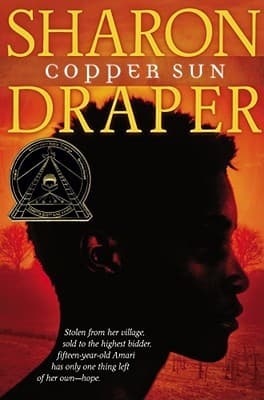
Sharon M. Draper (2006)
Genre
Historical Fiction / Young Adult
Reading Time
360 min
Key Themes
See below
Sign in to track this book
Stolen from her West African village and thrust into the brutal American slave trade, fifteen-year-old Amari clings to the elusive dream of freedom as she embarks on a perilous journey to Fort Mose, a Spanish sanctuary in Florida.
Fifteen-year-old Amari lives a content life in the village of Ziavi, Ghana, with her family and her beloved fiancé, Besa. Her days are filled with traditional tasks, storytelling, and the anticipation of her upcoming marriage. One afternoon, while preparing for a celebration, the village is suddenly attacked by pale-skinned men, accompanied by Ashanti warriors, who set fire to homes and brutally murder the villagers. Amari witnesses her parents' horrific deaths and is captured, along with Besa and her younger brother, Kwasi. She is forced on a death march towards the coast, enduring starvation, thirst, and the constant threat of violence, as her once idyllic world collapses around her.
Amari, along with hundreds of other captured Africans, is forced onto a slave ship, a horrifying vessel they call 'the death boat.' The conditions below deck are unspeakable: overcrowding, disease, stench, and the constant cries of despair. She experiences the trauma of the Middle Passage, witnessing death, starvation, and the brutal treatment of her fellow captives. Besa, her fiancé, is on the same ship but they are kept apart. Upon arrival at Sullivan's Island, South Carolina, the survivors are 'cleaned' and prepared for auction, a humiliating process that strips them of their remaining dignity before being paraded before potential buyers.
At the slave auction in Charles Town, Amari is displayed like an animal. She is poked, prodded, and inspected. She sees Besa sold to a different owner, their last connection severed. Amari is ultimately purchased by a wealthy plantation owner, Mr. Percival Derby, for his seventeen-year-old son, Clay, as a birthday present. Clay immediately asserts his ownership with a cruel kiss. Amari is then transported to the Derby plantation, 'Derbytown,' a vast and imposing estate where she is introduced to the harsh realities of plantation life and the brutal hierarchy that governs it.
At Derbytown, Amari is given the name 'Myna' by Clay and assigned to work in the kitchen under Teenie, an older enslaved woman, and her young son, Tidbit. She quickly learns the strict rules and the severe punishments for disobedience. Here, she meets Polly, a fourteen-year-old white indentured servant who works as a housemaid and teaches Amari English. Polly, initially prejudiced, slowly begins to see Amari as a person rather than property. Amari also experiences Clay's escalating cruelty, including sexual assaults, and witnesses the harsh treatment of the field slaves, including the brutal whipping of Noah, Teenie's husband.
Mr. Derby brings his new, much younger wife, Isabelle, to Derbytown. Isabelle is beautiful but equally cruel and self-centered. She immediately takes a dislike to Amari and Polly, often finding ways to belittle and punish them. Mr. Derby, obsessed with having a male heir, pressures Isabelle. Amari's life becomes increasingly difficult, caught between Clay's demands, Isabelle's jealousy, and Mr. Derby's tyrannical control. Teenie and Tidbit offer Amari some comfort and guidance, teaching her the ways of survival on the plantation and sharing stories of resistance and hope.
Isabelle gives birth to a mixed-race baby, revealing her affair with Noah, Teenie's husband. Enraged, Mr. Derby brutally murders Noah in front of everyone. He then demands that Clay kill the infant by smashing its head against a tree. Clay, despite his usual cruelty, hesitates. When he refuses, Mr. Derby orders Amari to do it. Amari, horrified, refuses, which enrages Mr. Derby further. In a fit of uncontrolled rage, Mr. Derby then orders Clay to kill Amari, Polly, and Tidbit to cover up the scandal. Clay, seemingly wanting to spare them, instead gives them a gun, some supplies, and a head start, instructing them to escape.
Following Clay's unexpected decision, Amari, Polly, and Tidbit flee Derbytown under the cover of night. Their destination is Fort Mose, a Spanish settlement in Florida known as a sanctuary for escaped slaves. The journey is immediately fraught with danger and uncertainty. They must navigate the wilderness, evade slave catchers, and ration their meager supplies. Polly, initially resentful of Tidbit, begins to develop a maternal bond with the young boy, while Amari draws upon her inner strength and knowledge of nature, a legacy from her African upbringing, to guide them through the treacherous landscape.
As they travel south, the trio encounters various challenges. They face hunger, thirst, and the constant threat of wild animals. They meet a kind old woman who offers them shelter and food, but also encounter dangerous individuals, including a group of white men who attempt to capture them. They learn to trust their instincts and rely on each other. Polly's initial prejudice against Amari and Tidbit slowly dissolves, replaced by a deep bond of friendship and mutual dependence. Amari's resilience and Polly's resourcefulness become crucial for their survival as they push forward towards their elusive freedom.
After weeks of arduous travel, Amari, Polly, and Tidbit finally reach Fort Mose, a small, fortified settlement near St. Augustine, Florida. They are greeted by the community of free Africans, Native Americans, and other escaped individuals. Here, they find a sense of belonging and safety they have never known. Amari begins to heal from her traumas, finding solace in the community and the promise of a life free from the brutalities of slavery. Polly, too, finds her place, realizing that her indentured status is a form of bondage and embracing a future where she can choose her own path. Tidbit finds a new family.
In Fort Mose, Amari, Polly, and Tidbit begin to build new lives. Amari finds a respected place in the community, sharing her knowledge and skills. She slowly starts to envision a future where she can truly be free and perhaps even find love again. Polly, now free from her indenture, becomes an integral part of the Fort Mose community, contributing her literacy and organizational skills. Tidbit thrives in the safe environment, surrounded by caring adults. The community at Fort Mose represents not just physical freedom, but also the reclamation of dignity, identity, and the hope for a self-determined future, a stark contrast to the horrors they left behind.
The Protagonist
Amari transforms from a naive, happy girl into a strong, determined survivor who reclaims her agency and finds a new sense of belonging.
The Supporting
Polly evolves from a prejudiced, self-pitying girl into a compassionate and loyal friend who champions freedom for all.
The Supporting
Tidbit grows from an innocent child surviving slavery into a hopeful, free boy embraced by a new community.
The Antagonist
Clay remains largely unchanged in his cruelty, but his moment of hesitation and 'mercy' hints at a suppressed humanity that he chooses not to fully embrace.
The Antagonist
Mr. Derby remains a static character, embodying unyielding cruelty and the corrupting influence of absolute power.
The Supporting
Teenie's arc highlights the enduring strength of a mother's love and the quiet acts of resistance and mentorship within the brutal system of slavery.
The Mentioned
Besa's arc is tragically cut short by slavery, serving as a symbol of lost love and the destruction of Amari's former life.
The Supporting
Isabelle's arc is one of self-serving actions leading to devastating consequences for others, ultimately highlighting her own entrapment despite her privileged position.
The Supporting
Noah's arc is tragically cut short by his murder, serving as a poignant symbol of the ultimate cost of defiance and the brutality of the slave system.
Amari's journey is a profound exploration of lost innocence and the struggle to maintain identity in the face of dehumanization. Her vibrant African heritage is stripped away through capture, the Middle Passage, and the renaming upon arrival in America. She must constantly fight to remember her true name, her family, and her traditions. The book vividly portrays how slavery attempts to erase individuality and culture, forcing Amari to forge a new identity rooted in resilience and the hope for freedom, rather than passively accepting the one imposed upon her.
“'My name is Amari,' she whispered to the darkness, a tiny flame of defiance against the vast, cold night. 'I am from Ziavi.'”
The novel unflinchingly depicts the horrific realities of the transatlantic slave trade and plantation life. From the violent capture and death march, to the unspeakable conditions of the slave ship, and the constant physical and psychological abuse on the Derby plantation, Draper spares no detail. The institutionalized dehumanization is evident in the auctions, the renaming of enslaved people, the casual violence, and the forced sexual exploitation. This theme emphasizes the profound cruelty and injustice of the system, highlighting its devastating impact on human dignity and life.
“'They were not people to him. They were property. He owned them, body and soul, and he could do whatever he wanted with them.'”
Despite enduring unimaginable suffering, Amari, Polly, and Tidbit demonstrate remarkable resilience and an unwavering will to survive. Amari draws upon her inner strength and the lessons from her African upbringing, while Polly finds unexpected courage and resourcefulness. Their arduous journey to Fort Mose is a testament to the human spirit's capacity to endure hardship, find hope in despair, and fight for a better future. This theme is central to the narrative, showing that even in the darkest circumstances, the desire for life and freedom can persist.
“'Hope was a small, fragile thing, but it was all Amari had left. And she held onto it with all her might.'”
A key theme is the formation of unlikely friendships and alliances across racial and social divides. The bond between Amari, a captured African, and Polly, a white indentured servant, is initially fraught with prejudice but evolves into a deep, loyal friendship. Their shared experiences of oppression, though different, forge a powerful connection. The inclusion of Tidbit solidifies their unit, demonstrating how shared suffering can transcend societal barriers and lead to profound human connection and mutual support, which is essential for their survival and escape.
“'We got each other,' Polly said, her voice soft. 'And that's more than some folks got.'”
The ultimate goal for Amari and her companions is freedom—not just physical liberation from chains, but the freedom to define their own lives and futures. Fort Mose represents this elusive dream, a place where they can reclaim their dignity, build a community, and live without the constant threat of violence and ownership. The journey itself is an act of self-determination, a deliberate choice to risk everything for the chance at a life on their own terms, highlighting the fundamental human right to liberty and autonomy.
“'Freedom. It was a word that hummed in her blood, a song whispered by the wind.'”
Allows intimate access to Amari's thoughts and experiences.
The story is primarily told from Amari's first-person perspective, immersing the reader directly into her experiences, emotions, and suffering. This narrative choice creates a powerful sense of empathy and immediacy, allowing the reader to witness the horrors of slavery through the eyes of a young girl who experiences it firsthand. It highlights her internal struggle to maintain her identity and hope, making her journey of survival and self-discovery deeply personal and impactful.
The physical journey mirrors the characters' internal transformations.
The physical journey from Africa to America, and then the escape to Fort Mose, serves as a powerful metaphor for Amari's (and Polly's) internal transformation. Each stage of the journey represents a different trial and a step in her development, from the loss of innocence during the capture, to the resilience forged during the Middle Passage, and finally to the hope and self-discovery found on the path to freedom. The arduous physical journey parallels the emotional and psychological journey of reclaiming one's humanity.
Names represent identity, ownership, and resistance.
The changing of names holds significant symbolic weight. Amari's original name connects her to her heritage and identity. Being given the name 'Myna' by Clay is an act of dehumanization and ownership, an attempt to strip her of her past. Her internal struggle to remember and reclaim 'Amari' symbolizes her resistance against the erasure of her self. Conversely, Polly's full name, 'Polly Robert,' signifies her indentured status, marking her as property until she, too, reclaims her autonomy.
A recurring image symbolizing the passage of time, enduring beauty, and hope.
The image of the 'copper sun' appears periodically throughout the narrative, particularly when Amari reflects on her past in Africa or looks towards the future. It symbolizes the relentless passage of time, the beauty of her lost homeland, and a persistent, albeit sometimes faint, glimmer of hope. Even in the darkest moments, the memory of the sun (or the promise of a new dawn) represents a connection to life, warmth, and the possibility of a brighter future beyond the present suffering.
“I will not cry. I will not cry. I will not cry. I will not cry.”
— Amari's mantra as she endures the horrors of the slave ship.
“The ocean was a giant beast, a hungry mouth that swallowed ships whole.”
— Amari's perspective on the Atlantic Ocean during the Middle Passage.
“Hope was a tiny spark, easily extinguished, but it was there, somewhere.”
— Amari's internal struggle to maintain optimism amidst despair.
“They took everything from me. Everything. But they cannot take my mind. They cannot take my spirit.”
— Amari's defiant thought about the enslavers.
“A human being should not have to beg for the right to live.”
— Polly's reflection on the injustice of slavery.
“The chains were not just on their bodies, but on their souls.”
— Polly observing the psychological impact of slavery on the enslaved.
“He said I was a good investment. Like a horse, or a cow. Not a person.”
— Amari's bitter realization about being sold by Clay.
“Sometimes, silence was the loudest scream.”
— Amari's internal processing of trauma and her inability to vocalize her pain.
“Freedom was not a gift to be given, but a right to be taken.”
— Amari's evolving understanding of what it means to be free.
“The past was a heavy blanket, suffocating them all.”
— Description of how the legacy of slavery impacted everyone, even those who weren't enslaved.
“Love was a dangerous thing in this new world, a weakness that could be exploited.”
— Amari's cautious approach to forming attachments in her perilous situation.
“The color of their skin did not determine the content of their hearts.”
— Polly's growing understanding of racial prejudice.
“Every step was a prayer. Every breath was a wish.”
— Amari's desperate journey towards freedom.
“To be truly free, one had to free their mind first.”
— Amari's philosophical realization about mental liberation.
Ready to see how well you understood this book? Take our interactive quiz with 10 questions.

Biography coming soon.







