“The world is a vast prison, and we are all prisoners in it.”
— Munoo reflects on his life of servitude and exploitation.

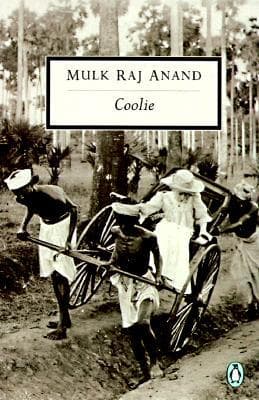
Mulk Raj Anand (1900)
Genre
Literary Fiction / Historical Fiction
Reading Time
350 min
Key Themes
See below
Sign in to track this book
Munoo, a young boy uprooted from his village, embarks on a harsh, picaresque odyssey through pre-Partition India, enduring the brutal realities of servitude, factory labor, and rickshaw pulling in a desperate fight for survival.
Munoo, a fourteen-year-old orphan from the village of Bilaspur in the Kangra Hills, lives with his uncle and aunt who struggle with poverty. His aunt, greedy and resentful of his presence, constantly reminds him of his orphaned status. One day, his uncle, Gujri, informs him that he must leave the village to work for a Babu, a distant relative named Babu Nathoo Ram, in the town of Sham Nagar. Despite his initial reluctance and fear of the unknown, Munoo is packed off with a few belongings, leaving behind the familiar mountains and the only home he has ever known. This begins his journey into the harsh realities of colonial India.
In Sham Nagar, Munoo becomes a domestic servant for Babu Nathoo Ram and his family. He is subjected to constant work, from cleaning and cooking to running errands, often with little food or rest. Mrs. Nathoo Ram, a cruel and demanding mistress, constantly abuses him physically and verbally, calling him a 'coolie' and accusing him of theft. He is often beaten with a shoe or a stick for minor infractions. The children of the house also mock and torment him. Munoo's attempts to find comfort or understanding are met with indifference, and he realizes the immense social gap between himself and his employers. Eventually, after a particularly severe beating and being framed for a theft, Munoo decides to run away.
After escaping the Nathoo Ram household, Munoo wanders through Sham Nagar, hungry and afraid. He is found by a kind old baker, Prabha, who takes him in, feeds him, and offers him a place to stay. Prabha treats Munoo with compassion, a stark contrast to his previous employers. Munoo works in the bakery for a short period, experiencing a brief rest from hardship. However, Prabha's business partner, Ganpat, is manipulative and greedy. When Ganpat cheats Prabha out of his share of the business, Prabha is ruined. With no work left for him, Munoo is forced to leave Sham Nagar again, this time boarding a train to the bustling city of Daulatpur, hoping for better prospects.
In Daulatpur, Munoo finds work in a pickles and jams factory owned by a wealthy Seth, Sir Todar Mal. He works long hours in a hot, unsanitary environment, alongside other impoverished laborers. The conditions are bad, with minimal wages, no safety measures, and constant supervision by an exploitative foreman. Munoo befriends other workers, including a young boy named Hari, and witnesses the injustices faced by the working class. He observes the stark contrast between the factory owners' opulent lifestyle and the workers' miserable existence. A strike is organized to demand better wages and conditions, but it is brutally suppressed by the police and management, leaving Munoo disillusioned and further stuck in poverty.
Following the failed strike, tensions escalate in Daulatpur, made worse by communal propaganda. A Hindu-Muslim riot erupts, fueled by economic desperation and religious manipulation. Munoo, caught in the chaos, witnesses horrific violence and destruction. He is accidentally separated from his friends and, fearing for his life, scrambles onto a train leaving the city. On the train, he encounters an elephant driver, who, in a moment of unexpected kindness, allows him to travel with him without a ticket. Munoo is heading towards Bombay, a city he has heard whispers about, believing it to be a place of opportunity and escape from the unending cycle of poverty and violence.
Upon arrival in Bombay, Munoo is overwhelmed by the sheer size and squalor of the city. He finds lodging in a chawl, a crowded tenement building, and secures a job in a cotton mill. The work is hard and dangerous, with machinery constantly threatening injury and the air thick with cotton dust. He works under a cruel foreman and experiences the dehumanizing routine of factory life, where workers are mere cogs in a capitalist machine. Munoo befriends a fellow worker, Ratan, who introduces him to the harsh realities of the city's underside and the working class's struggles. He witnesses the exploitation of labor and the stark divide between the wealthy mill owners and the impoverished workers.
The relentless physical labor, poor nutrition, and unsanitary living conditions in Bombay begin to severely impact Munoo's health. He develops a persistent cough and feels a growing weakness in his body. The constant noise and pollution of the city, combined with the emotional toll of his solitary existence, deepen his despair. He longs for the simple life of his village and the clean air of the mountains. Despite his deteriorating health, he continues to work, driven by the desperate need to survive. He witnesses the death of a fellow worker, further emphasizing the precariousness of life for the poor in the city.
One day, while working in the mill, Munoo is involved in an accident, sustaining an injury to his leg. Weakened and unable to continue working, he is left vulnerable. He is found by Mrs. Mainwaring, a wealthy Anglo-Indian woman who is a friend of the mill owner. Mrs. Mainwaring, often portrayed as eccentric and somewhat flighty, takes pity on Munoo and decides to employ him as her personal servant. She is a peculiar character, with a superficial interest in 'native' culture and a desire to appear philanthropic. This unexpected turn of events offers Munoo a temporary escape from the mill, but also introduces him to a different kind of exploitation.
Mrs. Mainwaring takes Munoo with her to Simla, the British summer capital, where she plans to spend the season. In Simla, she decides that Munoo should work as a rickshaw puller for her. This is the most physically demanding and degrading work Munoo has yet encountered. He is forced to pull heavy loads, often uphill, in all weather conditions, competing with other desperate coolies. The high altitude and strenuous labor further worsen his already fragile health, particularly his persistent cough. He experiences the contempt of the colonial elite and the fierce competition among the coolies, creating a sense of utter hopelessness.
The relentless strain of pulling a rickshaw in Simla, coupled with inadequate food and rest, rapidly worsens Munoo's health. His cough gets worse, and he shows clear signs of tuberculosis. Despite his failing body, he is forced to continue working to earn enough to survive. He dreams of returning to his village, but the dream remains distant and unattainable. One day, while pulling Mrs. Mainwaring's rickshaw up a steep hill, he collapses. He is taken to a small, unsanitary room and left to die. Isolated and without any family or friends to care for him, Munoo passes away, a victim of the brutal social and economic forces that defined his short, tragic life. His death goes largely unnoticed, showing how expendable the 'coolie' was in pre-Partition India.
The Protagonist
Munoo starts as a naive village boy and gradually becomes hardened by the realities of exploitation and poverty, ultimately succumbing to illness and despair.
The Supporting/Antagonist
He remains a static character, representing the petty bureaucracy and class hierarchy that Munoo encounters.
The Antagonist
She remains a static, oppressive figure, serving as Munoo's initial tormentor.
The Supporting
He is a temporary, static character whose kindness provides a stark contrast to Munoo's usual experiences.
The Antagonist
A static character serving as an obstacle to Munoo's temporary well-being.
The Mentioned/Antagonist
A static, symbolic representation of capitalist exploitation.
The Supporting
A static character who provides Munoo with companionship and a broader understanding of the working class struggle.
The Supporting/Antagonist
A static character whose 'benevolence' is ultimately a form of exploitation.
The Supporting
A static character, representing the multitude of child laborers.
The novel clearly shows the constant exploitation of the poor by various social classes in pre-Partition India. Munoo is exploited first by his own relatives, then by the lower-middle-class Nathoo Ram family, the wealthy factory owners in Daulatpur and Bombay, and finally by the colonial elite through Mrs. Mainwaring. Each employer takes advantage of his vulnerability, offering meager wages, bad working conditions, and physical abuse. The theme highlights the systemic nature of injustice, where the 'coolie' is seen as expendable labor, without rights or dignity, serving the interests of those above him in the social hierarchy.
“For Munoo, the world was a series of closed doors, each slamming shut in his face the moment he dared to hope.”
Anand carefully details the rigid class and caste structures in India, showing how Munoo, as an orphan and low-caste 'coolie,' is always at the bottom. His journey reveals the stark contrast between the lives of the wealthy (like Sir Todar Mal and Mrs. Mainwaring) and the impoverished masses. Even within the working class, subtle hierarchies exist. The novel shows how social status dictates access to basic necessities, respect, and opportunities, with Munoo constantly reminded of his inferiority through verbal abuse ('sweeper,' 'coolie') and physical mistreatment. This divide is a main reason for his suffering and ultimate death.
“He was a coolie, a burden, a useless mouth, a mere nothing in the vast, indifferent world.”
Munoo begins as a naive village boy, full of dreams and a yearning for connection. However, each successive experience of exploitation strips away his innocence and wears down his humanity. He is subjected to physical and emotional abuse, forced into degrading labor, and witnesses violence and despair. The constant labeling as 'coolie' and 'sweeper' reduces him to a functional object, denying his individuality and dignity. By the end, he is a broken shell, his spirit crushed by the constant struggle for survival, symbolizing the dehumanizing impact of extreme poverty and societal indifference.
“The child in him died, and a new self, hard and bitter, began to grow.”
The novel criticizes the dark side of India's early industrialization and quick urbanization under British rule. Munoo's experiences in the factories of Daulatpur and Bombay expose the bad working conditions, long hours, low wages, and lack of safety that characterized early industrial labor. The overcrowded, unsanitary chawls of Bombay and the grueling work of rickshaw pulling in Simla further show how urban centers, while promising opportunity, often trap the poor in new forms of misery and exploitation. The polluted air, noise, and anonymity of the city contrast sharply with Munoo's memories of his peaceful village, showing the destructive impact on human health and spirit.
“The city was a monster, swallowing up the innocent and spitting out their bones.”
Despite the overwhelming odds and constant suffering, Munoo shows an extraordinary will to survive. He repeatedly runs away from abusive situations, seeks new employment, and adapts to unfamiliar environments. Even when ill and despairing, he continues to push his body to its limits to earn a living. His resilience shows in his ability to form temporary bonds of friendship (with Prabha, Ratan, Hari) and his persistent hope for a better future, even if it is often dashed. This theme shows the human drive to live, even when facing great difficulty, though ultimately, for Munoo, survival is a losing battle.
“He survived, not because he was strong, but because the will to live was a fire in his belly.”
Munoo's episodic journey through various social strata and locations.
The novel employs a picaresque structure, following Munoo, a 'picaro' figure, through a series of loosely connected episodes and encounters as he travels across India. Each new location (Bilaspur, Sham Nagar, Daulatpur, Bombay, Simla) and each new employer introduces him to a different facet of Indian society and a new form of exploitation. This structure allows Anand to present a panoramic view of colonial India's social injustices, rather than focusing on a single, tightly knit plot. It emphasizes Munoo's constant displacement and his role as an observer of the world's harsh realities.
Detailed and unflinching depiction of poverty and exploitation.
Anand's use of social realism is central to 'Coolie.' The novel provides a stark, unromanticized portrayal of the lives of the impoverished masses in pre-Partition India. It meticulously details the squalid living conditions, meager diets, grueling labor, and physical abuse endured by characters like Munoo. Anand uses vivid, often visceral descriptions to immerse the reader in the harsh realities, aiming to expose the systemic injustices and evoke empathy for the marginalized. This device is crucial for fulfilling the novel's purpose as a critique of colonial and capitalist exploitation.
The term 'coolie' as a symbol of dehumanization and disposability.
The term 'coolie' itself functions as a powerful symbol throughout the novel. Initially a derogatory term used by Mrs. Nathoo Ram, it comes to represent Munoo's entire identity as an exploited, disposable laborer. It strips him of his individuality, reducing him to a mere cog in the economic machine. The word symbolizes the social and economic forces that categorize and dehumanize the working class, highlighting their lack of agency and their expendability in the eyes of the dominant classes. Munoo's journey is a gradual embodiment of this very term, culminating in his death as an anonymous 'coolie' in Simla.
Contrasting wealth and poverty, kindness and cruelty.
Anand frequently uses juxtaposition to highlight the stark inequalities and moral complexities of the world Munoo inhabits. This is evident in the contrast between the opulence of the mill owners' bungalows or Mrs. Mainwaring's lifestyle and the squalor of the chawls and factories. Similarly, the brief kindness offered by Prabha is juxtaposed with the pervasive cruelty of the Nathoo Ram family or the mill foremen. These contrasts serve to emphasize the injustice of Munoo's suffering and the vast chasm between different social strata, making the societal critique more potent.
Providing insight into Munoo's thoughts, feelings, and evolving understanding.
While primarily written in third-person, the narrative frequently delves into Munoo's internal thoughts, fears, and observations, often bordering on stream of consciousness. This device allows the reader to experience the world through Munoo's innocent yet increasingly disillusioned eyes. It reveals his yearning for home, his confusion about the injustices he faces, his fleeting hopes, and his growing understanding of class struggle. This intimate perspective fosters empathy for Munoo and underscores his individual suffering amidst the broader societal critique, preventing him from becoming a mere symbolic figure.
“The world is a vast prison, and we are all prisoners in it.”
— Munoo reflects on his life of servitude and exploitation.
“I am a coolie, a beast of burden, not a man.”
— Munoo describes his dehumanizing labor conditions.
“The rich live on the sweat of the poor.”
— Observation about economic inequality in colonial India.
“Hunger is a fire that burns the belly and the soul.”
— Munoo experiences extreme poverty and starvation.
“In this world, only the strong survive; the weak are crushed.”
— Reflection on the brutal realities of survival.
“The city is a monster that devours the innocent.”
— Munoo's impression of Bombay as a migrant laborer.
“My body is not my own; it belongs to my master.”
— Munoo's realization of his complete lack of autonomy.
“Hope is a cruel joke played on the poor.”
— Cynical view of optimism in oppressive circumstances.
“The British sahibs rule with whips and laws.”
— Critique of colonial authority and violence.
“Even animals are treated better than coolies.”
— Comparison highlighting extreme dehumanization.
“My dreams are all I have left, and they are fading.”
— Munoo's dwindling hope for a better life.
“The factory machines have no heart; they grind us down.”
— Description of industrial labor's brutality.
“We are born to suffer and die unknown.”
— Fatalistic view of the coolie's life trajectory.
“The monsoon rains wash away the dirt but not our sorrows.”
— Poetic reflection on enduring misery.
Ready to see how well you understood this book? Take our interactive quiz with 10 questions.

Biography coming soon.







