“We Peruvians are all fucked, from the top to the bottom.”
— Santiago Zavala reflects on the pervasive corruption and despair in Peruvian society during the 1950s Odría dictatorship.

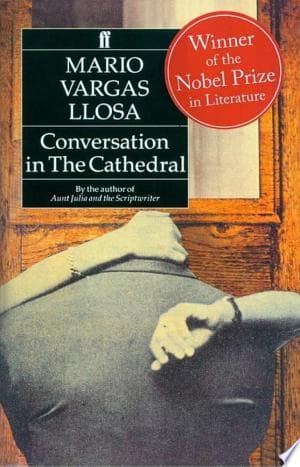
Mario Vargas Llosa (2012)
Genre
Historical Fiction
Reading Time
1200 min
Key Themes
See below
Sign in to track this book
Amidst the suffocating corruption and political decay of 1950s Peru, Santiago Zavala grapples with his father's complicity in a regime that shattered their nation, all while searching for the precise moment everything went irrevocably wrong.
The novel opens with Santiago Zavala, a disillusioned journalist, meeting Ambrosio, his family's former chauffeur, outside 'The Cathedral,' a seedy bar in Lima. This chance meeting starts a long, non-linear conversation between the two men, which forms the story's structure. Santiago, now living a simple life, feels guilty and wants to understand the past, especially the moral decay and political corruption that defined Peru during the Odria dictatorship in the 1950s. Ambrosio, from a humble background, served the powerful Zavala family. He holds many secrets from that time, and his reluctant disclosures slowly reveal a dark history involving Santiago's prominent father, Don Fermín.
The story often flashes back to Santiago's youth as a university student at San Marcos in the 1950s. Disgusted by the hypocrisy and corruption of his wealthy, conservative family and the oppressive Odria regime, Santiago is drawn to left-wing student activism. He joins Cahuide, a secret communist group, and commits to revolutionary ideals. This greatly upsets his father, Don Fermín, a powerful businessman and politician with ties to the regime. Santiago's involvement in Cahuide, with friends like Jacobo and Aída, is his first attempt to break free from his privileged background and support a cause he believes in, even if it conflicts with his family and the political order.
A central mystery unfolds through the fragmented talks: the murder of a well-known prostitute named La Musa (Amelia Folch). Ambrosio's account, combined with other characters' memories, slowly suggests Don Fermín's involvement in her death, or at least in its cover-up. It is revealed that Don Fermín led a secret homosexual life, visiting brothels and having a long affair with Ambrosio. La Musa was reportedly involved with powerful men, including Don Fermín, and her death is linked to a wider network of political intrigue, blackmail, and sexual misconduct among the elite. This discovery deeply troubles Santiago, forcing him to face the moral depravity within his own family.
Ambrosio's past is closely linked to Cayo Bermúdez, the ruthless and ambitious head of security for the Odria regime. Ambrosio served as Bermúdez's driver and confidant, becoming an unknowing or unwilling participant in many of the regime's illegal activities, including spying, threats, and cover-ups. His relationship with Bermúdez shows the widespread corruption and how power corrupts both those who have it and those who serve it. Ambrosio's own moral compromises, driven by survival and loyalty, are revealed. He is a complex figure caught between his personal feelings and the demands of a brutal political system. His involvement in disposing of La Musa's body is a key confession.
The novel also tells the story of the political schemes and eventual fall of the Odria regime. Cayo Bermúdez, despite his great power and ruthlessness, eventually loses favor. His downfall is partly caused by rivals within the regime and partly by his own overreach and growing public unhappiness. The story shows how political alliances shift and betrayals happen within the authoritarian system. The Odria dictatorship, known for censorship, repression, and widespread corruption, slowly loses its power, making way for a more democratic, though still flawed, transition. Bermúdez's fall represents how temporary power is, even in a dictatorship.
Santiago's strong political idealism from his youth slowly fades. Seeing the internal quarrels, betrayals, and ultimate failure of the student movements, along with the harsh reality of the dictatorship's power, he becomes more cynical. His communist group, Cahuide, ultimately fails to achieve its goals, and many of his comrades either become disillusioned, are taken in by the system, or face brutal repression. This disillusionment extends to his personal life, leaving him with a deep sense of emptiness and a loss of purpose. He stops his studies and his revolutionary hopes, choosing a path of self-imposed distance from his family's world and his past ideals. He becomes the detached journalist we meet at 'The Cathedral.'
The novel combines the fates of many supporting characters, showing the widespread impact of the era. Queta, a prostitute, is deeply involved in the underworld and is a confidante for many, including Don Fermín. Hortensia, Don Fermín's mistress, represents another part of the moral decay; her life is tied to the powerful. Carlitos, Santiago's brother, shows the shallow, privileged youth of the elite, benefiting from the corrupt system. Their stories, often sad and marked by exploitation or moral compromise, complete the picture of Peruvian society under Odria, showing how personal lives were shaped and often twisted by the political climate and the widespread corruption.
In a short, fragmented scene, Don Fermín, near the end of his life, tries to confess his secrets to Santiago. He admits to his homosexual affairs and his involvement in the events around La Musa's death, though the full extent of his guilt remains unclear. This confession, though incomplete, forces Santiago to confront his father's true nature – not just the powerful, respected figure, but also a man with deep personal secrets and moral flaws. While it does not fully clear Don Fermín in Santiago's eyes, it offers a more complex, humanized picture of him, adding another layer to Santiago's understanding of the past and his own identity.
Throughout his conversation with Ambrosio and his internal thoughts, Santiago is haunted by the question: 'When exactly did Peru get screwed up?' This question, asked repeatedly, becomes a symbol for his inability to pinpoint the exact moment or cause of the nation's moral and political decline, mirroring his own personal disillusionment. The fragmented story structure itself reflects how hard it is to reconstruct a definite truth from unreliable memories and conflicting views. Santiago's search for understanding ultimately leads him to a deep sense of resignation, realizing that the past is complex, often unpleasant, and can never be fully understood or neatly resolved.
The long conversation between Santiago and Ambrosio eventually ends, though without a clear solution or relief. Santiago is left with a deeper, perhaps even more painful, understanding of the moral compromises, betrayals, and corruption that filled his family and his country during the Odria era. He realizes that the past cannot be easily escaped or simply summarized. The novel ends with Santiago's lasting despair, a feeling that the 'screwing up' of Peru, and by extension his own life, is a continuous, almost natural condition. He remains a man burdened by memory, unable to fully accept the bitter truths uncovered at 'The Cathedral.'
The Protagonist
From idealistic student revolutionary, he descends into cynicism and detachment, seeking to understand a past that offers no easy answers.
The Supporting
From a seemingly simple chauffeur, he is revealed as a man with a complex, morally compromised past, haunted by his actions.
The Supporting
His public image as a powerful figure is gradually dismantled, revealing a man riddled with secrets, guilt, and moral compromises.
The Antagonist
Rises to immense power through brutal efficiency, only to suffer a political downfall.
The Supporting
Her life and tragic death serve to expose the moral corruption of the powerful men around her.
The Supporting
A survivor in a corrupt world, she maintains her agency and perspective despite her circumstances.
The Supporting
Her life is one of quiet endurance, defined by her relationship with Don Fermín and the social limitations placed upon her.
The Supporting
She remains a steadfast and supportive figure, representing a potential for normalcy in Santiago's troubled life.
The Supporting
He remains largely unchanged, representing the unexamined privilege and moral complacency of his class.
The Supporting
Starts as an idealistic revolutionary, his fate reflecting the dangers and disappointments of political activism.
The novel carefully shows the widespread corruption that ran through Peruvian society during the Odria dictatorship, from the highest levels of government to the personal lives of the elite. Don Fermín's secret life, Cayo Bermúdez's ruthless power, and the cover-up of La Musa's murder all show how power, greed, and fear destroy moral integrity. This idea is central to Santiago's 'when exactly did Peru get screwed up?' question, suggesting a deep national problem where personal and political corruption are closely linked.
“From what moment did Peru get screwed up? The question came to Santiago like a shiver, a cold gust of wind in his heart.”
Santiago Zavala's journey from an idealistic student revolutionary to a cynical, detached journalist is the core of this theme. His youthful hopes for political change are crushed by the realities of a repressive government, the internal arguments of the left, and the widespread hypocrisy of his own class. This disillusionment goes beyond politics, affecting his personal life and leaving him with a deep sense of emptiness and a loss of purpose. The novel suggests that the 'screwing up' of Peru also involved crushing a generation's hopes.
“He remembered the enthusiasm of those days, the conviction that they could change the world, and now he only felt a profound weariness.”
Santiago's search to understand his father's past and the nation's political history is also a journey of self-discovery. By facing the dark truths about his family and his country, he tries to reconcile his privileged background with his revolutionary ideals. His struggle to define himself outside the shadow of his powerful, corrupt father is a main conflict. The novel explores how individual identity is shaped by family history, social class, and the political environment, often leading to a painful confrontation with one's own involvement or powerlessness.
“He wanted to know who his father was, who he himself was, in that labyrinth of lies and half-truths.”
The novel's non-linear, fragmented structure, built around a conversation full of conflicting memories and viewpoints, highlights how subjective and unreliable memory is. Santiago and Ambrosio's attempts to reconstruct the past are full of gaps, contradictions, and intentional omissions. The 'truth' about La Musa's murder or Don Fermín's actions is never fully revealed simply, showing that historical truth is often a mix of individual recollections, biases, and the passing of time. The act of remembering itself becomes a central struggle.
“Memory was a capricious animal, offering fragments, distorting others, always leaving out the essential.”
The clear division between Peru's wealthy elite (like the Zavalas) and the poor working class (like Ambrosio) is a basic part of the novel. The story shows how power works through social levels, with the elite exploiting and controlling those below them. Ambrosio's subservient role, Don Fermín's freedom from punishment, and the general disregard for the lives of the poor illustrate the rigid class structure and its effect on individual destinies. 'The Cathedral' itself, a place where these different classes briefly meet, symbolizes the fragmented nature of Peruvian society.
“What was a life worth in a country where some were born to rule and others to serve?”
Multiple interwoven dialogues and internal monologues creating a non-linear timeline.
Vargas Llosa employs a highly complex, non-linear narrative, often referred to as 'dialogue à quatre' or 'cajas chinas' (Chinese boxes). The main conversation between Santiago and Ambrosio at 'The Cathedral' is constantly interrupted by flashbacks, internal monologues, and other dialogues involving various characters from different time periods. This fragmentation mirrors the difficulty of reconstructing the past and the subjective nature of memory, forcing the reader to piece together the events and motivations, reflecting Santiago's own struggle to understand 'when exactly did Peru get screwed up?'
A seedy bar serving as a liminal space where past and present, rich and poor, intersect.
The bar 'The Cathedral' is more than just a physical location; it functions as a powerful symbol. It's a place of convergence for different social classes and a crucible where the past is confronted. Its seedy, rundown nature reflects the moral decay of Lima itself, while its name ironically contrasts with the sacred, suggesting a profane confession. It is a liminal space where Santiago and Ambrosio, representatives of vastly different worlds, can meet on seemingly equal footing to excavate the buried truths of their shared history.
A leitmotif representing Santiago's existential and nationalistic quest.
This rhetorical question, repeated numerous times by Santiago throughout the novel, serves as a powerful leitmotif. It encapsulates his personal and nationalistic quest to understand the origins of corruption, moral decay, and disillusionment in Peru. More than just a plot device, it is a philosophical inquiry into the nature of his country and his own identity. The lack of a definitive answer reinforces the novel's theme of the complexity and ambiguity of historical truth, suggesting that the 'screwing up' might be an ongoing, multifaceted condition rather than a single event.
Direct access to Santiago's thoughts, anxieties, and memories.
The narrative frequently delves into Santiago's interior monologues, providing direct access to his thoughts, anxieties, and fragmented memories. This technique allows the reader to experience Santiago's profound disillusionment, his moral questioning, and his struggle to reconcile his past with his present. It contributes to the novel's psychological depth, showcasing his internal conflict and the burden of his conscience as he grapples with the dark secrets of his family and his nation. This often blends seamlessly with the external dialogues, blurring the lines between inner and outer reality.
“We Peruvians are all fucked, from the top to the bottom.”
— Santiago Zavala reflects on the pervasive corruption and despair in Peruvian society during the 1950s Odría dictatorship.
“In Peru, the only thing that works is what doesn't work.”
— A cynical observation about the dysfunctional nature of Peruvian institutions and bureaucracy.
“Memory is a traitor; it idealizes or vilifies, but never tells the truth.”
— Characters discuss how personal and collective memories distort reality, especially regarding Peru's political past.
“Power doesn't corrupt, it reveals.”
— A reflection on how political power exposes people's true characters and moral weaknesses.
“We're all accomplices, even if we don't want to be.”
— Santiago realizes how ordinary citizens become entangled in systemic corruption through silence or inaction.
“The only thing worse than being exploited is having no one to exploit.”
— A bitter commentary on the hierarchical and exploitative nature of Peruvian social structures.
“In this country, even the rain is dirty.”
— A metaphorical expression of how corruption and decay permeate every aspect of life in Peru.
“Friendship is the first casualty of ambition.”
— Observing how personal relationships are destroyed by political and social climbing.
“We live in a cathedral of conversations where nothing is ever resolved.”
— The title's reference, highlighting how endless talk in bars and gatherings leads to no real change.
“The past is a labyrinth we can never escape.”
— Characters feel trapped by personal and national history that continues to shape their present.
“To be honest in a dishonest world is a form of madness.”
— A reflection on the difficulty and seeming irrationality of maintaining integrity in a corrupt society.
“Every man has his price, and in Peru, it's very low.”
— A cynical view of how easily people compromise their principles under economic and political pressure.
“We are all prisoners of our own choices, even when we think we have none.”
— Santiago contemplates personal responsibility and fate in the constrained environment of dictatorship.
“The truth is not what happened, but what people believe happened.”
— A commentary on how political narratives and propaganda reshape historical truth.
“In the end, we are all alone with our conscience, and it's the worst company.”
— A moment of introspection about guilt and moral isolation in a compromised society.
Ready to see how well you understood this book? Take our interactive quiz with 10 questions.
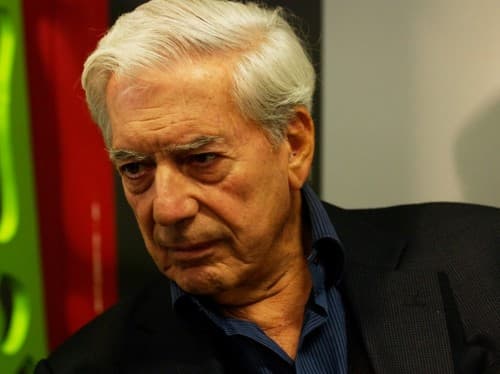
Jorge Mario Pedro Vargas Llosa, 1st Marquess of Vargas Llosa, more commonly known as Mario Vargas Llosa, is a Peruvian novelist, journalist, essayist and former politician, who also holds citizenship of Spain and the Dominican Republic. Vargas Llosa is one of Latin America's most significant novelists and essayists, and one of the leading writers of his generation. Some critics consider him to have had a larger international impact and worldwide audience than any other writer of the Latin American Boom. In 2010 he won the Nobel Prize in Literature, "for his cartography of structures of power and his trenchant images of the individual's resistance, revolt, and defeat." He also won the 1967 Rómulo Gallegos Prize, the 1986 Prince of Asturias Award, the 1994 Miguel de Cervantes Prize, the 1995 Jerusalem Prize, the 2012 Carlos Fuentes International Prize, and the 2018 Pablo Neruda Order of Artistic and Cultural Merit. In 2021, he was elected to the Académie française.







