“Perhaps there is no such thing as a natural death, only a death whose cause has not yet been discovered.”
— The narrator reflects on the mysterious nature of death, particularly in a time before advanced medical understanding.

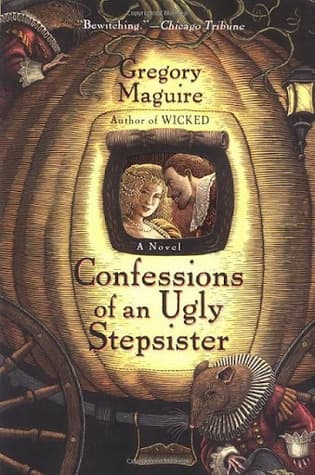
Gregory Maguire (1999)
Genre
Fantasy / Historical Fiction / Young Adult
Reading Time
7-8 hours
Key Themes
See below
Sign in to track this book
In 17th-century Holland, an "ugly" stepsister named Iris navigates a world of artifice and ambition, uncovering the treacherous secrets behind her new family's wealth and the true curses accompanying her beautiful stepsister Clara's looks.
The story opens with Iris, her mother Margarethe, and her simple-minded stepsister Ruth arriving in Haarlem, Netherlands. They fled England due to accusations of witchcraft. They have no money and struggle to find work or shelter. Margarethe, a practical and often harsh woman, quickly sees their desperate situation. Iris, observant and intelligent, navigates their poverty, often taking on responsibilities beyond her years. They eventually find a meager existence on the city's outskirts, where Margarethe tries to sell Ruth's 'healing' touch, a dangerous act in their superstitious new home. This initial struggle shows the family's uncertain position and Iris's developing sense of injustice.
Through luck, Margarethe secures a position as a housekeeper for the wealthy Schoonmaker family. The household includes the widowed Master Cornelis Schoonmaker, his beautiful but withdrawn daughter Clara, and his eccentric sister, Hendrickje. Iris and Ruth come along, living in the servants' quarters. This move offers stability and access to a world of luxury and art. However, the transition has challenges, as they must adapt to the rigid social structures and expectations of their new environment. The mysterious nature of the Schoonmaker family begins to unfold before Iris.
Clara Schoonmaker is a girl of ethereal beauty but great isolation. She spends her days by the hearth, seemingly obsessed with ashes and fire, and rarely speaks. Master Schoonmaker and Hendrickje treat her with reverence and fear, believing her beauty is a curse or a gift to be protected. Iris observes Clara with awe and pity, noting her detachment from the world. This seclusion prevents Clara from developing social skills or a sense of self beyond her appearance, making her a passive figure whose fate is largely determined by others. Iris, in contrast, must be active and resourceful.
Margarethe, ambitious and shrewd, sees a chance to improve their status. She begins to manipulate Master Schoonmaker, playing on his loneliness and his need for a strong hand in the household. Her practical skills and forceful personality gradually win him over. Despite Iris's discomfort with her mother's actions, Margarethe convinces Schoonmaker to marry her. This union makes Iris and Ruth stepsisters to Clara, giving them higher social standing but also entangling them more deeply in the secrets of the Schoonmaker family. The dynamic between the three girls, especially the two 'ugly' stepsisters and the beautiful Clara, is now set.
Living in the Schoonmaker household, Iris gains access to books and a more refined environment. Driven by curiosity and a desire for knowledge, she secretly teaches herself to read and reads any literature she can find, particularly philosophical texts and the works of Descartes. She also develops an interest in painting and art, drawn to Haarlem's art scene and the work of local artists like Caspar. Iris's intellectual growth contrasts with Clara's passive existence and Ruth's simplicity. She begins to question beauty, truth, and perception, moving beyond survival to ponder deeper philosophical questions, which will shape her understanding of the world and her place within it.
Rumors circulate about a visit from the Prince of Orange to Haarlem, sparking excitement and ambition within the Schoonmaker household, especially for Margarethe, who sees a chance for Clara to make an advantageous match. A talented but struggling painter named Caspar (a fictionalized Vermeer) becomes enamored with Clara's unique beauty. He seeks permission to paint her portrait, believing her face holds a truth he wishes to capture. Iris develops a complex relationship with Caspar, admiring his artistic vision and finding in him a kindred spirit who sees beyond appearances. Caspar's interest in Clara further raises her perceived value, while also highlighting her objectification.
A grand ball is held, possibly in honor of the Prince's visit, and Clara, dressed exquisitely by Margarethe, makes a stunning appearance. Her beauty captivates everyone, including a representative of the Prince of Orange. During the festivities, Clara's slipper, with a unique design, is mysteriously lost. This event, whether accidental or planned, becomes a moment when the Prince's emissary or a nobleman from his court begins a search for the maiden whose foot fits the lost slipper. This mirrors the classic Cinderella narrative, but Iris, observing, sees the artifice and the power dynamics at play, understanding that Clara's fate is being shaped by external forces rather than her own will.
Following the ball, the search for the slipper's owner begins, filling Haarlem with anticipation and desperate hopes. Various girls try to fit their feet into the exquisite, tiny slipper, but none succeed. Within the Schoonmaker household, Margarethe is frantic, determined that one of her daughters will be chosen. She tries to force Ruth's foot into the slipper, even using painful measures, but fails. Iris, though pressured, refuses to participate. Tension builds as the emissary approaches their home. The reality of Clara's unique foot size, and her inherent 'fit' for the role being imposed upon her, becomes undeniable. This highlights the arbitrary nature of such a 'destiny'.
The emissary arrives at the Schoonmaker home, and Clara, with her naturally small and perfectly shaped foot, effortlessly fits into the lost slipper. This confirms her identity as the maiden sought by the Prince. Margarethe is triumphant, and Clara is betrothed to the Prince of Orange, or at least a high-ranking nobleman in his retinue, destined for a life of royalty and prestige. However, Clara herself remains detached and unemotional, her beauty having paved her path without her active participation or desire. Iris observes this with growing unease, recognizing that Clara's supposed 'happily ever after' is less about personal happiness and more about fulfilling a societal role dictated by her appearance.
Driven by her analytical mind and unease about Clara, Iris begins to piece together information. She learns about the mysterious circumstances of Clara's birth and the death of her mother. Through conversations with Hendrickje and old servants, and her own deductions, Iris uncovers the dark truth: Clara is not Master Schoonmaker's biological daughter but was adopted or taken in under suspicious circumstances. Her unusual beauty and detachment relate to a deeper, unsettling origin, possibly involving magic or a psychological trauma. This revelation shatters the illusion of Clara's perfect destiny and reveals the deceit and manipulation that have governed her life.
Throughout these events, Caspar, the painter, continues to work on Clara's portrait. Unlike others who are captivated by her external beauty, Caspar tries to capture her inner essence, her profound otherworldliness, and the melancholy that seems to cling to her. He struggles to convey the 'truth' of Clara on canvas, wrestling with the limitations of paint and perception. His artistic journey parallels Iris's intellectual one, both trying to understand Clara beyond her surface. The finished portrait is not just a likeness but an interpretation, revealing a depth and mystery that most people overlook, hinting at the secrets Iris has uncovered. It shows that true beauty, or truth, lies beyond the superficial.
As Clara prepares for her royal marriage, Iris makes a choice for herself. She rejects the path of superficiality and societal advancement her mother pursued. Having gained an education and a deeper understanding of human nature and the world's complexities, Iris decides to forge her own intellectual and independent path. She bids farewell to Clara, recognizing that their destinies, though connected, are different. Iris leaves the Schoonmaker household, possibly with Caspar or to pursue her own studies, embracing a life of thought and observation rather than one dictated by beauty or social status. Her departure means her liberation from the fairytale narrative.
Clara, beautiful and silent, proceeds with her marriage to the Prince or nobleman. Her 'happily ever after' is a gilded cage, a life of luxury and social prominence but without genuine emotion or self-determination. She remains an object of admiration, a symbol of beauty, but never truly a person with agency. The novel implies that her detachment and her mysterious origins continue to define her existence, preventing her from forming deep connections or experiencing true personal fulfillment. Her story concludes not with joy, but with a sense of melancholic inevitability, showing the burdens and isolation that can accompany extraordinary beauty when not paired with inner life.
Ruth, Iris's simple-minded stepsister, remains largely unaffected by the ambitions and manipulations around her. Her gentle nature and lack of intellectual complexity shield her from the pressures that weigh on Iris and Clara. She finds contentment in simple tasks and small comforts, perhaps even developing a quiet connection with one of the servants or a local boy. Her fate contrasts with both Clara's gilded cage and Iris's intellectual striving, suggesting that happiness can be found outside the pursuit of beauty, wealth, or power. Ruth's story offers a quiet counterpoint, highlighting the value of an unburdened and unassuming existence.
The novel concludes with Iris, now an older woman, reflecting on her past and the events that shaped her and her stepsisters. She is the 'ugly stepsister' who, through her intelligence and observation, has come to understand the true nature of beauty, power, and perception. Her 'confessions' are not of guilt, but of insight, revealing the subjective and often cruel realities behind the traditional fairytale. She questions the societal narratives that elevate superficial beauty and condemn those who lack it, offering a revisionist perspective on the Cinderella story. Iris's narrative voice is one of wisdom and nuanced understanding, having seen through the illusions to the underlying truths.
The Protagonist
Iris transforms from a struggling, observant child into a wise, independent woman who understands the true nature of beauty and societal illusions, forging her own intellectual path.
The Supporting/Antagonist
Margarethe rises from destitution to a position of wealth and power, but her relentless pursuit of status ultimately leaves her unfulfilled.
The Supporting/Protagonist of the 'fairytale'
Clara remains largely static, a beautiful object whose life is dictated by her appearance and the machinations of others, never truly finding her own voice or agency.
The Supporting
Ruth remains a constant, gentle presence, finding simple happiness and remaining uncorrupted by ambition or the pursuit of beauty.
The Supporting
Master Schoonmaker slowly declines, becoming more dependent and ultimately a pawn in Margarethe's ambitions.
The Supporting
Hendrickje remains a constant, observant presence, largely unchanged but providing moral commentary and a glimpse into the family's past.
The Supporting
Caspar struggles to capture the essence of truth in his art, eventually finding a muse in Clara and an intellectual connection with Iris.
The Mentioned/Catalyst
Not applicable as he is a distant, symbolic figure.
The novel explores the subjective and often deceptive nature of beauty. Clara's ethereal beauty is a burden, isolating her and making her an object rather than an individual. Iris, considered 'ugly,' is free to develop her intellect and agency, seeing beyond appearances. The story questions whether beauty is a blessing or a curse, and how society defines and values it. Caspar the painter's quest to capture Clara's 'truth' on canvas, rather than just her likeness, shows that true beauty is deeper than the surface. The contrast between Clara's external perfection and her internal emptiness highlights this theme.
“Beauty is a burden, or it is a gift, depending on the soul that bears it.”
A central theme is the difference between how things appear and how they truly are. The 'fairytale' narrative of Cinderella is deconstructed, revealing the harsh realities, manipulations, and tragic undercurrents. Clara's 'happily ever after' is a gilded cage. Iris, through her keen observation and intellectual curiosity, constantly challenges accepted perceptions, uncovering the truth behind Clara's origins, Margarethe's motives, and the societal illusions of grandeur. The novel shows how easily people are swayed by appearances and how difficult it is to discern genuine truth.
“What is real? What is seen, or what is known?”
The story examines how much individuals can control their own destinies. Clara, despite her elevated status, lacks agency; her life is dictated by her beauty and the ambitions of others. Margarethe, driven by her own will, manipulates circumstances but is still confined by societal expectations. Iris, by contrast, actively seeks knowledge and chooses an independent path, rejecting the predetermined roles society offers. Her journey is one of asserting her own will against circumstance, showing that true freedom comes not from external fortune, but from internal choice and intellectual liberation. The contrast between Clara's passive acceptance and Iris's active pursuit of knowledge is key.
“Some are born to be painted, some to paint. Others to simply watch the paint dry.”
Maguire reworks the familiar Cinderella myth, using it to explore how stories shape our understanding of the world and ourselves. The novel questions the simple 'good vs. evil' narratives of fairytales, showing the complexities and moral ambiguities of its characters. By presenting the 'ugly stepsister' as the intelligent narrator, the book challenges the reader to look beyond established myths and consider alternative perspectives. It demonstrates how powerful narratives, like the Cinderella story, can both inspire and constrain, shaping destinies and perceptions, and how challenging these narratives can reveal deeper truths about human nature.
“Every story has two sides, and the truth often lies somewhere in between.”
The story is told from Iris's subjective perspective, offering her 'confessions'.
The entire novel is narrated by Iris in the first person, providing an intimate and subjective account of events. As the 'ugly stepsister,' her perspective is inherently critical and observant, allowing the author to deconstruct the traditional Cinderella narrative. While she strives for truth, her confessions are filtered through her own experiences, biases, and later, her philosophical musings, making her a subtly unreliable narrator. This device forces the reader to question assumptions and to see the fairytale from a fundamentally different, often cynical, viewpoint, highlighting the internal journey of understanding and self-discovery.
The story is set against the backdrop of Golden Age Netherlands, influencing themes and characters.
The specific historical setting of 17th-century Haarlem, Netherlands, during its Golden Age, is more than just a backdrop; it's integral to the novel's themes. This era was characterized by scientific advancements (Descartes), flourishing art (Vermeer, Rembrandt), burgeoning merchant classes, and a lingering undercurrent of superstition and religious fervor. This setting allows Maguire to explore the tension between reason and magic, art and commerce, and the rigid social structures of the time. The emphasis on painting and light, particularly through the character of Caspar, grounds the fantastical elements in a tangible, historical reality, enriching the narrative with cultural depth.
The novel reinterprets the Cinderella story from a marginalized perspective.
The most prominent plot device is the retelling and deconstruction of the classic Cinderella fairytale. By shifting the perspective to the 'ugly stepsister' (Iris), the novel subverts reader expectations and challenges the simplistic morality of the original. It exposes the darker, more complex realities behind the 'happily ever after,' revealing the manipulation, social pressures, and personal costs involved. This device allows Maguire to explore themes of beauty, class, agency, and truth, using the familiar framework to ask profound questions about human nature and societal values, ultimately offering a more nuanced and often melancholic version of the beloved myth.
Clara's obsession with ashes and fire symbolizes her isolation and origins.
Clara's consistent presence by the hearth, her fascination with ashes and fire, serves as a powerful symbol. It directly links her to the 'Cinderella' archetype, but also suggests her detachment and perhaps a deeper, more elemental connection to something ancient or mystical. Ashes can represent both death and rebirth, destruction and transformation, hinting at her mysterious origins and passive nature. Fire can symbolize both warmth and destruction, beauty and danger. This recurring motif underscores Clara's enigmatic character, her isolation, and the hidden truths surrounding her existence, making her more than just a pretty face.
“Perhaps there is no such thing as a natural death, only a death whose cause has not yet been discovered.”
— The narrator reflects on the mysterious nature of death, particularly in a time before advanced medical understanding.
“The world is not a stage, but a puppet show. And we are all puppets.”
— Iris ponders the lack of control people have over their lives, feeling manipulated by unseen forces.
“Beauty, it appeared, was not a thing to be admired but a thing to be feared, for it brought with it the envy and malice of others.”
— Iris observes the destructive power of Clara's beauty and the negative reactions it elicits from those around her.
“To be born a woman is to be born into a world of limits, of expectations, of a thousand small deaths before the final one.”
— The narrator reflects on the restrictive roles and societal pressures placed upon women in the 17th century.
“Love is a kind of blindness, a willful refusal to see the faults of the beloved.”
— Iris contemplates the nature of love, particularly in the context of her mother's infatuation with the painter, and the subsequent disappointments.
“There are some stories that are so old, so ingrained, that they become more real than reality itself.”
— The story acknowledges the enduring power of fairy tales and how they shape perceptions, even of historical events.
“It is not the glass slipper that makes the princess, but the foot that fits it.”
— A twist on the traditional Cinderella narrative, suggesting true worth comes from within, not from external symbols.
“Sometimes the greatest kindness is to let someone believe their own lies.”
— Iris considers the complex ethics of truth and deception, particularly when protecting others' fragile illusions.
“We are all born with a certain amount of madness. We use it to survive.”
— The characters often exhibit eccentricities or unconventional behaviors as coping mechanisms in a harsh world.
“The world is full of people who want to tell you who you are. Don't let them.”
— A message of self-determination, encouraging individuals to define themselves rather than accept others' labels.
“Memory is a mischievous servant; it tells you what it wants to, not what you need to hear.”
— The unreliable nature of memory is a recurring theme, as characters grapple with their pasts and the stories they tell themselves.
“There is a kind of hunger that no food can satisfy, a hunger for something lost, or something never found.”
— Iris reflects on the deep emotional longings and unfulfilled desires that plague many of the characters.
“To be a monster is to be misunderstood. And to be misunderstood is to be alone.”
— Relates to the 'ugly' stepsister's perspective, highlighting the isolation that comes from being judged and ostracized.
“Fairy tales are more than true: not because they tell us that dragons exist, but because they tell us that dragons can be beaten.”
— A meta-commentary on the power and purpose of storytelling, especially in the context of the book being a retelling.
Ready to see how well you understood this book? Take our interactive quiz with 10 questions.

Biography coming soon.







