“I love new clothes. If everyone could just wear new clothes every day, I reckon depression wouldn't exist anymore.”
— Rebecca expresses her belief in shopping as a cure for sadness.

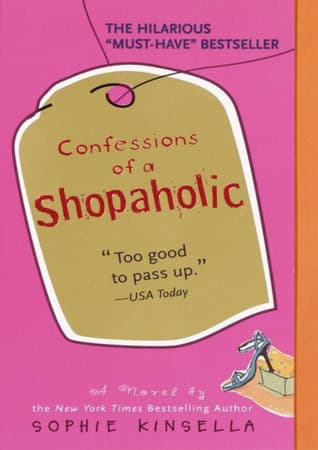
Sophie Kinsella (2000)
Genre
Young Adult / Romance
Reading Time
360 min
Key Themes
See below
Sign in to track this book
A charming but financially reckless London journalist, drowning in debt and designer labels, must confront her shopping addiction when her lies begin to unravel her glamorous facade and threaten her chance at true love and self-acceptance.
Rebecca 'Becky' Bloomwood is a financial journalist for 'Successful Saving' magazine, which is ironic given her own bad financial situation. She lives in London, surrounded by designer clothes and a stylish life she cannot afford. Her flatmate, Suze, often helps her, but Becky's debt to the bank, especially her overdraft, is growing out of control. Derek Smeath, her bank manager, sends more and more urgent letters, which Becky avoids opening. Even though she knows she needs to save, Becky cannot resist sales and new fashion items, telling herself each purchase is a 'necessary' investment or a 'bargain' she cannot miss, which makes her debt worse.
Becky tries to spend less, such as buying only essentials or sticking to a budget, but these efforts always fail, often leading to more impulse buys. Her job at 'Successful Saving' is boring, and she struggles to write good articles about finance. However, she gets a chance when asked to research an article about investing in clothes, a topic she genuinely likes. This assignment leads her to a press conference where she first meets Luke Brandon, a successful and charming PR mogul who is starting a new ethical investment fund. Becky finds him attractive and interesting, despite their initial professional rivalry.
Wanting a new scarf she saw in a window, Becky makes up a story for the shop assistant, claiming she needs it for her sick aunt who is dying and has always wanted that specific scarf. She uses this story to get a discount. Later, at a charity auction attended by Luke Brandon, Becky sees the same scarf being auctioned. To her surprise, Luke Brandon wins it. When he talks to her, she keeps up her fabricated story, pretending the scarf is for her 'dying aunt.' Luke, seemingly sympathetic, offers her the scarf, creating an awkward situation where Becky must accept it while continuing her lie, feeling both embarrassed and triumphant.
Feeling bad about the scarf and her lie, Becky tries to return it to Luke, but her attempts are clumsy. She ends up getting into his cab and going with him to a business meeting, where she accidentally gives surprisingly good advice. Luke is impressed by her unexpected intelligence and humor, and they start to meet more often. Despite her financial problems and the threat from Derek Smeath, Becky finds herself more and more drawn to Luke, enjoying their witty talks and his attention. She starts to see him as more than just a work contact.
Becky's articles for 'Successful Saving' about fashion as an investment, based on her own experiences, become popular. This leads to an opportunity for her to appear on a daytime television show as a financial expert. She is excited by the idea of fame. However, this happens at the same time Derek Smeath is getting more impatient. He threatens to reveal her debt publicly if she does not pay, which puts a lot of pressure on her. Becky worries, knowing that her public image as a financial expert would be ruined if her personal financial problems were shown on national television or in the news.
During her live television appearance, just as Becky is about to give financial advice, Derek Smeath calls into the show, revealing her large overdraft and questioning her credibility as a financial expert. The news is devastating and humiliating for Becky, who is completely surprised and speechless. Her career and reputation are instantly ruined, and she faces public mockery. Luke Brandon, who is watching, is shocked and disappointed by her dishonesty. Becky's friends and family are also upset by the public reveal of her secret, and she withdraws into deep embarrassment and sadness.
Overwhelmed by shame and the public reaction, Becky leaves London and stays with her parents in Surrey. She isolates herself, refusing to answer calls or see anyone. During this time, she finally starts to face her addiction and the harm it has caused. She gets a call from Luke Brandon, who, despite his initial anger, expresses concern. He says that his company, Brandon Communications, is facing bad publicity because of her scandal and suggests she could help him fix the situation. This gives Becky some hope and a goal beyond her self-pity.
Inspired by Luke's call and a new sense of responsibility, Becky makes a plan to deal with her debt. She decides to sell all her designer clothes and accessories, realizing that her possessions are the cause of her problems, not her happiness. She holds a large yard sale with Suze's help, selling her beloved items. She also agrees to appear on television again, this time to publicly apologize for her deception and explain her journey to financial recovery. This act of humility and honesty starts to improve her public image.
Becky's public apology and real efforts to fix her situation are well-received. She pays off a lot of her debt. Luke Brandon, seeing her sincerity and new maturity, forgives her. He offers her a job at Brandon Communications, recognizing her ability to connect with people and her understanding of consumer behavior, despite her past. Becky accepts, wanting a fresh start. Their work relationship quickly becomes a romantic one, strengthening their bond. Becky finds happiness, not through shopping, but through honest work, real relationships, and financial responsibility.
The Protagonist
Becky transforms from a debt-ridden shopaholic in denial to a financially responsible individual who finds purpose and love through honesty and hard work.
The Love Interest/Supporting
Luke initially views Becky with professional interest and later disappointment, but eventually comes to understand and love her, helping her find her path.
The Supporting
Suze remains a steadfast friend, her unwavering support helping Becky through her darkest moments.
The Antagonist/Supporting
Smeath serves as the consistent external force pushing Becky to confront her debt, ultimately leading to her public downfall and subsequent recovery.
The Supporting
Graham remains a loving and supportive parent, offering Becky a stable refuge when she needs it most.
The Supporting
Jane consistently offers maternal support and a safe home for Becky throughout her struggles.
The Supporting
Tarquin serves as a brief, unfulfilled romantic possibility for Becky, highlighting her true romantic trajectory with Luke.
The Supporting/Mentioned
Alicia remains a background figure who serves as a source of professional and personal comparison for Becky.
The novel looks at consumerism and materialism in modern society, especially through Becky's desire for designer goods. Her constant need to buy, often more than she can afford, shows the draw of advertising and social pressures to fit certain lifestyle ideals. The book shows how material things, first seen as sources of happiness and status, lead to debt, dishonesty, and emotional distress, as seen in Becky's credit card bills and public humiliation. Her story is a direct look at the emptiness of a life driven only by buying things.
“A man will never love you or treat you as well as a store. If a man doesn't fit, you can't exchange him for a fresh one. And you'll never get a two-for-one deal on a man.”
Becky's identity is tied to her possessions and the image she presents, not her true self. She constantly tricks herself about her financial situation, making up reasons for her purchases and avoiding talking to her bank manager. This self-deception extends to her work, where she writes about saving money while being deeply in debt. Her public downfall forces her to let go of this false identity and face her true self, leading to a more real sense of who she is, separate from her material things.
“There's no point in saving money for a rainy day if you're going to spend it all on a handbag.”
The novel shows shopping as an addiction, with Becky showing signs like denial, compulsive behavior, withdrawal when trying to stop, and a constant need for a 'fix.' Her 'high' from buying new things is followed by guilt and worry. The book's climax, where her addiction is publicly revealed, is her lowest point. Her decision to sell her beloved items, pay off her debts, and seek a new path reflects the steps of recovery, showing the difficult but rewarding process of overcoming a compulsive behavior.
“When I shop, the world gets better, the world is better, and then it's not care any more. And I don't care because I'm happy.”
A main idea is the results of honesty versus dishonesty. Becky's life is built on lies: lying to her bank manager, her friends, her family, and herself about her money. Her elaborate made-up stories, like the 'dying aunt' story, always lead to more problems and embarrassment. The public reveal of her dishonesty is the final reckoning. Her path to getting better begins only when she chooses to be completely honest about her situation, publicly apologizing and truly committing to change, showing the freeing power of truth.
“I'm not going to lie to him. It's too much effort. I'm going to tell him the truth. For once.”
Beyond shopping, the novel explores how real relationships develop. Becky's friendship with Suze provides a steady, loyal support, while her relationship with Luke Brandon forces her to face her true self. Luke's initial attraction to her wit and later his disappointment in her dishonesty, followed by his understanding and forgiveness, shows the complexities of love built on trust. The book suggests that true happiness comes from honest, supportive relationships rather than superficial material gains, as Becky finds love and purpose after dealing with her addiction.
“He's not just handsome, he's... interesting. And he looks at me like I'm interesting too.”
Provides direct access to Becky's thoughts, rationalizations, and anxieties.
The story is told entirely from Becky's perspective, immersing the reader in her unique blend of charm, denial, and financial delusion. Her internal monologues are key to understanding her rationalizations for shopping, her avoidance of debt, and her often humorous but self-sabotaging thought processes. This device creates intimacy with the character, allowing readers to sympathize with her even as they witness her poor decisions, and makes her eventual realization and growth more impactful. It also highlights the gap between her public persona and private reality.
Used throughout to highlight the absurdity of Becky's situation.
Irony is a pervasive element, most notably in Becky's job as a financial journalist for 'Successful Saving' magazine while she is deeply in debt. This central irony underscores the absurdity of her situation and her profound self-deception. Further ironic situations include her giving financial advice on television while her own finances are a disaster, or her 'dying aunt' lie to acquire a scarf that she later sees at a charity auction won by her love interest. The irony serves to both entertain and to emphasize the disconnect between appearance and reality.
A recurring symbol of Becky's mounting debt and avoidance.
The unopened, increasingly urgent letters from Derek Smeath at the bank serve as a constant visual and thematic reminder of Becky's spiraling debt and her profound avoidance tactics. Each letter represents a step closer to her inevitable financial reckoning. They are a tangible manifestation of her buried problems, growing in number and severity, until they can no longer be ignored. Their eventual public revelation on live television marks the climax of her crisis, making them a powerful symbol of her denial and the consequences of her actions.
The primary method Becky uses to deal with stress, boredom, or negative emotions.
Shopping for Becky is not just about acquiring goods; it's a powerful coping mechanism and a form of self-medication. When she's stressed, bored, sad, or even happy, her immediate impulse is to buy something. This 'retail therapy' provides a temporary high, distracting her from her problems and giving her a fleeting sense of control or happiness. This device illustrates the psychological grip of consumerism and how it can become an addictive behavior, offering short-term relief at the expense of long-term well-being and financial stability.
“I love new clothes. If everyone could just wear new clothes every day, I reckon depression wouldn't exist anymore.”
— Rebecca expresses her belief in shopping as a cure for sadness.
“A man will never love you or treat you as well as a store. If a man doesn't fit, you can't exchange him seven days later for a gorgeous cashmere sweater.”
— Rebecca humorously compares relationships to shopping returns.
“I mean, it's not like I'm addicted to shopping. I can stop anytime I want. I just don't want to.”
— Rebecca denies her shopaholic tendencies in a self-aware moment.
“Shopping is cheaper than a psychiatrist.”
— Rebecca justifies her spending as emotional therapy.
“I have a little mantra: 'Accessorize, accessorize, accessorize.'”
— Rebecca shares her fashion philosophy.
“It's a new month. A new month means a new start. A new start means a new outfit.”
— Rebecca rationalizes buying clothes for fresh beginnings.
“I'm not a shopaholic. I'm a collector of beautiful things.”
— Rebecca reframes her shopping habit as a hobby.
“Sometimes I look at my bank statement and think, 'Who is this Rebecca Bloomwood and what has she done with my money?'”
— Rebecca reflects on her financial disconnect.
“A girl can never have too many shoes.”
— A common saying Rebecca lives by.
“I don't have a shopping problem. I have a storage problem.”
— Rebecca blames lack of space, not her habits.
“Retail therapy is the best kind of therapy.”
— Rebecca promotes shopping for emotional relief.
“When in doubt, wear red.”
— Rebecca's go-to fashion advice for confidence.
“I'm not avoiding my problems. I'm prioritizing my happiness.”
— Rebecca defends shopping as a positive focus.
“Credit cards are like fairies. They grant wishes.”
— Rebecca whimsically describes the allure of credit.
“Life is too short to wear boring clothes.”
— Rebecca's motto for expressive dressing.
Ready to see how well you understood this book? Take our interactive quiz with 10 questions.

Biography coming soon.