“The island was his, a private kingdom, and he was its sole, if unwilling, monarch.”
— After Maitland crashes his car and finds himself stranded on the traffic island.

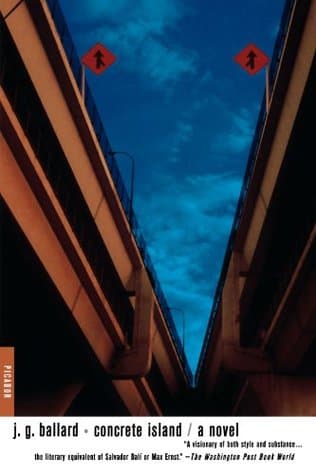
J.G. Ballard (1974)
Genre
Thriller / Mystery / Science Fiction
Reading Time
150 min
Key Themes
See below
Sign in to track this book
After a car crash traps him on a desolate concrete island beneath a highway, a man fights for survival against the strange place and its reclusive inhabitants. This becomes a terrifying look into his own mind.
One Tuesday afternoon in April, Robert Maitland, an architect, takes an unfamiliar exit off the Westway motorway in London. Distracted by a sudden desire for a shortcut, he swerves his Jaguar, loses control, and crashes over the concrete wall, landing on a triangular patch of wasteland beneath the converging flyovers. The impact breaks his windscreen, throws him forward, and leaves him with a severe concussion and a badly injured leg. Initially dazed, Maitland tries to climb back to the motorway, but his injuries and the steep, crumbling slopes make it impossible. He soon realizes he is trapped on what seems to be a deserted 'concrete island' in the middle of urban infrastructure.
Maitland spends his first night on the island in shock and pain, his leg hurting. The next morning, he systematically tries to find a way off. He attempts to climb the steep, trash-covered slopes back to the motorway but repeatedly fails, his injured leg giving out. He tries to signal passing cars and trucks by waving his jacket, but drivers either do not see him or ignore his pleas. The constant noise of traffic overhead reminds him of the civilization he has lost, but it only makes his isolation worse. He searches his wrecked car for supplies, finding a briefcase, some documents, and a small amount of food and water, which he carefully saves.
As days pass, Maitland's leg becomes infected, and his mental state gets worse. One evening, while exploring a run-down part of the island, he finds a crude shelter made of corrugated iron and scavenged materials. Inside, he finds a man, Proctor, a large, mentally disabled former laborer, who communicates mostly with grunts and simple hand signs. Proctor is initially cautious but not aggressive, and Maitland realizes he is not alone. Proctor's presence, though unsettling, offers a small bit of hope, suggesting that survival on the island is possible, and maybe even a way off.
Maitland's exploration leads him to another, more complex dwelling, where he meets Jane Shepherd, a young woman. Jane is mysterious and distant, seemingly happy with her life on the island. She says she was once a prostitute and has been living there for years, finding a strange freedom from society's demands. She treats Maitland's injured leg with a basic antiseptic, offering him some relief. Her presence creates a complex situation, as Maitland feels drawn to her unsettling appeal, yet is also frustrated by her apparent lack of desire to escape their shared problem.
Maitland tries to fit into the strange routines of the island's inhabitants. He learns that Proctor, despite his limitations, is skilled at scavenging and maintaining their meager life, often bringing back discarded food and useful items. Jane, meanwhile, has a quiet but strong influence over Proctor, who seems dedicated to her. Maitland's first attempts to take charge or convince them to help him escape are met with indifference or quiet resistance. He realizes that the island has its own established social structure, almost like a tribe, and his presence is an intrusion that he must carefully handle.
As weeks pass, Maitland's physical injuries slowly heal, but his mental state changes completely. The constant noise of the motorway, once a source of torment, begins to fade into a background hum. He finds himself adapting to the primitive life, looking for food, and watching the island's patterns. He becomes interested in the city's discarded items that collect on the island—broken objects, forgotten memories. The rules of his former life, his career, his family, begin to feel distant and unimportant. He starts to question his own identity and the values he once held, finding a strange, almost basic, freedom in being trapped.
The isolation and closeness lead to increased sexual tension between Maitland and Jane. Jane, with her distant sensuality, seems to both invite and reject Maitland's advances. Their interactions are a complex dance of power and weakness. Maitland, despite his physical recovery, becomes more dependent on Jane for emotional support. She, in turn, seems to enjoy the control she has over him and Proctor. The island becomes a setting for their basic desires and hidden issues, reflecting Maitland's own mental state.
A sudden, brief thought of his former life jolts Maitland out of his island stupor. He realizes how much he has changed and the danger of losing himself entirely. He creates a new plan: to use the car's remaining fuel and some scavenged materials to make a signal fire or a makeshift raft. He tries to get Jane and Proctor's help, but they are either unwilling or unable to understand how urgently he wants to leave. Their indifference confirms his realization that he is truly alone in his desire for the outside world.
Maitland's renewed efforts to escape lead to a tense confrontation. He discovers that Jane and Proctor have been subtly sabotaging his attempts, either by hiding tools or by creating distractions. They see him not as a fellow prisoner to be freed, but as an important, though new, part of their island life. In a desperate act, Maitland tries to overpower Proctor, but his weakened state and Proctor's surprising strength make the attempt useless. The struggle leaves Maitland further injured and broken, both physically and mentally. He now understands that his entrapment is not just physical, but also a result of the strange, almost connected relationship he has formed with the island and its residents.
Defeated and accepting, Maitland stops trying to escape. He sheds the last parts of his former identity as an architect, a husband, a member of society. He begins to live completely in the present, embracing the primitive existence of the island. He joins Proctor in scavenging, and his relationship with Jane settles into a strange, almost domestic, routine, though without conventional romance. He becomes, in essence, another 'concrete islander,' a primitive man living on the edge of an indifferent modern world. His change is complete; the island has not only trapped him but has also changed who he is, reflecting the desolate place within him.
The Protagonist
From a rational, driven architect, Maitland transforms into a primal, almost feral inhabitant of the island, shedding his former identity.
The Supporting
She remains largely static, serving as a catalyst for Maitland's transformation, embodying the island's unchanging, primal nature.
The Supporting
He remains consistent in his childlike, primal state, serving as a foil and a physical obstacle to Maitland's escape attempts.
The Mentioned
Her presence diminishes as Maitland's transformation progresses, embodying the fading relevance of his former life.
The Mentioned
N/A, serves as a background detail for Jane's character.
The novel looks at how a person's identity disappears when they are removed from societal structures. Maitland, an architect, slowly loses his civilized self, becoming more primitive and driven by instinct. His suit and briefcase, symbols of his old life, are discarded as he adapts to the island's harsh conditions. This regression is not just about survival but a mental breakdown, questioning what defines a human when external signs of status and purpose are gone.
“He felt himself becoming a man of the island, as much a part of its derelict landscape as the broken concrete and abandoned cars.”
Ballard turns a traffic island into a strong symbol of isolation and a modern wilderness. Despite being surrounded by the constant noise of a major city, Maitland is completely cut off. The island becomes a small example of human existence, a place where civilization's rules no longer apply. This theme shows the contradiction of urban life—the chance for deep loneliness and disconnection despite being surrounded by many people and activity. The island is both a physical trap and a mental mirror for Maitland's inner state.
“The roar of the traffic was a continuous presence, a vast, indifferent ocean of sound that merely emphasized his isolation.”
While Maitland first sees the island as a prison, Jane Shepherd and Proctor see it as a kind of freedom from society's expectations and duties. The novel challenges common ideas of freedom, suggesting that true liberation might mean getting rid of civilization's burdens. Maitland's final acceptance of being trapped can be seen as finding a new, though primitive, form of freedom, free from the pressures of his former life. This contradiction is central to the novel's examination of human desires and psychological needs.
“He had imagined escape as liberation, but perhaps liberation lay in remaining.”
Removed from social rules, Maitland's basic instincts, especially his sexuality, come forward. His interactions with Jane Shepherd are full of raw, almost animalistic desire and power struggles. The island environment removes social niceties, showing the fundamental drives that support human behavior. The relationships between Maitland, Jane, and Proctor become their most basic forms, driven by survival, control, and sexual urges, showing a return to a more primitive state.
“Her indifference was more provocative than any overt gesture, a challenge to his male authority.”
The concrete island is made from the discarded waste of the surrounding city—broken concrete, abandoned cars, rubbish. This physical setting is a metaphor for the psychological waste of modern life and the forgotten people who are overlooked. Ballard carefully details the scavenged items, showing how these leftovers of consumer culture are reused for survival. The island is a dumping ground, not just for material trash, but also for people considered unnecessary by society.
“The island was a museum of forgotten objects, a graveyard of the consumer age.”
The literal setting functions as a psychological prison and a catalyst for transformation.
The concrete island itself is more than just a location; it acts as a character in the novel. Its desolate, refuse-strewn landscape, the constant roar of traffic, and its physical entrapment directly influence Maitland's psychological state and transformation. The island becomes a mirror for his subconscious, a physical manifestation of his internal chaos and eventual regression. It is a modern, urban wilderness that strips away civilization, forcing the protagonist to confront his primal self.
The external plot mirrors Maitland's internal mental and emotional journey.
Ballard uses the physical entrapment on the island as an allegory for Maitland's internal psychological state. The crash and subsequent isolation represent a breakdown in his ordered life and a descent into a more primitive consciousness. The other inhabitants, Jane and Proctor, can be seen as aspects of Maitland's own psyche – his repressed desires, his primal urges, and his eventual acceptance of a less 'civilized' self. The island is not just a place but a mental landscape.
A contemporary reinterpretation of the classic survival story, focusing on psychological rather than physical survival.
The novel directly references the Robinson Crusoe archetype, but subverts it. Maitland is a 'wickedly modern Robinson Crusoe,' stranded not on a tropical island but in the heart of urban decay. Unlike Crusoe, whose primary struggle is physical survival and recreating civilization, Maitland's battle is internal. His 'island' is psychological, and his 'savages' are not external threats but the inhabitants who represent his own primal urges, making his 'survival' a descent into a new, more primitive self rather than a triumph of reason.
The Jaguar symbolizes Maitland's former life, status, and ultimate downfall.
Maitland's Jaguar is a potent symbol of his upper-middle-class status, his control, and his connection to the modern world. Its destruction in the crash signifies the shattering of his former life and identity. Throughout his time on the island, the wrecked car remains a constant, decaying reminder of what he has lost and what he can no longer access. It represents the technological world that has failed him and the material possessions that are ultimately meaningless in his new, primitive reality.
“The island was his, a private kingdom, and he was its sole, if unwilling, monarch.”
— After Maitland crashes his car and finds himself stranded on the traffic island.
“He began to feel that the entire island was a carefully designed trap, a stage set for some obscure drama of which he was the unwitting lead.”
— Maitland's growing paranoia and realization of his predicament.
“The concrete was not merely a surface, but a living, breathing entity, its pores filled with the detritus of a thousand forgotten journeys.”
— Maitland's increasingly surreal perception of his environment.
“He moved through the debris like a diver exploring a sunken city, each object a relic from a lost civilization.”
— Maitland scavenging for useful items on the island.
“The roar of the traffic was a constant, indifferent presence, a reminder of the world he had left and the world that had forgotten him.”
— The ever-present sound of the motorway surrounding the island.
“His own body, once a familiar instrument, became a strange and recalcitrant machine, subject to the whims of pain and hunger.”
— Maitland's physical deterioration and struggle for survival.
“He was learning to see the world again, not through the lens of civilization, but through the raw, unfiltered gaze of a primitive man.”
— Maitland's regression to a more primal state.
“The island was a mirror, reflecting not the city around it, but the hidden landscapes of his own mind.”
— Maitland's psychological journey and self-discovery on the island.
“He began to understand that the true prison was not the concrete island, but the expectations and routines of the life he had led.”
— Maitland's evolving perspective on freedom and confinement.
“The distinction between sanity and madness blurred, becoming as fluid and uncertain as the shadows cast by the passing cars.”
— Maitland's mental state deteriorating under the stress of isolation.
“He was not escaping the city, but entering a more profound, more authentic version of it.”
— Maitland re-evaluating his relationship with the urban environment.
“The most dangerous thing about the island was not its physical hazards, but its insidious ability to reshape the mind.”
— Maitland reflecting on the psychological impact of his ordeal.
“He had come to the island an unwilling castaway, but he was leaving it, if he ever did, as something else entirely.”
— Maitland's profound personal change throughout his time on the island.
“The concrete was a canvas, and he was the reluctant artist, painting his own slow disappearance onto its grey surface.”
— Maitland's sense of fading away and becoming part of the island.
Ready to see how well you understood this book? Take our interactive quiz with 10 questions.

Biography coming soon.







