“The only bad part about our town was that we had to eat whatever the weather served us.”
— The narrator describes the unique but sometimes inconvenient food-based weather in Chewandswallow.

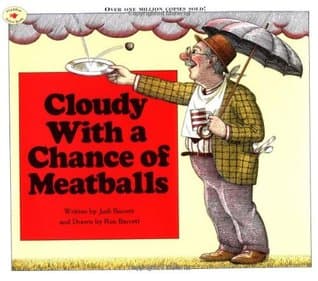
Judi Barrett (1978)
Genre
Fantasy / Children's
Reading Time
5 min
Key Themes
See below
Sign in to track this book
In the whimsical town of Chewandswallow, daily life is a delicious, if sometimes dangerous, smorgasbord as food rains from the sky, leading to culinary delights and comedic chaos.
The book begins with a family—a grandfather, a boy, and a girl—at the breakfast table. The grandfather accidentally flips a pancake onto the boy's head, which makes him tell a very unusual bedtime story to the children later that night. His story starts in Chewandswallow, a place where, instead of rain or snow, food fell from the sky three times a day. The townspeople never went to a grocery store or cooked; they simply went outside with plates and bowls to collect their meals. This setup establishes the central fantastical idea of the book, preparing for the increasingly strange events to follow.
In Chewandswallow, breakfast brought juice, eggs, and toast. Lunch might feature ham, peas, and grapefruit. Dinner could be anything from lamb chops to baked potatoes. The weather forecasters were important, predicting not just sun or clouds, but what type of food would fall. Sometimes the food was perfect, like sunny-side-up eggs or perfectly cooked steaks. Other times, it was less ideal, such as when it rained soup or showered with mashed potatoes, creating a bit of a mess but generally manageable. The town's daily rhythm was completely set by these food-related weather events, making life both convenient and constantly surprising for its residents.
Life in Chewandswallow, while unique, was mostly pleasant until the weather started to get worse. The food began falling in larger quantities and in less convenient forms. Instead of neat servings, there were giant pancakes that covered entire streets, and huge pieces of cheese that blocked traffic. The portions became enormous, and the variety of food became less appealing. For example, a giant hot dog bun might fall without a hot dog, or a single pea might be the size of a golf ball. These early signs showed that the food-producing weather system was becoming unstable and potentially dangerous, moving beyond just inconvenience.
The situation in Chewandswallow quickly got worse. One day, a huge storm of pancakes, syrup, and butter descended, making roads impassable and houses sticky. After this, a massive 'storm' of soft drinks and jelly hit the town, causing sticky floods and making it difficult to move around. Then came the 'storm' of giant hamburgers, so large and numerous that they began to crush houses and cars. The townspeople had to start using shovels and plows to clear away the excess food, which quickly began to rot and smell, creating a health hazard and an unbearable living environment. The sheer volume and size of the food became a real threat.
With the town buried under mountains of stale, rotting food, life in Chewandswallow became impossible. The citizens realized they could no longer live there. They decided to combine their ideas and resources to escape. Using giant pieces of stale bread as the hulls, and other discarded food items like peanut butter for sealant and sails made from cheese, they built makeshift boats. Their goal was to sail away from Chewandswallow and find a new, normal place to live, where food did not threaten to bury them alive. This group effort marked a turning point, as the townspeople chose survival over their unique, but now dangerous, lifestyle.
The people of Chewandswallow successfully sailed away from their food-plagued town. After days at sea, they landed on a small, uninhabited island. Here, they had to adapt to a completely different way of life. They built new homes from scratch, planted gardens, and learned to fish and hunt for their food. They discovered the satisfaction of growing their own vegetables and cooking their own meals, something they had never experienced in Chewandswallow. This new life, though challenging, brought a sense of normalcy and control that had been missing in their old town, showing their resilience and adaptability.
As the years passed on the new island, the former residents of Chewandswallow raised their families. Their children grew up hearing stories about the town where food fell from the sky, tales that seemed almost unbelievable. The islanders occasionally sailed back to Chewandswallow, but they could never get very close due to the massive, rotting food piles that still covered the entire town. It remained a monument to their past, a cautionary tale of too much of a good thing. The legend of Chewandswallow became a cherished, if cautionary, part of their culture, passed down through generations.
Back in the present, the grandfather finishes his story, leaving the children wide-eyed and thoughtful. He explains that the people of Chewandswallow learned to appreciate the simple act of going to a store for food or cooking a meal. The children, having heard the tale, look at their own breakfast with a new perspective, perhaps even a bit of apprehension about the idea of food falling from the sky. The story concludes with the idea that sometimes, what seems like a dream can turn into a nightmare, and that the ordinary can be truly wonderful, reinforcing a subtle moral about appreciating what you have.
The Narrator/Supporting
Grandpa remains a consistent, wise storyteller, using his narrative to impart a subtle lesson without direct preaching.
The Listener/Supporting
He begins as an innocent listener and ends with a new, thoughtful perspective on food and daily life.
The Listener/Supporting
She begins as an innocent listener and ends with a new, thoughtful perspective on food and daily life.
The Collective Protagonist
They transition from carefree recipients of food to desperate survivors, ultimately building a new, self-sufficient life.
The Mentioned/Supporting
Their role shifts from being essential guides to being helpless observers as the weather turns catastrophic.
A main theme of the book is that too much of a good thing can be disastrous. While food falling from the sky initially seems like a dream, the sheer volume and unpredictable nature of the food in Chewandswallow eventually turn it into an overwhelming nightmare. The town becomes literally buried and uninhabitable, forcing its residents to flee. This shows how convenience, when taken to an extreme, can lead to chaos and destruction, emphasizing the importance of balance and moderation.
“But the weather took a turn for the worse. One day, there was a storm of pancakes, followed by a shower of maple syrup and butter. Everyone ate so much, they got a little sick.”
The people of Chewandswallow show great adaptability and resilience. At first, they adapt to the unique challenges of edible weather, using umbrellas for soup and shovels for excess food. When their town becomes completely uninhabitable, they work together to escape, building boats from stale bread and other food items. Their journey to a new island and their efforts to build new homes, farm, and fish show humanity's ability to overcome problems and create a new life from scratch, even after losing everything familiar.
“They decided to build a fleet of boats out of giant pieces of stale bread, with peanut butter and jelly for sails. They sailed off to find a new land.”
The story subtly teaches appreciation for the mundane and the ordinary. The children at the end of the story look at their normal breakfast with new respect, understanding that the simple act of choosing and preparing food is a privilege. The people of Chewandswallow, after their ordeal, learn to value growing their own food and buying it from a store, activities they once took for granted or never even knew. This theme suggests that sometimes, the most extraordinary experiences can lead to a deeper appreciation for the simple, consistent parts of daily life.
“And the people of Chewandswallow never went back to their old town. They learned to grow their own food, and they learned to cook. And they were very happy.”
The main narrative is told by Grandpa to his grandchildren.
The entire fantastical tale of Chewandswallow is presented as a bedtime story told by a grandfather to his two grandchildren. This framing device allows for a natural introduction and conclusion to the imaginative narrative, grounding the extraordinary events within a relatable family setting. It enables the grandfather to be the omniscient narrator, controlling the pacing and details of the story. The children's reactions also serve as a proxy for the reader's, enhancing engagement and providing a subtle moral takeaway at the end.
Weather is given food-related characteristics and actions.
The central conceit of the book involves the weather being personified, not with human traits, but with edible ones. Instead of 'rain,' there's 'soup,' and instead of 'snow,' there are 'mashed potatoes.' This device creates the fantastical world of Chewandswallow and is crucial to the plot's development. As the weather becomes more aggressive and destructive (e.g., 'storm of pancakes,' 'giant hamburgers'), it takes on an almost antagonist-like role, directly threatening the townspeople and forcing them to react to its increasingly chaotic 'moods' and 'temperament' of food.
Exaggeration is used to create humor and emphasize the problem.
Hyperbole is extensively used to describe the food and its impact. From 'pancakes as big as the town square' to 'a single pea the size of a golf ball,' the exaggerated descriptions create both humor and a sense of growing absurdity and danger. This literary device makes the fantastical elements more vivid and memorable, effectively conveying the overwhelming nature of the food disaster. The sheer scale of the food falling from the sky is constantly exaggerated to underscore the central theme of excess and its consequences.
The town symbolizes the dangers of unchecked abundance.
Chewandswallow, as a town, symbolizes a cautionary tale about the dangers of unchecked abundance and convenience. What initially appears to be a utopian existence, free from the labor of food production, eventually devolves into a dystopia where the very source of their comfort becomes their undoing. The town, buried under mountains of rotting food, represents the consequences of an unsustainable and uncontrolled 'good thing,' serving as a stark reminder that balance and moderation are essential, even in the most fantastical scenarios.
“The only bad part about our town was that we had to eat whatever the weather served us.”
— The narrator describes the unique but sometimes inconvenient food-based weather in Chewandswallow.
“For breakfast, we'd wake up to the smell of eggs sizzling on the sidewalk.”
— Illustrating the whimsical daily life where food falls from the sky as weather.
“One day, it rained soup and juice.”
— A simple example of the town's magical weather events.
“The people of Chewandswallow never had to worry about food shopping or cooking.”
— Highlighting the convenience and charm of their food-weather system.
“But then the weather took a turn for the worse.”
— The turning point when the food weather becomes chaotic and dangerous.
“Giant pancakes covered the school.”
— An example of the escalating, problematic food storms.
“We had to leave our town and find a new place to live.”
— The resolution where the townspeople abandon Chewandswallow due to the weather.
“Now we have to buy our food in stores, just like everyone else.”
— The narrator reflects on their new, ordinary life after leaving Chewandswallow.
“It was a mess of epic proportions.”
— Describing the aftermath of a massive food storm.
“Sometimes I miss the old days.”
— The narrator's nostalgic reflection on their fantastical past.
“Food fell from the sky three times a day.”
— A foundational description of Chewandswallow's magical system.
“We never knew what was for dinner until it started to rain.”
— Emphasizing the unpredictability and excitement of their weather.
“The town was buried under a mountain of spaghetti.”
— Another humorous example of the food weather getting out of control.
“Life is simpler now, but not as much fun.”
— The narrator's bittersweet conclusion about their current life.
Ready to see how well you understood this book? Take our interactive quiz with 10 questions.
Biography coming soon.







