“Our lives are not our own. From womb to tomb, we are bound to others. Past and present. And by each crime and every kindness, we birth our future.”
— Spoken by Sonmi~451, reflecting on the interconnectedness of all lives across time.


David Mitchell (2004)
Genre
Literary Fiction / Fantasy / Historical Fiction / Science Fiction
Reading Time
12-15 hours
Key Themes
See below
Sign in to track this book
Six connected stories span centuries, from a 19th-century Pacific journey to a future after the world ends, showing how lives change and choices echo through time, shaping destinies as civilizations rise and fall.
Adam Ewing, an American notary from San Francisco, keeps a journal during his journey from the Chatham Islands home in 1850. He sees the harsh treatment of Moriori natives by Maori settlers and becomes friends with Autua, a freed slave. During the trip, Ewing gets sick with a strange parasitic worm, and the ship's doctor, Henry Goose, starts treating him. Goose's treatments, however, seem to make Ewing worse. Autua, noticing Dr. Goose's suspicious actions, warns Ewing, eventually saving him from Goose's plan to poison him for his valuables. Ewing recovers and promises to dedicate his life to ending slavery, having seen the wrongs in the Chatham Islands and survived Dr. Goose's betrayal.
Robert Frobisher, a poor and bisexual English composer, writes letters to his lover, Rufus Sixsmith, in 1931 from Zedelghem, Belgium. He works as an assistant to the old, sick maestro Vyvyan Ayrs, hoping to finish his main work, the 'Cloud Atlas Sextet.' Frobisher gets involved in Ayrs's household, having an affair with Ayrs's wife, Jocasta, and developing a complicated relationship with their daughter, Eva. He finds out that Ayrs is trying to steal his music, especially the 'Cloud Atlas Sextet.' Frobisher confronts Ayrs, gets beaten, finishes his sextet, and then, feeling both despair and victory, kills himself in a hotel room in Bruges.
Luisa Rey, a determined investigative journalist in 1975 California, meets Rufus Sixsmith, an old nuclear physicist, in a hotel elevator. Sixsmith, before his apparent suicide, gives her Robert Frobisher's letters and hints at a dangerous cover-up at the Seaboard Corporation's new nuclear power plant in Swellendam. Luisa, with help from Sixsmith's niece, Megan, and later Joe Napier, a security chief, investigates the plant. She finds proof of the plant's faulty design and the corporation's plan to cause a meltdown for money. Luisa faces several attempts on her life by Lloyd Hooks, a Seaboard hitman, but eventually exposes the conspiracy with Napier's help, though Sixsmith's original report is lost.
Timothy Cavendish, a sixty-something publisher in present-day England, finds himself in trouble after his criminal brother, Denholme, sends him to a harsh nursing home called Aurora House. Mistaken for Denholme, Timothy is trapped by the strict Nurse Noakes and her abusive staff. He tries several escape plans, befriending other residents like Ernie. While confined, he thinks about his life, his failed publishing career, and the manuscript he is editing: 'Half-Lives: The First Luisa Rey Mystery.' Eventually, with help from some fellow residents, Timothy makes a dramatic escape from Aurora House, ending up in a remote pub where he tells his story.
Sonmi~451, a 'fabricant' (a genetically engineered clone) server in a fast-food restaurant in Neo-Seoul, Korea, tells her life story to an archivist after being called an 'ascended' clone. First a quiet server, Sonmi is recruited by Hae-Joo Im, a member of the Union, an underground rebel group. She learns the truth about fabricants – that they are harvested for their protein after they are no longer useful. Sonmi gets advanced education, falls in love with Hae-Joo, and becomes a symbol of rebellion against the corporate-controlled society. This leads to her public broadcast of the truth about fabricants before her execution.
Zachry, a goat herder in a world after the apocalypse in Hawaii, lives in a simple society called the Valley, long after 'The Fall.' Meronym, an Elder from a technologically advanced but shrinking civilization called the Prescients, visits him. Meronym seeks a star-map from the ruins of Mauna Kea. Zachry goes with her, facing dangers from the cannibalistic Kona tribe. During their journey, Meronym tells the stories of 'Sonmi~451' and the world before 'The Fall.' Zachry helps Meronym find her equipment, and they escape the Kona. Later, Zachry, now an old man, tells his grandchildren his story, having eventually left Earth with Meronym to settle a new planet.
Continuing her 'orison,' Sonmi~451 describes the end of her revolutionary journey. After escaping the corporate stronghold with Hae-Joo Im, she is taken to a hidden facility where she records her 'Declaration,' revealing the systematic use and eventual 'repurposing' of fabricants into 'Soap' (food for future fabricants). Sonmi understands that her rebellion and broadcast are part of a larger, planned strategy by the Union to awaken humanity, even if it means her death. She delivers her message to the world, becoming a martyr and a religious figure for future generations, before authorities execute her.
After his escape from Aurora House, Timothy Cavendish finds safety in a remote pub, thinking about his incredible experience. He finishes editing 'Half-Lives: The First Luisa Rey Mystery' and sees it published, surprising and delighting him. Despite his initial dislike for the manuscript, he grows to appreciate its adventurous spirit. He also makes up with his brother Denholme, though reluctantly. Timothy's time in Aurora House, while scary, forces him to face his own self-importance and the fragility of his life, leading to a deep, if late, sense of humility and a new appreciation for freedom.
Luisa Rey, having survived several attempts on her life by Lloyd Hooks and his helpers, continues her investigation into the Seaboard Corporation. With help from security chief Joe Napier, she gets into the nuclear plant. They find clear proof of the faulty reactor design and the planned meltdown. Despite their success in revealing the conspiracy, Rufus Sixsmith's important report is destroyed in a fight, leaving Luisa with a moral victory but no hard evidence for public prosecution. She publishes her story, though, relying on her journalistic integrity and the testimonies she gathered to bring out the truth.
Robert Frobisher's letters end with his artistic breakthrough and personal despair. He describes finishing his 'Cloud Atlas Sextet,' a work he believes will define his legacy. His relationship with Vyvyan Ayrs gets worse as Ayrs tries to claim credit for Frobisher's work. Frobisher, having secured the final pages of his sextet, leaves Ayrs's estate. He thinks about his difficult life, his love for Rufus Sixsmith, and his artistic goal. In a final, emotional letter, he describes his decision to take his own life in a hotel room in Bruges, having achieved his artistic purpose but unable to find peace.
Adam Ewing's journal ends with his recovery and new purpose. Autua, the freed slave, saves Ewing from Dr. Goose's final, deadly dose of poison, revealing Goose's true plan to steal Ewing's belongings. Ewing, barely alive, sees Goose die and is nursed back to health. The experience changes him deeply. He thinks about how all beings are connected and the universal fight against control. He decides to return to California and dedicate his life to the abolitionist movement, understanding that true freedom and justice go beyond personal survival to the liberation of all enslaved people.
The Protagonist
Transforms from a passive observer into an active abolitionist, committed to fighting injustice after a near-fatal encounter.
The Protagonist
Achieves artistic brilliance and completes his magnum opus, but succumbs to despair and commits suicide.
The Protagonist
Uncovers a dangerous corporate conspiracy, facing multiple threats to her life, and ultimately exposes the truth, albeit without definitive proof.
The Protagonist
Transforms from a self-absorbed publisher into a more humble and appreciative individual after a harrowing experience.
The Protagonist
Evolves from an enslaved, ignorant clone to a conscious, revolutionary leader who sacrifices herself for the liberation of her kind.
The Protagonist
Overcomes his superstitious fears and embraces a broader understanding of the world, ultimately becoming a leader and colonizing a new planet.
The Supporting
Serves as a catalyst for Ewing's moral awakening and survival, embodying the fight for freedom.
The Supporting
His life is marked by love and a persistent pursuit of justice, influencing future generations through his actions and legacy.
The Antagonist
Serves as a static representation of evil, ultimately meeting a deserved demise.
The Supporting
Acts as a conduit of historical knowledge and a guide for Zachry, ensuring the survival of humanity's legacy.
The novel clearly explores the idea that all lives are connected across time and space, appearing in different bodies and situations. The recurring comet birthmark on various main characters shows this most vividly, suggesting a cycle of existence and the movement of lives. The story's structure, with its nested tales and return to the start, strengthens this theme, showing how actions in one era affect others. For example, Adam Ewing's journal is read by Robert Frobisher, whose letters are read by Luisa Rey, and so on, creating a direct chain of influence and shared experience. The 'Cloud Atlas Sextet' also represents this theme with its interwoven melodies.
“Our lives are not our own. From womb to tomb, we are bound to others, past and present, and by each crime and every kindness, we birth our future.”
A main theme is the constant struggle between those who want to control and use others, and those who fight for freedom and fairness. Each story shows a different kind of control: the Moriori by the Maori and Europeans (Adam Ewing), artistic theft (Robert Frobisher), corporate greed (Luisa Rey), abuse in a care home (Timothy Cavendish), and systematic slavery (Sonmi~451). On the other hand, each main character, or a key supporting character, actively works for freedom, whether through ending slavery, exposing corruption, or starting a revolution. The cycle suggests that while the forms of control change, the human desire for freedom lasts, with each act of resistance adding to a larger, ongoing struggle.
“To be enslaved and to be free are not two states of being, but a single, endless war.”
The novel itself shows the power of stories. Each part is a different kind of narrative – a journal, letters, a thriller manuscript, a memoir, an 'orison,' and an oral history – showing how stories shape understanding, inspire action, and keep memories alive. The 'Cloud Atlas Sextet' acts as a strong artistic link, inspiring Frobisher and later becoming a symbol of hope. The Prescients' preservation of Sonmi~451's 'orison' highlights how stories become myths and foundations for future societies. These stories allow characters, and by extension the reader, to connect with past lives and learn from history, emphasizing art's role in telling truth and building empathy.
“A book is a mirror: if an ape looks in, no apostle looks out.”
The novel gradually shows the harm to the environment and the results of human actions across different periods. From the early industrial growth hinted at in Ewing's time, to the nuclear threat in Luisa Rey's story, and finally to Zachry's post-apocalyptic world, humanity's destructive impact is a repeated idea. 'The Fall' in Zachry's timeline is a direct result of unchecked technology and environmental neglect, serving as a clear warning. The difference between the advanced but dying Prescient civilization and the simple Valley dwellers highlights how fragile progress is and how society can collapse if people do not act responsibly.
“The greater the power, the greater the number of children whose lives will be blighted to fuel it.”
Six stories presented as fragments within fragments, then reversed
The novel employs a unique nested narrative structure, where each story is incomplete, interrupted by the beginning of the next, until the central story (Zachry's) is reached. The narrative then reverses, completing each story in reverse order. This structure mirrors the theme of interconnectedness, as each character encounters a 'relic' of the previous story (e.g., Ewing's journal, Frobisher's letters, Luisa Rey's manuscript), creating a literal chain that binds the timelines and characters together. It also builds suspense and encourages the reader to actively piece together the overarching plot and themes.
A physical symbol of a recurring soul across different lives
The comet-shaped birthmark is a subtle but powerful symbol that appears on the shoulder of various protagonists throughout the different timelines: Adam Ewing, Robert Frobisher, Luisa Rey, Timothy Cavendish, Sonmi~451, and Zachry. This physical mark serves as a visual representation of the novel's central theme of reincarnation and the transmigration of souls. It suggests that these characters are manifestations of the same soul, or a closely linked cluster of souls, experiencing different lives and struggles across centuries, reinforcing the idea that 'our lives are not our own.'
A musical composition that transcends time and connects characters
The 'Cloud Atlas Sextet' is a fictional musical masterpiece composed by Robert Frobisher. It is described as having six interwoven voices that are distinct yet blend into a harmonious whole, mirroring the novel's own structure and themes. The sextet is heard or referenced by characters in subsequent timelines (Luisa Rey, Timothy Cavendish, Sonmi~451), acting as a powerful artistic and emotional link. It represents the enduring power of art to communicate across generations and cultures, embodying the novel's message of interconnectedness and the cyclical nature of creation.
A framing device for Sonmi~451's 'orison'
Sonmi~451's 'orison' (a recorded testimony) is framed as an interrogation by an unnamed Archivist. This device allows Sonmi to recount her entire life story from a retrospective, knowing perspective, providing a comprehensive account of her society and her role in the rebellion. The Archivist's questions guide the narrative, adding layers of context and subtly revealing the dystopian nature of Sonmi's world. This framing device also serves to emphasize the importance of historical record and the creation of a foundational myth for future generations, as her 'orison' becomes a sacred text.
“Our lives are not our own. From womb to tomb, we are bound to others. Past and present. And by each crime and every kindness, we birth our future.”
— Spoken by Sonmi~451, reflecting on the interconnectedness of all lives across time.
“A half-read book is a half-finished love affair.”
— From Robert Frobisher's letters, expressing his passion for literature.
“To be is to be perceived, and to be perceived is to be in time.”
— Dr. Henry Goose's philosophical musings during Adam Ewing's voyage.
“The better you know someone, the less you can say about them.”
— Timothy Cavendish's observation about human relationships.
“Truth is singular. Its 'versions' are mistruths.”
— Sonmi~451's assertion about the nature of truth in a world of manipulation.
“All boundaries are conventions, waiting to be transcended. One may transcend any convention if only one can first conceive of doing so.”
— Robert Frobisher's belief in pushing artistic and personal limits.
“Slavery was not a race thing, it was a power thing. Us, the powerless. Them, the powerful.”
— Zachry's understanding of the historical roots of conflict and oppression.
“If you don't know where you've come from, you don't know where you're going.”
— Adam Ewing's reflection on the importance of history and heritage.
“There ain't no island left for anyone. We're all on the same boat, getting tossed by the same waves.”
— Zachry's realization about the shared fate of humanity in a post-apocalyptic world.
“The past is a foreign country; they do things differently there.”
— Timothy Cavendish's sardonic reflection on the differences between eras and his own past.
“The world is an ocean, and we are but drops.”
— Often repeated sentiment, reflecting the smallness of individuals in the grand scheme.
“Civilization is a thin veneer over a seething barbarity.”
— Timothy Cavendish's cynical view of society when he finds himself imprisoned.
“Fear, greed, and a lust for power. Those are the engines of history.”
— From Sonmi~451's oration, describing the enduring motivations behind human actions.
“What is an ocean but a multitude of drops?”
— Sonmi~451's profound rhetorical question, emphasizing the collective power of individuals.
Ready to see how well you understood this book? Take our interactive quiz with 10 questions.
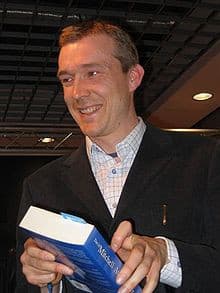
David or Dave Mitchell may refer to:







