“The world is a dangerous place to live; not because of the people who are evil, but because of the people who don't do anything about it.”
— Reflection on moral responsibility in the face of global threats.

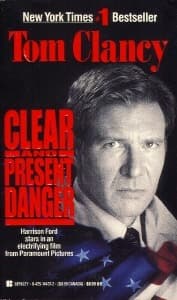
Tom Clancy (1989)
Genre
Thriller / Mystery
Reading Time
15-20 hours
Key Themes
See below
Sign in to track this book
When Colombian drug cartels assassinate the FBI Director, Jack Ryan and the enigmatic Mr. Clark must navigate a shadowy war where the gravest threat might not be the enemy abroad, but the betrayals lurking within their own government.
FBI Director Emil Jacobs is killed in Colombia by drug cartel operatives while on a fishing trip. This act, along with his family's murder, shocks Washington D.C. President Bennett, pressured to act decisively, meets with his top advisors. James Cutter, the President's National Security Advisor, suggests a covert, extra-legal military operation against the cartel. Admiral James Greer, Deputy Director of Intelligence for the CIA, is hesitant because of legal implications but gives his approval, wary of mission creep and the dangers of operating outside established rules. Jack Ryan, a CIA analyst, is brought into these discussions, unaware of the full scope of the secret plans.
Admiral Greer is diagnosed with pancreatic cancer and his condition worsens, leading to his hospitalization. In his absence, Jack Ryan is promoted to Acting Deputy Director of Intelligence (DDI). His first major task is to investigate the Medellín Cartel's financial holdings, especially how their drug money is laundered into the U.S. economy. Ryan, with his finance background, quickly uncovers investments in American businesses and political figures, including a significant amount tied to Robert Ritter, the Deputy Director of Operations at the CIA. This discovery makes Ryan suspicious, suggesting a deeper threat than just the Colombian drug lords.
Ryan does not know that Colonel John Clark, a veteran CIA black operations officer, is tasked by Robert Ritter and James Cutter to lead a covert paramilitary force into Colombia. This force, called 'RECIPROCITY' and made of U.S. Army Rangers, is deployed without official congressional approval or declaration of war, making the entire operation illegal. Their mission is to disrupt the Medellín Cartel's operations by targeting drug processing labs, transportation routes, and personnel. Clark, a skilled operative, begins this mission with precision, using advanced surveillance and intelligence from Ritter, who plans the operation from Washington.
Ernesto Escobedo and fellow drug lord Félix Cortez quickly realize they are under attack by an unseen force. Cortez, a former KGB officer, is good at counter-intelligence. They retaliate by bombing a DEA office in Miami and killing a U.S. ambassador. As these events happen, Ryan, still focused on the financial investigation, becomes suspicious of the intelligence Ritter provides and the lack of transparency in the U.S. response. He notices inconsistencies and a deliberate withholding of information, especially about key cartel figures. His instincts tell him that something more complex and dangerous is happening than he is being told.
Driven by his suspicions, Ryan investigates further. He uses his DDI access to cross-reference intelligence reports and eventually uncovers evidence of the illegal paramilitary operation in Colombia. He finds satellite imagery, decrypted communications, and financial records that point to Colonel Clark's team and their unauthorized activities. Horrified by the disregard for law and potential international problems, Ryan confronts Ritter, demanding answers. Ritter, at first evasive, admits to the operation but tries to justify it as necessary for national security, emphasizing the President's direct involvement and the extreme secrecy.
As the covert operation creates too much risk and potential for exposure, President Bennett and James Cutter decide to cut their losses. They make a secret deal with Félix Cortez, the cartel's intelligence chief, agreeing to exchange intelligence on Clark's team for information on Escobedo's operations and a promise to reduce drug flow. This deal betrays the American soldiers, leaving them stranded and vulnerable. Clark and his team are cut off from support and intelligence; their lives are now expendable to their own government. Ritter, under direct orders, complies with this betrayal, though with internal conflict.
Ryan, now fully aware of the political betrayal, is horrified. He realizes that the U.S. soldiers are being sacrificed for political reasons and that their lives are in danger. With Admiral Greer's health declining and his own career at risk, Ryan acts. He secretly contacts the U.S. Coast Guard and other military assets, trying to gather resources and intelligence for a rescue mission. He also tries to warn Clark, but communication is difficult and dangerous. Ryan's actions come from a strong moral obligation and a refusal to let American soldiers be abandoned by their government.
Cut off from support and hunted by the cartel, Colonel Clark and his second-in-command, Domingo 'Ding' Chavez, realize they have been betrayed. They lead their remaining Rangers in a desperate fight for survival, using their training and knowledge of guerrilla warfare to evade capture and fight their way out of Colombia. They face overwhelming odds, constant pursuit, and the harsh jungle. The team suffers casualties, but Clark's leadership and Chavez's combat skills are important for keeping the unit together and alive, despite their despair and anger at their superiors.
Against great odds and bureaucratic obstruction, Ryan plans a rescue operation. He uses his contacts and a mix of official and unofficial channels to get a small, covert rescue force, including a special operations team, into Colombia. Working with Clark's desperate stand, the rescue team extracts the surviving Rangers. The soldiers are brought back to the U.S., traumatized but alive. The rescue, however, remains unofficial, and the returning soldiers are debriefed under strict secrecy, with their mission's true nature suppressed to prevent a political scandal.
After the soldiers return safely, Ryan decides he cannot let the truth stay hidden. He writes a detailed report about the illegal operation, the political betrayal, and the abandonment of the troops. He leaks this information to the media and gives it to Congress. This exposure causes a large political scandal, leading to congressional hearings, investigations, and public outrage. President Bennett's administration is in disarray, and James Cutter resigns. Ryan's actions, while controversial, are motivated by his commitment to truth and justice, even if it costs his career.
The political fallout from Ryan's revelations is large. President Bennett, facing impeachment, resigns. James Cutter is arrested and charged with crimes related to the illegal operation. Robert Ritter, facing career ruin, cooperates with investigators, giving more details about the conspiracy. While the drug cartels continue to operate, the exposure of the U.S. government's illegal actions forces a reevaluation of foreign policy and covert operations. Jack Ryan, despite scrutiny and criticism, becomes a hero who stood for integrity and the rule of law, solidifying his reputation as a man of principle in the intelligence community.
The Protagonist
Ryan transforms from a desk-bound analyst into a moral crusader, exposing high-level government corruption and evolving into a figure of significant influence within the intelligence community.
The Supporting
Clark, initially a loyal operative following orders, becomes a betrayed soldier fighting for survival, ultimately leading him to question the ethics of his superiors.
The Antagonist/Supporting
Ritter's journey moves from orchestrator of an illegal war to a conflicted figure who ultimately aids in revealing the truth, facing the consequences of his actions.
The Antagonist
President Bennett's arc depicts his descent from a powerful leader to a disgraced figure who resigns to avoid impeachment, highlighting the consequences of abusing power.
The Antagonist
Cutter's arc demonstrates the fall from power of a Machiavellian political manipulator, ultimately facing arrest and charges for his illegal actions.
The Supporting
Greer's arc is cut short by illness, but his legacy and moral guidance continue to influence Ryan's decisions throughout the crisis.
The Antagonist
Escobedo's arc depicts his struggle to maintain power against both U.S. covert action and internal cartel threats, ultimately leading to his downfall.
The Antagonist
Cortez's arc showcases his rise through cunning and betrayal, negotiating with the U.S. government to secure his own position amidst the drug war.
The Supporting
Chavez evolves from a dedicated soldier following orders to a disillusioned survivor, forever marked by the betrayal of his government.
The novel examines how those in the highest levels of government can abuse their power. President Bennett and his National Security Advisor, James Cutter, authorize an illegal covert war in Colombia without congressional approval. This theme is central to the plot, as Ryan's conflict comes from uncovering this executive overreach. The decision to abandon the American soldiers to save the administration from scandal shows how unchecked power can corrupt, demonstrating how political reasons can override moral and legal duties.
“''What in God's name is happening here?' Ryan said softly. 'They're just going to leave them out there?'”
This theme is shown by the contrast between Jack Ryan's strong moral compass and the utilitarian approach of figures like President Bennett and James Cutter. Ryan consistently prioritizes truth, justice, and the lives of American soldiers, even when risking his career and facing political pressure. The administration chooses political reasons, sacrificing legal and ethical principles for short-term gains and to avoid public scandal. The novel explores the difficult choices leaders make and the consequences of compromising one's integrity.
“''I will not be a part of this,' Ryan said, his voice hard. 'I will not let American soldiers be sacrificed for political expediency.'”
The story shows the deception and lack of transparency in covert operations, both for the public and for individuals in government. Jack Ryan is initially kept unaware of the mission's true nature, and the soldiers on the ground are intentionally misled and betrayed. This theme highlights how information is controlled and manipulated to serve political agendas, creating a 'fog' that hides the truth and allows illegal activities. The novel suggests that in such environments, trust is rare and dangerous.
“''It's not just the enemy out there, Jack. Sometimes, it's the enemy in here.'”
The novel explores the vulnerability and sacrifice of soldiers in covert operations, especially when their government abandons them. Colonel Clark and his team of Rangers are trained professionals, but they become pawns in a political game, left to die in a foreign jungle when their mission becomes inconvenient. This theme humanizes the soldiers, showing their courage, loyalty, and the psychological impact of betrayal by their own country. It criticizes the cost of undeclared wars and the moral responsibility of leaders to those they send into harm's way.
“''We were good men, doing our job. And they just left us to rot.'”
While a story about fighting drug cartels, the novel explores the complex and often morally ambiguous nature of the 'War on Drugs.' It shows how pursuing drug lords can lead to illegal covert actions, executive overreach, and the corruption of democratic principles. The assassination of FBI Director Jacobs causes a retaliatory response that escalates into an undeclared war, demonstrating how well-intentioned efforts can spiral out of control and create more problems than they solve, blurring the lines between justice and revenge.
“''When does a criminal act become an act of war?'”
Alternating viewpoints between Washington D.C. and Colombia.
The novel employs a dual perspective narrative, primarily alternating between Jack Ryan's investigation in Washington D.C. and Colonel John Clark's covert operation in Colombia. This device allows the reader to simultaneously experience the high-level political machinations and the brutal ground-level reality of the secret war. It effectively builds suspense and highlights the vast disconnect between the decision-makers and the soldiers carrying out their orders, emphasizing the ethical chasm that develops between them.
Crucial evidence revealing the illegal operation.
The 'smoking gun' document, in this case, is the collection of intelligence, financial records, and satellite imagery that Jack Ryan meticulously uncovers, proving the existence and illegality of Operation RECIPROCITY. This device is critical to the plot as it provides irrefutable proof of the administration's malfeasance, enabling Ryan to confront Ritter and eventually expose the entire scandal to the public. It serves as the tangible evidence that transforms Ryan's suspicions into undeniable facts.
The abandonment of U.S. soldiers by their own government.
This plot device is the central turning point and moral outrage of the novel. The decision by President Bennett and James Cutter to cut a deal with Félix Cortez, sacrificing the lives of John Clark and his Rangers to save their own political careers, drives the latter half of the story. It elevates the conflict beyond a simple war on drugs to a profound ethical dilemma, forcing Jack Ryan to take extreme measures to expose the truth and rescue the abandoned soldiers. This betrayal underscores the novel's themes of moral integrity versus political expediency.
Admiral Greer's illness as a catalyst for Ryan's growth.
Admiral James Greer's severe illness and eventual death serve as a significant plot device. His absence from the CIA leadership creates the vacuum that necessitates Jack Ryan's promotion to Acting DDI. More importantly, it removes Ryan's primary institutional buffer and moral guide, forcing him to rely solely on his own judgment and integrity when confronting the illegal covert operation. Greer's deteriorating health also provides a ticking clock, as Ryan feels compelled to act before his mentor's final decline.
“The world is a dangerous place to live; not because of the people who are evil, but because of the people who don't do anything about it.”
— Reflection on moral responsibility in the face of global threats.
“The difference between a democracy and a dictatorship is that in a democracy you vote first and take orders later; in a dictatorship you don't have to waste your time voting.”
— A cynical observation about political systems.
“You don't have to be a genius to see that the world is full of complicated problems.”
— Comment on the complexity of international affairs.
“The first casualty when war comes is truth.”
— A statement about the erosion of honesty during conflict.
“It's not the size of the dog in the fight, it's the size of the fight in the dog.”
— Emphasizing determination over resources.
“The only thing necessary for the triumph of evil is for good men to do nothing.”
— A call to action against injustice.
“In politics, nothing happens by accident. If it happens, you can bet it was planned that way.”
— A view on the intentionality behind political events.
“The price of freedom is eternal vigilance.”
— Highlighting the constant effort required to maintain liberty.
“War does not determine who is right—only who is left.”
— A grim assessment of the outcomes of conflict.
“The greatest enemy of knowledge is not ignorance, it is the illusion of knowledge.”
— Warning against overconfidence in understanding.
“Power tends to corrupt, and absolute power corrupts absolutely.”
— A cautionary note on the dangers of unchecked authority.
“The only way to deal with an unfree world is to become so absolutely free that your very existence is an act of rebellion.”
— Advocating for personal freedom as resistance.
“In the end, we will remember not the words of our enemies, but the silence of our friends.”
— Reflecting on the impact of inaction from allies.
“The truth is rarely pure and never simple.”
— Commenting on the complexity of reality.
Ready to see how well you understood this book? Take our interactive quiz with 10 questions.

Biography coming soon.







