“The hardest part of saying goodbye to someone is that you don't actually get to say goodbye. You just have to live with the fact that they're gone.”
— After discovering her father's death and the secret family, Yahaira reflects on grief.

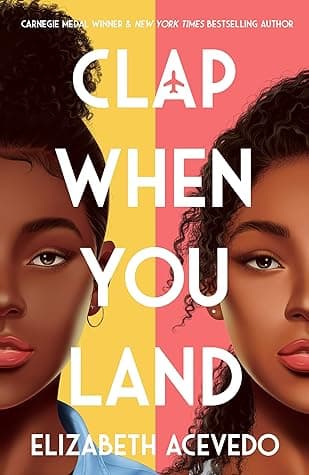
Elizabeth Acevedo (2020)
Genre
Young Adult
Reading Time
240 min
Key Themes
See below
Sign in to track this book
Two sisters, unknowingly separated by an ocean and their father's secret life, are brought together by his sudden death, forcing them to navigate grief, betrayal, and the complex, newfound bond that reshapes their futures.
Camino Rios, seventeen, in the Dominican Republic, waits for her father, Papi, who visits every summer from New York City. She goes to the airport with her aunt, Tía Caridad, but instead of Papi, they find crying people and news of a plane crash. In New York City, Yahaira Rios, also seventeen, is called to her principal's office where her mother, Mami, delivers the news: Papi's plane, Flight 157, has crashed, killing everyone. Both girls deal with the immediate shock and grief, their worlds shattering as the reality of their father's death sets in, ending their routines and expectations.
As Yahaira grieves Papi, she notices her mother's odd behavior and a hidden envelope with a second passport. It shows a different photo of Papi, with a young girl. Overwhelmed, Yahaira tells her girlfriend, Dre, who helps her piece together the truth: Papi had another family in the Dominican Republic. Yahaira's grief mixes with a deep sense of betrayal and anger, realizing his frequent 'business trips' were visits to his other daughter and life. This discovery complicates her mourning, forcing her to confront a hidden part of her seemingly perfect father.
In the Dominican Republic, Camino's grief is made worse by money worries. Papi was her main financial support, and his death puts her future, especially her dream of studying medicine, at risk. She also becomes aware of El Cero, an older man who preys on young girls in the community. With Papi gone, Camino feels more exposed and vulnerable, especially after El Cero makes an unwanted advance. Tía Caridad tries to protect her, but Camino realizes she must find a way to secure her future and safety.
A large memorial service is held in New York for the victims of Flight 157, attended by Yahaira and her mother. The event is a sad public display of grief, yet for Yahaira, it is also a public front, as she deals privately with the knowledge of Papi's secret. Later, needing answers and to claim Papi's remains, Yahaira and her mother travel to the Dominican Republic. This journey is full of tension and unspoken truths, as Yahaira knows she is about to meet the other family, while her mother is still reeling from the betrayal and the public exposure of Papi's double life.
Yahaira, her mother, and Camino, with Tía Caridad, all meet at the memorial near the plane crash site. Here, the two sisters, Camino and Yahaira, see each other for the first time. The meeting is emotional, a silent acknowledgment of their shared father and the devastating secret he kept. There is a mix of curiosity, resentment, and a strange familiarity between them. The moment is awkward and painful, as they stand amidst the wreckage and grief, forced to confront the living proof of Papi's deception and their unexpected family bond.
Camino and Yahaira begin to interact cautiously, first through glances and then conversations. They find similarities in their personalities and experiences with Papi, but also differences in their lives and expectations. Their mothers, however, remain hostile towards each other, their grief made worse by anger and betrayal. This animosity makes it hard for the girls to connect openly, forcing them to build their budding sisterhood in secret or in brief moments, all while processing their individual and collective grief for their father.
El Cero's unwanted attention towards Camino worsens from unsettling glances to direct, threatening advances. He follows her, makes inappropriate comments, and tries to touch her, making Camino feel unsafe in her community. His presence darkens her life, increasing her vulnerability now that Papi is not there to protect her. Camino is scared but determined not to let him ruin her dreams, realizing she needs to find a way to escape him and secure her future away from the island.
As the sisters spend more time together, Yahaira learns about Camino's dreams of studying medicine and her difficult situation with El Cero. Seeing Camino's intelligence and potential, Yahaira offers to help her come to New York. This offer becomes hope for Camino, a chance to escape her circumstances and pursue her dreams. Through their talks, they also share stories and memories of Papi, starting to form a more complete, though complex, picture of their father, finding comfort and connection in their shared experiences.
When El Cero's harassment of Camino reaches a peak, Tía Caridad, who has always been protective, steps in with fierce determination. Yahaira, seeing the threat, also stands up for her sister, showing a new protective instinct. Together, they confront El Cero, making it clear that Camino is not alone and will not be an easy target. This confrontation is a key moment, asserting Camino's safety and strengthening the bond between the three women, showing El Cero that Camino now has strong support.
After much tension, the mothers, Yahaira's Mami and Tía Caridad, begin a slow, painful process of reconciliation. They understand that their daughters' bond is more important than their individual resentments. With the help of the extended family, arrangements are made for Camino to move to New York. The sisters share an emotional farewell with Tía Caridad, who has been Camino's support. Camino leaves the Dominican Republic, carrying her grief, her dreams, and the promise of a new life with her newfound sister, marking a bittersweet end to one chapter and a hopeful start to another.
Camino arrives in New York and begins to adjust to her new life with Yahaira and her mother. The transition is challenging, with cultural differences and the lingering absence of Papi. However, with Yahaira's support, Camino enrolls in school and starts her academic goals. The sisters learn to live together, navigating their shared history and forming a deeper bond. Yahaira's mother, still dealing with her own pain, slowly opens her heart to Camino, recognizing her as family and a part of Papi's legacy, solidifying their new, unconventional family unit.
The Protagonist
Camino transforms from a vulnerable, dependent girl to a strong, independent young woman who finds her voice and secures her future by embracing her sister and moving to New York.
The Protagonist
Yahaira moves from a state of shock and betrayal to understanding and forgiveness, ultimately embracing her new sister and redefining her concept of family.
The Central Figure (Deceased)
Papi's character arc is posthumous; his death forces his loved ones to reconcile the man they knew with the man he truly was, leading to a re-evaluation of his legacy.
The Supporting
Tía Caridad evolves from a protective, somewhat resigned figure to an active advocate for Camino's future, ultimately accepting Yahaira and her mother into their family.
The Supporting
Mami's arc is one of profound grief and betrayal, moving towards a difficult but ultimately redemptive path of forgiveness and acceptance of her new, expanded family.
The Supporting
Dre remains a consistent source of support, representing unconditional love and a safe haven for Yahaira throughout her emotional turmoil.
The Antagonist
El Cero remains a static antagonist, serving as a significant external threat that Camino and her new family must overcome.
The novel explores grief after Papi's sudden death. Both Camino and Yahaira experience shock, sadness, and confusion, but their situations shape their mourning. Camino's grief is tied to money worries and vulnerability (e.g., facing El Cero's advances), while Yahaira's is complicated by betrayal and anger after discovering Papi's double life. The book shows that grief is not linear and can be made worse by unresolved issues, forcing characters to confront the complexities of the person they lost. The memorial services and the journey to the crash site also show communal and individual expressions of loss.
“Grief is a house / with no doors or windows. / It swallows you whole. / It is the ocean after a storm. / It is a plane crash.”
Papi's double life is the central secret, causing deep feelings of betrayal for both his daughters and his wife. Yahaira struggles with the shattering of her idealized image of her father, feeling his love was a lie (e.g., finding the second passport). Camino, while not directly betrayed by the secret of a second family, feels betrayed by the uncertainty of her future once Papi's support is gone. The book explores how hidden truths damage relationships and identity, and the difficult process of reconciling love with deception. The tension between the mothers shows the deep wound of betrayal.
“How can a man / be a hero / and a liar / at the same time?”
Despite the painful circumstances of their meeting, Camino and Yahaira form a strong sisterly bond that goes beyond Papi's betrayal. Their connection is built on shared grief, a mutual desire to understand their father, and a growing appreciation for each other's strengths. Initially strangers, they become each other's support system, with Yahaira offering Camino a path to a better future and Camino offering Yahaira a deeper understanding of their father's life. This theme shows that family can be redefined and chosen, and that strong connections can emerge from unexpected places, healing past wounds.
“We are two halves / of a whole, / split by an ocean, / brought back together / by a plane crash.”
Both Camino and Yahaira deal with their identities, shaped by their different upbringings and the sudden changes in their lives. Camino's identity is tied to her Dominican roots and her dreams for a medical career, but Papi's death and El Cero's threats challenge her sense of safety and belonging. Yahaira, a New Yorker, questions her identity as 'Papi's girl' after discovering his secrets, feeling disoriented. Their journey of meeting and integrating their lives makes them reconsider who they are, where they belong, and how they define family, finding a new sense of self through their shared sisterhood.
“How do you mourn a man / you thought you knew?”
The novel highlights the vulnerability of young women, especially Camino, who lives in a community where predatory figures like El Cero exist. Papi's death leaves Camino exposed and without her main protector, forcing her to confront dangers alone. This theme shows the importance of community, family, and self-advocacy in protecting one's well-being. Yahaira's eventual protectiveness towards Camino, and Tía Caridad's strong support, demonstrate how collective action and family bonds can offer protection against external threats and exploitation.
“Some men / are born with a hunger / for what isn't theirs.”
Alternating first-person perspectives in free verse.
The novel is told through alternating first-person perspectives of Camino and Yahaira, each chapter written in free verse. This device allows readers intimate access to the distinct emotional landscapes and internal monologues of both sisters. The verse format enhances the emotional impact, making the girls' grief, anger, and eventual connection feel immediate and raw. It also allows for concise, poetic language that captures complex feelings and imagery, effectively contrasting their separate lives and then intertwining them as the plot unfolds, mirroring their eventual convergence.
Represents separation, connection, cleansing, and danger.
The ocean serves as a powerful and recurring symbol throughout the novel. Initially, it represents the vast distance and separation between Camino and Yahaira, and between Papi's two lives. The plane crash itself occurs over water, making the ocean a site of tragedy and loss. However, it also symbolizes connection, as both girls are drawn to it, and later, the ocean becomes a space for reflection and healing. For Camino, it represents both the beauty of her home and the unknown dangers (like El Cero) that lurk beneath the surface, while for Yahaira, it symbolizes the journey to discover her other family.
A tangible object revealing Papi's secret life.
The discovery of Papi's second passport, with a different picture and details, is the concrete plot device that shatters Yahaira's world and reveals Papi's hidden family. It serves as irrefutable evidence of his deception, moving the plot from grief to investigation and betrayal. This physical object acts as a powerful catalyst, propelling Yahaira to seek answers and ultimately leading to the sisters' meeting. It represents the tangible manifestation of a secret that can no longer be contained, forcing a confrontation with the truth.
A metaphor for Yahaira's identity, expression, and connection to Papi.
Yahaira's bass guitar is more than just an instrument; it's deeply intertwined with her identity and her relationship with Papi, who encouraged her musical talent. When Papi dies, Yahaira struggles to play, symbolizing her shattered world and her inability to express herself amidst her grief and anger. As she begins to heal and connect with Camino, her ability to play returns, representing her process of finding her voice again and reconciling with Papi's complex legacy. Music becomes a powerful outlet for her emotions and a way to honor parts of her father's memory.
“The hardest part of saying goodbye to someone is that you don't actually get to say goodbye. You just have to live with the fact that they're gone.”
— After discovering her father's death and the secret family, Yahaira reflects on grief.
“There are some things that, once broken, can't ever be put back together the same way. And maybe that's okay. Maybe they're stronger, different, better for having been broken.”
— Camino ponders the aftermath of her father's death and the revelations.
“We are not meant to be alone. We are meant to find our people, our tribe, the ones who see us for who we are and love us anyway.”
— Yahaira thinks about the importance of family and belonging, especially after meeting Camino.
“A secret is a knot, and the tighter you pull it, the more it chokes you.”
— Camino reflects on the burden of her father's secrets and the impact on her mother.
“You can't choose your family, but you can choose how you let them affect you.”
— Yahaira struggles with her feelings towards her father after learning about his double life.
“Sometimes the most honest thing you can do is just admit you don't know.”
— Camino grapples with the complexities of her father's life and her own future.
“Grief is a tricky thing. It doesn't always come when you expect it, and it doesn't always leave when you want it to.”
— Both Yahaira and Camino experience waves of grief at different times.
“Home isn't always a place. Sometimes it's a person. Sometimes it's a feeling.”
— Yahaira travels to the Dominican Republic and finds a new sense of home with Camino.
“There's a difference between forgiving and forgetting. You can forgive someone without ever forgetting what they did.”
— The girls' mothers discuss the possibility of moving forward after their shared loss.
“When you're a girl, you learn quickly that your body isn't always your own.”
— Camino faces objectification and the dangers of being a young woman in her community.
“Sometimes the truth is a jagged thing, and it cuts everyone who touches it.”
— The reveal of the father's secret causes pain for both families.
“We were two halves of a whole, just separated by an ocean, by a secret, by a lie.”
— Yahaira reflects on her newfound sisterly bond with Camino.
“It's a strange thing, to mourn someone you thought you knew, only to realize you didn't know them at all.”
— Both sisters grapple with their father's dual identity after his death.
“The world doesn't stop just because your heart breaks.”
— Yahaira and Camino must continue living their lives despite their profound loss and discoveries.
Ready to see how well you understood this book? Take our interactive quiz with 10 questions.

Biography coming soon.