“When you’re a kid, you think you’ll always have your parents. You don’t think about them dying. Then, one day, it hits you. They’re going to go.”
— Lev and Kolya discuss their parents during a cold night.

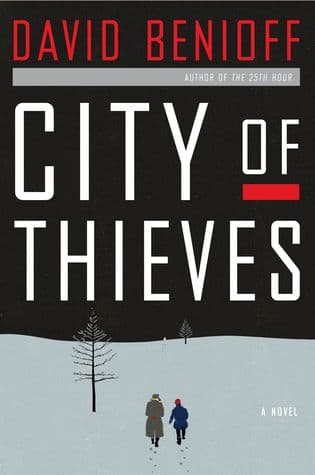
David Benioff (2008)
Genre
Historical Fiction
Reading Time
360 min
Key Themes
See below
Sign in to track this book
In besieged Leningrad, two friends go on a dangerous quest for a dozen eggs, finding courage and friendship in the face of death.
In January 1942, during the siege of Leningrad, seventeen-year-old Lev Beniov is caught looting a dead German paratrooper for a cigarette and arrested by the NKVD. He is put in a cell with Kolya, a charming Red Army deserter. Instead of execution, the two are brought before Colonel Grechko. Grechko tells them his daughter is getting married in five days and wants them to find a dozen eggs for her wedding cake. Failure means execution; success means a reprieve. This task sends them on a desperate search through the frozen, starving city.
Lev and Kolya are released with a small amount of money and a permit. Their first lead takes them to the Vasilevsky Island market, a black market center, but they find no eggs. They meet starving girls who tell them about a cooperative where eggs might be found. The cooperative, however, has none. Kolya, always clever, suggests they look for chickens, believing that where there are chickens, there must be eggs. Their search is dangerous, with hunger, freezing temperatures, and the constant threat of German shelling and Soviet authorities.
Following a rumor, Lev and Kolya go into a district known for its black market and meet a cannibal. They barely escape a terrifying encounter, showing the extreme desperation in Leningrad. Later, they visit a building where a chess club is said to be, hoping to find someone with food connections. They meet an old chess master who, after a game, gives them a clue about a possible source of eggs in a village outside the city, beyond German lines. This clue points them toward an even more dangerous journey.
With the chess master's vague directions, Lev and Kolya decide to risk crossing the front lines into German-occupied land, believing it is their only chance to find eggs. They face dangers, navigating minefields, avoiding German patrols, and enduring the brutal cold. Kolya's quick thinking and charm, along with Lev's growing courage, help them survive close calls. This journey tests them and strengthens their bond, forcing them to rely on each other for survival in a hostile area.
Deep in German territory, Lev and Kolya find a group of Soviet partisans hiding in the woods. They are held captive and questioned. The partisan leader is a tough woman named Vika, who is also looking for eggs for her own reasons – to trade for penicillin for her wounded comrades. Vika is doubtful of their story but agrees to help them, seeing their shared desperation and common enemy. She gives them some food and a plan, but also warns them of dangers ahead.
Vika leads Lev and Kolya to a German-occupied barn said to have chickens. Under cover of darkness, they plan their entry. The mission is tense as they move past German guards. Inside the barn, they find chickens and a sleeping German soldier. Kolya, despite the danger, manages to catch several chickens. They quickly leave, barely avoiding detection, with the chickens, which are their best hope for getting eggs.
After getting the chickens, Vika, Lev, and Kolya return to the partisan hideout. They share a meal, cooking one of the chickens. Vika tells them more about her past and reasons for fighting, showing the harsh realities of war. She then gives Lev and Kolya some of the captured chickens, enough to trade for eggs, and directions back to Leningrad, leaving them to continue her own fight. Her help gives Lev and Kolya hope, but they still face a difficult journey.
With the chickens, Lev and Kolya begin their journey back to Leningrad. They face the same dangers as before – freezing temperatures, enemy patrols, and hunger. Their bond grows as they move through the difficult land, relying on each other for morale and survival. They eventually cross back over the front lines, entering the edge of the besieged city, tired but determined to finish their mission. The chickens, though alive, are a heavy burden, and their value is huge.
Upon returning to Leningrad, Lev and Kolya look for a source for eggs. They find an old woman who runs a small, illegal operation. They try to trade their chickens for the dozen eggs needed. The woman, seeing their desperation, drives a hard bargain. Kolya, using his charm, negotiates the trade. However, the eggs turn out to be rotten, a cruel trick in the desperate world of the siege. This problem is devastating, pushing them to despair as their deadline nears.
After the rotten eggs, Lev and Kolya have no options. Defeated and out of time, they decide to return to Colonel Grechko, ready to face execution. They arrive at his office, empty-handed, and admit their failure. Grechko, seeing their effort and perhaps moved by their situation, or finding the whole thing absurd, makes an unexpected decision. He reveals that his daughter’s wedding was a trick; he simply wanted eggs. He commutes their sentence, acknowledging their survival against odds, and releases them from their task.
After their release, Lev and Kolya remain friends. Kolya continues to use his wit and charm to survive, becoming a successful playwright. Lev, changed by his experiences, becomes a writer, telling the stories of those who endured the siege. Their friendship, formed in war and an absurd mission, lasts for decades. The narrator, Lev's grandson, says Lev never forgot Kolya, often sharing stories of their adventures, showing the lasting effect of their shared experience and the strength of their bond. The story ends with a thought on survival, memory, and human connection during suffering.
The Protagonist
Transforms from a sheltered, fearful boy into a hardened but compassionate survivor and storyteller.
The Protagonist/Supporting
Remains largely consistent in his resourceful and cynical nature, but his bond with Lev reveals a deeper capacity for loyalty and care.
The Antagonist/Supporting
Initially appears as a ruthless authority figure, but ultimately displays a pragmatic and somewhat whimsical mercy.
The Supporting
A strong, independent character whose brief but impactful presence guides the protagonists.
The Supporting
A static character who serves as a brief but pivotal source of information.
The Mentioned
Serves as the present-day voice, reflecting on the past and the legacy of his grandfather's experiences.
The Mentioned
A static, symbolic character representing the brutal realities of the siege.
The Mentioned
A static, unseen character whose supposed needs drive the plot.
The novel shows the extreme conditions of the Siege of Leningrad, where survival is the only goal for its people. Lev and Kolya's quest for a dozen eggs, a normal task in peacetime, becomes a matter of life and death, showing how far people will go to endure. The constant hunger, cold, and threat of violence (from both enemy and citizens) show how fragile life is and the basic instincts that appear under pressure, as seen with the cannibal and harsh black market exchanges.
“Hunger makes men do things they wouldn't dream of doing under normal circumstances.”
At its core, 'City of Thieves' is a story about the bond formed between Lev and Kolya. Despite their different personalities – Lev's innocence versus Kolya's cynicism – their shared experience creates a strong friendship. They rely on each other for survival, emotional support, and morale. Kolya's wit often keeps Lev from despair, while Lev's steadiness provides a grounding influence. This relationship is a sign of humanity in the brutal setting of war, showing how connection can keep hope alive.
“We were a team, now. Partners in crime. And, I realized, for the first time in a long time, I wasn't alone.”
Lev Beniov's journey is a coming-of-age story set against the backdrop of war. At seventeen, he goes from innocence into a world of horrors. His experiences, from looting a corpse to crossing enemy lines and facing death, force him to confront the realities of life and war. He learns to be brave, resourceful, and morally flexible, losing his youthful innocence but gaining an understanding of human nature and resilience. His change is central to the story, shaping him into the man who will tell this story.
“I was no longer a boy. The siege had seen to that.”
The novel shows the absurdity of war through its central idea: two men risking their lives for a dozen eggs for a wedding cake. This small mission contrasts with the dangers and suffering they endure, showing the random nature of life and death in wartime. Colonel Grechko's real reason for the eggs further shows this absurdity, revealing a personal desire hidden as a military order. The humor, often dark, in Kolya's dialogue also shows the illogical aspects of their grim reality.
“A dozen eggs. For a wedding cake. In the middle of the greatest siege in history.”
The story is told by Lev's grandson, meaning the whole story is a memory passed down. This shows the importance of storytelling to preserve history, honor those who suffered, and make sense of traumatic events. Lev himself is a writer, and his journey helps him become a storyteller. Telling the past, especially difficult truths, becomes a way to face trauma and ensure the human experience of the siege is remembered.
“My grandfather told me this story more than once. Sometimes, he’d embellish a little. But the core of it, the truth of it, remained.”
The story is presented as a recollection told by Lev's grandson.
The entire novel is framed by the narrator, Lev Beniov's grandson, who recounts his grandfather's experiences during the Siege of Leningrad. This device adds a layer of reflection and historical distance, allowing for commentary on memory, the nature of storytelling, and the enduring impact of wartime trauma. It also lends an intimate, personal touch to the historical events, making the grand narrative of the siege feel more immediate and human through the lens of one family's history.
The seemingly trivial object that drives the entire plot.
The dozen eggs serve as the primary MacGuffin in 'City of Thieves.' They are the object that Lev and Kolya must acquire to save their lives, but their inherent value to the plot is less about the eggs themselves and more about the journey and character development they inspire. The absurdity of risking life and limb for such a mundane item in the midst of a brutal siege highlights the novel's themes of survival, desperation, and the absurdity of war. The revelation that Grechko merely craved them further solidifies their role as a plot device rather than an object of intrinsic importance.
The contrasting personalities of the protagonists highlight each other's traits.
Lev and Kolya function as classic foil characters. Lev is intellectual, initially timid, and reflective, representing a more internal struggle. Kolya, in contrast, is street-smart, cynical, charming, and action-oriented, providing the external drive and comic relief. Their contrasting personalities create dynamic dialogue and highlight each other's strengths and weaknesses, making their bond more compelling. Kolya's pragmatism often pushes Lev out of his comfort zone, while Lev's moral compass provides a counterpoint to Kolya's more opportunistic tendencies.
Ironic and cynical humor used to cope with extreme suffering.
Dark humor is a pervasive plot device, primarily employed through Kolya's dialogue and the overall tone of the narrative. It serves as a coping mechanism for the characters and a way for the author to explore the grim realities of the siege without succumbing to unrelenting despair. The jokes about starvation, death, and the absurdity of their mission create a sense of gallows humor that humanizes the characters and makes their terrifying experiences more palatable, while still emphasizing the horror they face. It's a key element in the novel's unique voice.
“When you’re a kid, you think you’ll always have your parents. You don’t think about them dying. Then, one day, it hits you. They’re going to go.”
— Lev and Kolya discuss their parents during a cold night.
“A good story is a dream shared by the author and the reader.”
— Kolya, an aspiring writer, shares his philosophy on storytelling.
“Courage is not the absence of fear, but rather the assessment that something else is more important than fear.”
— Lev reflects on his own bravery and the nature of courage.
“In a city of starving people, it’s not hard to find a thief. It’s hard to find an honest man.”
— Lev observes the desperate conditions in besieged Leningrad.
“The secret to happiness, I’d discovered, was to get used to the things you weren’t going to get.”
— Lev's somber realization about managing expectations in dire circumstances.
“You can always find something to laugh at, even in the darkest times.”
— Kolya often tries to lighten the mood with humor, even in grim situations.
“A man without a story is like a man without a country.”
— Kolya emphasizes the importance of personal narratives and identity.
“There are no atheists in foxholes, they say. And in the siege of Leningrad, there were no atheists anywhere.”
— Lev notes the pervasive desperation and search for faith during the siege.
“The living envy the dead. The dead envy no one.”
— Lev contemplates the suffering of the living compared to the peace of the dead.
“Even in the coldest winter, the human heart can burn.”
— A reflection on the enduring spirit and warmth of human connection.
“Sometimes you have to do bad things to survive. That doesn't make you a bad person.”
— Lev's internal struggle with the moral compromises necessary for survival.
“Books are the only proof that humans can work magic.”
— Kolya expresses his deep love and reverence for literature.
“We are all just stories in the end, make sure yours is a good one.”
— A final thought on legacy and the impact of one's life story.
Ready to see how well you understood this book? Take our interactive quiz with 10 questions.

David Benioff is a novelist and screenwriter, best known as the co-creator of the acclaimed HBO series "Game of Thrones." His debut novel, "The 25th Hour," was published in 2000, followed by "City of Thieves" in 2008, a historical fiction novel set during the Siege of Leningrad. Benioff's work often explores dark themes and complex characters.







