“At some point in a woman's life, she just gets tired of being ashamed all the time. After that, she is free to become whoever she truly is.”
— Vivian reflects on her personal growth and liberation from societal expectations.

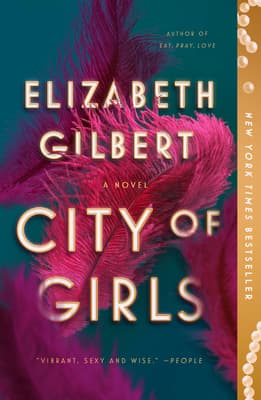
Elizabeth Gilbert (2019)
Genre
Historical Fiction / Romance
Reading Time
500 min
Key Themes
See below
Sign in to track this book
In 1940s New York City, a young woman's theatrical awakening leads her to a life of pleasure, self-discovery, and unconventional love, told from her ninety-five-year-old perspective.
In 1940, nineteen-year-old Vivian Morris is expelled from Vassar College for poor grades. Her wealthy parents, unsure what to do, send her to New York City to live with her Aunt Peg, who owns the Lily Playhouse, a rundown but charming burlesque theater. Vivian, a talented seamstress, starts working in the costume department. She quickly becomes friends with the showgirls, including Celia Ray and Marjorie. Aunt Peg introduces Vivian to the theater's characters, including stage manager Olive, actor Arthur Watson, and Arthur's wife, actress Edna Watson. Vivian is immediately drawn to the theater's free atmosphere, a contrast to her sheltered upbringing.
Vivian, Celia, and Marjorie fully enjoy the life at the Lily Playhouse and in New York City. They spend their nights at bars, dancing, and having casual relationships. Vivian, losing her shyness, discovers her sexuality and enjoys her new freedom. Aunt Peg largely allows the girls' personal lives, encouraging them to experience life. Vivian's skill at sewing makes her important in the costume shop, where she creates outfits for the showgirls. Her days are full of creative work, and her nights with social events, as she navigates friendships and fleeting romances in the theater scene.
Aunt Peg decides to change the Lily Playhouse's shows beyond burlesque, bringing in director Billy Schake to produce a more theatrical show called 'Paradise Follies.' This new production needs more elaborate costumes, which Vivian designs and creates. Billy Schake's arrival brings professionalism and artistic ambition to the theater, but also new personalities and pressures. The showgirls, including Celia and Marjorie, are excited by the idea of a more important production. During this time, Vivian becomes close with Billy Schake, finding his artistic vision and free spirit appealing. The atmosphere at the Lily Playhouse becomes more focused as opening night approaches, while keeping its sense of friendship and unconventional spirit.
Vivian begins an affair with Arthur Watson, the lead actor and husband of Edna Watson. Their secret relationship grows during 'Paradise Follies' rehearsals. The affair is found out when Edna sees them backstage and publicly shames Vivian and Arthur. The scandal happens on opening night, overshadowing the production and bringing bad media attention to the Lily Playhouse. The public reaction and career damage are severe, leading to the closure of 'Paradise Follies' and a big financial and reputation loss for Aunt Peg's theater. Devastated and ashamed, Vivian has to leave New York City and return to her parents' home, her new life suddenly ended.
After the scandal, Vivian goes back to her parents' home, where she lives a quiet, lonely life for several years. She helps her father in his dental practice, a far cry from the glittering theater world. During this time, she deals with the shame and regret of her actions, especially the pain she caused Edna Watson and the damage to Aunt Peg's theater. This time away makes Vivian think about her youth and the sudden end to her carefree life. She misses the freedom of New York but understands she must face the results of her recklessness before she can move on.
With World War II starting, Vivian sees a chance to return to New York City and help with the war. She gets a job designing uniforms for women in the military, using her sewing and design skills. This work gives her purpose and allows her to settle back into the city, though in a more serious way. She lives simply, often alone, and focuses on her work. This time changes Vivian's life, as she moves from seeking pleasure to a more meaningful and disciplined existence, finding satisfaction in her contributions during a national crisis. She still occasionally sees Aunt Peg, but the old theater world is mostly behind her.
While designing uniforms, Vivian reconnects with Frank, a kind serviceman she had met years earlier at the Lily Playhouse. Frank, a man of quiet honesty and empathy, offers a different kind of love than Vivian had known. Their relationship grows slowly, built on mutual respect and understanding rather than quick passion. Frank knows about Vivian's past scandal but accepts her without judgment, giving her security and companionship. Their connection is deep, marked by emotional closeness and a shared understanding of life's challenges. This relationship becomes the most important love of Vivian's life, though it does not fit common expectations.
As World War II ends, Vivian and Frank continue their unconventional relationship. They never marry or live together in the usual way, but their bond stays strong and central to both their lives. Frank, a pilot, often travels, but their connection lasts through letters and regular meetings. Vivian continues to work as a seamstress and costume designer, eventually opening her own successful bridal shop. She finds happiness in her independent life, with her deep and lasting love for Frank. This time shows Vivian fully embracing her independence, making choices that fit her desires rather than societal expectations, and finding happiness in a life that is uniquely her own, free from shame and full of quiet joy.
Decades later, when Vivian is in her nineties, she gets a letter from a woman named Angela. Angela explains that her mother, Frank's wife, has recently died, and among her mother's things, she found letters from Vivian to Frank. Angela's letter asks about Vivian's relationship with Frank. This confirms what Vivian had always known: Frank had a secret, parallel life with a wife and family. The letter makes Vivian face the full truth of her unconventional love story, causing her to write down her life's story for Angela, explaining her past and her lasting love for Frank.
In her old age, Vivian tells her life story to Angela, detailing her youthful adventures, the scandal, her wartime service, and her love for Frank. She explains that while she knew Frank had a wife, she chose to accept their unique arrangement, valuing their deep connection over societal norms. Vivian says she has no regrets about her past, stating that life should be lived fully and without shame. She stresses the importance of female independence, pleasure, and the freedom to define one's own happiness. Her story shows a life lived on her own terms, offering Angela a message about self-acceptance, unconventional love, and the lasting joy of a life fully embraced.
The Protagonist
Vivian evolves from a sheltered, pleasure-seeking youth into a wise, self-possessed woman who lives life on her own terms, free from societal expectations and shame.
The Supporting
She remains a steady, guiding force for Vivian, demonstrating resilience and unwavering support for her chosen family.
The Supporting
Celia remains largely consistent in her pursuit of pleasure and freedom, serving as a foil and confidante for Vivian's early experiences.
The Supporting
Arthur's role is primarily as a catalyst for Vivian's downfall and subsequent growth, showing little personal development beyond his initial charm.
The Supporting
Edna is a catalyst for Vivian's period of exile and reflection, representing the societal judgment Vivian must overcome.
The Supporting
Frank's consistent love and acceptance provide Vivian with stability and the freedom to be her authentic self, without requiring her to conform to traditional expectations.
The Supporting
Billy serves as a catalyst for the 'Paradise Follies' production and a brief romantic interest for Vivian, representing a specific phase of her artistic and romantic awakening.
The Supporting
Olive remains a consistent and reliable figure, representing the steadfastness and dedication within the theatrical community.
The Mentioned
Angela's role is primarily as a narrative device to initiate Vivian's retrospective storytelling.
The novel explores female sexuality, especially in the 1940s, through Vivian's open enjoyment of pleasure and casual sexual encounters. Vivian's journey rejects societal shame around female desire. She ends up living a life defined by her own choices, including her unconventional relationship with Frank. The book supports a woman's right to define her own pleasure and independence, freeing herself from guilt and outside judgment, as seen in Vivian's later thoughts on being 'tired of being ashamed.'
“At some point in a woman's life, she just gets tired of being ashamed all the time. After that, she is free to become whoever she truly is.”
The book shows a complex view of love, going beyond traditional romantic ideas. Vivian experiences brief passions, the strong intensity of an affair, and then a deep, unconventional, lasting love with Frank. Their relationship, marked by acceptance, emotional closeness, and independence rather than marriage, challenges societal norms. The novel suggests that true love can appear in many forms, prioritizing real connection and understanding over traditional structures, and that a 'great love' does not always fit into neat categories.
“There is a difference between a man who wants to sleep with you, and a man who wants to sleep with you and then spend the entire next day with you, talking and laughing. If a man wants the latter, then you've got something there.”
Vivian's journey is about finding herself, from a naive Vassar dropout to a self-assured, elderly woman. Her first time in the Lily Playhouse helps her leave her sheltered past and explore her desires. The scandal forces her to think deeply, leading to a more mature understanding of herself and her values. By the end, Vivian fully accepts her true self, not needing outside approval. Her story shows the continuous growth of identity and the courage needed to live honestly.
“I was never a wife or a mother. I was a girl, then a woman, who loved her life, and who made mistakes, and who found her own way through it all.”
The novel is structured as Vivian's look back at her life, written for Angela. This act of storytelling is not just a recounting of events but a way to understand her past, own her story, and share wisdom. Vivian's memory, though decades old, is clear and detailed, showing how personal history shapes identity and understanding. Sharing her story is a statement of her truth and a final act of freedom from any remaining shame, turning her experiences into a legacy.
“When you get to be my age, you will understand that there is no such thing as a moral or immoral life. There is only a life.”
The Lily Playhouse is Vivian's first entry into a lively, unconventional world. This free lifestyle, with artistic freedom, casual sex, and late-night fun, offers excitement but also has risks, as seen in the scandal that affects Vivian's early life. The novel shows the appeal of living outside societal norms, celebrating its creativity and freedom, while also recognizing its potential for recklessness and the harsh consequences that can follow when those norms are broken.
“The theater was my education, my family, and my undoing. And it was everything.”
The entire story is presented as a letter from an elderly Vivian to Angela, Frank's step-daughter.
The novel employs an epistolary frame narrative, where Vivian Morris, at 95 years old, writes her life story to Angela, a woman who has discovered letters from Vivian to her stepfather, Frank. This device allows Vivian to reflect on her past with the wisdom and perspective of age, offering commentary and insights that a younger Vivian could not. It creates a sense of intimacy between the narrator and the 'reader' (Angela), and allows for a non-linear exploration of themes, as Vivian chooses what to reveal and how to interpret her memories. The letter from Angela also serves as the inciting incident for Vivian's retrospective.
Vivian's journey from naive youth to self-possessed elder, marked by significant life lessons and personal growth.
The novel is a classic Bildungsroman, tracing Vivian Morris's psychological and moral growth from adolescence to maturity and old age. Her expulsion from Vassar and subsequent immersion in the New York theater world initiate her journey. The scandal serves as a major turning point, forcing her into a period of exile and introspection. Her eventual return to New York, contribution to the war effort, and her unconventional love story with Frank all contribute to her evolution into a woman who embraces her true self, free from shame and societal expectations. The entire narrative is structured around her development and self-discovery.
The rundown theater symbolizes freedom, artistic expression, and the transient nature of youthful pleasure.
The Lily Playhouse functions as a powerful symbol throughout the novel. Initially, it represents freedom, excitement, and a bohemian escape from Vivian's staid upbringing. It's a place where unconventional characters thrive and artistic expression, even in its burlesque form, is celebrated. Its crumbling facade reflects its struggling nature, but also the transient beauty of the era and the ephemeral nature of the pleasures Vivian experiences there. After the scandal, its near-destruction symbolizes the consequences of recklessness, but its enduring spirit, largely through Aunt Peg, also represents resilience and the enduring power of chosen family and art.
The specific time and place shape the characters' opportunities, challenges, and societal norms.
The 1940s New York City setting is not merely a backdrop but an active plot device. It defines the social mores Vivian rebels against, the opportunities available to young women (or lack thereof), and the atmosphere of wartime change. The specific cultural context of the theater world, the shift from burlesque to more 'respectable' productions, and the impact of WWII on women's roles all directly influence Vivian's experiences and choices. The era's unique blend of glamour, danger, and burgeoning female independence profoundly shapes the narrative and the characters' actions.
“At some point in a woman's life, she just gets tired of being ashamed all the time. After that, she is free to become whoever she truly is.”
— Vivian reflects on her personal growth and liberation from societal expectations.
“Life is both fleeting and dangerous, and there is no point in denying yourself pleasure, or being anything other than what you are.”
— Vivian shares her philosophy on embracing life's joys and authenticity.
“You must learn in life to take things more lightly, my dear. The world is always shifting. Keep up.”
— Advice given to Vivian by her unconventional aunt Peg.
“I was not a bad girl. I was a free girl.”
— Vivian defends her choices and lifestyle in 1940s New York.
“The world ain't straight. You grow up thinking things are a certain way. You think there are rules. You think there's a way that things have to be. You try to live straight. But the world doesn't care about your plans. The world ain't straight.”
— Vivian reflects on life's unpredictability and the futility of rigid expectations.
“Never has a woman been so transformed by a sewing machine.”
— Vivian describes her passion for costume design and its impact on her identity.
“You don't have to be a good girl to be a good person.”
— Vivian challenges traditional notions of morality and virtue.
“I have been selfish, but I have never been cruel.”
— Vivian assesses her own character and life choices.
“The theater is a safe space for dangerous ideas.”
— Vivian explains the liberating and subversive nature of the theater world.
“You can't measure a life in years. You measure it in moments.”
— Vivian reflects on what truly gives life meaning and value.
“I had been raised to be a lady, but I was born to be a libertine.”
— Vivian contrasts her upbringing with her true nature and desires.
“Sometimes the best way to get over a man is to get under another one.”
— Vivian's blunt, humorous advice on moving on from heartbreak.
“We are all entitled to our own private madness.”
— Vivian acknowledges the quirks and eccentricities that make people unique.
“I have always been more interested in the costumes than the plot.”
— Vivian describes her focus on aesthetics and surface over deeper narratives.
“Love is not a transaction. It is a gift.”
— Vivian reflects on the nature of love after a lifetime of relationships.
Ready to see how well you understood this book? Take our interactive quiz with 10 questions.

Biography coming soon.







