“He said that the world's truth constituted a vision as simple as it was terrible and that the world's truth was a thing to be wary of.”
— John Grady Cole reflecting on a conversation with an old man about the nature of truth and reality.

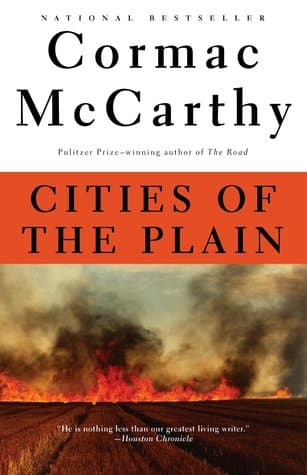
Cormac McCarthy (1998)
Genre
Literary Fiction / Historical Fiction
Reading Time
360 min
Key Themes
See below
Sign in to track this book
In the twilight of the American frontier, two cowboys confront the inescapable tides of change and the tragic consequences of a fated love affair amidst the stark beauty of 1950s New Mexico.
The novel opens in 1952. John Grady Cole and Billy Parham, now young men, work as cowboys on a large ranch near the U.S.-Mexico border, not far from El Paso and Juarez. Their days are filled with the rhythms of ranch life: breaking horses, mending fences, and trail drives. They live a stark, solitary existence, bound by shared experiences and a deep understanding of horses and the land. However, change is present; the old ways of the cowboy are fading, threatened by modernization. Billy, a pragmatist, senses this shift, while John Grady, more idealistic, still holds to the romanticized vision of their life, even as he feels a restless yearning for something more.
During a trip to Juárez with the other cowboys, John Grady visits a brothel. He sees Magdalena, a young Mexican prostitute with epilepsy, and is immediately captivated. Magdalena seems fragile and distant, marked by sadness. John Grady is drawn to her not out of lust, but empathy. He feels a desire to protect her and remove her from her life of exploitation. This initial encounter plants a seed of obsession in John Grady, setting him on a path that will consume him and lead to tragedy.
John Grady begins to spend his spare time and money in Juárez, seeking out Magdalena. He learns about her difficult circumstances, including her epilepsy and her control by a dangerous pimp named Eduardo. John Grady, with naive but determined idealism, forms a plan to free Magdalena and take her away from Juárez. He believes he can offer her a better life and sees himself as her savior. Billy, seeing John Grady's growing obsession, expresses his concerns, warning him about the dangers of interfering in such a brutal world and the futility of trying to save someone who may not want to be saved, or who is beyond saving.
John Grady tries to convince Magdalena to leave with him. She is reluctant, fearful of Eduardo and the consequences of defying him. Her epilepsy also makes her feel vulnerable and dependent. She understands the harsh realities of her world better than John Grady does. Eduardo, a man of power in the Juárez underworld, learns of John Grady's intentions. He subtly, and then more overtly, threatens John Grady, making it clear that Magdalena is his property and will not be released without a fight. The stakes for John Grady's mission escalate.
John Grady is determined to secure Magdalena's freedom and decides he must buy her from Eduardo. He tries to sell his horses, but the market is poor, and he struggles to raise the exorbitant sum Eduardo demands. He considers stealing horses, a desperate act that goes against his moral code but shows his commitment. Billy continues to advise caution, pointing out the futility and danger of John Grady's path, but John Grady ignores his warnings. He is convinced that his love and will can overcome any obstacle. He is increasingly isolated in his obsession, pushing away those who care for him.
Ignoring all warnings, John Grady goes to Eduardo's establishment in Juárez, intending to either buy Magdalena or take her by force. A tense confrontation ensues, escalating into a knife fight between John Grady and Eduardo. John Grady, skilled with a knife, initially holds his own, but Eduardo is a formidable opponent. John Grady is gravely wounded. He manages to fatally wound Eduardo, but not before sustaining injuries that prove to be mortal. The fight is a culmination of John Grady's idealism and the harsh realities of the world he dared to challenge.
In the chaos following the fight, Eduardo's men, seeking revenge, murder Magdalena. She is found dead, a victim of the violence John Grady had tried to save her from. John Grady, bleeding, is taken by Billy back across the border. Despite Billy's frantic efforts to get him medical help, John Grady dies on the journey, his idealistic quest ending in tragic failure. His death marks the end of his youthful romanticism and the bitter triumph of the harsh world he sought to defy.
Devastated by the loss of his friend, Billy mourns John Grady and deals with the aftermath. He carries John Grady's body back to the ranch, a solemn and heartbreaking task. The ranch owner understands the tragedy but offers little comfort. Billy, now alone, is adrift. He wanders the borderlands, working odd jobs, but the joy and purpose he once shared with John Grady are gone. He carries the weight of their experiences, the memory of John Grady's idealism and its tragic end, and the sense of a world irrevocably altered.
As Billy continues his solitary travels, he meets a series of enigmatic figures. These include an old man who has lost his entire family in a flood, a blind man, and others who share their stories and philosophies with him. These encounters often take place around campfires or in desolate landscapes, filled with long, philosophical discussions about good and evil, fate, memory, and existence. Through these interactions, Billy processes his grief for John Grady, grapples with life's harshness, and reflects on the impermanence of the world he knew. These figures offer different perspectives on the human condition.
Billy experiences an unsettling dream involving horses and a changing landscape, which seems to symbolize the end of an era and the future. The dream is a vivid, almost prophetic, vision of transformation and loss. He wakes with a profound sense of the world having irrevocably moved on. The novel concludes with Billy continuing his solitary journey, riding into the sunrise. His path is uncertain, but he carries the burden of the past, the memories of John Grady, and the knowledge that the world of the cowboy, as he and John Grady knew it, is truly gone, replaced by a new, less romantic, and more complex reality.
The Protagonist
John Grady's arc is one of tragic idealism, from a hopeful cowboy to a doomed lover whose noble intentions lead to his violent death.
The Protagonist/Narrative Voice
Billy's arc transforms from a loyal companion to a solitary wanderer, grappling with grief and the end of an era.
The Supporting
Magdalena's arc is one of a trapped victim, briefly offered hope but ultimately succumbing to the brutal forces of her environment.
The Antagonist
Eduardo's arc is that of a dominant antagonist, whose control is challenged and who ultimately dies defending his territory and power.
The Supporting
The ranch owner's arc is static, serving as a pillar of the old world, observing the tragedy unfold with a sense of fatalism.
The Mentioned/Supporting
The old man's arc is not explicitly shown, but he serves as a conduit for philosophical reflection and a symbol of enduring human experience.
The Mentioned
Blevins' arc is completed in the previous novel, but his memory in 'Cities of the Plain' serves as a cautionary tale.
The Mentioned
Don Arnulfo's arc is completed in the previous novel, but his wisdom informs Billy's character in 'Cities of the Plain'.
The novel is steeped in the melancholic atmosphere of a vanishing way of life. The cowboy, represented by John Grady and Billy, is a figure out of step with the modernizing world of 1952, with references to Alamogordo (atomic testing) and encroaching industrialization. John Grady's idealism and his belief in a code of honor clash with the brutal realities of Juárez. His death signifies not just a personal tragedy but the end of a certain kind of innocence and the demise of the old West.
“He knew that in the world to come all things would be altered and that there would be no time for the old ways.”
John Grady's love for Magdalena goes beyond physical attraction, evolving into an obsession rooted in a desire for redemption. He sees in her a soul to be saved, and his mission to free her becomes a spiritual quest. However, this love is ultimately fatal, proving that good intentions are no match for the corrupt and violent world he enters. The theme explores the destructive power of a love that blinds one to reality and the impossibility of unilaterally 'saving' another person from their circumstances.
“He loved her for her fragility and for her hopelessness and he loved her for that quality of being lost and for the desire he had to find her.”
Characters, particularly Billy and the old men he meets, debate how much human lives are predetermined or shaped by individual choices. John Grady's relentless pursuit of Magdalena, despite warnings, can be seen as an exercise of free will, yet it leads directly to his tragic end. The narrative suggests a powerful, almost cosmic, force at play, hinting that some destinies are inescapable, regardless of one's efforts. The cyclical nature of violence and loss further emphasizes this theme.
“A man's life is a long and sorrowful thing. The world is not a place for the innocent.”
Violence is an ever-present force in McCarthy's world. From the dangers of breaking horses to the realities of the Juárez underworld, violence is depicted as both a primal instinct and a tool of power. John Grady's fatal knife fight with Eduardo is a stark portrayal of this. The novel shows the devastating consequences of violence, not just for those directly involved, but for the innocent (Magdalena) and for those left behind (Billy), perpetuating cycles of grief and despair.
“Blood is on the world. It is not in the world. It is the world.”
After John Grady's death, Billy becomes the keeper of their shared memories and stories. The encounters he has with various old men, who share their own life stories and philosophical musings, show the importance of narrative in making sense of a harsh world. These stories, often long and rambling, transmit wisdom, lament loss, and preserve the past. Remembering and telling tales becomes a form of survival and a way to grapple with the meaning of suffering and the passage of time.
“Every man's story is a story of suffering. And how he bears it is his story.”
Long, often abstract conversations that explore themes of fate, morality, and human existence.
McCarthy frequently employs extended philosophical dialogues, particularly in the latter half of the novel when Billy encounters various solitary figures. These conversations, often between Billy and an unnamed old man, are not directly plot-driven but serve to deepen the thematic exploration of the book. They allow the characters (and the reader) to grapple with complex ideas about the nature of good and evil, the meaning of life and death, the role of memory, and the inevitability of suffering. They provide a reflective counterpoint to the brutal events of the plot.
Horses represent freedom, a vanishing way of life, and a connection to a purer existence.
Horses are central to the lives of John Grady and Billy, symbolizing their identity as cowboys and their connection to a more elemental, untamed world. For John Grady, horses embody a purity and nobility that he seeks to find in Magdalena. Their mastery of horses represents a dying art and a fading era. The struggle to break and train horses mirrors the characters' own struggles with control and wildness, while the eventual decline of horse-centered ranching underscores the theme of the end of an era.
The U.S.-Mexico border symbolizes a liminal space between worlds, cultures, and moral codes.
The geographical border between the U.S. and Mexico functions as more than just a physical line; it is a potent metaphor. It represents the frontier between civilization and wilderness, law and lawlessness, innocence and corruption. For John Grady, crossing into Juárez is a descent into a darker, more dangerous world where his moral code is challenged and ultimately shattered. It's a place where different rules apply, where the old ways of the cowboy are irrelevant, and where the forces of fate seem more potent.
Subtle hints and warnings throughout the narrative that predict the tragic outcome.
McCarthy masterfully uses foreshadowing to build a sense of impending doom. Billy's repeated warnings to John Grady about the dangers of Juárez and interfering with Eduardo are explicit examples. More subtle are the discussions about fate and the nature of evil, and the general melancholic tone that permeates the narrative, suggesting that John Grady's idealistic quest is doomed from the start. These portents heighten the tragic impact of the climax, making the reader aware of the inevitability of the characters' fates.
A vivid, symbolic dream at the end that encapsulates the novel's themes of change and loss.
The powerful dream Billy experiences towards the end of the novel is a significant plot device. It is a highly symbolic sequence, filled with imagery of horses, landscapes, and a sense of transformation. The dream serves as a narrative and thematic summation, encapsulating the end of the cowboy era, the loss of John Grady, and Billy's own uncertain future. It moves beyond literal events to convey a deeper, almost mythical, understanding of the profound changes occurring in the world and within Billy himself.
“He said that the world's truth constituted a vision as simple as it was terrible and that the world's truth was a thing to be wary of.”
— John Grady Cole reflecting on a conversation with an old man about the nature of truth and reality.
“He thought that in the beauty of the world were hid a secret. He thought the world's heart beat at some terrible cost and that the world's pain and its beauty were in a relationship that was difficult to understand.”
— John Grady contemplating the connection between beauty and suffering in the natural world.
“The closest bonds we will ever know are bonds of grief. The deepest community one of sorrow.”
— Narrative reflection on human relationships and shared suffering.
“He said that the souls of horses mirror the souls of men more closely than men suppose and that horses also love war.”
— A character discussing the nature of horses and their connection to human traits.
“What is constant in history is greed and foolishness and a love of blood and this is a thing that even God—who knows all that can be known—seems powerless to change.”
— Philosophical musing on the unchanging aspects of human history and nature.
“He said that those who have endured some misfortune will always be set apart but that it is just that misfortune which is their gift and which is their strength and that they must make their way back into the common enterprise of the world for no other reason than that is where they belong.”
— Advice given to a character about overcoming hardship and reintegrating into society.
“The truth about the world, he said, is that anything is possible. Had you not seen it all from birth and thereby bled it of its strangeness it would appear to you for what it is, a hat trick in a medicine show, a fevered dream, a trance bepopulate with chimeras having neither analogue nor precedent, an itinerant carnival, a migratory tentshow whose ultimate destination after many a pitch in many a mudded field is unspeakable and calamitous beyond reckoning.”
— A character describing the surreal and unpredictable nature of existence.
“He said that the wicked know that if the ill they do be of sufficient horror men will not speak against it.”
— Observation on human silence in the face of extreme evil.
“Scars have the strange power to remind us that our past is real.”
— Reflection on physical and emotional scars as proof of lived experience.
“He said that the only thing that makes life possible is permanent, intolerable uncertainty: not knowing what comes next.”
— Philosophical statement about the necessity of uncertainty in human life.
“The light of the world was in men's eyes only for the world itself moved in eternal darkness.”
— Metaphorical description of human perception versus the true nature of the world.
“He said that the dreams of the just are wiser than the histories of the wise.”
— Comment on the value of innocence and intuition over learned knowledge.
“He said that the blood of the wolf is the blood of the lamb and that the blood of the lamb is the blood of the wolf.”
— Symbolic statement about the interconnectedness of predator and prey, good and evil.
“He said that the world is made of stories, not of atoms.”
— Assertion about the primacy of narrative over physical reality in human experience.
Ready to see how well you understood this book? Take our interactive quiz with 10 questions.
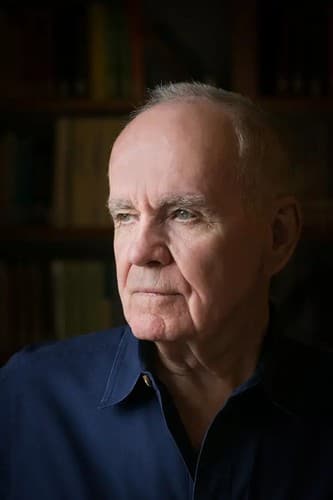
Cormac McCarthy was an American writer who authored twelve novels, two plays, five screenplays, and three short stories, spanning the Western and postapocalyptic genres. He was known for his graphic depictions of violence and his unique writing style, recognizable by a sparse use of punctuation and attribution. McCarthy is widely regarded as one of the greatest American novelists.







