“I thought once that gods are the opposite of death, but I see now they are more dead than anything, for they are unchanging, and can hold nothing in their hands.”
— Circe reflects on the nature of divinity and mortality.

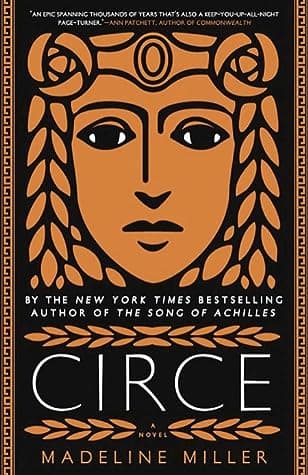
Madeline Miller (2018)
Genre
Fantasy / Historical Fiction
Reading Time
9-12 hours
Key Themes
See below
Sign in to track this book
Banished witch-goddess Circe forges her own path through a world of vengeful Olympians and legendary mortals, mastering her magic to protect the love she finds on her solitary island.
Circe is born to Helios, the Titan god of the sun, and Perse, an Oceanid nymph. Unlike her powerful father or beautiful mother, Circe is plain, with a reedy voice and no inherent divine powers. Her family and siblings, especially her brother Perses, scorn her, and she feels like an outcast among the gods. Her only comfort comes from watching the mortal world and occasionally talking to mortals brought to her father's palace. She develops a quiet resentment towards her divine family and a growing curiosity about the world beyond their gilded halls, sensing a difference within herself that she cannot yet name.
Circe falls in love with Glaucus, a mortal fisherman, and wants him to be immortal so they can be together. She discovers witchcraft, a hidden power, and uses herbs and incantations to transform Glaucus into a sea god. However, Glaucus, now immortal, rejects Circe and instead falls in love with the nymph Scylla. Overcome with jealousy and rage, Circe transforms Scylla into a terrifying, multi-headed monster that preys on sailors. This act of violence and the reveal of her potent, forbidden power, pharmakeia, causes shockwaves through the divine world, marking Circe as a dangerous anomaly.
When Zeus and the other gods learn of Circe's witchcraft and the transformations of Glaucus and Scylla, they fear the threat she poses. As punishment and to contain her unpredictable powers, Zeus banishes Circe to the island of Aiaia, where she is to live in eternal exile. Circe is initially desolate and lonely, but she slowly adapts to her new home. She learns to build a house, cultivate a garden, and refine her witchcraft, experimenting with various herbs and spells. She discovers a deep connection to the island and its wild creatures, embracing her independence.
During her exile, Circe is visited by the god Hermes, who brings her news from the world of the gods and sometimes offers companionship, though their relationship is complex and transactional. She also meets Daedalus, the master craftsman, who washes ashore after fleeing Crete, bringing with him the story of the Minotaur, a creature Circe's sister Pasiphaë gave birth to. Circe helps Daedalus, giving him a safe haven and advice. Later, she is forced to help Pasiphaë give birth to the Minotaur, a horrifying experience that further separates her from her divine kin and solidifies her understanding of mortal suffering.
After years of solitude, Circe begins to receive visitors—mortal sailors who are shipwrecked or intentionally land on Aiaia. Initially, she offers them hospitality, but many prove to be violent and predatory, attempting to rape and enslave her. In self-defense, Circe uses her witchcraft to transform these men into pigs, a fate she thinks fitting for their brutish nature. This repeated act solidifies her reputation as a sorceress and reinforces her wariness of mortal men, while showing the power she has cultivated in her isolation.
The hero Odysseus arrives on Aiaia with his weary crew. Unlike previous visitors, Odysseus is cunning and resilient, having been warned about Circe by Hermes. When Circe tries to transform him, he is protected by an herb given to him by Hermes, and he resists her magic. Impressed by his wit and determination, Circe forms an uneasy truce with him. She agrees to restore his men, whom she had transformed into pigs, and offers him and his crew hospitality for a year, during which they become lovers, and Circe experiences a deep connection with a mortal.
After Odysseus leaves Aiaia to continue his journey home, Circe discovers she is pregnant with his child. She gives birth to a son, Telegonus, and raises him on the island, protecting him from dangers. As Telegonus grows, he wants to know his father and the outside world. Circe foresees that Telegonus will accidentally kill Odysseus. Despite her efforts to keep him on Aiaia, Telegonus eventually builds a boat and sails away in search of his father, leaving Circe distraught and fearing for their fates.
Telegonus eventually lands on Ithaca, Odysseus's homeland, intending to meet his father. However, a misunderstanding leads to a fight, and Telegonus, unaware of his father's identity, tragically kills Odysseus with a spear tipped with a stingray spine that Circe had prepared for him, fulfilling the prophecy. Telegonus, accompanied by Odysseus's grieving widow Penelope and their son Telemachus, returns to Aiaia. Circe is devastated by the news but finds an unexpected kinship with Penelope and Telemachus, who are also dealing with the aftermath of Odysseus's death and Telegonus's actions.
On Aiaia, a household forms: Circe, her son Telegonus, Penelope, and Telemachus. Circe helps Penelope and Telemachus cope with their loss and navigate their new lives. She finds a deep connection with Penelope, sharing stories and understanding. Telemachus, seeking wisdom and a peaceful existence, begins to fall in love with Circe. She teaches him about her island, her magic, and her life, and he, in turn, offers her a different kind of companionship and understanding than she has ever known, free from the expectations and burdens of the divine world.
Athena, the goddess of wisdom and war, visits Aiaia. She demands that Telegonus, as Odysseus's son, be brought to Ithaca to claim his place and that Circe's magic be controlled. Circe refuses to allow her son to be used or to give up her autonomy. She stands firm against Athena, protecting her new family and her chosen way of life. This confrontation solidifies Circe's resolve to live as she chooses, rejecting the oppressive rules of the gods. She realizes her true desire is for a mortal life, with all its joys and sorrows, and a connection to the human world.
Having found love and belonging with Telemachus and a connection to her mortal family, Circe decides to fully embrace mortality. She uses her witchcraft to transform herself from an immortal goddess into a mortal woman, accepting the finite nature of human life. This act shows her complete rejection of her divine heritage and her full commitment to the human world, to love, and to a future with Telemachus. She sheds her divinity, choosing a life of vulnerability and genuine connection, finally finding peace and belonging.
The Protagonist
From an insecure, scorned nymph, Circe transforms into a powerful, self-possessed witch who ultimately chooses mortality and genuine human connection over the emptiness of divine immortality.
The Supporting
He serves as a catalyst for Circe's emotional awakening and motherhood, but his arc is largely external to Circe's, representing the mortal world she longs for and the pain of its impermanence.
The Supporting
From a sheltered boy, he becomes an unwitting patricide, leading to the formation of a new family unit on Aiaia.
The Supporting
From a grieving widow, she finds unexpected kinship and a new purpose on Aiaia, forming a profound bond with Circe.
The Supporting
From a young man seeking his father's legacy, he finds his own path on Aiaia, offering Circe love and a mortal future.
The Supporting
Helios remains largely static, a symbol of the oppressive divine patriarchy Circe escapes.
The Supporting
He remains largely consistent, a symbol of fleeting divine connection, never truly committed to Circe.
The Supporting
Her arc is one of suffering and cruelty, serving as a cautionary tale of divine hubris and the consequences of the gods' whims.
The Mentioned
His brief appearance highlights the tragic beauty and ingenuity of mortals, influencing Circe's perspective.
The Antagonist
She serves as the final external antagonist, embodying the divine power Circe ultimately rejects.
Circe's journey is a quest to understand who she is, separate from the expectations and scorn of her divine family. Initially defined by her 'unlikeness' to other gods, she finds her true self through her exile on Aiaia, cultivating her unique power of witchcraft and forming connections with mortals. Her change from an insecure nymph to a powerful, independent witch, and finally to a woman choosing mortality, shows her active creation of her own identity. This is clear when she realizes, 'I was not a monster. I was a god, and I was a witch, and I was a woman. I was myself.'
“I was not a monster. I was a god, and I was a witch, and I was a woman. I was myself.”
Witchcraft, or pharmakeia, is not just a magical ability but a core part of Circe's identity and power. Unlike the gods' inherent, often destructive, power, Circe's magic is learned, cultivated, and connected to the natural world. It gives her agency and protection, allowing her to transform men into pigs in self-defense and heal her son. It is a source of both fear and wonder, setting her apart from both gods and mortals, and ultimately enabling her final transformation into a mortal woman, showing its capacity for creation and self-definition.
“I learned that I could not be a god, but I could be a witch.”
Circe's banishment to Aiaia, initially a punishment, becomes the place for her growth. Stripped of divine society and forced into self-reliance, she learns to build, cultivate, and master her powers. The solitude allows her to shed her family's influence and develop her own moral compass. Her interactions with occasional visitors, both divine and mortal, are filtered through her independent existence, shaping her understanding of the world and her place within it. The island itself becomes an extension of her solitude and strength.
“I had been born a god, but I had learned to be a witch, and I knew that a witch could make her own way.”
A central tension in the novel is the contrast between the fleeting, often painful, but deeply felt lives of mortals and the eternal, often apathetic, existence of the gods. Circe, born immortal, increasingly finds the gods' lives empty and cruel. Through her relationships with Glaucus, Odysseus, Telegonus, Penelope, and Telemachus, she comes to value mortal love, suffering, and the preciousness of a finite life. Her decision to shed her immortality and embrace mortality shows her rejection of her birthright for genuine human experience and connection.
“I had been born a god, but I had learned that I preferred the company of mortals.”
The novel explores various forms of feminine power, from the alluring but destructive beauty of nymphs to the terrifying power of goddesses like Athena. Circe's power, however, is distinct. It is tied to her domesticity, her connection to nature, and her capacity for creation and protection. She uses her witchcraft to defend herself against male aggression, raise her son, and ultimately define her own destiny, rejecting patriarchal divine structures. Her bond with Penelope highlights female resilience and solidarity.
“I was not a monster. I was a god, and I was a witch, and I was a woman. I was myself.”
Allows intimate access to Circe's thoughts and emotional journey
The novel is narrated entirely from Circe's first-person point of view. This narrative choice is crucial, as it immerses the reader directly into her internal world, allowing for deep empathy with her feelings of loneliness, yearning, anger, and eventual self-acceptance. It emphasizes her subjective experience of events, her observations of both gods and mortals, and her evolving philosophical understanding of life, power, and love, making her transformation a deeply personal and relatable journey.
Reinterprets familiar Greek myths from a marginalized female perspective
Miller takes well-known figures and events from Greek mythology—Circe, Odysseus, the Minotaur, Scylla—and retells them from Circe's perspective. This device allows for a fresh, nuanced exploration of these stories, challenging traditional heroic narratives and giving voice to a character often depicted as a one-dimensional sorceress. It delves into the untold emotional lives and motivations behind mythological events, offering a feminist reinterpretation that highlights themes of agency, exile, and the struggle against patriarchal power structures.
A symbolic crucible for Circe's transformation and independence
Aiaia serves not merely as a setting but as a powerful symbol and a character in itself. It is Circe's prison, sanctuary, classroom, and home. Its isolation forces her to cultivate self-reliance and master her witchcraft. The island's flora and fauna are integral to her magic and her connection to the natural world. Aiaia represents her autonomy and the space where she can shed the constraints of both divine and mortal society, becoming truly herself. It is where she builds her own world, literally and metaphorically.
A literal and metaphorical representation of change and power
Transformations are central to Circe's story, both as her primary magical ability and as a metaphor for her own personal growth. She transforms Glaucus, Scylla, and numerous invading sailors, using her power to alter external forms. More profoundly, her entire character arc is a series of internal transformations: from an unloved nymph to a powerful witch, from a solitary exile to a loving mother, and ultimately, from an immortal goddess to a mortal woman. These changes reflect her evolving understanding of self, power, and purpose.
“I thought once that gods are the opposite of death, but I see now they are more dead than anything, for they are unchanging, and can hold nothing in their hands.”
— Circe reflects on the nature of divinity and mortality.
“When I was born, the name for what I was did not exist.”
— Circe introduces herself and her unique identity as a witch.
“Humbling women seems to me a chief pastime of poets. As if there can be no story unless we crawl and weep.”
— Circe criticizes the portrayal of women in myths and stories.
“It is a common saying that women are delicate creatures, flowers, eggs, anything that may be crushed in a moment's carelessness. If I had ever believed it, I no longer did.”
— Circe asserts her strength and resilience after enduring hardships.
“All my life I have been moving forward, and now I am here.”
— Circe contemplates her journey and arrival on the island of Aiaia.
“I will not be like a bird bred in a cage, I thought, too dull to fly even when the door stands open.”
— Circe resolves to embrace her freedom and power.
“But in a solitary life, there are rare moments when another soul dips near yours, as stars once a year brush the earth. Such a constellation was he to me.”
— Circe describes her deep connection with Odysseus.
“It is not the world that is cruel, it is the people in it.”
— Circe observes human nature and suffering.
“I have a better idea. I will do as I please, and when you count your children, leave me out.”
— Circe defiantly rejects her father Helios's expectations.
“Witchcraft is nothing but a word men use for what they cannot understand.”
— Circe explains the nature of her powers and how they are perceived.
“You threw me to the crows, but it turns out I prefer them to you.”
— Circe confronts her family about their betrayal and exile.
“I would say, some people are like constellations that only touch the earth once in a lifetime.”
— Circe reflects on fleeting but meaningful relationships.
“There is no word for what I am, except the one I choose.”
— Circe asserts her self-definition and autonomy.
“The thought was this: that all my life had been murk and depths, but I was not a part of that dark water. I was a creature within it.”
— Circe realizes her separation from the negativity around her.
Ready to see how well you understood this book? Take our interactive quiz with 10 questions.

Biography coming soon.







