“Ah, the sun, the sun. God's sun. It makes a man want to sing and work and love.”
— Geremio, a bricklayer, expresses his joy and appreciation for life and the sun, unaware of his impending death.

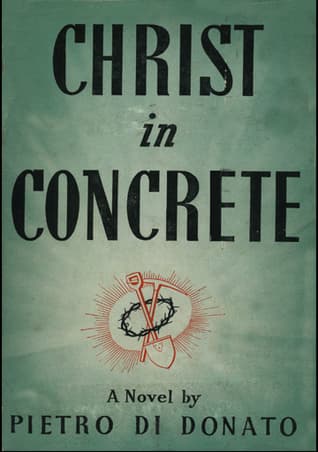
Pietro Di Donato (1937)
Genre
Historical Fiction
Reading Time
Not provided, but likely 4-6 hours based on typical novel length.
Key Themes
See below
Sign in to track this book
In the shadow of the Great Depression, a twelve-year-old Italian immigrant boy must forsake his studies to lay bricks and become the man of his family after his father is tragically crucified in the collapse of a New York City construction site.
On a Good Friday, Geremio, a skilled Italian immigrant bricklayer, works on the tenth floor of a new building in New York City. Despite his foreman's assurances, Geremio feels danger as concrete is poured too quickly. His fears come true when the building collapses, trapping him and his crew. Geremio is impaled by rods, literally crucified in concrete. His younger brother, Luigi, also on site, survives. The tragedy leaves Geremio's pregnant wife, Annunziata, and their eight children, including twelve-year-old Paul, in despair and poverty. It is a devastating change for the family.
After Geremio's death, the family faces immediate and severe poverty. Annunziata, grieving and pregnant, aims to feed her children. Paul, at twelve, feels immense responsibility. He decides to quit school, giving up his education dreams, to take his father's dangerous job as a bricklayer's helper. His mother feels both pride and sorrow, seeing his childhood end early but knowing his sacrifice is needed. Paul's entry into the harsh construction world forces him from boy to man, taking on his family's survival.
Paul starts work as a hod carrier, a physically hard and dangerous job for a boy his age. He quickly learns the brutal realities of the construction site, the constant threat of injury, and the harshness of some foremen. He encounters the union, a powerful but often corrupt group that promises protection but also demands loyalty and fees. The harsh environment chips away at Paul's innocence, yet he shows strength and determination, driven by his father's memory and his family's needs. He sees solidarity among Italian workers, but also internal politics and betrayals within their community and the union.
Annunziata's life after Geremio's death is a constant struggle. She gives birth to her ninth child, a girl, adding to her responsibilities. Her grief is deep and constant, often appearing in vivid dreams and spiritual questions. She tirelessly manages the household, making meager resources last, always worrying about her children's safety, especially Paul's at work. Her faith, while strong, is tested by Geremio's unjust death and endless hardships. She relies on community support, but carries the main burden of keeping her family together and fed.
The family lives in a crowded tenement apartment, common for immigrant families in the Lower East Side. Their home is busy, filled with children, the smell of Italian cooking, and the hum of neighbors' lives. The Italian immigrant community provides a strong support network, sharing food, stories, and sorrows. Paul sees both the cultural traditions and the harsh realities of tenement life — poverty, illness, and the fight for dignity. The Church plays a role in their lives, offering comfort and continuity amid chaos, though its influence is sometimes questioned by their suffering.
As Paul grows on the job, he questions Church teachings and the justice of a God who would allow such suffering, especially his father's death. He struggles to align his Catholic faith with the harsh realities he sees daily — worker exploitation, the rich's indifference, and the constant threat of death. He has internal talks and debates, seeking answers to existential questions about life, death, and divine will. His spiritual journey includes doubt and anger, but also a desire for meaning and justice for his family and people.
Paul becomes more aware of the power differences between workers and bosses. He experiences the challenges and dangers of a construction strike, seeing firsthand the solidarity among his fellow Italian laborers who unite for better wages and safer conditions. However, he also sees internal divisions, the fear of losing work, and the manipulative tactics of both union leaders and employers. The strike shows the working class's collective strength but also their vulnerability and the constant threat to their livelihood. Paul's involvement deepens his understanding of social injustice and the fight for dignity.
Through his work and interactions, Paul's understanding of the world grows beyond his family. He sees the contrast between the wealthy building owners and the poor workers who build their structures. He sees systemic injustices, exploitation, and disregard for human life. This awareness fuels a quiet anger and a growing class consciousness. He starts to voice his thoughts, sometimes clashing with his elders' traditional views, but always driven by a strong sense of right and wrong, and a desire for a better life for his family and community.
Amidst the toil and hardship, Paul experiences a tender, new love with a young woman named Gloria. This relationship offers him a brief break from his burdens, a glimpse of personal happiness and normalcy. However, the harsh realities of their lives, including his relentless work and constant poverty, make a sustained relationship difficult. The story hints at the challenges young immigrants face trying to build personal lives amid economic struggles. This experience further shapes Paul's understanding of life's complexities and the sacrifices often required of him.
As years pass, Paul works tirelessly, providing for his mother and siblings. He grows into a strong, capable young man, but his responsibilities never truly lift. He embodies self-sacrifice, always putting his family's needs first. The story ends with Paul as the family patriarch, forever changed by the Good Friday tragedy and his journey into manhood. He is a symbol of strength, showing the enduring spirit of immigrants facing great hardship, carrying his father's legacy and his family's hopes.
The Protagonist
Paul transforms from an innocent boy with dreams of education into a hardened but compassionate man, sacrificing his youth to become the unwavering pillar of his family.
The Catalyst/Symbolic Figure
Geremio's physical presence is brief, but his symbolic sacrifice and the trauma of his death define the narrative and shape Paul's entire existence.
The Supporting/Matriarch
Annunziata endures immense suffering and loss, yet remains a steadfast, loving mother, a symbol of enduring maternal strength amidst adversity.
The Supporting
Luigi remains a constant, supportive figure, representing the continuity of the working-class immigrant experience and the bonds of family and community.
The Antagonist/Symbolic
Serves as a static representation of indifferent authority, a recurring obstacle and symbol of the workers' exploitation.
The Supporting
Gloria provides a moment of personal connection for Paul, but her role is ultimately to underscore the sacrifices he makes for his family.
The Supporting/Collective
They remain largely static, representing the dependent family unit Paul is committed to supporting and protecting.
The Antagonist/Collective
They remain consistently antagonistic, representing the corrupt systems that exploit the working class.
The novel shows the great sacrifices Italian immigrant workers make for their families. Geremio's death, a literal crucifixion in concrete, shows this, followed by Paul's sacrifice of his childhood and education to provide for his family. The hard physical labor, constant danger, and low wages highlight the strength needed to survive and support a family in a new, often uncaring, country. This theme is clear in every scene Paul works, from his first day carrying hod, to his endurance during strikes, always driven by Annunziata's and his siblings' needs.
“For Geremio, and for Paul, life was a continuous, brutal battle, a fight for bread and dignity against the stone and steel of the city.”
A main theme is the exploitation and injustice faced by the working class, especially immigrant laborers. The dangerous conditions leading to Geremio's death, the foreman's negligence, low wages, and workers' powerlessness against bosses and corrupt union elements all show this theme. Paul's journey is a constant confrontation with these injustices, creating in him a growing class consciousness. The contrast between the wealth of building owners and the poverty of those who build them is a repeated idea, showing deep societal inequalities.
“The rich built their palaces, but it was the blood and bone of men like Geremio that cemented them.”
Paul's story explores the loss of innocence and his forced quick path to adulthood. At just twelve, he is taken from childhood and put into the brutal adult world of manual labor. His education dreams are broken, replaced by the grim reality of providing for his family. This theme is clear in his early struggles with the job's physical demands, his growing understanding of society's corruption, and his spiritual questions. He carries a man's responsibilities while still a boy, forever changed by this early maturation.
“The boy in him was buried with his father, replaced by the man who must provide.”
The novel deeply explores the characters' Catholic faith, especially Annunziata's devotion and Paul's later struggle with doubt. Geremio's death on Good Friday, a literal 'crucifixion in concrete,' fills the story with strong religious symbolism. While Annunziata finds comfort in prayer and tradition, Paul struggles to reconcile his faith with the suffering and injustice he sees. He questions God's will and the Church's teachings, seeking a more real form of justice and meaning in a world that seems uncaring about their struggles. His spiritual journey includes questioning, anger, and a desperate search for truth.
“Where was God in the falling concrete? Where was Christ in the blood of men?”
Despite the great hardships, strong family and community bonds are a vital source of strength and survival. Annunziata's dedication to her children, Paul's commitment to his siblings, and the mutual support among Italian immigrant neighbors in the tenement show this theme. Sharing food, offering comfort, and uniting during strikes demonstrate the power of collective identity and mutual aid. These relationships provide emotional and practical support, helping the family endure constant hardship.
“In the tenement, every door was open, every sorrow shared, every joy amplified.”
Geremio's death on Good Friday, impaled in concrete, symbolizes the suffering of the working class.
The central plot device is the powerful symbolism surrounding Geremio's death. Occurring on Good Friday, his impalement by reinforcing rods, literally 'crucified in concrete,' draws a direct parallel to the crucifixion of Christ. This imagery elevates Geremio's personal tragedy to a universal statement about the suffering, sacrifice, and exploitation of the working class. It imbues the novel with a profound spiritual dimension, influencing Paul's theological questioning and highlighting the 'passion' of the immigrant laborers. This symbolism is not merely religious but socio-economic, equating the workers' plight with a sacred martyrdom.
The story is told primarily through Paul's eyes, emphasizing his emotional and intellectual development.
While not strictly first-person, the narrative heavily privileges Paul's internal thoughts, perceptions, and emotional responses, making him the primary lens through which the reader experiences the story. This allows for an intimate portrayal of his loss of innocence, his struggles with faith, and his growing class consciousness. The reader witnesses the harsh realities of construction work and tenement life through his maturing perspective, feeling the weight of his responsibilities and the depth of his spiritual and intellectual conflicts. This interiority deepens the emotional impact and allows for complex character development.
Geremio's unease and warnings before the collapse hint at the impending disaster.
Before the building collapse, Geremio expresses unease and warns his foreman about the dangerous speed of the concrete pouring. This serves as a clear instance of foreshadowing, creating a sense of dread and inevitability for the reader. It highlights Geremio's experience and foresight, making his death even more tragic as it could have been prevented. This device also underscores the negligence of the employers and the disregard for worker safety, reinforcing the theme of social injustice even before the catastrophe occurs.
The narrative vividly depicts the harsh realities of immigrant life and labor in early 20th-century New York.
The novel employs social realism to portray the unvarnished truth of Italian immigrant life in the Lower East Side. It meticulously details the dangerous conditions of construction work, the poverty of tenement living, the struggles for survival, and the cultural nuances of the community. This device immerses the reader in the specific historical and social context, making the characters' struggles feel authentic and immediate. The graphic descriptions of labor, death, and daily life serve to highlight the systemic issues and human cost of industrialization and immigration.
“Ah, the sun, the sun. God's sun. It makes a man want to sing and work and love.”
— Geremio, a bricklayer, expresses his joy and appreciation for life and the sun, unaware of his impending death.
“The wall was a tomb. A wall of death.”
— Paulie witnesses his father Geremio's death as he is buried alive in a collapsed concrete wall.
“God, why did you take my father? Why?”
— Young Paulie grapples with the sudden, violent death of his father, questioning divine will.
“Work, work, work! That is all we do. We build and we die.”
— One of the Italian laborers laments their difficult, dangerous lives, constantly working with little reward.
“He was a good man, my Geremio. Strong hands, strong heart.”
— Annunziata, Geremio's wife, remembers her deceased husband with love and sorrow.
“The concrete, it eats men. It takes them.”
— A recurring sentiment among the workers, highlighting the perilous nature of their construction jobs.
“I am Christ in concrete. I am the sacrifice.”
— Paulie, feeling the burden of responsibility and suffering after his father's death, likens himself to a crucified figure.
“They buried him like a dog. No priest, no prayers, just dirt and concrete.”
— Annunziata's bitter reflection on the impersonal and undignified burial of her husband, contrasting with religious tradition.
“Money, always money. It makes men slaves.”
— A common complaint among the workers, recognizing their economic bondage and lack of control over their lives.
“The city… it grows on our bones.”
— An observation by a worker, expressing the grim reality that the grand structures of the city are built upon the sacrifices and lives of laborers.
“He became a man that day, a man of sorrow.”
— Narrative reflection on Paulie's transformation and loss of innocence after witnessing his father's death.
“We are nothing. Just hands for the rich to use.”
— A worker's cynical view of their position in society, highlighting their dehumanization and exploitation by the wealthy.
“But the sun, it shines for all, even for the dead.”
— Despite the tragedies, there is a persistent glimmer of hope or a recognition of nature's indifference/universality.
“The Lord giveth and the Lord taketh away. Blessed be the name of the Lord.”
— Annunziata attempts to find solace in religious scripture despite her immense grief and anger.
“And the city, like a monstrous beast, continued to devour.”
— A powerful metaphor depicting the insatiable and destructive nature of the growing city, consuming lives in its expansion.
Ready to see how well you understood this book? Take our interactive quiz with 10 questions.

Biography coming soon.







