“Women's hearts are like water; they are easily swayed by the wind.”
— Binodini reflects on the nature of women's affections and their susceptibility to external influences.


Rabindranath Tagore (1970)
Genre
Literary Fiction / Historical Fiction / Romance
Reading Time
8-10 hours (based on 298 pages)
Key Themes
See below
Sign in to track this book
In colonial Bengal, a captivating young widow's arrival starts a storm of forbidden desires, jealousy, and social upheaval within a seemingly harmonious household, challenging tradition and loyalty.
Mahendra, a young, educated man from a wealthy Kolkata family, initially does not want to marry, preferring to spend time with his mother, Rajlakshmi. However, he eventually gives in to family pressure and marries Asha, a naive, uneducated girl from the countryside. Their early days are filled with gentle, though somewhat shallow, affection. Soon after, Rajlakshmi, worried about Mahendra's complete focus on Asha and feeling ignored, arranges for Binodini, a beautiful, intelligent, and recently widowed young woman, to come live with them. Binodini, having a good education, quickly impresses everyone with her wit and charm, subtly changing the household's dynamics, especially the close bond between Mahendra and Asha.
Binodini, initially a companion for Rajlakshmi, soon becomes Asha's tutor and confidante. She teaches Asha to read and write, and helps her with her new life. Asha, innocent and trusting, grows very fond of Binodini, unaware of the subtle changes happening around her. Meanwhile, Mahendra, initially uninterested in Binodini, finds himself more and more drawn to her intelligence and sophisticated conversation, qualities his simple wife lacks. He begins spending more time with Binodini, having intellectual discussions that excite him, while Asha feels increasingly ignored and alone, though she struggles to express her unease.
Bihari, Mahendra's best friend and a man with strong morals, often visits the household. He watches the growing closeness between Mahendra and Binodini with increasing concern. He sees Mahendra's growing obsession and Asha's quiet suffering. Bihari, who secretly has feelings for Binodini, tries to subtly warn Mahendra about his improper behavior, appealing to his sense of duty and loyalty to Asha. However, Mahendra, blinded by his growing obsession and his own intellectual pride, dismisses Bihari's concerns, seeing them as jealousy or being too cautious, further distancing his friend and widening the gap in his own household.
Mahendra becomes completely obsessed with Binodini, giving her much attention and gifts, while Asha withdraws further, heartbroken and confused. Binodini, despite her growing feelings for Mahendra, also knows the moral issues and the pain she is causing Asha. Bihari, seeing the family turmoil, feels he must protect Asha and confront Mahendra, which leads to arguments and tension between the two friends. Binodini herself struggles with her conscience, torn between her desire for Mahendra's intellectual company and her awareness of their destructive path. The household is now fully consumed by the unspoken desires and resentments of the three main characters.
Overwhelmed by the guilt of betraying Asha and the moral difficulties of her situation, Binodini decides to leave Mahendra's house. Her departure creates an emptiness in Mahendra's life, and he suddenly faces the hollowness of his actions. He realizes the extent of his foolishness and the pain he has caused Asha. Driven by a mix of remorse and continued obsession, Mahendra goes looking for Binodini, hoping to restart their connection, but also dealing with the results of his choices. Asha, meanwhile, is left alone to cope with the aftermath, her trust shattered and her spirit wounded.
Mahendra tracks Binodini to various places, trying to persuade her to return to him, often using manipulative arguments about their intellectual bond. Binodini, though still attracted to him, is wary of his changeability and the chance of more heartbreak. Bihari, having learned of Mahendra's pursuit, steps in to protect Binodini. He offers her shelter and talks to her about the importance of self-respect and the true nature of love, comparing his own steadiness with Mahendra's impulsive desires. Bihari's actions come from his genuine affection for Binodini and his concern for her well-being, as well as his desire to keep Asha happy.
After a period of suffering and thought, Asha, having matured greatly through her ordeal, decides to confront Binodini. She seeks her out, not with anger, but with a new understanding and a desire for reconciliation. During their emotional meeting, Binodini confesses her deep regret for the pain she caused and reveals her true feelings: that she has come to love Bihari, recognizing his integrity and selfless devotion. This confession is a turning point, as Binodini acknowledges the shallowness of her initial attraction to Mahendra and embraces a deeper love, one based on respect and stability, which Bihari represents.
Mahendra, seeing the changes in Asha and Binodini, and after a period of intense self-reflection, finally accepts the extent of his mistakes. He recognizes his selfish and fickle nature, and the irreversible damage he inflicted on his marriage and friendships. He understands that his pursuit of Binodini came more from intellectual pride and a desire for novelty than genuine love. He sees Asha's quiet strength and unwavering loyalty, realizing the true depth of her love and the preciousness of what he almost lost. This realization brings him deep regret and a desire for redemption.
Despite Mahendra's pleas for her return and Bihari's sincere proposal of marriage, Binodini makes a firm choice for her future. She rejects both men, explaining that she cannot return to a life that caused so much pain and that she cannot marry Bihari, as she believes her past would always affect their relationship. Instead, Binodini chooses independence and self-reliance. She decides to dedicate her life to service and spiritual growth, embracing a life of quiet dignity away from the complexities of romantic problems and societal expectations, thus asserting her will and making her own future.
With Binodini's departure, Mahendra and Asha slowly begin the difficult process of rebuilding their marriage. Mahendra, humbled, dedicates himself to making amends and earning back Asha's trust. Asha, wounded but strong, gradually opens her heart again, her love for Mahendra lasting despite his wrongs. Bihari, though heartbroken by Binodini's refusal, respects her decision and continues his life of selfless service and moral uprightness, finding comfort in his principles. The novel ends with a sense of closure, though not necessarily a happy ending for all, emphasizing the results of actions and the possibility of growth and forgiveness within societal rules.
The Protagonist
Mahendra transforms from a self-absorbed, fickle husband to a humbled man who recognizes his mistakes and the true value of love and loyalty.
The Protagonist/Catalyst
Binodini evolves from a woman seeking intellectual and emotional fulfillment within societal constraints to one who chooses independence and a life of purpose beyond marriage.
The Protagonist
Asha matures from a naive and dependent wife into a stronger, more understanding woman capable of forgiveness and rebuilding her life.
The Supporting/Moral Compass
Bihari remains a steadfast moral figure, experiencing unrequited love but finding solace in his principles and service.
The Supporting
Rajlakshmi's arc involves realizing the unintended consequences of her attempts to control her son's affections.
The Mentioned/Supporting
Remains a static character, representing traditional values.
The novel clearly shows the limited choices available to women, especially widows, in late 19th-century Bengali society. Binodini, despite her intelligence and beauty, is initially dependent and vulnerable, seen as a burden or an object of desire. Asha's initial naivety comes from her lack of education, a common issue for women. The story explores how these women navigate societal expectations, their fight for identity, and their eventual assertions of independence, whether through Binodini's choice of freedom or Asha's quiet strength in rebuilding her marriage. The 'chokher bali' (sand in the eye) metaphor itself speaks to the discomfort and disruption a woman like Binodini caused in a patriarchal household.
““The curse of widowhood, Binodini, is not that one lives without a husband, but that one is denied the right to live at all.””
Tagore carefully distinguishes between superficial attraction and real, lasting love. Mahendra's initial 'love' for Asha is shown as possessive and somewhat childish, based on physical affection and novelty. His later obsession with Binodini is intellectual and ego-driven, a search for excitement rather than a deep connection, leading to chaos. In contrast, Bihari's love for Binodini is selfless, respectful, and constant, though not returned romantically. Asha's love, initially naive, matures through suffering into a deep, forgiving bond. The novel criticizes how quickly passion fades when not based on respect and understanding, and celebrates the strength of true affection.
““Love, when it is real, is not a sudden storm, but a slow, steady rain that nourishes the earth.””
Mahendra, an educated man, prides himself on his intellect, yet his emotional immaturity and selfishness lead him to ruin. He is drawn to Binodini's intelligence, which he finds lacking in Asha. However, his intellectual pursuits are separate from moral responsibility and empathy. Bihari, while also intelligent, shows great emotional maturity, self-control, and a strong moral compass, which guides his actions. The novel suggests that true wisdom is not just intellectual ability, but the combination of intellect with empathy, ethical behavior, and emotional intelligence. Mahendra's journey is one of learning this painful lesson.
““A man's learning is not in his books, but in his heart and in his actions.””
Selfishness, mainly shown by Mahendra and initially by Rajlakshmi, acts as a damaging force throughout the story. Mahendra's self-centered pursuit of his own desires, first with Asha and then with Binodini, blinds him to the suffering he causes. Rajlakshmi's initial jealousy of Asha's bond with Mahendra leads her to bring Binodini into the household, starting the chain of events. This theme highlights how unchecked personal desires, when put before empathy and responsibility, can break family harmony, destroy trust, and cause deep emotional wounds to everyone involved, creating unhappiness and regret.
““When one’s own desire becomes the only truth, all other truths become lies.””
Binodini represents an ideal that neither Mahendra nor Bihari can fully possess, leading to her ultimate independence.
Binodini, with her intelligence and beauty, becomes an unattainable ideal for both Mahendra and Bihari, albeit for different reasons. For Mahendra, she represents the intellectual stimulation and novelty he craves, but he cannot commit to her fully without betraying Asha, nor can he truly understand her deepest desires. For Bihari, she is the woman he truly loves and respects, but her past and her desire for independence prevent her from accepting his proposal. This device highlights the limitations of societal expectations and the complexities of human relationships, as Binodini ultimately chooses to forge her own path rather than be defined by either man.
The audience is often aware of the characters' true feelings or impending conflicts before the characters themselves.
Dramatic irony is frequently employed, particularly in the early stages of Mahendra's infatuation and Asha's naivety. The reader understands the danger and emotional complexities of Binodini's presence long before Asha comprehends the threat to her marriage. Similarly, Mahendra's self-deception about his 'love' for Binodini is clear to the reader, and to Bihari, while Mahendra remains oblivious. This creates tension and suspense, as the audience anticipates the inevitable emotional fallout, highlighting the characters' blindness to their own emotions and the consequences of their actions.
The title itself symbolizes Binodini's disruptive and irritating presence in the conventional household.
The title, 'Chokher Bali' (literally 'sand in the eye'), serves as a powerful symbol. It refers to Binodini, who, despite her beauty and charm, becomes an irritant and a source of discomfort within Mahendra's household. Like sand in the eye, her presence, though initially perhaps unnoticed or even welcomed, causes increasing irritation, pain, and eventually threatens the stability and peace of the family. It symbolizes her role as a disruptive force, challenging the established order and exposing the weaknesses and hypocrisies within the seemingly harmonious domestic sphere.
Letters exchanged between characters reveal inner thoughts and advance the plot.
Letters play a crucial role in revealing the characters' inner thoughts, desires, and conflicts, which they might not express openly in conversation. The exchange of letters between Binodini and Mahendra, and later between Binodini and Asha, allows for a deeper exploration of their complex emotions, their struggles with morality, and their changing perspectives. These letters not only advance the plot by communicating vital information but also provide intimate glimpses into the characters' psychological states, adding layers of nuance and personal reflection that would be difficult to achieve through dialogue alone.
“Women's hearts are like water; they are easily swayed by the wind.”
— Binodini reflects on the nature of women's affections and their susceptibility to external influences.
“The world is a stage, and we are merely players.”
— A philosophical observation on the human condition and the roles people play in life.
“To love is to suffer. To avoid suffering one must not love. But then one suffers from not loving. Therefore, to love is to suffer, not to love is to suffer. To suffer is to suffer. To be happy is to love. To be happy then is to suffer. But suffering makes one unhappy. Therefore, to be unhappy one must love, or love to suffer, or suffer from too much happiness.”
— A complex rumination on the paradoxical nature of love and suffering, often attributed to the character's internal monologue.
“A woman's beauty is her greatest asset, but also her greatest curse.”
— Binodini's cynical view on the double-edged sword of female beauty in society.
“The human heart is a strange thing; it often desires what it cannot have.”
— Reflecting on the unpredictable and often contradictory desires of the human heart.
“Sometimes, silence speaks louder than words.”
— Highlighting the power of unspoken communication and hidden emotions.
“True happiness lies not in possession, but in contentment.”
— A philosophical insight into the nature of true happiness, contrasting it with material wealth.
“Love is a fire that consumes everything in its path.”
— A metaphorical description of the intense and often destructive power of love.
“The past is a stubborn ghost; it always finds a way to haunt the present.”
— Reflecting on the lingering influence of past events and relationships.
“Duty often clashes with desire, and in that conflict, hearts are broken.”
— Exploring the internal struggle between personal desires and societal or familial obligations.
“It is easier to forgive an enemy than to forgive a friend who has betrayed you.”
— A poignant observation on the depth of pain caused by betrayal from a trusted individual.
“The greatest tragedy is not death, but life without love.”
— Emphasizing the profound importance of love as essential to a meaningful existence.
“In the labyrinth of the heart, one often loses oneself.”
— A metaphorical depiction of the complexities and confusing nature of one's own emotions and desires.
“A caged bird may sing, but its song is never truly free.”
— A metaphor used to describe the constrained life of women in traditional society, despite outward appearances.
Ready to see how well you understood this book? Take our interactive quiz with 10 questions.
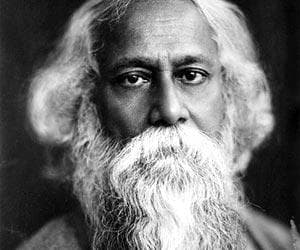
Rabindranath Tagore was a Bengali poet, writer, playwright, composer, philosopher, social reformer and painter. He reshaped Bengali literature and music as well as Indian art with Contextual Modernism in the late 19th and early 20th centuries. Author of the "profoundly sensitive, fresh and beautiful" poetry of Gitanjali, he became in 1913 the first non-European and the first lyricist to win the Nobel Prize in Literature. Tagore's poetic songs were viewed as spiritual and mercurial; however, his "elegant prose and magical poetry" remain largely unknown outside Bengal. He was a fellow of the Royal Asiatic Society. Referred to as "the Bard of Bengal", Tagore was known by sobriquets: Gurudeb, Kobiguru, Biswokobi.







