“Maman always said that the art of good housekeeping was to be able to make a meal out of nothing.”
— Vianne reflects on her mother's wisdom about resourcefulness.

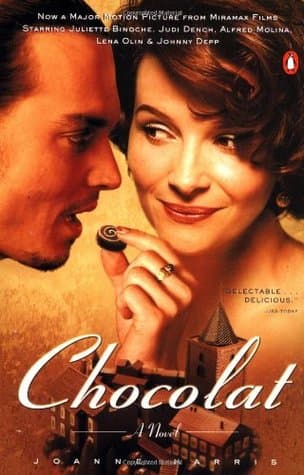
Joanne Harris (1999)
Genre
Fantasy / Historical Fiction / Romance
Reading Time
360 min
Key Themes
See below
Sign in to track this book
In a quiet French village, a mysterious chocolatier arrives during Lent, sparking a quiet revolution with her sweets and her ability to help villagers embrace their hidden desires.
In the quiet, traditional French village of Lansquenet-sous-Tannes, a mysterious woman named Vianne Rocher arrives with her young daughter, Anouk, during Lent. Carried by the 'wind,' they settle into an old bakery building. Vianne, with her red shoes and lively spirit, opens a chocolate shop, La Céleste Praline, directly across from the church. Her arrival immediately creates a stir, especially among the devout, as her shop's sweet aromas and temptations clash with the Lenten vows of abstinence. Father Reynaud, the village priest, sees her as a disruptive influence threatening the established order and the spiritual discipline of his community.
Vianne's chocolate shop quickly becomes a source of fascination and, for some, temptation. She has a unique ability to see each customer's secret desires and fears, recommending specific chocolates that seem to ease their worries or awaken hidden joys. Armande Voizin, an elderly and reclusive woman, finds her strained relationship with her grandson, Luc, rekindled through Vianne's subtle help and a shared love for chocolate. Joséphine Muscat, a timid woman suffering from domestic abuse, is drawn to the shop, finding a safe place and a glimmer of self-worth. These small acts of kindness begin to soften the villagers' rigid adherence to tradition and Father Reynaud's stern teachings.
Father Reynaud becomes increasingly worried by Vianne's growing influence. He sees her as a pagan force, perhaps even a witch, undermining his authority and the spiritual foundation of Lansquenet. He preaches sermons against indulgence and temptation, clearly targeting Vianne's shop without naming her. He encourages his parishioners to avoid La Céleste Praline and emphasizes Lenten fasting. His efforts create tension in the village, dividing the community between those drawn to Vianne's warmth and those loyal to the Church's strict rules, leading to a quiet battle for the villagers' beliefs.
Joséphine Muscat, abused and isolated by her husband, Paul-Marie, seeks comfort at Vianne's shop. Vianne, seeing Joséphine's situation, quietly encourages her to leave Paul-Marie. When Paul-Marie sets fire to Vianne's doormat in a rage, Joséphine, feeling stronger with Vianne's support, finally leaves him. She moves in with Vianne and Anouk, and under Vianne's care, begins to change. Joséphine loses her shyness, regains her confidence, and even develops a playful sense of humor, surprising the villagers who had known her only as a downtrodden wife.
The arrival of a group of river gypsies, led by the charismatic Roux, further disrupts the village's peace. These nomadic people, with their free lifestyle and disregard for conventional rules, are met with suspicion and hostility by most villagers, especially Father Reynaud. Vianne, however, finds a connection with Roux and his people. She welcomes them, offering food and friendship, further solidifying her reputation as an outsider. Roux, in turn, is drawn to Vianne's independent spirit and her ability to challenge the status quo, and a romantic interest begins to develop between them.
Armande Voizin, who has been secretly ill, confides in Vianne. Despite Father Reynaud's disapproval, Vianne helps Armande organize a joyful birthday party, with chocolates and a lively atmosphere, allowing her to make up with her grandson, Luc, and experience happiness in her final days. Armande passes away peacefully shortly after, leaving a quiet example of defiance against the village's rigid norms and a sign of Vianne's ability to bring comfort and joy. Her death, though sad, shows the impact Vianne has had on individual lives.
As Easter approaches, Vianne announces her plan for a grand chocolate festival, scheduled for Easter Sunday. This directly challenges Father Reynaud and the sacredness of Lent, which ends on Easter. The festival promises many rich, luxurious chocolates and a celebration of sensory pleasure, directly opposing the priest's call for spiritual strictness. The village is again divided, with some secretly eager for the festival and others condemning it as sacrilege. The upcoming event sets the stage for a dramatic conflict between Vianne's philosophy of joy and Father Reynaud's adherence to tradition.
Angry about Joséphine's transformation and Vianne's influence, Paul-Marie Muscat, Joséphine's abusive ex-husband, tries to get revenge. On the eve of the chocolate festival, he breaks into La Céleste Praline, intending to destroy it. He smashes display cases and tries to set the shop on fire. However, his efforts are stopped by the timely arrival of Roux and the other river gypsies, who have been watching over Vianne's shop. Paul-Marie is caught, further showing the contrast between destructive forces and the protective community Vianne has helped create.
Overwhelmed by Vianne's success and the apparent failure of his attempts to maintain order, Father Reynaud experiences a deep crisis of faith. He secretly enters Vianne's shop on Easter Sunday morning, just before the festival, planning to ruin her creations. However, the aroma of the chocolates overwhelms him, bringing back suppressed desires and memories. He gives in to temptation, eating a large quantity of chocolate, and is found later, covered in chocolate, in a state of both physical and spiritual confusion. This moment marks a turning point for him, forcing him to face his own rigid beliefs and humanity.
Despite the earlier sabotage attempt and Father Reynaud's internal struggle, the Easter Chocolate Festival is a great success. Villagers, including many who had previously avoided Vianne, openly embrace the joy and indulgence. The atmosphere is one of celebration and newfound freedom. However, as the festival ends, Vianne feels the familiar 'wind' calling her to move on. Though she has grown fond of Lansquenet and its people, her nomadic nature pushes her to leave. She prepares to depart with Anouk, leaving behind a village forever changed by her presence.
As Vianne prepares to leave Lansquenet, Anouk, who usually accepts their nomadic lifestyle, strongly wishes to stay. She has made friends and found a sense of belonging in the village. At the same time, Father Reynaud, having experienced his own change, makes an unexpected gesture: he subtly acknowledges Vianne's positive impact and offers a quiet sign of acceptance. These two events, combined with Vianne's growing attachment to the village and Roux, lead her to reconsider. She decides to defy the 'wind' and make Lansquenet her permanent home, breaking her family's long tradition of constant movement.
The Protagonist
Vianne learns to plant roots and find a home, choosing to defy her nomadic heritage for the first time.
The Antagonist
Father Reynaud undergoes a profound crisis of faith and self-discovery, eventually softening his stance and embracing a more compassionate understanding of humanity.
The Supporting
Anouk finds her voice and agency, choosing to settle in Lansquenet and influencing Vianne's decision to stay.
The Supporting
Armande finds reconciliation and peace in her last days, dying with dignity and joy.
The Supporting
Joséphine transforms from a timid, abused victim into a confident, independent, and joyful woman.
The Supporting
Roux finds a sense of belonging with Vianne, though his nomadic instincts remain.
The Supporting
Luc finds emotional freedom and a connection with his grandmother before her death, and friendship with Anouk.
The central conflict of the novel is the clash between the deeply rooted traditions and religious conservatism of Lansquenet, represented by Father Reynaud, and the changes brought by Vianne Rocher. Vianne's arrival during Lent, her shop, and her unconventional lifestyle directly challenge the village's strict routine and self-denial. This theme is clear in the villagers' initial suspicion of Vianne, Father Reynaud's sermons against her, and the eventual division of the community as some accept her influence while others hold onto the old ways. The chocolate festival on Easter Sunday is the ultimate symbol of this conflict, setting sacred tradition against joyful rebellion.
“''If I have learned anything in this past year, it is that nothing is as it seems. That the wind does not always blow in the same direction, and that while we may be powerless to change the wind's course, we have it in our power to adjust our sails.''”
Chocolate, in this novel, is not just a sweet but a strong symbol of temptation, pleasure, and indulgence. Vianne's chocolates awaken hidden desires and pleasures in the villagers, directly opposing the Lenten vows of abstinence promoted by Father Reynaud. Characters like Armande, Joséphine, and even Father Reynaud himself give in to the appeal of chocolate. This represents embracing life's joys, passions, and human flaws rather than denying them. Choosing chocolate over strict piety becomes a way to choose happiness and self-acceptance over rigid rules.
“''We are what we eat, my friend. And what we eat in this village is the past.''”
Vianne and Anouk are guided by the 'wind,' a metaphor for their nomadic, free lifestyle, always seeking new places. This freedom, however, comes with the cost of true belonging. The novel explores the tension between the desire for complete freedom and the human need for community and a sense of home. Vianne helps others, like Joséphine and the river gypsies, find their own kinds of freedom. Ultimately, Vianne's decision to stay in Lansquenet, influenced by Anouk's desire for roots and her own growing attachment, shows a blend of freedom and belonging, suggesting that true home is where one chooses to be, not where the wind dictates.
“''The wind. I am sometimes afraid of it. It has a voice, and a personality. It brings change, and sometimes it takes things away.''”
The bond between Vianne and Anouk is central to the story, showing the challenges and joys of single motherhood. Vianne's main goal is Anouk's happiness and well-being, yet her nomadic lifestyle sometimes creates instability for her daughter. The theme extends to other family dynamics, such as Armande's strained relationship with her daughter Caroline, contrasted with her loving bond with her grandson Luc. The novel highlights different forms of family, including the unconventional 'family' Vianne creates with Joséphine and the river gypsies, emphasizing that family is often chosen and defined by love and support rather than strictly by blood.
“''It is a burden, this gift. The wind. It tells me where to go, but it never tells me where to stay.''”
Vianne's greatest gift, beyond her chocolate-making, is her deep empathy and acceptance of others. She sees past surface appearances and judgments, understanding the hidden sorrows and desires of the villagers. Her ability to offer a specific chocolate that speaks to a person's individual need shows radical acceptance. This contrasts sharply with Father Reynaud's judgmental and rigid approach. Through Vianne's actions, characters like Joséphine, Armande, and even Father Reynaud learn to accept themselves and others, leading to healing and personal growth. The novel suggests that true community is built on understanding and compassion.
“''I remember my mother saying that a woman's heart is a deep ocean of secrets. But I know that for a man, too, there are secrets below the surface.''”
Subtle magical elements woven into an otherwise realistic setting.
The novel subtly incorporates elements of magic realism, where extraordinary or supernatural occurrences are presented as ordinary and commonplace. Vianne's uncanny ability to discern people's secret desires and recommend the perfect chocolate, her family's nomadic 'wind' that guides their movements, and Anouk's imaginary kangaroo, Pantoufle, are examples. These elements are not questioned by the characters or narrator, adding a whimsical and mystical layer to the narrative without fully breaking from the realistic portrayal of French village life, enhancing the themes of intuition and the unseen forces at play.
Detailed descriptions of chocolate used to evoke emotion and symbolize indulgence.
Harris uses vivid, evocative descriptions of chocolate throughout the novel, appealing to all senses. The rich aromas, varied textures, and complex flavors of Vianne's creations are meticulously detailed, making chocolate almost a character in itself. This sensory imagery serves as a powerful metaphor for pleasure, sensuality, and the breaking of inhibitions. The descriptions of chocolate are not merely decorative; they are integral to illustrating the themes of temptation, indulgence, and the awakening of suppressed desires in the villagers, often directly reflecting their emotional states or transformations.
A metaphorical and literal force guiding Vianne's nomadic life.
The 'wind' is a recurring motif and a significant plot device, representing Vianne's inherited nomadic instinct and the forces of change. It is both a literal wind that blows through the village and a metaphorical urge that compels Vianne and her ancestors to move from place to place. The wind's arrival often signals a new beginning or a period of disruption, while its eventual 'quieting' in Lansquenet symbolizes Vianne's decision to settle. It embodies themes of freedom, restlessness, and the search for home, acting almost as a character that dictates Vianne's movements until she actively chooses to defy it.
Vianne's subjective and sometimes biased perspective shapes the story.
Vianne Rocher narrates the majority of the story in the first person, offering her subjective insights into the villagers and events. While this gives intimate access to her thoughts and feelings, her perspective is inherently biased, especially regarding Father Reynaud and the more conservative villagers. Her descriptions of their reactions and motivations are filtered through her own experiences and interpretations. This creates a nuanced narrative where the reader is privy to Vianne's unique, often magical, understanding of the world, but also subtly encouraged to question or consider alternative viewpoints, particularly through the interjections of Father Reynaud's third-person narration.
“Maman always said that the art of good housekeeping was to be able to make a meal out of nothing.”
— Vianne reflects on her mother's wisdom about resourcefulness.
“Happiness is like a small bird that has flown into your house. If you open the door, it will fly away. If you keep it, it will die.”
— Vianne muses on the elusive nature of happiness.
“The secret of happiness, you see, is not found in seeking more, but in developing the capacity to enjoy less.”
— Vianne observes the simplicity of true happiness.
“We are what we eat, it is often said. I wonder, then, what of those who eat nothing at all?”
— Vianne ponders the deeper meaning of food and sustenance.
“Sometimes I think I have been here before; that I am destined to return to this place over and over again.”
— Vianne feels a sense of déjà vu about her nomadic lifestyle.
“Small acts of rebellion, it seems, can have far-reaching consequences.”
— Vianne reflects on the impact of her chocolate shop on the town.
“There are some people who are like anchors, who hold you in place, and others who are like sails, who carry you away.”
— Vianne categorizes people by their influence on her life.
“It is not the taste of the chocolate that matters, but the pleasure it gives.”
— Vianne explains her philosophy behind making and selling chocolate.
“One cannot be strong if one is not a little mad.”
— Vianne considers the nature of strength and unconventionality.
“The wind. It whispers things. Secrets. Promises. Lies.”
— Vianne describes the omnipresent and symbolic wind that guides her.
“We all have our secrets. Some of us hide them better than others.”
— Vianne acknowledges the hidden lives of the townspeople.
“A little of what you fancy does you good.”
— Vianne's pragmatic advice about indulgence.
“It’s not just about the chocolate, you know. It’s about understanding people, what they want, what they need.”
— Vianne reveals the deeper purpose of her chocolate shop.
“Sometimes you have to break the rules to find your own way.”
— Vianne's approach to life, often defying conventional norms.
Ready to see how well you understood this book? Take our interactive quiz with 10 questions.

Biography coming soon.







