“Coincidence is just an explanation waiting to happen.”
— Calder and Petra discuss the mysterious events surrounding the stolen Vermeer painting.

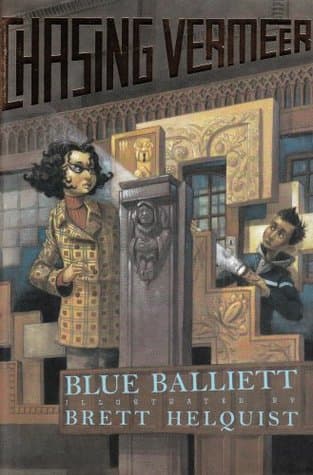
Blue Balliett (2004)
Genre
Children's / Creativity / Mystery / Young Adult
Reading Time
250 min
Key Themes
See below
Sign in to track this book
When a priceless Vermeer vanishes, two quick-witted middle schoolers, guided by a cryptic book and their own sharp intuition, must decode a labyrinth of clues to outsmart an art thief who has stumped even the FBI.
Petra Andalee, a new student at the University of Chicago Lab School, and Calder Pillay, who likes pentominoes, find their lives connected. Both get a mysterious, unsigned letter with random words and numbers that asks, 'Are you there?' Their sixth-grade teacher, Ms. Hussey, introduces them to Johannes Vermeer's art. Petra likes words and mysteries, and Calder thinks logically. They are careful around each other at first but are drawn together by the letter and strange events. They notice connections, including a shared interest in frogs and an old woman, Mrs. Sharpe, who lives nearby and seems to watch them.
The art world is surprised by the theft of Johannes Vermeer's "A Lady Writing." It was stolen from a heavily guarded crate during a train trip from the National Gallery of Art in Washington D.C. to an exhibition in Chicago. The thief, who calls himself 'The Uniter,' sends a letter to the Chicago Tribune. He says the painting was stolen because Vermeer's art is not appreciated. He will return it only if certain conditions are met. The FBI is confused. The news affects Petra and Calder, who just studied Vermeer in class.
The Uniter's letters continue. He demands art experts acknowledge Vermeer's use of symbols and hidden messages, especially frogs and toads. He claims "A Lady Writing" has a secret only a true admirer can find. Petra and Calder remember studying Vermeer and their mysterious letters. They start to think The Uniter's demands are connected to their experiences. They notice a frog figurine appearing in different places, like Ms. Hussey's classroom and near Mrs. Sharpe's house. They believe The Uniter is sending a message through clues in plain sight.
Calder, who likes pentominoes (shapes made of five squares), realizes the random words in their first letters match specific pentomino shapes. He uses his pentominoes to arrange letters, hoping to find a hidden message. Petra focuses on the frog. They discover a 'tree frog' appears subtly in several Vermeer paintings. They also link the frog to a book, 'Lo! A Key to Vermeer,' by a secluded art historian, Mrs. Sharpe, who lives nearby. They believe this book holds the key to The Uniter's demands and the painting's secret.
Petra and Calder visit Mrs. Sharpe, an old woman living alone in a house full of books and art. They learn Mrs. Sharpe is a former art historian whose theories about hidden symbols in Vermeer's work, especially frogs, were mocked. She had a friend, Tommy Segovia, who believed her theories. Mrs. Sharpe says her book, 'Lo! A Key to Vermeer,' has a code she made to prove her theories. Petra and Calder realize The Uniter is likely someone who also believes Mrs. Sharpe's theories and wants them known, perhaps Tommy Segovia.
As Petra and Calder investigate, they notice that several people connected to their school act suspiciously. Ms. Hussey, their sixth-grade teacher, has a copy of Mrs. Sharpe's book and shows unusual interest in the Vermeer theft. She also has a copy of "A Lady Writing." They find an old art history textbook at school with a handwritten note about Vermeer's hidden symbols. This confirms their belief that the mystery's key is nearby. They begin to suspect Ms. Hussey because of her Vermeer knowledge and her closeness to them.
The Uniter sends a final message to the Chicago Tribune. He says if his demands are not met by a certain date, "A Lady Writing" will be destroyed. This makes Petra and Calder's investigation more urgent. Calder uses his pentominoes to crack a code from one of The Uniter's letters. The message reveals a location and time at the Art Institute of Chicago. It also hints at The Uniter's identity, suggesting it is someone close to Mrs. Sharpe and her theories. The children realize they must act fast to save the painting and learn the truth.
Following the pentomino code, Petra and Calder go to the Art Institute of Chicago. They arrive at the location and time and find Ms. Hussey. Ms. Hussey reveals she is The Uniter. She explains she is Tommy Segovia's granddaughter. Her grandfather, a friend of Mrs. Sharpe, died sad after their Vermeer theories were rejected. Ms. Hussey stole the painting to force the art world to acknowledge the hidden messages and symbols in Vermeer's work, like the frog, as her grandfather and Mrs. Sharpe had said. She wanted to bring justice to their ignored research.
Petra and Calder confront Ms. Hussey. She realizes they understand her reasons and passion and agrees to return "A Lady Writing." She reveals the painting's hiding place in the museum. The FBI finds the painting unharmed. Ms. Hussey faces legal consequences, but her actions, meant to honor her grandfather and Mrs. Sharpe, cause the art world to re-evaluate Vermeer's work. Experts start looking more closely at subtle details and possible symbolism in his paintings, giving credit to the theories that had been dismissed. Petra and Calder become local heroes for their intelligence and investigation.
Afterward, Petra and Calder think about their adventure. Their initial caution has turned into a strong friendship based on respect for each other's talents. Petra's love for words and Calder's logical approach with pentominoes were a powerful combination. They realize the world has many hidden connections. Observation, intuition, and looking beyond the obvious can reveal important truths. The mystery of "A Lady Writing" brought them together and showed them the complexities of art, history, and human motivation. They are left with a lasting sense of wonder and a deeper understanding of the world.
The Protagonist
Petra transforms from a somewhat isolated new student into a confident detective who learns the power of collaboration and trusting her instincts.
The Protagonist
Calder learns to apply his unique logical skills to real-world mysteries, expanding his understanding beyond abstract puzzles to human motivations.
The Antagonist/Supporting
Ms. Hussey, initially appearing as a supportive teacher, is revealed as a complex character driven by a quest for artistic justice, ultimately confronting the consequences of her actions.
The Supporting
Mrs. Sharpe, initially isolated, finds vindication for her life's work through the actions of the children and The Uniter, leading to a re-evaluation of her theories.
The Mentioned
Though deceased, his legacy is posthumously vindicated through the resolution of the mystery.
The Supporting
Maintains a steady, supportive role throughout the narrative, providing a grounding influence for Petra.
The Supporting
Her arc is primarily as a supportive parental figure, largely outside the direct mystery.
The Antagonist
The Uniter's actions drive the plot, evolving from an anonymous threat to a revealed identity with complex motivations, ultimately leading to the painting's return and a shift in artistic perspective.
The book shows the importance of observation and looking past what is obvious. Petra and Calder, with their different ways of seeing the world (Petra's intuition, Calder's logic), notice small details like the frog, pentomino shapes, and specific words that adults miss. This idea is important for understanding Vermeer's art, which is said to have hidden meanings, and for solving the mystery. The story suggests that understanding comes from seeing deeper connections and questioning common ideas, like Mrs. Sharpe's overlooked theories.
“What do you see when you look at a painting? Do you see only the surface, or do you see what lies beneath?”
Petra and Calder's friendship is a main part of the story. They are different and independent, but their combined strengths (Petra's verbal intuition and Calder's logical, spatial reasoning) help them solve the complex mystery. Neither could have done it alone. Their teamwork shows how different views and mutual respect lead to new ideas. The story celebrates their growing bond, showing how their adventure strengthens their friendship and teaches them the value of working together.
“Sometimes it takes two different ways of looking at things to see the whole picture.”
A main theme is the search for artistic truth and the desire for justice for ignored ideas. Mrs. Sharpe and Tommy Segovia's theories about Vermeer's hidden symbols were dismissed by the art world, causing them pain. Ms. Hussey, as The Uniter, steals the painting not for money, but to make the art world reconsider these theories. She seeks justice for her grandfather's and Mrs. Sharpe's work. The book explores how 'truth' in art can be personal and how established groups can sometimes stop new but valid interpretations.
“There are truths in art that the world refuses to see.”
The book explores the meaning of art, especially Vermeer's work, and the creative process. It looks at how art can have hidden meanings, communicate more than what is visible, and cause strong feelings. The characters' interaction with Vermeer's paintings—their beauty, mystery, and possible symbolism—is central. The book suggests that truly appreciating art means engaging with it, thinking critically, and exploring deeper layers. It also touches on the creativity in solving puzzles, whether with pentominoes or by decoding cryptic letters.
“Art is not just about what you see, but what you feel, and what you understand when you really look.”
Throughout the mystery, Petra and Calder constantly decide who to trust. They first suspect each other, then their teacher, and even their neighbors. The story shows that appearances can be misleading, and even people who seem trustworthy can have hidden reasons. This theme adds suspense and complexity to the plot, making the children rely on their own judgment and intuition instead of blindly trusting adults. Their ability to tell truth from lies is key to solving the crime.
“How do you know who to trust when everyone seems to have a secret?”
Geometric puzzle pieces used for coding and problem-solving.
Calder's ubiquitous pentominoes serve as a central plot device. They are not just a character quirk but a crucial tool for decoding The Uniter's cryptic messages. Each pentomino shape represents a letter, allowing Calder to transform seemingly random sequences of words into meaningful sentences. This device highlights Calder's logical mind and his unique way of perceiving patterns, providing a visual and tactile element to the code-breaking process. The pentominoes symbolize the idea that solutions often come from unconventional approaches and that puzzles can be found and solved in everyday objects.
A hidden symbol in Vermeer's paintings and a key to the mystery.
The frog, specifically the tree frog, acts as a significant symbolic and plot device. It is initially mentioned in Ms. Hussey's class as a possible hidden symbol in Vermeer's works, a theory championed by Mrs. Sharpe and Tommy Segovia. Its recurring appearance in various contexts—in Ms. Hussey's classroom, near Mrs. Sharpe's house, and in The Uniter's demands—serves as a crucial clue for Petra and Calder. The frog symbolizes the overlooked details and the hidden truths that The Uniter wants the art world to acknowledge, directly linking to Mrs. Sharpe's theories and the motive behind the theft.
The primary means of communication for The Uniter and a challenge for the protagonists.
The anonymous, coded letters received by Petra, Calder, and later sent to the Chicago Tribune by 'The Uniter' are the driving force of the plot. These letters contain a mix of seemingly random words, numbers, and phrases that challenge the protagonists to decipher their hidden meanings. They serve to communicate The Uniter's demands, provide clues, and ultimately reveal his identity and motives. The act of decoding these messages engages the reader in the mystery alongside the children, highlighting themes of observation, interpretation, and critical thinking.
The setting for the stolen painting's exhibition and the climax.
The Art Institute of Chicago is more than just a setting; it's a significant plot device. It is the intended destination for 'A Lady Writing' before its theft, making it the focal point of the art world's attention. More importantly, it becomes the location for the climax of the story, where Petra and Calder confront The Uniter and the painting is finally recovered. The museum represents both the institutional art world that dismissed Mrs. Sharpe's theories and the place where those theories can finally gain recognition. Its grand, public nature contrasts with the secretive nature of the theft.
“Coincidence is just an explanation waiting to happen.”
— Calder and Petra discuss the mysterious events surrounding the stolen Vermeer painting.
“A letter can hold a secret, and a secret can change the world.”
— Petra reflects on the importance of the anonymous letters they receive.
“Sometimes you have to look at things from a different angle to see what's really there.”
— Calder uses his pentominoes to solve puzzles in the investigation.
“The truth is like a puzzle; you have to find all the pieces before you can see the whole picture.”
— Petra explains their approach to uncovering the art theft mystery.
“Art isn't just about what you see; it's about what you feel.”
— Petra contemplates the emotional impact of Vermeer's paintings.
“Every problem has a solution, if you're willing to think outside the box.”
— Calder encourages Petra when they hit a dead end in their investigation.
“Trust your instincts, even when others don't believe you.”
— Petra and Calder decide to pursue their suspicions despite adult skepticism.
“Patterns are everywhere; you just have to know how to look for them.”
— Calder uses his love for patterns and pentominoes to decode clues.
“A mystery is only impossible until you solve it.”
— The duo motivates themselves when the case seems overwhelming.
“Friendship is the best tool for solving any puzzle.”
— Petra and Calder rely on each other's strengths throughout the investigation.
“Sometimes the smallest detail can lead to the biggest discovery.”
— They notice a minor clue that becomes crucial to solving the mystery.
“Curiosity is the key that unlocks every door.”
— Petra emphasizes the importance of asking questions in their search.
“Don't be afraid to question what everyone else accepts as truth.”
— Calder challenges conventional explanations about the art theft.
“The world is full of hidden connections, waiting to be found.”
— Reflecting on how seemingly unrelated events tie into their investigation.
Ready to see how well you understood this book? Take our interactive quiz with 10 questions.

Blue Balliett is a critically acclaimed author of children's mystery novels. She is best known for the "Pentacle" series, which includes the award-winning "Chasing Vermeer." Her works are celebrated for their intricate puzzles and integration of art and history.

Dan Gemeinhart
4.5
Kate O'Hearn
4.4

Jeanne Birdsall
4.4

Jen Wang
4.4

Wendelin Van Draanen
4.3

John Marsden
4.3

Chris Van Allsburg
4.3
Jennifer A. Nielsen
4.2