“My name is Isabel, not girl.”
— Isabel's internal defiance against being dehumanized by her enslavers.

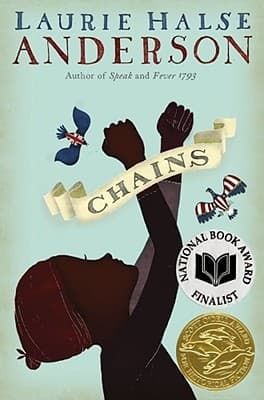
Laurie Halse Anderson (2008)
Genre
Children's / Historical Fiction / Young Adult
Reading Time
4-5 hours
Key Themes
See below
Sign in to track this book
Caught between the Loyalists and Patriots, a young enslaved girl in Revolutionary New York navigates espionage and betrayal in a desperate, deeply personal quest for freedom after her promised emancipation is cruelly stolen.
In January 1776, thirteen-year-old Isabel and her younger sister, Ruth, are enslaved in Newport, Rhode Island. Their owner, Miss Mary Finch, dies, and her will states that Isabel and Ruth are to be freed. However, Miss Finch's nephew, Robert Finch, ignores the will and quickly sells the girls to the Locktons, a wealthy Loyalist couple from New York City. Isabel, fiercely protective of Ruth, tries to assert their freedom, but Robert threatens her. The Locktons, especially Madam Lockton, immediately show their cruel authority, making it clear that Isabel and Ruth will live as servants in a city on the brink of war.
Isabel and Ruth travel by ship to New York City, a busy center for Loyalist and Patriot activity. When they arrive, they are put to work in the Locktons' large house. During an errand, Isabel meets Curzon, a slave belonging to the Patriot Bellingham family. Curzon, wearing a red hat, asks Isabel to spy for the Patriots. He explains that the Locktons are Loyalists with connections to British officers and that their house could be a good source of information. Isabel hesitates, as her main concern is Ruth's safety and their freedom, not politics.
While serving Madam Lockton, Isabel overhears conversations and sees suspicious activities that confirm Curzon's suspicions about the Locktons' Loyalist ties. She discovers that Master Lockton is involved in a plan to assassinate General George Washington, who is expected in New York. Isabel realizes how serious this is and sees a chance to use this information for her and Ruth's freedom, so she decides to act. She slips away from the Locktons' house and reports the plot to Colonel Regan, a Patriot officer. He first dismisses her because she is a slave, but eventually takes her seriously.
Isabel's information about the assassination plot proves important. Colonel Regan and the Patriots raid a tavern where the conspirators, including Master Lockton, are meeting. The plot is stopped, and several men are arrested, though Master Lockton escapes immediate capture by pretending to be ill and hiding in a chest. Isabel, despite her vital help, receives no recognition or promise of freedom from the Patriots. Instead, she is sent back to the Locktons, who are angry and suspicious, though unaware of her direct involvement. This incident makes Isabel more cynical about the Patriots' promises.
Ruth, who has always been frail, has a severe epileptic seizure. Madam Lockton, who is superstitious and cruel, believes Ruth's illness is a sign of demonic possession. She becomes afraid of Ruth and treats her with extreme scorn and fear, believing Ruth is a danger to the household. Isabel, seeing her sister suffer and Madam Lockton's terrible reaction, feels helpless and angry. This event is a turning point, strengthening Isabel's hatred for Madam Lockton and her resolve to protect Ruth at all costs, even if it means defying her owners.
Driven by her fear and hatred, Madam Lockton decides to sell Ruth, sending her to a plantation in the Caribbean. She tells Isabel that Ruth has gone to live with a family in the country, but Isabel knows this is a lie, recognizing the signs of her sister being sold. Devastated and enraged by being separated from her only family, Isabel confronts Madam Lockton. Her defiance leads to a brutal punishment: Madam Lockton has Isabel publicly branded on the cheek with the letter 'I' for 'Insolence.' This extreme cruelty leaves Isabel physically and emotionally scarred, but also strengthens her resolve to escape.
The Revolutionary War grows more intense, and British forces launch a major attack on New York City. The Battle of Long Island results in a British victory, and the city falls under British occupation. The Locktons, as Loyalists, welcome the British, and their house becomes a center for British officers. Isabel, now bearing her brand scar, observes the changing city. The British promise freedom to any slave who deserts a Patriot master, which gives Isabel a glimmer of hope, though she remains enslaved to Loyalist owners. The city is chaotic, full of soldiers, prisoners, and refugees.
Despite her earlier disappointment with the Patriots, Isabel continues to gather information from the Locktons' house, passing it to Curzon, who now works for the Patriot cause. However, the British eventually capture Curzon and imprison him in the Provost Dungeon. Isabel, feeling a bond with him and remembering his earlier help, begins to secretly bring food and messages to Curzon and other Patriot prisoners, risking her own safety. She uses her errands for the Locktons as cover, showing her growing courage and cleverness in the face of danger.
A large, uncontrolled fire breaks out in New York City, destroying much of the wooden city. The Locktons' house is spared, but the chaos of the fire gives Isabel an unexpected chance. Seeing the city in disarray and the authorities busy, Isabel realizes this is her opportunity to escape. She carefully plans her departure, gathering what few supplies she can. The fire represents the destructive nature of war, but also the possibility for new beginnings and the breaking of old structures, mirroring Isabel's desire to break free from her own chains.
Executing her plan during the fire's confusion, Isabel forges a pass using Master Lockton's signature and a blank paper. She goes to the Provost Dungeon, where she convinces the guards to release Curzon, claiming he is needed for a task by Master Lockton. With Curzon, weak and ill, in tow, Isabel takes a small boat, leaving the burning city behind. They row across the river, heading for Patriot-held New Jersey, determined to find Ruth and finally claim their freedom. The journey is dangerous, but Isabel's resolve is firm.
The Protagonist
Isabel transforms from a hopeful, naive girl into a cunning, independent young woman who takes charge of her own destiny, finding her voice and true courage.
The Supporting
Ruth's physical and emotional vulnerability serves as a catalyst for Isabel's growth, though Ruth herself does not undergo a significant personal arc within the narrative.
The Antagonist
Madam Lockton remains a static character, her cruelty and self-interest never wavering, serving as a constant oppressive force.
The Supporting
Master Lockton's character remains largely static, primarily serving as a vehicle for the Loyalist political intrigue.
The Supporting
Curzon evolves from a confident recruiter to a vulnerable prisoner, ultimately joining Isabel in a desperate bid for freedom.
The Supporting
Colonel Regan's character remains largely static, embodying the limitations and prejudices within the Patriot movement.
The Supporting
Grandfather serves as a spiritual guide, his wisdom providing Isabel with comfort and direction.
The Supporting
Sarah remains a consistently kind and supportive figure throughout her presence in the story.
The novel explores freedom not just as a physical state but also as an internal, spiritual condition. Isabel's journey shows that political freedom (for the Patriots) does not automatically mean personal freedom for enslaved people. The Patriots fight for their own liberty from Britain, yet many deny freedom to their own enslaved people. Isabel learns that true freedom means controlling one's destiny, even if it requires defying society and risking one's life. This is clear when she reclaims her name, 'Isabel Gardener,' and finally escapes, understanding that her spirit is not bound by slavery or the brand on her cheek.
“'A name is a person's first possession. It's the only thing that can't be stolen.'”
Isabel's struggle for identity is central to the novel. Stripped of her name (called 'Sal Lockton' by her owners) and marked with a 'brand' of 'Insolence,' she fights to keep her sense of self. Grandfather's wisdom about names and the 'river' helps her understand that her worth is inherent, not defined by her enslavers. Her refusal to accept the name 'Sal' and her eventual reclaiming of 'Isabel Gardener' are strong acts of self-affirmation. The internal battle to preserve her dignity and humanity against dehumanizing treatment is a constant theme, ending in her courageous escape.
“'The chains that held us were forged of fear and indifference, not iron.'”
The novel shows the deep hypocrisy of a society fighting for liberty while also supporting slavery. The Patriots, who champion 'freedom' and 'rights,' repeatedly betray Isabel's trust and deny her the very liberty they seek for themselves. Colonel Regan's failure to grant Isabel freedom after she provides important information is a key example. The Locktons' betrayal of Miss Finch's will sets up Isabel's initial enslavement. These betrayals force Isabel to rely only on herself and to question the true motives of both Loyalists and Patriots, seeing that neither side is truly just in its treatment of enslaved people.
“'Melancholy held me hostage, and the chains of my past clinked in the darkest corners of my mind.'”
Isabel shows incredible resilience when faced with constant adversity. Despite abuse, separation from her sister, and the constant threat of violence, she never gives up hope for freedom. Her acts of resistance range from subtle defiance (like refusing the name 'Sal') to open rebellion (spying, attempting to escape, freeing Curzon). Her inner strength allows her to endure the branding and the emotional pain of Ruth's 'sale.' The novel shows how enslaved people found various ways to resist oppression, both openly and by preserving their inner spirit, ultimately leading to Isabel's successful escape.
“'My name is Isabel. I am not Sal. I am Isabel.'”
A physical mark of Isabel's enslavement and defiance.
The branding iron, used to mark Isabel's cheek with an 'I' for 'Insolence,' serves as a powerful symbol of dehumanization, ownership, and the brutality of slavery. It is a physical manifestation of Madam Lockton's cruelty and the system's attempt to strip Isabel of her identity. However, Isabel transforms this mark of shame into a symbol of her resilience and defiance. The brand becomes a constant reminder of what she is fighting against, fueling her resolve for freedom rather than breaking her spirit.
A recurring metaphor for freedom, passage, and spiritual journey.
The river (specifically the water surrounding Manhattan) functions as a potent metaphor throughout the novel. Grandfather tells Isabel that 'the river is waiting,' signifying a path to freedom and a spiritual journey beyond the confines of slavery. It represents the boundary between oppression and potential liberty, a physical barrier that must be crossed to reach a new life. Isabel's eventual escape by boat across the river is the literal fulfillment of this metaphor, symbolizing her passage from bondage to self-liberation and the start of her quest to find Ruth.
The initial catalyst for Isabel's journey and a symbol of broken promises.
Miss Finch's will, which explicitly grants Isabel and Ruth their freedom, is the inciting incident of the novel. Its betrayal by Robert Finch immediately establishes the injustice and arbitrary nature of slavery, regardless of legal documents. The will represents a broken promise and highlights how the legal system often failed to protect enslaved people. It sets Isabel's core motivation for seeking freedom and underscores the theme of betrayal, as the very document meant to free her becomes the first instance of her rights being denied.
A distinctive identifier for Curzon and a symbol of Patriot allegiance.
Curzon's red hat serves as a simple yet effective plot device for identification and symbolism. It makes him recognizable to Isabel and to the reader, marking him as a distinct character. More importantly, the red hat initially signals his allegiance to the Patriot cause, as it's a color associated with the rebel soldiers (though often confused with British redcoats). It becomes a subtle symbol of the choices and risks taken during wartime, and later, even in prison, it signifies his enduring spirit and connection to the fight for liberty, both political and personal.
“My name is Isabel, not girl.”
— Isabel's internal defiance against being dehumanized by her enslavers.
“A tiny rebellion sparked in my chest. If I was going to be a slave, I would be a spy.”
— Isabel's decision to use her forced proximity to Loyalists to gather intelligence for the Patriots.
“The world was a large cage, and we were all trapped inside.”
— Isabel's reflection on the pervasive lack of freedom, even for those not legally enslaved.
“Curzon had said that a person’s name was like a tree, with roots that grew deep and branches that reached for the sky. He said that my name was a strong tree, and that it would not be easily cut down.”
— Isabel recalling Curzon's words about the importance of her name and identity.
“Melancholy held me hostage, and the only chains I felt were the ones around my heart.”
— Isabel's emotional state after the loss of her sister, Ruth, and her own difficult circumstances.
“The library was a dangerous place. It was a place where people could think.”
— Isabel's discovery of the power of books and knowledge while working for the Locktons.
“A person cannot steal what is not theirs to begin with.”
— Isabel's internal justification for her actions against her enslavers, recognizing her inherent right to freedom.
“Fire and water, earth and air. We are all made of the same stuff. We are all connected.”
— Isabel's contemplation of the interconnectedness of humanity, despite societal divisions.
“My body was a cage, but my mind was free.”
— Isabel's mental escape and resilience in the face of physical bondage.
“Words are like seeds. They grow into thoughts, and thoughts grow into actions.”
— Isabel's growing understanding of the power of communication and ideas.
“Hope is a powerful thing. It can make you do things you never thought possible.”
— Isabel reflecting on the motivation behind her perseverance and acts of courage.
“I was a ghost, a shadow, a whisper in the wind. But I was still here. And I would not be forgotten.”
— Isabel's determination to maintain her existence and identity despite being overlooked and abused.
“No matter how many chains they put on my body, they could not chain my spirit.”
— Isabel's unwavering internal strength and refusal to be completely broken by slavery.
“The truth has a way of coming out, no matter how hard you try to bury it.”
— Isabel's observation about the inevitable revelation of secrets and injustices.
Ready to see how well you understood this book? Take our interactive quiz with 10 questions.

Biography coming soon.

Dan Gemeinhart
4.5

Kate O'Hearn
4.4

Jeanne Birdsall
4.4

Jen Wang
4.4

Wendelin Van Draanen
4.3

John Marsden
4.3

Chris Van Allsburg
4.3

Jennifer A. Nielsen
4.2