“She had survived, had learned, had grown. She was not the same woman who had walked into that hellish place, and she would never be again.”
— Eve reflects on her past trauma and growth.

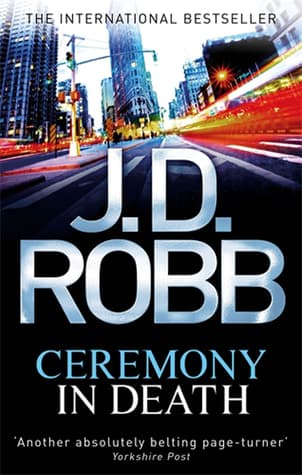
Genre
Thriller / Mystery / Science Fiction / Romance
Reading Time
6-7 hours
Key Themes
See below
Sign in to track this book
In a future New York where ancient evils persist, Lieutenant Eve Dallas investigates a fellow officer's death, forcing her to confront loyalty, justice, and the power of malevolence, all while a personal warning lands on her doorstep.
Lieutenant Eve Dallas investigates the death of Commander Abraham Skinner, a decorated officer found in a hotel room with a prostitute named Tanya. The initial assessment suggests a heart attack, but Eve notices inconsistencies. Skinner's uniform is meticulously folded, and his personal communicator is missing. Tanya seems unusually calm and provides a rehearsed alibi. Eve's superiors, particularly Captain Ryan Feeney, want to close the case quickly to protect the police force's reputation, but Eve senses something more sinister, leading her to investigate Skinner's life and the circumstances of his death.
As Eve continues her investigation, she returns home to find a disturbing package on her doorstep: a severed human hand. This is a direct threat, indicating the killer knows where she lives and is trying to intimidate her. Her husband, Roarke, a billionaire businessman with a shadowy past, immediately recognizes the message's gravity. The hand belongs to a low-level criminal named Benny, recently released from prison. This escalates the case from a suspicious death into a targeted attack against Eve, forcing her to confront the possibility that the killer knows her life and methods intimately.
Eve and her team investigate Commander Skinner's background, finding little to suggest a hidden life. However, after extensive digging, Peabody uncovers suspicious financial transactions and a hidden data chip in Skinner's belongings. This leads them to a secluded, high-tech compound called 'The Community,' a seemingly benevolent self-help organization led by Brother Michael. Eve suspects 'The Community' is a front for something darker, possibly a cult, and that Skinner's death is directly linked to his involvement. The investigation shifts from a simple murder to uncovering the secrets of this group.
Eve, with Roarke's help, decides to go undercover to access 'The Community.' Roarke, using his resources, arranges for them to attend an introductory session. They observe Brother Michael, a man of mesmerizing charm, who preaches about purity, discipline, and achieving a higher state of being. Eve is disturbed by his followers' fervent devotion, who seem to have surrendered their individual wills to him. Roarke, with his own experience dealing with powerful, controlling figures, recognizes the dangerous psychological manipulation, confirming Eve's suspicions that Brother Michael is more sinister than he appears.
Through investigation and analysis of data recovered from Skinner's hidden chip, Eve and her team uncover the horrific nature of 'The Community's' inner circle. They discover that Brother Michael's 'Ceremony of Purity' involves the ritualistic murder of individuals deemed 'impure' or 'unworthy,' often those who question his authority or try to leave. Victims are chosen from within the community, and their deaths are orchestrated to appear as accidents, suicides, or natural causes. Skinner, it turns out, had become disillusioned and was trying to expose Brother Michael, leading to his own death. Eve realizes she is dealing with a highly organized and ruthless killer who uses spiritual manipulation as a cover for murder.
As Eve investigates, she identifies Brother Amos, a large, imposing man, as Brother Michael's primary enforcer and likely perpetrator of the murders. Amos is loyal to Michael and carries out his commands without question, acting as the physical arm of the cult's violence. His background reveals a history of violence and complete devotion to Michael, suggesting he has been indoctrinated. The severed hand left for Eve was likely Amos's work, a direct message from the cult to intimidate her. Eve realizes that confronting Brother Amos will be dangerous, as he is physically formidable and driven by a fanatical belief in Michael's cause.
While assisting Eve, Roarke begins to feel a disturbing familiarity with Brother Michael's methods and rhetoric. He realizes that Michael's teachings and manipulative tactics resemble those of the cult leader who controlled his own mother and led to her tragic death. This personal connection ignites a fierce, protective fury in Roarke, who sees Michael as a direct threat to everything he holds dear, especially Eve. His past trauma resurfaces, making him even more determined to dismantle Michael's organization, not just for Eve's safety, but to avenge the suffering caused by similar figures in his own life. This personal investment adds urgency and danger to the investigation.
Armed with overwhelming evidence, Eve obtains a warrant and leads a full-scale raid on 'The Community.' The compound, initially serene, quickly reveals its hidden defenses and the fanatical resistance of its members. Eve and her team face armed resistance from Brother Amos and other indoctrinated followers. A fierce firefight ensues as Eve works her way through the compound to reach Brother Michael. The raid is chaotic and dangerous, pushing Eve and her officers to their limits, highlighting the extreme lengths to which Michael's followers will go to protect him and their beliefs.
Eve finally corners Brother Michael in his inner sanctum. The confrontation is primarily psychological, as Michael tries to use his charismatic manipulation on Eve, attempting to undermine her resolve and justify his actions with twisted spiritual rhetoric. Eve, however, remains impervious to his charms, her focus unwavering. She systematically dismantles his arguments, exposing the cruelty and hypocrisy beneath his piety. The scene is a battle of wills, with Eve demonstrating her moral compass against Michael's insidious evil. He refuses to surrender, believing himself untouchable and divinely chosen, forcing Eve to make a critical decision.
Brother Michael, despite his attempts to escape or manipulate, is ultimately captured and arrested, though not without a final, desperate struggle. Brother Amos is killed during the raid after attempting to attack Eve. The remnants of 'The Community' are shattered, and remaining members are offered counseling and support to deprogram from Michael's influence. In the aftermath, Eve grapples with the insidious nature of the evil she encountered, reflecting on how easily people can be manipulated and how dangerous blind faith can be. She finds solace in Roarke's steadfast presence and her own commitment to upholding justice, even against the most seductive forms of evil.
The Protagonist
Eve confronts a form of evil that challenges her understanding of human nature, forcing her to rely on her inner strength and the support of her husband.
The Supporting
Roarke confronts personal demons from his past as Brother Michael's cult reminds him of his mother's tragic fate, solidifying his commitment to Eve and justice.
The Antagonist
Brother Michael's reign of terror is exposed and dismantled by Eve, proving that even the most seductive forms of evil cannot escape justice.
The Supporting
Peabody continues to develop her detective skills and confidence under Eve's mentorship, solidifying her role as a crucial member of the team.
The Mentioned
Skinner's arc is completed before the book begins; his death serves as the inciting incident and a cautionary tale of falling prey to manipulative cults.
The Supporting
Brother Amos's unwavering loyalty to Michael leads to his violent demise during the police raid.
The Supporting
Feeney continues to support Eve, demonstrating his unwavering trust in her abilities even when the case becomes politically sensitive.
The Supporting
Dr. Mira provides essential psychological insights into the cult, reinforcing her role as a key consultant for Eve.
This theme explores how charismatic figures like Brother Michael manipulate vulnerable individuals, leading them to commit horrific acts under the guise of spiritual enlightenment. The novel illustrates psychological tactics used to strip followers of individuality, replacing it with unwavering devotion. Commander Skinner's initial involvement and subsequent disillusionment highlight the insidious nature of cults. The followers' willingness to kill and die for Michael underscores the dangers of blind faith and how easily people can be led astray by promises of purity and belonging.
“Evil isn't always a monster, Dallas. Sometimes it's a man with a beautiful smile and a comforting voice, whispering promises into lonely ears.”
The novel explores the line between Eve's professional pursuit of justice and Roarke's personal vendetta against Brother Michael. Eve is driven by duty and her moral code, seeking to uphold the law, while Roarke's motivation is rooted in his past trauma with cults and his desire to protect Eve. This tension is evident in Roarke's more aggressive and morally ambiguous tactics compared to Eve's adherence to police procedure. The story explores whether personal investment enhances or compromises the pursuit of justice, especially when the lines between right and wrong blur.
“I don't just want him locked up, Eve. I want him broken. I want him to suffer.”
Despite the futuristic setting, the human need for connection and loyalty is a strong theme. Eve, an orphan, has built her own 'family' with Roarke, Peabody, Feeney, and others. The loyalty within her police unit contrasts with the twisted loyalty Brother Michael demands from his cult members. The novel shows the strength of genuine, chosen family bonds, like Eve and Roarke's unwavering support for each other, against the coercive, destructive 'family' dynamic of the cult, where loyalty is enforced through fear and manipulation. This theme shows that true family is built on love and respect, not control.
“You're my family, Roarke. My whole damn world. And nobody touches my world.”
Both Eve and Roarke confront their past traumas in this case. Eve's difficult childhood and her battle against darkness make her sensitive to victims' suffering. Roarke's personal history with cults, particularly his mother's tragic fate, resurfaces, making Brother Michael a deeply personal enemy. The case acts as a catalyst for both characters to revisit old wounds, strengthening their bond as they face these challenges together. Their ability to confront and overcome these demons is central to their character development and the plot's resolution.
“I know what it's like, Eve, to see someone you love lost to that kind of madness. To that kind of evil.”
Misleading clues used to divert the reader's attention.
The initial staging of Commander Skinner's death as a heart attack in a seedy hotel room with a prostitute serves as a significant red herring. This setup is designed to make the police, and the reader, believe it's a simple case of a respected officer having a fatal lapse in judgment. This initial misdirection attempts to close the case quickly, protecting the department's image, and makes Eve's persistence in looking deeper seem almost insubordinate, highlighting her unique investigative intuition.
A character whose testimony or perspective is intentionally misleading.
Tanya, the prostitute found with Commander Skinner, acts as an unreliable witness. Her calm demeanor, rehearsed alibi, and quick dismissal of Skinner's death as a natural occurrence immediately raise Eve's suspicions. Tanya's testimony is crafted by the cult to cover up the murder, making her a pawn in Brother Michael's scheme. Her unconvincing performance is a key indicator to Eve that the official story is a fabrication and that there's more to Skinner's death than meets the eye.
The audience knows something the characters do not.
Dramatic irony is present when the reader, alongside Eve and Roarke, begins to understand the true, sinister nature of 'The Community' and Brother Michael, while many of the cult's followers remain blissfully unaware of the murderous rituals. This creates tension as Eve and Roarke infiltrate the group, knowing the danger they are in and the dark secrets hidden beneath the veneer of enlightenment, while the other members continue to believe in Michael's benevolence. This heightens the sense of dread and urgency for the protagonists.
Hints or clues about future events in the story.
Roarke's initial unease and strong reaction to the mention of cults, even before Brother Michael is identified, foreshadows his personal connection to the case. His past experiences with a cult that took his mother's life are hinted at, suggesting that this investigation will resonate deeply with him. The severed hand placed at Eve's home also foreshadows the personal danger and the extreme lengths the cult will go to intimidate anyone who threatens them, indicating that the conflict will become highly personal for Eve.
“She had survived, had learned, had grown. She was not the same woman who had walked into that hellish place, and she would never be again.”
— Eve reflects on her past trauma and growth.
“The dead don’t care about your feelings, Dallas. They just are.”
— Roarke reminds Eve of the stark reality of death.
“Justice, she thought, was a tricky bitch. Sometimes she whispered, sometimes she screamed.”
— Eve contemplates the nature of justice while investigating a case.
“There were a lot of things she didn't know, but how to catch a killer wasn't one of them.”
— Eve's confidence in her detective skills during an investigation.
“Love wasn’t a weakness. It was the greatest strength of all, a shield and a sword.”
— Eve's evolving understanding of love through her relationship with Roarke.
“Some monsters wore human faces, and some of them wore suits.”
— Eve's cynical view of human nature and crime.
“You can’t outrun your past, Dallas, but you can choose what you do with it.”
— Roarke's advice to Eve about dealing with her traumatic past.
“The city never slept, and neither did its demons.”
— Eve's observation about the constant presence of crime in New York City.
“It wasn't about the kill, it was about the control. The power.”
— Eve's insight into the motivation of a particular killer.
“Sometimes the ugliest truths were the most necessary.”
— Eve facing a difficult revelation in her investigation.
“She was a cop, not a social worker. But sometimes the lines blurred.”
— Eve grappling with the emotional toll of her job.
“Every victim had a story, and it was her job to hear it, even if they couldn't speak.”
— Eve's dedication to giving a voice to the victims.
“Even in the darkest corners, there was always a flicker of light.”
— Eve finding hope amidst the grim realities of her work.
“She didn't need a cape to be a hero. Just a badge, a gun, and an unbreakable will.”
— Eve's internal monologue about her identity as a detective.
Ready to see how well you understood this book? Take our interactive quiz with 10 questions.

Biography coming soon.







