“We're all digital now, but I think what's lost is the analog. The real connection.”
— Early in the story, Clay considers the ubiquity of cell phones and the potential loss of genuine human interaction.

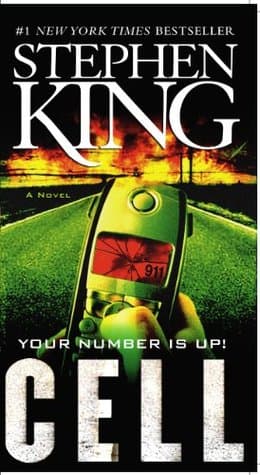
Stephen King (2006)
Genre
Thriller / Fantasy / Science Fiction
Reading Time
900 min
Key Themes
See below
Sign in to track this book
When cell phone calls turn ordinary people into rabid, murderous zombies, a graphic artist navigates a post-apocalyptic New England to find his son.
Clayton Riddell, a graphic artist, is in Boston celebrating a new comic book deal when 'The Pulse' strikes. At 3:03 PM, every active cell phone transmits a signal that instantly turns anyone using it into a rabid, violent, and mindless 'phoner.' Chaos erupts as these phoners attack uninfected people, causing widespread destruction and death. Clay sees the horrific transformations and slaughter, barely escaping the initial violence. He is separated from his wife, Sharon, and son, Johnny, whose fates are unknown. The city descends into anarchy as the uninfected struggle to survive against many phoners.
Amid the urban collapse, Clay meets Tom McCourt, a middle-aged man who used a payphone during The Pulse, avoiding its effects. They quickly realize the danger of the phoners, who seem to operate with instinctual aggression. Later, they find Alice Maxwell, a terrified teenage girl hiding in a department store. Alice, having seen her mother become a phoner, is traumatized but resilient. The three decide to travel together, aiming to escape Boston and find safety. They notice that the phoners, initially mindless, show some basic collective behaviors, like gathering in large groups and moving with a strange, coordinated purpose.
Clay, Tom, and Alice decide to head north, hoping to reach Clay's home in Kent Pond, Maine, where he believes his son Johnny might be. Their journey is dangerous, as they constantly evade phoners and scavenge for supplies. They observe the phoners' changing behavior: they are no longer just randomly violent but are gathering in specific locations, making a strange, almost ritualistic buzzing sound, and seem to be 'recharging.' The survivors also encounter other uninfected people, some hostile, some helpful. They experience the psychological toll of the apocalypse, with Alice struggling with PTSD and Clay haunted by his family's unknown fates.
As they travel, the group finds temporary sanctuary in Kashwak, Maine, a seemingly deserted private school. Here, they make a horrifying discovery: the phoners are not only evolving but are developing telepathic abilities, forming a hive mind. They are also starting to show more sophisticated behaviors, such as herding and trapping the uninfected. The phoners are led by a particularly powerful and malevolent entity called the 'Raggedy Man,' who appears in their collective consciousness and drives their increasingly coordinated actions. This changes their understanding of the threat, from mindless zombies to a dangerous, evolving collective intelligence.
While in Kashwak, Clay, Tom, and Alice meet a group of survivors from New Hampshire, led by Jordan, a young boy with a knack for observation and strategy. This new group includes Denise, a tough woman who becomes a close ally. They combine resources and knowledge, confirming their fears about the phoners' evolution. Jordan reveals his observations about the phoners' patterns and the apparent existence of a central intelligence. Together, they plan to strike back against the phoners, realizing that mere evasion is no longer enough. Alice, however, dies during a phoner attack, deeply affecting the group.
The survivors learn that the phoners gather at the local airport, which acts as a central hub for their evolving hive mind, overseen by the Raggedy Man. Jordan, with his sharp mind, devises a daring plan: they will use a truck full of propane tanks and explosives to blow up the airport, hoping to disrupt or destroy the phoners' collective intelligence and their leader. The plan is risky and requires careful execution, as the phoners can now anticipate human movements and set traps. Clay, driven by the hope of finding Johnny, volunteers to be a key part of the mission, along with Tom, Jordan, and Denise.
The group infiltrates the airport, a gathering place for thousands of phoners, all buzzing with their eerie collective hum. They successfully position the truck filled with explosives. During the mission, they face intense resistance from the phoners, who seem to have a psychic awareness of their presence. Clay directly confronts the Raggedy Man, who appears as a mental projection, taunting him and revealing the extent of the phoners' new powers. The Raggedy Man's telepathic presence is overwhelming, trying to break Clay's will. Despite the mental assault, Clay activates the explosives, causing a massive explosion that engulfs the airport and seemingly destroys the phoner hive.
The explosion at the airport scatters the phoners, temporarily disrupting their collective. Many are destroyed, and the remaining ones seem to revert to a more disorganized, less intelligent state. The Raggedy Man's influence is diminished, but not entirely gone. With the immediate threat seemingly neutralized, the surviving members of the group go their separate ways. Clay, still wanting to find Johnny, continues his journey to Kent Pond, Maine, despite the lingering dangers. He is alone again, armed with the knowledge of the phoners' resilience and the unsettling possibility that The Pulse's effects might not be entirely reversible.
Clay finally reaches Kent Pond, his hometown, only to find it deserted and quiet. He discovers Johnny, but his son is not the same. Johnny, along with other uninfected survivors in the town, has been 'flocked' by the phoners. This means they are not fully transformed but are under the phoners' telepathic control, acting as servants or puppets. They are in a catatonic state, performing strange, repetitive tasks, their minds partially taken over. Clay is devastated to see his son in this condition, realizing that The Pulse's effects are far more insidious and complex than mere transformation into violent creatures. He now faces a new, even more heartbreaking challenge.
Driven by love and desperate hope, Clay recalls a theory he and Tom discussed: that the phoners might be 'rebootable' if exposed to another, controlled Pulse. He finds an active cell phone and, despite the immense risk, decides to use it on Johnny. He believes that if the original Pulse turned people into phoners, a second, controlled pulse might 'reset' them. The act is a leap of faith, uncertain, as it could either restore Johnny or complete his transformation into a full phoner. The book ends ambiguously, with Clay holding the phone to Johnny's ear, the outcome of his desperate gamble left unknown, leaving the reader to ponder the ultimate fate of Johnny and humanity.
The Protagonist
Clay transforms from a bewildered survivor into a determined leader, willing to take extreme risks to protect others and find his son, even if it means confronting the source of the apocalypse.
The Supporting
Tom remains a consistent source of support and reason, evolving from a shocked survivor into a hardened but still compassionate companion.
The Supporting
Alice begins as a traumatized victim, gradually finding strength and companionship, only to tragically succumb to the dangers of the post-Pulse world.
The Antagonist
The Raggedy Man evolves from an unseen influence to a fully manifest, telepathic antagonist, representing the ultimate, non-human threat to humanity.
The Supporting
Jordan emerges as a strategic genius, proving that intellect and resourcefulness can be powerful weapons against a seemingly unstoppable enemy.
The Supporting
Denise proves her resilience and resourcefulness, becoming a vital member of the combined survivor group.
The Mentioned/Supporting
Johnny's presence drives Clay's journey, and his 'flocked' state at the end presents a final, ambiguous challenge.
The Mentioned
Sharon's status remains unresolved, symbolizing the sweeping and often final losses incurred by The Pulse.
The novel critiques humanity's over-reliance on technology, specifically cell phones, by making them the literal weapon of the apocalypse. The Pulse transmits through the very devices meant to connect people, turning them into instruments of destruction. King suggests that constant connectivity and immersion in digital life can be a vulnerability, stripping away humanity and leaving us susceptible to external control. The phoners, once individuals, become a hive mind, mirroring fears of conformity and loss of individuality in a technologically saturated society. The irony of communication devices leading to the breakdown of all communication is central to this theme.
“''The Pulse, coming like a flash flood, had simply wiped the slate clean. No more cell phones, no more computers, no more television, no more Internet. No more anything.'''”
A core theme explores the complete loss of individual identity among the phoners, who become part of a telepathic hive mind. Initially mindless, they evolve into a coordinated, intelligent collective, led by the Raggedy Man. This contrasts with the uninfected survivors' struggles to maintain their unique identities, emotions, and moral compasses in a world without societal norms. The phoners' 'flocking' of some survivors, like Johnny, further emphasizes the insidious nature of this collective, which seeks to assimilate rather than merely destroy. It questions the value of individual thought when faced with a powerful, unified entity.
“''They weren't just crazy anymore. They were connected. They were a network. And the network had a boss.'”
The novel shows the rapid collapse of civilization after The Pulse. Laws, social structures, and common decency vanish almost instantly, replaced by a brutal struggle for survival. The uninfected survivors must confront their own primal instincts for self-preservation, leading to difficult moral choices. The phoners, in their initial stages, embody pure, animalistic aggression, reflecting humanity's baser nature unleashed. The story explores how quickly civilization can crumble, revealing the raw, often violent, core beneath, and the difficult process of building new forms of community and purpose in a shattered world.
“''The world had gone from normal to hell in less than a minute.'”
Despite the horror and loss, the characters cling to hope. Clay's relentless search for Johnny shows this, as does the group's plan to strike back against the phoners. However, this hope often mixes with desperation, leading to risky and ambiguous actions, such as Clay's final attempt to 'reboot' Johnny. The novel offers no easy answers or guaranteed victories. Instead, it portrays a world where survival is a daily struggle and the future remains uncertain, yet the human spirit's refusal to surrender completely endures, even if it leads to potentially futile gestures.
“''Sometimes a desperate hope is the only kind you have.'”
The inciting incident and catalyst for the apocalypse.
The Pulse is the mysterious, instantaneous signal transmitted through cell phones that transforms humans into 'phoners.' It acts as the central plot device, initiating the entire narrative and establishing the rules of the new, apocalyptic world. Its enigmatic origin (never fully explained) adds to the horror and unpredictability. The Pulse is not just a single event but an ongoing force, as its effects evolve, driving the narrative forward and constantly raising the stakes as the phoners develop new abilities and the survivors struggle to understand and counter them.
The gradual development of the phoners from mindless zombies to a telepathic hive mind.
This device creates a continuously escalating threat. Initially, the phoners are mindless, violently aggressive creatures. However, as the story progresses, they begin to exhibit coordinated behavior, gather in 'flocks,' and eventually develop telepathic communication and a collective intelligence led by the Raggedy Man. This evolution keeps the survivors, and the reader, on edge, forcing them to constantly adapt their strategies and deepening the mystery and horror of the new enemy. It transforms the conflict from a simple zombie survival story into a more complex battle against an evolving, non-human consciousness.
Clay's personal quest to find his son, Johnny, as a driving force.
This device provides the emotional core of the narrative, giving Clay's journey a deeply personal and relatable motivation beyond mere survival. His unwavering hope and desperation to find Johnny (and Sharon) humanize the apocalyptic setting and provide a clear, compelling objective for the protagonist. It allows the reader to connect with Clay on an emotional level, emphasizing the universal desire to protect loved ones, even in the most dire circumstances. The ambiguity of Johnny's fate at the end amplifies the emotional impact of this device.
The speculative idea that a second Pulse might reverse the phoners' condition.
This plot device is introduced late in the novel as a desperate, unproven hypothesis. It serves to raise the stakes in the climax and provides a glimmer of hope, however slim and dangerous. The 'reboot' theory challenges the finality of The Pulse's effects and offers a potential, albeit highly risky, solution to the phoners' condition, particularly for the 'flocked' individuals like Johnny. Its ambiguous outcome at the very end leaves the reader with a powerful, unresolved question about the nature of the transformation and the possibility of redemption, rather than a definitive closure.
“We're all digital now, but I think what's lost is the analog. The real connection.”
— Early in the story, Clay considers the ubiquity of cell phones and the potential loss of genuine human interaction.
“The world had not ended, not really, but it had certainly been put on hold.”
— Clay reflects on the immediate aftermath of The Pulse, where society is in a state of suspended animation.
“We're not just fighting the phoners; we're fighting what they represent. The end of everything we thought we knew.”
— Tom McCourt articulates the broader struggle against the new reality created by The Pulse.
“There are no goodbyes in the apocalypse, only sudden absences.”
— Clay muses on the abrupt and often unceremonious departures of people in the post-Pulse world.
“The phone was a weapon now, not a convenience.”
— The survivors realize the very devices that connected them have become tools of destruction and control.
“In a world without rules, the only rule is to survive.”
— A pragmatic view of the new societal order, or lack thereof, adopted by the uninfected.
“They weren't just infected; they were *activated*.”
— The survivors begin to understand that the phoners aren't merely mindless zombies but are evolving.
“Sometimes the only way to save yourself is to stop trying to save everyone else.”
— A harsh lesson learned about self-preservation in extreme circumstances.
“The world was a slaughterhouse now, and we were just the next in line.”
— A grim realization of the pervasive danger and the precariousness of their existence.
“The ultimate irony: the things that connected us are now the things that destroy us.”
— A recurring theme about the double-edged sword of modern technology.
“You can't outrun the future, no matter how much you might want to.”
— A philosophical observation about the inevitability of change and progress, even catastrophic change.
“Fear is a powerful motivator, but sometimes hope is even stronger.”
— Despite the overwhelming odds, the characters cling to hope for their loved ones and a better future.
“There's always a choice, even when it feels like there isn't one.”
— A mantra of resilience, reminding the characters that agency remains even in dire situations.
Ready to see how well you understood this book? Take our interactive quiz with 10 questions.

Stephen Edwin King is an American author of horror, supernatural fiction, suspense, crime, science-fiction, and fantasy novels. Described as the "King of Horror", his books have sold more than 350 million copies as of 2006, and many have been adapted into films, television series, miniseries, and comic books. King has published over 65 novels/novellas, including seven under the pen name Richard Bachman, and five non-fiction books. He has also written approximately 200 short stories, most of which have been published in book collections.







