“Cassandra didn't need a crystal ball to see that her life was about to get complicated.”
— Cassandra reflecting on her future after discovering her prophetic abilities.

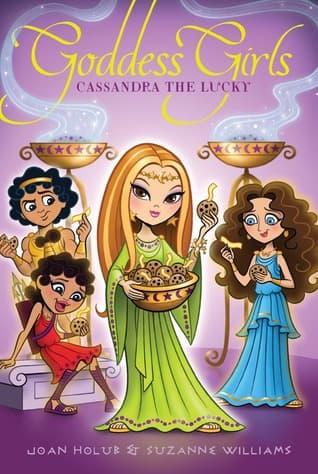
Joan Holub (2013)
Genre
Fantasy / Children's / Romance
Reading Time
240 min
Key Themes
See below
Sign in to track this book
At Mount Olympus Academy, Cassandra, a new student with foresight, struggles to convince classmates of dangers while developing a romance with Apollo, the god of prophecy, who may be her only ally.
Cassandra, a mortal girl, arrives at Mount Olympus Academy as a new student, feeling nervous among the gods and goddesses. She quickly meets her friendly roommate, Persephone. Cassandra has a secret: she sees glimpses of the future. However, she has learned that whenever she tries to warn others, they never believe her. This lack of credibility makes her hesitant to share her visions, causing her to feel alone, even as she tries to make friends. She hopes her fresh start at the academy will change her luck.
During a class, Cassandra sees a vision of a golden apple falling and causing a commotion in the cafeteria. She tries to warn her new friends, Persephone, Athena, and Aphrodite, but they dismiss it as nerves or imagination. As predicted, a large, decorative golden apple falls during lunch, creating chaos. Even though the event happens exactly as she described, her friends see it as a coincidence, making Cassandra feel more frustrated and isolated by her unique ability.
Cassandra meets Apollo, the handsome god of music, poetry, and prophecy. She is drawn to his charm, and he seems intrigued by her. Apollo, being a god of prophecy, recognizes a similar spirit in Cassandra, even if he doesn't fully understand her gift yet. They share an interest in the future, and Apollo's presence makes Cassandra feel less alone. She develops a crush on him, hoping he might understand and believe her. Their first talks are filled with playful banter and a growing connection, hinting at a potential romance.
Apollo, curious about Cassandra's claims, decides to test her abilities. He challenges her to predict a series of events more formally, hoping to understand her gift. He suggests they visit the Oracle of Delphi, a powerful prophetic site, to see if Cassandra can interpret its messages or if her visions match its pronouncements. Cassandra, wanting to prove herself and gain Apollo's trust, accepts. This test is important to her; she desperately wants someone, especially Apollo, to believe in her, seeing it as a chance to break her curse of disbelief.
Cassandra experiences a powerful vision of a major disaster about to strike Mount Olympus Academy. She sees a large, uncontrolled fire spreading through the dormitories, causing panic and destruction. The vision is vivid, showing students in danger and the beautiful buildings burning. Overwhelmed by the clarity of this prophecy, Cassandra knows she must warn everyone, despite past failures. The danger is greater than ever, threatening the entire school. She feels immense pressure to be heard and prevent the disaster.
Cassandra frantically tries to warn Apollo and her friends about the fire. She describes her vision in detail, stressing the danger. However, despite his initial interest, Apollo, influenced by general skepticism, finds it hard to believe such a dire prediction without proof. He advises caution, suggesting her vision might be an overreaction. Her friends, having seen her previous 'coincidences,' are also hesitant. Cassandra feels the familiar sting of disbelief, but the seriousness of her vision pushes her to keep trying, pleading with them to listen.
Apollo takes Cassandra to the Oracle of Delphi for more guidance. The Oracle gives a cryptic prophecy about a 'spark from above' leading to 'a blaze of despair' unless 'the unseen truth is heard.' While Apollo and others struggle to understand the message, Cassandra immediately recognizes it as confirmation of her fire vision. She explains her interpretation, linking the 'spark from above' to a specific event she saw, like a lightning strike. This match between her vision and the Oracle's words strengthens her belief, but others remain cautious, needing more direct proof.
With time running out and her warnings still mostly ignored, Cassandra decides to act herself. She identifies the specific location and time where the fire will start, based on her vision. Knowing she cannot convince everyone to leave, she focuses on preventing the fire from starting. She tries to disable a faulty magical device or remove flammable items from the predicted spot. Her actions appear strange to onlookers, confirming their view of her as eccentric. Despite their disbelief and potential ridicule, Cassandra is determined to prevent the disaster, even if she acts alone.
Just as Cassandra predicted, a small incident occurs at the exact time and location she warned about—perhaps a magical spark. Because of Cassandra's earlier, seemingly odd actions, the potential disaster is narrowly avoided or significantly lessened. While a full fire does not erupt, the near-miss is clear. Witnessing this, Apollo and Cassandra's friends finally understand. They realize her 'eccentric' behavior and warnings were genuine attempts to prevent the catastrophe. A deep change occurs as they begin to understand and believe in her gift.
After the avoided disaster, Apollo and her friends finally believe Cassandra. They apologize for their doubt and are amazed by her ability. Apollo feels relief and regret for doubting her, and their bond grows stronger. He becomes her strongest supporter, eager to help her understand and manage her gift. Her friends, Persephone, Athena, and Aphrodite, also accept her, seeing her as brave and gifted. Cassandra, for the first time, feels truly seen and accepted for who she is. She realizes that being believed is more important than being 'lucky.'
With her gift finally acknowledged, Cassandra's relationship with Apollo grows. They spend more time together, with Apollo, as the god of prophecy, offering guidance as Cassandra learns to navigate her visions. He encourages her to trust her instincts and helps her communicate her prophecies more effectively, even if people are still slow to believe. Their romance deepens, built on mutual respect and a shared interest in the future. Cassandra, no longer burdened by disbelief, feels hope and belonging, ready to face the future, knowing she has allies.
The Protagonist
Cassandra begins as an isolated, doubted prophet and evolves into an accepted, confident individual who learns to use her gift despite its challenges.
The Supporting / Love Interest
Apollo moves from intrigued skepticism to full belief and supportive love, becoming Cassandra's anchor.
The Supporting
Persephone remains a loyal friend, growing from initial doubt to full acceptance of Cassandra's gift.
The Supporting
Athena’s logical mind struggles with the unprovable, but she eventually accepts the reality of Cassandra’s gift.
The Supporting
Aphrodite's initial focus on appearances gives way to a deeper appreciation and belief in Cassandra's unique abilities.
The Mentioned
Not applicable, as the Oracle is a static entity.
This theme explores the isolating experience of knowing the future but being unable to convince others. Cassandra's gift is a curse because it brings her no joy, only the constant pain of foreseeing danger and being dismissed. This is clear when her warnings about the golden apple or the fire are met with laughter or disbelief, making her feel helpless despite her attempts to help. The story shows the emotional cost of having such a responsibility without being able to act effectively.
““It was the worst thing about her gift—no matter how clearly she saw the future, no one ever believed her.””
The story highlights how important belief and trust are, both for the prophet and the community. Cassandra's struggle is mainly about gaining trust. Her inner conflict comes from others' lack of faith, which stops her from using her gift to prevent harm. Apollo's journey from doubt to belief is key, showing how trust can turn a curse into a valuable asset. The story suggests that true connection and effective action depend on mutual trust.
““All she wanted was for someone, just one person, to truly believe her.””
As a mortal in an academy for gods and goddesses, Cassandra initially feels like an outsider. Her unique, misunderstood gift only makes this feeling worse. The story follows her journey to find acceptance, not by changing who she is, but by being understood and valued for her true self. Her friendships with Persephone, Athena, and Aphrodite, and especially her romance with Apollo, help her feel like she belongs in the divine world, despite her mortal origins and unusual abilities.
““Being 'lucky' wasn't about avoiding trouble; it was about finally being seen and believed.””
The growing romance between Cassandra and Apollo shows the theme of love and acceptance. Apollo, initially curious about her, eventually becomes the first (and most important) person to truly believe in her. His acceptance of her gift, despite its difficulties, creates a deep emotional bond. Their relationship demonstrates that true love means seeing and valuing a person for who they are, including their unique and sometimes difficult qualities. His belief helps Cassandra finally accept her own gift and herself.
““He didn't just see her visions; he saw her, truly saw her, for the first time.””
Cassandra's prophetic visions are never believed by others.
This is the central plot device of the story. Cassandra is gifted with foresight, but simultaneously cursed so that no one ever trusts or acts upon her warnings, regardless of how accurate they prove to be. This curse creates constant dramatic irony and fuels Cassandra's internal and external conflicts. It forces her to find increasingly desperate ways to prevent the disasters she foresees, and it serves as the primary obstacle to her relationships and her ability to feel understood. The resolution of this 'curse' (or rather, the overcoming of its effects) is key to Cassandra's character arc.
Cassandra's visions provide glimpses of future events, creating suspense.
Cassandra's prophetic visions function as a direct form of foreshadowing. The reader is privy to her often unsettling glimpses of the future (e.g., the falling apple, the school fire), which builds suspense and a sense of impending doom. This device highlights the tragedy of her curse, as the reader knows her warnings are valid even when the characters do not. It also allows the narrative to set up conflicts and then show Cassandra's desperate attempts to prevent them, often against overwhelming odds of disbelief.
A traditional prophetic source used to validate Cassandra's unique gift.
The Oracle of Delphi serves as an external, authoritative plot device to lend credibility to the concept of prophecy within the story's world. By having Apollo take Cassandra to the Oracle, the narrative establishes a recognized benchmark for prophetic truth. The Oracle's cryptic warning, which Cassandra is uniquely able to interpret in line with her own visions, acts as a pivotal moment that starts to sway Apollo's skepticism, providing a more 'official' corroboration of Cassandra's abilities, even if not immediately understood by all.
“Cassandra didn't need a crystal ball to see that her life was about to get complicated.”
— Cassandra reflecting on her future after discovering her prophetic abilities.
“Sometimes the best way to change your fate is to not look at it too closely.”
— Cassandra considering whether to use her powers to alter events.
“Even a prophetess can be surprised by love.”
— Cassandra realizing her feelings for a character she hadn't foreseen.
“A true hero isn't afraid to be a little bit lucky, and a little bit scared.”
— A mentor figure advising Cassandra on courage.
“The future isn't set in stone; it's written in the sand, and the tides are always changing.”
— Cassandra understanding the mutable nature of her visions.
“It's hard to be a normal girl when you know what's going to happen tomorrow.”
— Cassandra lamenting the burden of her foresight.
“Some secrets are meant to be kept, even from yourself.”
— Cassandra debating whether to reveal a difficult truth.
“A little bit of magic can go a long way, especially if you know how to use it.”
— Cassandra learning to control her powers.
“Even the clearest vision can be misinterpreted if you're not looking with your heart.”
— Cassandra realizing she misjudged a situation due to her own biases.
“Sometimes the most important thing to see isn't the future, but the present.”
— Cassandra being reminded to live in the moment.
“Being lucky isn't just about good things happening; it's about making the most of whatever happens.”
— Cassandra's internal monologue about the meaning of luck.
“The greatest adventures often begin with a single, unexpected glimpse.”
— Narrator describing the start of Cassandra's journey.
“It's not about being able to see everything, but about knowing what to do with what you do see.”
— Cassandra's ultimate understanding of her prophetic gift.
“Love, like prophecy, often arrives when you least expect it and changes everything.”
— Cassandra reflecting on her romantic journey and its impact.
Ready to see how well you understood this book? Take our interactive quiz with 10 questions.

Biography coming soon.







