“The past is a country from which we are all exiles.”
— Casanova reflecting on his life and travels, a poignant observation on memory and change.

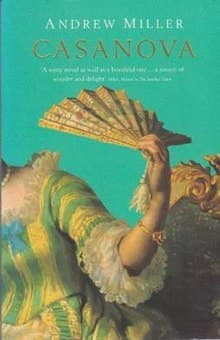
Andrew Miller (2000)
Genre
Historical Fiction / Romance
Reading Time
277 min
Key Themes
See below
Sign in to track this book
In 1760s London, Casanova's relentless pursuit of a mysterious beauty leads him not to seduction, but to the brink of self-destruction in the murky Thames.
Giacomo Casanova, having recently fled a Venetian prison and established a reputation across Europe, arrives in London in the summer of 1763. He is accompanied by his young servant, a boy named Lestocq, and carries letters of introduction to various members of the English aristocracy, including the French Ambassador, the Comte de Guerchy. Casanova observes the city's unique blend of sophistication and squalor, its busy streets, and the reserved nature of its inhabitants. He quickly establishes himself in fashionable lodgings in Soho, eager to immerse himself in London society and find new avenues for his restless spirit, both intellectual and amorous, while navigating the complexities of English social etiquette.
Casanova begins to attend various social functions, using his charm, wit, and linguistic skills to impress those he meets. He frequents coffee houses, theatres, and gambling establishments, all while attempting to secure an audience with King George III, hoping to pitch a scheme for a national lottery. He finds the English aristocracy a mix of the refined and the eccentric, often contrasting their reserved public demeanor with their private indulgences. Despite his efforts, Casanova struggles to fully enter the inner circles of London's elite, often feeling like an outsider observing a complex and sometimes impenetrable social structure. His finances are a constant concern, leading him to rely on his wits and occasional gambling wins.
During his social explorations, Casanova encounters Marianne Charpillon, a young woman of French Huguenot descent living with her mother and an older woman, Madame Dubois. Marianne is beautiful, with an air of innocence that immediately captivates Casanova. He is drawn to her delicate features and the hint of melancholy in her eyes. Despite his vast experience with women, Marianne presents a new kind of challenge; she is elusive, coquettish, and seems to delight in teasing him. His initial advances are met with a tantalizing mix of encouragement and resistance, igniting in him a passionate pursuit unlike any he has undertaken before. He is determined to win her affection, believing her to be the key to his happiness in London.
As Casanova's pursuit of Marianne intensifies, he discovers that she, her mother, and Madame Dubois are not as innocent as they appear. They manipulate his affections and his finances, using his infatuation to extract money and favors from him. Marianne's behavior is a constant source of frustration and fascination; she makes promises only to break them, offers intimacy only to withdraw it, and constantly keeps Casanova on edge. He is drawn deeper into their manipulative web, his pride and passion blinding him to the obvious deceptions. He spends lavishly on gifts and entertains them, convinced that his persistence will eventually win Marianne over, despite the growing evidence to the contrary.
Casanova's relentless pursuit of Marianne Charpillon takes a severe toll on his already precarious finances. He squanders what little money he has on her and her family, borrowing from acquaintances and even pawning his valuables. His reputation, once a source of pride, begins to suffer as word of his entanglement with the Charpillons spreads through London society. He becomes a figure of gossip and pity, his usual charm failing to deflect the ridicule. The French Ambassador, Comte de Guerchy, who initially offered Casanova support, grows increasingly wary of his association with the disreputable Charpillons, further isolating Casanova from the very circles he sought to impress. His once-unshakeable confidence starts to waver under the weight of his financial and social decline.
Feeling humiliated and financially ruined by the Charpillons, Casanova's infatuation turns into a desire for revenge. He concocts a desperate plan to expose Marianne and her family for their manipulative schemes. He enlists the help of a former acquaintance, a woman named Mrs. Cornelys, who runs a fashionable masquerade hall, hoping to catch Marianne in a compromising situation or force a confession. However, his attempts are clumsy and easily thwarted by the cunning Charpillons. Each failed attempt further increases his frustration and deepens his despair. He is caught in a psychological battle he is ill-equipped to win, as Marianne consistently outmaneuvers him, playing on his weaknesses.
Casanova's desperation ends in a public confrontation with Marianne Charpillon at a social gathering. He accuses her of deceit and manipulation, hoping to shame her into admitting her wrongs. However, Marianne, with her practiced innocence, skillfully turns the tables, presenting herself as the wronged party and Casanova as an obsessed suitor. The onlookers, swayed by her apparent vulnerability, side with her, and Casanova is publicly humiliated, his accusations dismissed as the ravings of a madman. This crushing blow shatters his already fragile self-esteem and leaves him feeling alone and defeated. His once-unshakeable belief in his own charm and intellect is irrevocably broken.
Following his public humiliation and the complete collapse of his finances and reputation, Casanova falls into a deep depression. He sees no way out, his once-lively spirit extinguished by Marianne's cruelty and his own folly. In a moment of despair, he walks to the River Thames, intending to end his life by drowning. The cold, dark water seems to offer the only escape from his suffering. He wades into the murky depths, convinced that death is preferable to the ignominy he has endured. This act marks the lowest point in his London sojourn, a stark contrast to his usual zest for life and his strong will.
Just as Casanova is about to succumb to the Thames, he is pulled from the water by a passing boatman. Though saved from death, he is left shaken and reflective. The near-death experience forces him to confront his despair and the destructive nature of his obsession with Marianne. He begins a slow, painful process of introspection, questioning his past actions, his self-delusions, and the very nature of his identity. This moment of reckoning is a turning point, marking the beginning of his recovery and a gradual re-evaluation of his life's direction. He starts to see the Charpillons not as unique villains, but as a catalyst for his own crisis.
Following his rescue, Casanova slowly begins to recover both physically and mentally. He finds solace in the kindness of a few remaining acquaintances and starts to regain some of his former resilience. The experience with Marianne Charpillon, though devastating, has stripped away some of his vanity and forced him to confront his vulnerabilities. He realizes that London, for all its promise, has offered him little but heartbreak and humiliation. With a renewed sense of purpose, though tinged with melancholy, Casanova makes arrangements to leave England. He departs London, a city that tested him like no other, carrying with him the scars of his ordeal but also a newfound, albeit painful, understanding of himself and the complexities of human nature.
The Protagonist
Casanova's journey in London strips away his vanity and forces him to confront his vulnerabilities, leading to a profound self-reckoning and a more introspective understanding of himself.
The Antagonist
Marianne remains largely unchanged, a consistent force of manipulation, but her interactions expose Casanova's vulnerabilities.
The Supporting
Lestocq remains a constant, loyal presence, witnessing Casanova's downfall and quiet recovery.
The Supporting
His initial support for Casanova diminishes as Casanova's reputation declines, reflecting the social consequences of Casanova's actions.
The Supporting
She consistently acts as an enabler and participant in the Charpillons' schemes, remaining a static character.
The Supporting
She consistently supports the Charpillons' manipulations, serving as a static, cunning figure.
The Supporting
She serves as a brief, pragmatic ally to Casanova, showcasing the diverse social landscape of London.
The novel explores how obsession can blind even the most astute individuals to reality. Casanova, despite his experience and intelligence, becomes consumed by Marianne Charpillon, refusing to acknowledge her manipulative nature. His self-delusion stems from his pride and his belief in his own irresistible charm. He projects his desires and ideals onto Marianne, creating a fantasy that he tries to uphold, even as evidence mounts against it. This theme is most evident in his escalating financial ruin and his increasingly desperate, yet futile, attempts to 'win' Marianne, climaxing in his public humiliation and attempted suicide.
“He saw what he wanted to see, not what was there. He constructed a Marianne in his mind, and then he fell in love with her.”
Casanova's identity is linked to his reputation as a charmer, an adventurer, and a man of wit. His arrival in London is driven by a desire to rebuild this reputation after past scandals. However, his entanglement with Marianne systematically dismantles it, stripping him of his social standing, his financial stability, and his self-worth. The novel examines how external validation shapes one's sense of self and the crisis that ensues when that validation is withdrawn. His attempted suicide is the ultimate expression of a man whose carefully constructed identity has completely collapsed.
“His name, once a password to every pleasure, now seemed a brand of shame.”
Casanova is a man who values his freedom and independence above all else, constantly moving, never settling, and refusing to be tied down. However, the novel suggests that this freedom comes at a high price: loneliness, rootlessness, and a perpetual search for fleeting connections. His pursuit of Marianne can be seen as an attempt to find a deeper connection, yet his inability to recognize true deceit, and his own self-serving nature, ultimately leads to his downfall. His freedom, in this instance, makes him vulnerable to manipulation, as he lacks the stable social ties that might have offered protection or advice.
“To be free was to be unmoored, and sometimes, to be unmoored was to drift into dangerous waters.”
London itself is a significant thematic element, serving as a test for Casanova's character. Unlike the more open societies of continental Europe he is accustomed to, London is portrayed as a city of strict social codes, reserved manners, and a certain pragmatic cynicism. It is a place where Casanova's usual charms and strategies prove less effective, forcing him to confront his limitations. The city's indifference to his plight, and its unforgiving social landscape, contribute directly to his sense of isolation and despair, ultimately breaking him down before he can begin to rebuild.
“London was not Venice, nor Paris. It was a city that judged, and then forgot.”
Marianne Charpillon embodies the seductive, dangerous woman who leads the protagonist to ruin.
Marianne Charpillon functions as a classic femme fatale. Her beauty, apparent innocence, and elusive nature are the primary tools she uses to ensnare Casanova. She is not overtly evil, but her manipulative actions, driven by self-preservation and financial gain, systematically destroy Casanova's fortune, reputation, and emotional well-being. Her ability to maintain an air of vulnerability while actively deceiving him highlights her power and Casanova's susceptibility to her charms, despite his vast experience. She represents the alluring danger that often accompanies unchecked desire and hubris.
The reader is often aware of Marianne's deception before Casanova fully comprehends it.
Dramatic irony is frequently employed throughout the novel. The reader, privy to the subtle cues and the mounting evidence of Marianne's and her family's manipulations, often understands the true nature of their intentions before Casanova does. This creates a sense of tension and foreboding, as we witness Casanova, with all his supposed worldliness, walk blindly into a trap. This device heightens the tragedy of his downfall and underscores his self-delusion, making his eventual humiliation and despair all the more poignant for the reader.
Casanova's experience in London contrasts his usual confidence and success in European courts.
Casanova's role as a 'fish out of water' in London is a key plot device. His established methods of charm and seduction, which worked so effectively in other European capitals, often fall flat or are misinterpreted in the more reserved and pragmatic English society. This cultural clash contributes significantly to his vulnerability and isolation. The unfamiliarity of London's social rules and the distinct character of its inhabitants make him less adept at navigating its complexities, leaving him exposed to the Charpillons' machinations and contributing to his eventual downfall, highlighting how even a celebrated figure can be undone by unfamiliar territory.
The River Thames represents both escape and the culmination of Casanova's despair.
The River Thames serves as a powerful symbol in the narrative. Initially, it is a backdrop to Casanova's arrival in London, a gateway to new possibilities. However, as his fortunes decline and his despair mounts, the river transforms into a symbol of finality and escape. His attempted suicide in the Thames represents the absolute nadir of his emotional and psychological state, a desire to wash away his shame and end his suffering. Its murky, indifferent waters reflect the cold, unforgiving nature of his London experience and the ultimate collapse of his once-indomitable spirit.
“The past is a country from which we are all exiles.”
— Casanova reflecting on his life and travels, a poignant observation on memory and change.
“To be truly free, one must first be free of oneself.”
— Casanova pondering the nature of freedom, often in the context of his own desires and obligations.
“Love, he had learned, was not a thing to be hoarded, but to be spent lavishly.”
— Casanova's evolving understanding of love, moving beyond possessiveness to generosity.
“Every journey, no matter how grand, begins with a single step into the unknown.”
— Casanova embarking on one of his many adventures, encapsulating his adventurous spirit.
“The greatest prison is a mind that refuses to imagine anything beyond its own walls.”
— Casanova's thoughts on intellectual freedom and the dangers of narrow-mindedness.
“He understood that true charm lay not in what one possessed, but in how one presented oneself to the world.”
— Casanova's insights into the art of social interaction and personal charisma.
“Regret was a useless emotion, a ghost that haunted only those who allowed it.”
— Casanova's pragmatic approach to past mistakes and his refusal to dwell on them.
“The finest stories are not found in books, but lived in the unpredictable currents of life.”
— Casanova's belief in the value of lived experience over mere academic knowledge.
“There was a certain melancholy in knowing that even the most fervent passion eventually cooled.”
— Casanova's mature reflection on the transient nature of intense emotions and relationships.
“He had always believed that a man's worth was measured not by his wealth, but by his wit.”
— Casanova's personal philosophy on true value, prioritizing intellect and charm.
“Deception, when artfully executed, was merely another form of poetry.”
— Casanova's often amoral perspective on his own cunning and manipulative tendencies.
“The future, like a beautiful woman, revealed herself only in tantalizing glimpses.”
— Casanova's musings on the unpredictable and alluring nature of what lies ahead.
“Loneliness was a companion he knew well, even amidst the most boisterous company.”
— Casanova's underlying sense of isolation despite his many social encounters and relationships.
“To truly know a place, one must taste its bread, drink its wine, and speak its language, however imperfectly.”
— Casanova's immersive approach to travel and understanding different cultures.
Ready to see how well you understood this book? Take our interactive quiz with 10 questions.

Andrew Miller is an award-winning British author known for his critically acclaimed novels. His 2011 novel, 'Pure,' was shortlisted for the Man Booker Prize, and his 2001 novel, 'Casanova,' won the James Tait Black Memorial Prize. Miller's work is often characterized by its rich historical detail and complex, often morally ambiguous characters.







