“There are two kinds of magic. The kind that fools you and the kind that doesn't.”
— Early in the book, Carter reflects on the nature of magic and illusion.

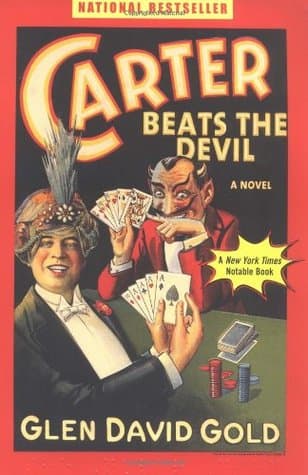
Glen David Gold (2001)
Genre
Fantasy / Historical Fiction / Mystery
Reading Time
12-15 hours
Key Themes
See below
Sign in to track this book
In a 1920s world of grand illusions and hidden dangers, master magician Charles Carter must find out how President Harding died, even if it means his own carefully built life might disappear.
In 1923, Charles Carter, known as Carter the Great, performs his illusion, 'The Lady and the Tiger,' at the Palace Theater in San Francisco. President Warren G. Harding is in the audience during his cross-country tour. Harding volunteers for a card trick, and Carter has a brief, strange talk with him backstage, where Harding shares a premonition. Soon after leaving the theater, President Harding gets sick and dies within days. This leads to public suspicion that Carter's magic, or some other foul play, caused it. The Secret Service, led by Agent Griffin, starts an investigation into Carter and his group, putting a dark cloud over the famous magician's career and life.
The story goes back to Carter's youth, showing his interest in magic and how he escaped a dull life. He becomes the student of Mysterioso, a private and brilliant magician who teaches Carter the true art and meaning of illusion. Mysterioso stresses the importance of showmanship, misdirection, and influencing an audience's mind. Carter also forms a complicated bond with Mysterioso's assistant, Olive, who shares his love for magic. This time is important in making Carter who he is as a magician, giving him both technical skill and a deep understanding of human perception and belief, while also hinting at Mysterioso's own hidden reasons and secrets.
Carter becomes famous, a strong competitor to the legendary Harry Houdini. Their rivalry is intense, fueled by professional jealousy and different ideas about magic. Houdini focuses on escape acts and exposing spiritualists, while Carter specializes in grand illusions and stage shows. Carter also marries his assistant, Olive, but their marriage is difficult due to his career demands, his constant search for perfection, and Olive's own unmet goals. The pressures of fame, constant travel, and Houdini's presence create a tense situation, pushing Carter further into his world of illusion, sometimes at the cost of his personal life.
After President Harding's death, Secret Service Agent Griffin, a careful and observant man, becomes sure that Carter is involved, or at least knows something important. Griffin looks into Carter's past, interviewing his friends, rivals, and old teachers. His investigation uncovers not just how Carter's illusions work but also hints at a deeper political plot around Harding's presidency, including the Teapot Dome scandal. Griffin's pursuit forces Carter to face not only the immediate threat to his freedom but also the moral questions of his art, especially when it mixes with real-world power and deceit, blurring the lines between magic and manipulation.
Mysterioso, Carter's old teacher, shows up again, seemingly out of nowhere, adding another layer of mystery to the events. His return is not random; he knows about Harding's death and is connected to the political schemes. Mysterioso's reasons are unclear, and his presence makes Carter rethink his past and the real meaning of his teacher's lessons. Mysterioso controls events from the shadows, using his own skill at deception to guide or mislead both Carter and Agent Griffin, eventually showing that his impact on Carter's life and the current problem goes deeper than Carter ever thought.
As Carter tries to clear his name and understand what is happening, he slowly finds the link between President Harding's death and the Teapot Dome scandal, a big political corruption case from the 1920s. He realizes that Harding's taking part in his show was not random, but part of a larger plan involving powerful people who wanted to silence the President. Carter's illusions, without his knowing, were used as a cover or a distraction for political moves. This discovery forces Carter to face the hard truth that his art, meant for wonder, has been used for bad purposes, making him an accidental player in a deadly political game.
Surprisingly, Harry Houdini, Carter's old rival, offers help. While their professional competition continues, Houdini, with his experience in exposing fraud and his understanding of deception, gives Carter important insights into the conspiracy. Houdini's involvement shows the moral code shared by real magicians, even rivals, to protect their art from those who would use illusion for bad reasons. His view helps Carter understand his enemies' motives and how to deal with the complex web of lies, guiding him toward actions that combine magical skill with a search for truth.
Using his skill as an illusionist, Carter creates a detailed plan to expose the person truly responsible for President Harding's death and the Teapot Dome conspiracy. He puts on a final, spectacular show, not just for an audience, but for the main people involved in the scandal, including the Secret Service and the conspirators themselves. This grand illusion becomes a trap, designed to make the villain reveal themselves. Carter uses misdirection, mind games, and theater to create a situation where the truth comes out through the art of deception, reflecting the themes of his own career.
In the climax, Carter discovers a deep personal betrayal by someone close to him, making his search for justice even harder. This discovery forces him to face the limits of his own understanding and the painful fact that even those he trusted can lie. However, through this difficulty, Carter finds a kind of redemption. He reclaims his identity not just as a performer, but as a man who can tell truth from illusion, both on stage and in life. His actions lead to the exposure of the conspiracy, and while the personal cost is high, he ends with a clearer understanding of himself and the power of his magic.
The exposure of the Teapot Dome conspiracy and the truth behind Harding's death causes major changes in politics. Carter, though cleared of direct involvement, finds his reputation changed forever. He deals with the results of using his art for such a serious purpose, and the loss of innocence that comes with it. The novel ends with Carter thinking about his journey, his relationship with Olive, and the lasting power of magic. He continues to perform, but with a deeper understanding of the world's illusions and the responsibility that comes with his unique talent, forever shaped by his involvement with history and deception.
The Protagonist
Carter transforms from a celebrated but somewhat naive performer into a man who understands the darker implications of illusion and uses his art for justice.
The Supporting
Olive struggles with her identity and desires, eventually seeking her own path and asserting her agency outside of Carter's shadow.
The Supporting/Antagonist
Mysterioso's true motives and involvement in the conspiracy are gradually revealed, challenging Carter's perception of his mentor.
The Supporting
Griffin evolves from a skeptical investigator to someone who recognizes the value of unconventional methods and the power of perception, even if it's not his own.
The Supporting
Houdini, despite his rivalry, provides crucial, if reluctant, assistance to Carter, demonstrating a shared ethical stance on magic's integrity.
The Mentioned
Harding's death serves as the inciting incident, revealing the corruption and political machinations of his era.
The Supporting
Frank remains a steadfast presence, providing unwavering support to Carter through his professional and personal trials.
The Supporting
Delia's relationship with Carter adds a layer of personal complication and ultimately contributes to his understanding of his commitments.
The novel often blurs the lines between what seems real and what is real, both on and off stage. Carter's magic relies on misdirection and creating believable illusions, but the main mystery of Harding's death makes him see how these same ideas apply to political corruption and personal lies. The characters themselves often live behind their own illusions – Olive's appearance of happiness, Mysterioso's hidden reasons, and even the public's view of Harding. The story asks the reader to question what they believe, much like a good magic trick. For example, the idea that Harding's death is linked to Carter's show uses this theme.
“The secret to magic was not to make people believe what was impossible, but to make them believe that what they saw was real.”
Carter's constant drive for magical perfection and fame costs him a lot personally. His dedication to his work often pushes away Olive and other loved ones, leaving him feeling alone. The strong rivalry with Houdini shows the fierce nature of their job and the pressure to always create new things and do better than others. The novel explores how fame can warp a person's life, making them keep up a public image that might not be who they really are. This is clear in Olive's frustration with her role and Carter's own struggles despite his public success.
“Every secret you kept, every illusion you created, took a piece of you. And there were only so many pieces to give.”
At its heart, the novel is a search for truth in a world full of lies. While Carter's job is based on clever deception for entertainment, he gets caught in a political conspiracy where deception is used for bad reasons. Agent Griffin's investigation is a systematic search for facts, which contrasts with Carter's more natural understanding of how people can be fooled. The story suggests that truth can be hidden in plain sight, obscured by misdirection, and that finding it often means looking past the obvious, whether it is a magic trick or a political scandal.
“The greatest trick the devil ever pulled was convincing the world he didn't exist.”
Power appears in different ways throughout the story: the political power of the presidency, Mysterioso's manipulative power, and Carter's own power to captivate and control an audience's perception. The Teapot Dome scandal shows how unchecked political power can corrupt. Mysterioso shows a more subtle, psychological power, influencing events and people from the shadows. Carter, in turn, learns to use his artistic power not just for entertainment but to expose unfairness, eventually finding a new way to control his own future and the unfolding story.
“A good magician controls not just what you see, but what you think you see.”
Misleading clues or characters designed to divert the reader's attention.
The initial suspicion cast upon Charles Carter after President Harding's death serves as a major red herring. The Secret Service, and by extension the reader, is led to believe that Carter's magic directly caused the President's demise, or that he was somehow a direct assassin. This initial focus on Carter's involvement diverts attention from the deeper political conspiracy and the true, more complex motives behind Harding's death. This device effectively builds suspense and misdirects the reader, mimicking the art of misdirection central to magic itself.
Interruption of chronological sequence to provide background information.
The novel frequently employs flashbacks to reveal Carter's past, particularly his apprenticeship with Mysterioso and his early career. These flashbacks are crucial for understanding Carter's motivations, his skill development, and the complex relationships that shaped him. They provide context for his current predicament, explaining his mastery of illusion and the philosophical underpinnings of his art, while also gradually revealing Mysterioso's influence and the roots of his rivalry with Houdini, enriching the present-day narrative with layers of history and character development.
An apparently insignificant detail that later proves to be crucial.
A subtle example of Chekhov's Gun is President Harding's brief, almost throwaway comment to Carter backstage about knowing 'too many secrets' and feeling 'unwell' before his death. This interaction, initially seeming like a mere character detail or a moment of presidential eccentricity, later proves to be a direct clue to the political machinations surrounding his death. It foreshadows the true nature of the conspiracy and signifies that Harding was aware of the danger he was in, making Carter's seemingly innocent magic show a critical, albeit unwitting, part of the unfolding tragedy.
The audience knows more about the situations, conflicts, and resolutions than the characters.
Dramatic irony is present throughout the novel, particularly concerning the true nature of the Teapot Dome scandal and the conspiracy surrounding President Harding's death. As the story unfolds, the reader often gains insight into the political machinations and the various characters' hidden motives before Carter fully comprehends the extent of the danger or the identities of his adversaries. For instance, the reader might infer Mysterioso's manipulative role or the political undercurrents of Harding's illness before Carter himself pieces together the full picture, creating tension and anticipation as Carter navigates a world he doesn't fully understand.
“There are two kinds of magic. The kind that fools you and the kind that doesn't.”
— Early in the book, Carter reflects on the nature of magic and illusion.
“The greatest trick the Devil ever pulled was convincing the world he didn't exist.”
— A reference to a classic saying, often invoked in discussions of hidden forces.
“Every secret is a weapon.”
— Carter understands the power of hidden knowledge in his world of secrets and espionage.
“The world was a stage, and he was merely a player, but what a player he was.”
— Describing Carter's larger-than-life persona and his impact on those around him.
“Sometimes the best way to hide something is in plain sight.”
— A principle of misdirection often employed by magicians and spies.
“The past is never dead. It's not even past.”
— Reflecting on the enduring influence of past events and relationships.
“Fear makes people do terrible things, but it also makes them believe wonderful ones.”
— Exploring the dual nature of fear's influence on human behavior and perception.
“A good magician never reveals his secrets, but a great one makes you think you know them.”
— Carter's philosophy on the art of illusion and audience engagement.
“Life was a series of illusions, some grand, some mundane, but all designed to keep you from seeing the truth.”
— A character's cynical view on the reality of existence.
“The most dangerous lies are the ones you tell yourself.”
— An internal reflection on self-deception and its consequences.
“There’s no such thing as a coincidence, only connections we haven’t understood yet.”
— A character pondering the intricate web of events and their underlying causes.
“The true art of magic is not in making something disappear, but in making people believe it has.”
— Carter's deeper understanding of the psychological aspect of his craft.
“Every man has his breaking point, and every breaking point has its story.”
— Observing the human capacity for endurance and the narratives behind collapse.
“To truly live, one must be willing to die, if only metaphorically.”
— A philosophical reflection on risk-taking and embracing life fully.
Ready to see how well you understood this book? Take our interactive quiz with 10 questions.

Biography coming soon.







