“But if I am to be a pirate, I will be a pirate of spirit, and will take no orders save from myself.”
— Blood's defiant declaration after being unjustly condemned and transported.


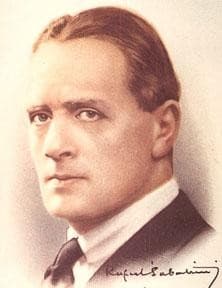
Rafael Sabatini (1922)
Genre
Historical Fiction / Romance
Reading Time
236 min
Key Themes
See below
Sign in to track this book
Wrongfully condemned to slavery, a brilliant physician transforms into the Caribbean's most feared pirate, battling empires and his own conflicted heart for the love of a woman who despises his very name.
In 1685, Dr. Peter Blood, an Irish physician and former soldier, has a quiet practice in the English town of Bridgwater. He is content with his new life, having left behind military service. However, the peace ends with the Monmouth Rebellion. One night, he is called to treat Lord Gildoy, a wounded rebel, purely out of professional duty. Despite his lack of political allegiance, his act of medical aid is misinterpreted by the authorities. This innocent act of compassion will soon plunge Blood into a nightmare of injustice, ending his tranquil existence in England and beginning an unwanted adventure.
Following the suppression of the Monmouth Rebellion, Judge Jeffreys presides over the 'Bloody Assizes.' Dr. Blood, with many others, is arrested and tried for treason. Despite his defense, asserting his role was purely medical and not political, Judge Jeffreys, known for his brutality, convicts him. Blood is sentenced to ten years of indentured servitude in the Caribbean colonies. Stripped of his freedom and his medical practice, he is transported aboard a slave ship to Barbados, a brutal journey that symbolizes his fall from a respected professional to a mere chattel.
Upon arrival in Barbados, Peter Blood is put up for sale as an indentured servant. His luck turns when Colonel Bishop, a wealthy plantation owner and the island's military governor, discovers Blood's medical expertise. Bishop purchases Blood, not for fieldwork, but to serve as his personal physician and to treat his household. This position offers Blood a slight reprieve from the harshest aspects of slavery. It is during this time that he meets Arabella Bishop, Colonel Bishop's beautiful and spirited niece, who has recently arrived from England. Their initial encounters are marked by a mix of disdain and grudging respect, setting the stage for their intertwined destinies.
Life as an indentured servant continues, but Blood's yearning for freedom remains strong. One day, the Spanish pirate Don Miguel de Espinosa launches a surprise attack on Bridgetown, the capital of Barbados. The island's defenses are overwhelmed, and Colonel Bishop is taken prisoner. Amidst the chaos and the Spaniards' subsequent celebration, Blood, seizing a desperate opportunity, rallies his fellow convicts and former soldiers. They stealthily board Espinosa's ship, the 'Cinco Llagas,' overpower the remaining Spanish crew, and sail away, leaving the stunned island behind. This audacious act marks their transformation from slaves to free men, albeit outlaws, and the birth of Captain Blood and his crew.
With the captured Spanish ship, which they rename 'The Arabella' in a gesture of defiance and perhaps ironic admiration for Arabella Bishop, Peter Blood and his crew embark on a life of piracy. Blood, with his strategic mind and medical knowledge, quickly proves himself a capable and surprisingly honorable captain. They establish a base on a secluded island and begin to prey on Spanish shipping, earning a fearsome reputation across the Caribbean. Unlike many ruthless buccaneers, Blood maintains a code of conduct, avoiding unnecessary cruelty and treating captives with respect. His fame grows, but so does the price on his head.
Captain Blood's piratical exploits lead him to intercept a Spanish galleon, only to discover Arabella Bishop among the passengers, being transported to safety by her uncle, Colonel Bishop, who had been ransomed. This unexpected reunion is full of tension. Arabella, though rescued from the Spaniards, views Blood as nothing more than a common thief and pirate, despite his chivalrous treatment of her. She struggles to reconcile the honorable physician she once knew with the feared buccaneer before her. Blood, still attracted to her, is stung by her condemnation, which highlights the difference between his current life and the respect he craves, especially from her.
Captain Blood's reputation attracts other pirates, including the brutal French buccaneer, Captain Levasseur. Levasseur, seeing an opportunity, attempts to form an alliance with Blood, but his treacherous nature and disregard for honor soon become apparent. A conflict arises, particularly regarding the treatment of captives and stolen goods. Blood, a man of principle despite his outlaw status, finds himself at odds with Levasseur's ruthlessness. The tension culminates in a dramatic duel where Blood, demonstrating his superior swordsmanship and strategic thinking, defeats Levasseur, solidifying his position as a leader among the buccaneers and further establishing his unique code of conduct.
A French fleet, under the command of Marquis de Rivarol, attacks the Spanish city of Cartagena. In a desperate move, the Spanish governor, Don Diego de Barrancas, offers Captain Blood and his crew a privateer's commission to defend the city against the French. Blood, pragmatic, accepts the offer, seeing an opportunity for legitimate gain and perhaps a step towards redemption. His strategic genius and naval expertise are put to the test as he masterminds the defense, effectively repelling the French invasion. This victory not only saves Cartagena but also significantly elevates Blood's standing, demonstrating his capabilities beyond mere piracy and earning him grudging respect from former enemies.
Following the Glorious Revolution in England, a new political landscape emerges. King James II is overthrown, and William of Orange ascends the throne. This shift brings about a war between England and France. The French, with their Spanish allies, begin to threaten the English colonies in the Caribbean. With the English fleet stretched thin and the colonies vulnerable, the desperate authorities, including the new Governor of Jamaica, are forced to consider unconventional solutions. They realize that Captain Blood, with his proven military prowess and knowledge of the local waters, is the most capable man to defend their interests, despite his past as a pirate.
In a dramatic turn of events, the English government, recognizing Captain Blood's service in defending their colonies against French and Spanish aggression, offers him a full pardon for his past 'crimes.' More astonishingly, he is offered the position of Governor of Jamaica. This official recognition marks Blood's complete redemption, transforming him from a hunted outlaw into a respected figure of authority. Upon accepting the governorship, he finally earns the admiration and love of Arabella Bishop, who had previously scorned his piratical life. Their love, once seemingly impossible, blossoms, culminating in their union and a promise of a future together, free from the shadows of his past.
The Protagonist
From a peaceful physician, he is unjustly transformed into a feared pirate, only to rise through his own merits to become a respected colonial governor, finding both freedom and love.
The Love Interest
She evolves from a woman bound by societal judgment to one who recognizes true honor and love beyond conventional appearances.
The Antagonist/Supporting
Begins as Blood's master and an antagonist, but eventually becomes a subordinate, forced to accept Blood's legitimate authority.
The Supporting
Remains a loyal and dependable companion, finding his true calling and purpose under Blood's command.
The Antagonist
Introduced as a potential ally, quickly reveals his treacherous nature, leading to his downfall.
The Mentioned/Antagonist
A static figure representing systemic injustice, whose actions set the entire plot in motion.
The novel critically examines the arbitrary nature of justice and the impact of injustice. Peter Blood's initial conviction for treason, despite his humanitarian actions, exemplifies this. Judge Jeffreys's 'Bloody Assizes' are depicted as a miscarriage of justice, stripping Blood of his freedom and forcing him into a life of piracy. Even as a pirate, Blood often acts with fairness, contrasting with the 'legitimate' authorities who initially condemned him. His eventual pardon and appointment as governor represent a triumph of true justice over the initial legalistic injustice.
““They had condemned him as a traitor because he had healed a dying man. They had enslaved him because he had acted as a physician.””
The theme of redemption is central to Captain Blood's journey. Though forced into piracy, Blood maintains a personal code of honor, distinguishing him from other buccaneers. He avoids unnecessary cruelty, protects the innocent, and strives for legitimate means of freedom. His actions, such as defending Cartagena and later the English colonies, are driven by a desire to prove his worth and regain his honor in the eyes of society and Arabella. His ultimate appointment as Governor signifies his full redemption, proving that honor can be found and restored even after a life of perceived crime.
““He was a pirate, true, but a pirate with a conscience, a sense of justice, and a heart that yearned for a life beyond the black flag.””
The romance between Peter Blood and Arabella Bishop is complicated by rigid social hierarchies and Blood's outlaw status. Arabella, a woman of high social standing, initially cannot reconcile her feelings for Blood with his identity as an indentured servant and later a pirate. Her internal conflict highlights the societal barriers to love across class divides. Blood's struggle to earn her respect and love is linked to his journey towards regaining his social standing and proving his inherent worth, demonstrating that true love can transcend conventional social barriers once prejudices are overcome.
““She could not love a thief and a pirate, even if he possessed the eyes of a physician and the soul of a gentleman.””
The narrative is driven by the contrast between freedom and various forms of servitude. Blood is first a free physician, then an indentured slave, and finally a free pirate captain. Even as a pirate, he exercises a form of freedom, albeit a dangerous and outlawed one. His escape from Barbados is a powerful act of reclaiming his liberty. The constant threat of recapture and the yearning for a legitimate, untainted freedom underscore this theme. His ultimate goal is not just physical freedom, but freedom from the stigma of his past and the ability to live a life of his own choosing.
““Better to reign in hell than serve in heaven, and better still to be master of one's own destiny on the wide, free sea.””
The historical event that propels Blood into his adventure.
The Monmouth Rebellion serves as the initial catalyst for Peter Blood's entire adventure. It is a historical event that, while not central to Blood's personal goals, directly leads to his unjust conviction and subsequent transportation to the Caribbean. This device effectively removes Blood from his comfortable life and thrusts him into an entirely new, dangerous environment, setting the stage for his transformation into Captain Blood. Its primary function is to initiate the conflict and provide a plausible reason for Blood's forced exile.
The means by which Blood and his crew escape slavery and begin their piratical life.
The seizure of Don Miguel de Espinosa's Spanish ship, renamed 'The Arabella,' is a pivotal plot device. It symbolizes Blood's dramatic break from servitude and his embrace of an outlaw existence. More than just a vessel, it represents the physical manifestation of his newfound freedom and the instrument through which he builds his reputation as Captain Blood. This act is the definitive turning point in the narrative, cementing his transition from a passive victim to an active agent of his own destiny.
Blood's personal ethical guidelines that differentiate him from other pirates.
Captain Blood's adherence to a personal code of conduct, which includes treating captives honorably, avoiding unnecessary cruelty, and maintaining a semblance of justice, serves as a crucial plot device. It allows the reader to perceive Blood as a morally complex protagonist rather than a simple villain. This code often creates internal and external conflicts, particularly when he interacts with more ruthless pirates like Levasseur, highlighting his inherent goodness and paving the way for his eventual redemption and acceptance by society.
The political upheaval in England that creates an opportunity for Blood's pardon.
The Glorious Revolution in England, leading to the ascension of William of Orange, is a significant external plot device. It shifts the political landscape, creating new alliances and conflicts (England vs. France/Spain) in the Caribbean. This geopolitical change makes Captain Blood, formerly a hunted outlaw, a valuable asset to the English Crown due to his military expertise and knowledge of the region. It provides the perfect, albeit unexpected, context for the English authorities to offer him a pardon and a legitimate position, thus resolving his central conflict and enabling his happy ending.
“But if I am to be a pirate, I will be a pirate of spirit, and will take no orders save from myself.”
— Blood's defiant declaration after being unjustly condemned and transported.
“For the future, let it be understood that I am Captain Blood, and I take what I want.”
— Blood asserting his leadership and new identity as a pirate captain.
“There are times when a man must choose between his conscience and his neck. I have chosen my neck.”
— Blood's pragmatic justification for embracing his pirate life.
“He laughed, a short, sharp laugh, that held more bitterness than mirth.”
— A description of Blood's reaction to a particularly ironic turn of events.
“Love, it seemed, was a commodity as dangerous as any other on the high seas.”
— Blood's internal reflection on his growing feelings for Arabella Bishop amidst his perilous life.
“A man's worth is not in the clothes he wears, but in the heart he carries.”
— Blood's philosophy on true value, often directed at those who judge by appearance.
“He had tasted the bitter bread of injustice, and it had made him strong.”
— Reflecting on how Blood's wrongful conviction forged his resilience.
“To be free is to be master of one's own destiny, even if that destiny leads to the gallows.”
— Blood's unwavering commitment to his freedom, despite the risks.
“There are no laws on the sea save those we make for ourselves.”
— Blood establishing the code of conduct among his pirate crew.
“He was a physician by training, a gentleman by birth, and a pirate by necessity.”
— A concise summary of Captain Blood's multifaceted identity.
“Fortune, like a woman, is fickle, and must be wooed with boldness.”
— Blood's adventurous outlook on seizing opportunities.
“It is not the crime that makes the villain, but the intent.”
— Blood's nuanced view on morality, distinguishing between forced actions and malicious intent.
“The greatest treasure a man can possess is his liberty.”
— Blood's deeply held belief, often expressed in contrast to material wealth.
“He had left England a convict, and returned a king of the seas.”
— A grand statement about Blood's dramatic transformation and rise to power.
Ready to see how well you understood this book? Take our interactive quiz with 10 questions.
Biography coming soon.







