“A man's home is his castle, but a woman's home is her heart.”
— Miriam reflects on the different meanings of home for men and women during her captivity.

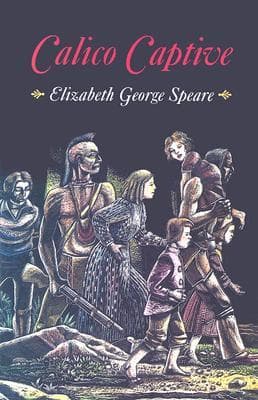
Elizabeth George Speare (1957)
Genre
Children's / Historical Fiction / Young Adult / Romance
Reading Time
360 min
Key Themes
See below
Sign in to track this book
Swept from her New Hampshire home by an Indian raid in 1754, Miriam endures a harrowing march through the wilderness, only to find an unexpected world of intrigue and surprising choices awaiting her in French Montreal, far from her beloved and all she once knew.
In the summer of 1754, Miriam Willard, a seventeen-year-old living in Charlestown, New Hampshire, anticipates a visit from her sweetheart, Phineas Whitney, who is about to leave for Harvard. Her day begins with domestic tasks and growing excitement. However, the peaceful morning is interrupted by the cries of a Native American raid. The attackers, led by a warrior, quickly overrun the small settlement. Miriam and her family, including her sister Suzanne, Suzanne's husband Titus, and their two young children, are taken captive along with several other villagers. Miriam sees homes burning and the reality of war as their forced march into the wilderness begins, leaving behind everything she has ever known.
The captives are forced on a long march north through the dense wilderness. Miriam struggles with exhaustion, hunger, and fear, often carrying her young niece, Abigail. Her sister, Suzanne, who is heavily pregnant, gives birth to a baby boy on the trail, whom they name Captive. The conditions are brutal, with meager rations and constant threat from their captors. Titus, Suzanne's husband, attempts an escape but is quickly recaptured and severely beaten, a grim warning to the others. Miriam develops a strong bond with a fellow captive, Mrs. Johnson, who offers her comfort and resilience. Miriam's initial hope of rescue slowly dwindles as they venture deeper into unfamiliar territory, moving further away from any English aid.
After weeks of travel, the group arrives at the Native American village of St. Francis. Here, the captives run the gauntlet, a ritual where they must run between two lines of villagers who strike them. Miriam, Suzanne, and their children endure this ordeal. Soon after, the captives are divided; some are kept by the Native Americans, and others are taken to Montreal to be sold to the French. Miriam, Suzanne, and the children are among those designated for Montreal. This separation from some of their fellow English captives reinforces the unpredictable reality of their situation, leaving Miriam feeling isolated and vulnerable as they prepare for the next stage of their captivity.
Upon arrival in Montreal, Miriam, Suzanne, and the children are taken to the market to be sold. Miriam is purchased by Madame Du Quesne, the matriarch of a wealthy and influential French family. Suzanne and her children are bought by a different family, causing another heartbreaking separation for Miriam. Miriam is brought to the elegant Du Quesne household, a stark contrast to her humble New Hampshire home. She is initially treated as a servant, but Madame Du Quesne, observing Miriam's education and gentle demeanor, takes an interest in her. Miriam quickly adapts to the French language and customs, finding herself in an environment of luxury and intrigue, far removed from her previous life.
Miriam's intelligence and adaptability impress Madame Du Quesne, who elevates her from a mere servant to a companion and tutor for the younger Du Quesne children, particularly Henri. Miriam learns French rapidly and is introduced to Montreal society, attending balls and social gatherings. She forms a close bond with Monsieur Du Quesne, who treats her with respect and kindness, and develops a complex relationship with Madame, who, despite her generosity, remains somewhat reserved. Miriam also encounters other English captives in Montreal, including Mrs. Johnson, and learns of their struggles to gain freedom. She constantly grapples with her loyalty to her English heritage versus her growing comfort and affection for her new French life.
As the French and Indian War rages on, Montreal becomes a hub of political intrigue. Miriam, due to her position in the Du Quesne household, inadvertently learns of hushed conversations and secret correspondence. She meets Captain Pierre Du Marais, a French officer who is a friend of the Du Quesne family. Pierre is attracted to Miriam, and despite her lingering thoughts of Phineas Whitney, Miriam finds herself drawn to Pierre's charisma and kindness. Their interactions grow more frequent, and Miriam experiences a deepening emotional conflict between her past love and the potential for a new future in Montreal. The war's uncertainty looms over everyone, affecting personal relationships and future prospects.
News arrives of a prisoner exchange between the French and English. Miriam is torn; she longs for her freedom and to see her family, but she has also grown accustomed to her life with the Du Quesnes and harbors growing feelings for Pierre. She seeks information about Suzanne and her children, and through the kindness of Monsieur Du Quesne, she visits them. She finds them living in much harsher conditions than her own, reinforcing her guilt and showing the disparity of their captivities. The prospect of returning to New England, with its memories of loss and the uncertainty of Phineas's fate, creates an internal struggle for Miriam, who has now experienced a vastly different world.
Pierre Du Marais, having grown fond of Miriam, proposes marriage. This places Miriam in a dilemma. She cares for Pierre and recognizes the security and affection he offers, but her heart is still tied to her English past, to Phineas, and to the hope of returning home. The war continues, making any future uncertain. Madame Du Quesne, while fond of Miriam, makes it clear that a marriage to Pierre would mean a permanent commitment to French life and a renunciation of her English identity. Miriam is advised by Monsieur Du Quesne to consider her future carefully, weighing the comfort and love offered by Pierre against the pull of her original home and family, whose fates are still unknown.
As the French and Indian War ends with English victory, the time for prisoner repatriation finally arrives. Miriam faces the ultimate decision: to remain in Montreal as Pierre's wife and embrace a new French life, or to return to New England, to the ruins of her past, and the faint hope of reuniting with Phineas. She visits Suzanne one last time, reaffirming her familial bonds. The Du Quesnes, despite their affection for Miriam, understand her need to choose her own path. Miriam carefully considers all the implications of each choice, her heart heavy with the weight of her experiences and the love she has found and lost.
After much deliberation, Miriam decides to return to New England. She bids a heartfelt farewell to the Du Quesne family, expressing her gratitude and affection, and a poignant goodbye to Pierre, acknowledging the love they shared. The journey back is a contrast to her captive march, filled with a mix of anticipation and apprehension. Upon returning to Charlestown, she finds a changed landscape and a community scarred by war. She learns that Phineas Whitney, her sweetheart, has indeed gone to Harvard and is now a learned man. While the future is uncertain, Miriam feels a sense of peace in choosing to return to her own people and to rebuild her life on familiar ground, carrying the complex memories of her captivity and her time in Montreal.
The Protagonist
Miriam transforms from an innocent colonial girl into a resilient young woman who navigates cultural divides and makes a profound choice about her identity and future.
The Supporting
Suzanne endures immense physical and emotional hardship, embodying the resilience of a mother protecting her children in captivity.
The Supporting
Phineas remains a steadfast symbol of Miriam's past and English identity, representing the life she might return to.
The Supporting
Madame Du Quesne initially acts as Miriam's mistress but evolves into a mentor figure, eventually accepting Miriam's choice to return home.
The Supporting
Monsieur Du Quesne provides Miriam with consistent kindness and wise counsel, acting as a supportive father figure throughout her captivity.
The Supporting
Pierre represents an alternative future for Miriam, offering love and a new life in Montreal, ultimately accepting her decision to return home.
The Supporting
Mrs. Johnson serves as a constant reminder of Miriam's English heritage and the shared struggle for freedom among the captives.
The Mentioned
Captive's birth symbolizes the harsh realities of captivity and the enduring hope for life amidst suffering.
The Supporting
Henri helps Miriam integrate into the Du Quesne family and provides her with a sense of purpose and connection.
Miriam's journey forces her to grapple with her sense of self and where she truly belongs. Torn between her English heritage and the French culture she adapts to, she questions where her loyalties lie. Her interactions with the Du Quesne family and Pierre challenge her preconceived notions, making her consider a life that is different from what she once knew. Ultimately, her decision to return to New England is a reaffirmation of her core identity, even as she carries the marks of her experiences in Montreal.
“She was an English girl, bred of English stock, and she belonged with her own people. Yet in her heart, she knew she would carry a part of Montreal with her always.”
The novel portrays Miriam's capacity for resilience in the face of hardship. From the forced march and the gauntlet to adapting to a foreign culture and language, Miriam continuously shows inner strength. Her ability to learn French, integrate into the Du Quesne household, and even find moments of joy and affection in captivity shows the human spirit's power to adapt and endure, even when stripped of everything familiar.
“She could only force herself to the next stopping place, the next small portion of food, the next icy stream to be crossed. It was a harrowing march north.”
Through Miriam's personal story, the book illustrates the human cost of the French and Indian War. It shows not just the physical violence of raids and battles, but also the psychological trauma of captivity, the separation of families, cultural displacement, and the loss of innocence. The varying fates of the captives, from Suzanne's harsh conditions to Miriam's comfort, show the arbitrary nature of war's impact on individual lives, beyond simple battle narratives.
“The stillness of Charlestown, New Hampshire, is shattered by the terrifying cries of an Indian raid. Young Miriam Willard, on a day that had promised new happiness, finds herself instead a captive on a forest trail.”
Miriam experiences love and loyalty throughout her captivity. Her enduring loyalty to her family and to Phineas Whitney, her sweetheart, forms a strong emotional tether to her past. However, her developing affection for Pierre Du Marais challenges these loyalties, forcing her to confront the possibility of a new future and a different kind of love. The novel explores the difficult choices that arise when one's heart is pulled in multiple directions, showing the sacrifices and compromises in such decisions.
“How could she reconcile the girl who had loved Phineas Whitney with the woman who now felt such a pull toward Pierre Du Marais?”
Allows for deep insight into Miriam's emotional and psychological journey.
The story is told from Miriam Willard's perspective, immersing the reader directly into her thoughts, fears, and observations. This narrative choice effectively conveys the psychological impact of her captivity, her internal conflicts, and her gradual adaptation to a new culture. It allows the reader to experience her journey intimately, from the terror of the raid to the complexities of her feelings for Pierre and her ultimate decision, making her transformation deeply personal and relatable.
Grounds the fictional narrative in the realities of the French and Indian War.
The novel is based on an actual narrative diary from 1807, lending authenticity to Miriam's experiences. The backdrop of the French and Indian War (1754) is not just scenery but a driving force of the plot, dictating the capture, the journey, the sale of captives, and the eventual repatriation. This historical context provides a rich tapestry against which Miriam's personal story unfolds, educating the reader about a specific period of colonial American history and the complex relationships between English settlers, Native Americans, and the French.
Highlights the differences and conflicts between English colonial and French Canadian societies.
The stark contrast between Miriam's humble English colonial life in Charlestown and the sophisticated, Catholic French society of Montreal is a central device. This contrast emphasizes Miriam's journey of adaptation, her learning of French language and customs, and the challenges of cultural assimilation. It also highlights the different ways captives were treated and integrated, or not integrated, into the respective societies, underscoring the broader cultural conflicts of the era and Miriam's internal struggle with her identity.
The name of Suzanne's child represents the overarching theme of captivity and resilience.
The baby born on the trail is named 'Captive,' a powerful symbol that encapsulates the central theme of the story. This name not only marks the circumstances of his birth but also represents the literal and metaphorical captivity experienced by Miriam and her family. It serves as a constant reminder of their ordeal, the loss of their freedom, and the enduring hope for survival and new life even in the most dire circumstances. The name imbues the child with a deeper significance beyond his individual character.
“A man's home is his castle, but a woman's home is her heart.”
— Miriam reflects on the different meanings of home for men and women during her captivity.
“We are not prisoners of the French, but prisoners of our own fears.”
— Miriam encourages her sister to stay strong while captured by Native Americans and French forces.
“In the wilderness, one learns that survival depends not on what one has, but on what one is.”
— Miriam adapts to life in captivity, realizing inner strength matters more than possessions.
“Love is not a thing to be bartered, like furs or corn.”
— Miriam rejects a marriage proposal based on practical arrangements rather than affection.
“The hardest chains to break are those forged by our own doubts.”
— Miriam struggles with uncertainty about her future and family during captivity.
“A true friend is a light in the darkest of places.”
— Miriam finds solace in friendships formed with other captives and Native Americans.
“Freedom is not just a place, but a state of the soul.”
— Miriam contemplates the meaning of freedom while physically imprisoned.
“In every stranger, there is a story waiting to be understood.”
— Miriam learns about the cultures of her captors, challenging her initial prejudices.
“Courage is not the absence of fear, but the will to go on in spite of it.”
— Miriam faces dangers and uncertainties during her journey and captivity.
“The past is a shadow that follows us, but the future is a path we must walk ourselves.”
— Miriam reflects on her life before captivity and her hopes for what comes next.
“Sometimes, the greatest battles are fought within the silence of our own hearts.”
— Miriam deals with internal conflicts about loyalty, love, and survival.
“A home is built not with logs and mortar, but with memories and love.”
— Miriam longs for her family and home in New England while in captivity.
“In the tapestry of life, every thread, no matter how dark, has its purpose.”
— Miriam finds meaning in her hardships and the people she meets during captivity.
Ready to see how well you understood this book? Take our interactive quiz with 10 questions.

Biography coming soon.

Dan Gemeinhart
4.5

Kate O'Hearn
4.4

Jeanne Birdsall
4.4

Jen Wang
4.4

Wendelin Van Draanen
4.3

John Marsden
4.3

Chris Van Allsburg
4.3
Jennifer A. Nielsen
4.2