“The people who have been beaten know what is coming. They know it in their bones, in their blood, in the way the air smells before a storm.”
— Rosa's internal reflection on the political climate and the anticipation of violence.


Nadine Gordimer (1980)
Genre
Literary Fiction / Historical Fiction
Reading Time
9-10 hours
Key Themes
See below
Sign in to track this book
In apartheid South Africa, Rosa Burger, daughter of revolutionary parents, struggles with their anti-apartheid legacy while trying to find her own way amid national unrest.
The novel begins with the arrest of Lionel Burger, a well-known white anti-apartheid activist and doctor, in South Africa. His daughter, Rosa, in her early twenties, sees this event. Such arrests are not new to their family, which is dedicated to the struggle. Lionel, with his wife Cathy, has always opposed the apartheid government, leading to frequent arrests and surveillance. This arrest, however, is a turning point. It leads to a long prison sentence and, eventually, Lionel's death in detention. Rosa must deal with the immediate aftermath, including public attention, the 'movement' community's support, and the personal grief and political weight of her family's legacy.
Rosa remembers her childhood, deeply involved in the 'Movement' – the network of activists, lawyers, and families working to end apartheid. Her childhood included political talks, secret meetings, and the constant threat of state repression. She recalls people like Marisa Kgosana, a black activist and friend of her parents, and the children of other comrades. This environment, while giving a strong sense of purpose and community, also meant a lack of normal life. Rosa's identity is closely tied to her parents' political work, and she struggles with the weight of these expectations and the unclear lines between private life and political commitment.
Lionel Burger dies in prison, officially from a stroke, though the circumstances are suspicious and many believe his treatment by the state caused it. This event shocks the anti-apartheid community and deeply affects Rosa. Her mother, Cathy, had died years earlier, also after time in prison. Lionel's death leaves Rosa an orphan, burdened by her parents' martyrdom. She attends his funeral, a highly political event, and grapples with public grief and private emptiness. This loss forces her to face the ultimate sacrifice her family made and to question her own place in this ongoing struggle.
After her father's death, Rosa gets a passport, a rare grant for someone from her background. She decides to leave South Africa and travels to France, aiming to escape the intense pressure of her political inheritance. In France, she tries to create a new identity, free from constant surveillance and the 'Movement's' expectations. She feels personal freedom, has casual relationships, and tries to live an ordinary life, far from her homeland's political unrest. This time is marked by a clear effort to break from her past and explore her own desires.
In France, Rosa meets Bernard Chabalier, a French academic. Their relationship gives her a different view of life and politics. Bernard, while supporting the anti-apartheid cause, sees it from an intellectual distance, engaging in theories rather than direct action. He is curious about Rosa's background but also represents a world of individual thought and personal goals that contrasts sharply with her communal, politically driven upbringing. Their talks highlight Rosa's inner conflict between her inherited political identity and her growing desire for personal independence and a life free from constant struggle.
Even in France, Rosa finds it impossible to fully leave her past behind. News from South Africa, letters from friends, and memories of her parents constantly interrupt her new life. She meets other exiles and activists, and political discussions, though less immediate, still revolve around the struggle against apartheid. She realizes that her identity as 'Burger's Daughter' is not something she can just discard. The guilt of living a normal life while others suffer and fight back home begins to weigh on her, pulling her back towards the responsibilities she tried to avoid.
While traveling through Europe, Rosa meets Conrad, a former comrade of her father's now living in exile in London. Conrad represents the older generation of activists, and their conversations bring back vivid memories of her parents and the early days of the struggle. He offers a critical view of the 'Movement' and the sacrifices made, acknowledging the personal cost. This meeting forces Rosa to confront the complexities and compromises in political activism and to question the purity of her parents' idealism. Conrad's insights challenge her romanticized view of the past and deepen her understanding of the human cost of the fight.
Overwhelmed by her inability to truly escape her past and South Africa's political reality, Rosa decides to return home. Her time abroad, instead of providing an escape, has shown her that her identity and purpose are linked to her country's struggle. She understands that she cannot find true peace or meaning by abandoning her heritage. The decision to return is not easy; it means re-entering a world of danger, surveillance, and personal sacrifice, but it also signals a re-acceptance of her role, however undefined, within the anti-apartheid movement.
Upon her return, Rosa is drawn back into the familiar world of the 'Movement.' She reconnects with old friends and comrades, including Marisa Kgosana, and begins to take part in activities, though more quietly and thoughtfully than her parents. She works as a physiotherapist, providing medical care, but her life is still shaped by the political climate. While she does not become a leader or a public figure like her parents, her presence and quiet commitment show a continuation of their legacy, on her own terms. She works to find her unique contribution within the collective struggle.
In the novel's final parts, Rosa starts to find a delicate balance between her personal need for independence and her inherited political responsibility. She accepts that her life will always be shaped by the anti-apartheid struggle, but she also asserts her individuality within that context. She understands that true freedom involves acknowledging her roots while making her own way. Her journey is not a rebellion against her parents' ideals, but a complex process of understanding and reinterpreting them to fit her own identity and the movement's changing realities. She finds a nuanced way to honor her heritage while living authentically.
The Protagonist
Rosa moves from a state of inherited political identity and attempted escape to a complex re-engagement with her roots, finding her own nuanced way to live within the struggle.
The Supporting/Posthumous Influence
Though deceased, his story is fully revealed through Rosa's memories, establishing him as a martyr whose ideals profoundly shape the narrative.
The Supporting/Posthumous Influence
Her character is developed through Rosa's recollections, serving as a reminder of the personal cost of the struggle and a counterpoint to Lionel's more public persona.
The Supporting
Bernard serves as a catalyst for Rosa's self-discovery, highlighting her internal conflict between personal freedom and political commitment.
The Supporting
Marisa remains a steadfast figure, representing the enduring heart of the anti-apartheid movement and grounding Rosa's journey in its true purpose.
The Supporting
Conrad's character provides a critical historical perspective, forcing Rosa to deepen her understanding of the anti-apartheid movement beyond her personal family narrative.
The Supporting
Dr. Grant helps Rosa find a practical and meaningful way to re-engage with the struggle on her own terms, through her profession.
The main theme is Rosa's struggle to create her own identity separate from her revolutionary parents' large legacy. She is 'Burger's Daughter' before she is simply Rosa, and the novel closely examines the burden and privilege of this inherited identity. Her trip to France is an attempt to escape this, to experience anonymity and personal freedom. However, she eventually realizes that her identity is tied to her past and her country's struggle, as seen when she returns to South Africa and finds a way to combine her personal self with her political inheritance. This conflict highlights the tension between individual independence and group responsibility.
“What I am is a white person who has been made by the black struggle. I am an honorary black. I am not black.”
Gordimer shows how, in an apartheid state, individuals' personal lives are inherently political. For Rosa, her childhood, family relationships, friendships, and even her job choice are all shaped by the political struggle. Her parents' arrests and deaths are not just private tragedies but public, political acts. Her love affairs, especially with Bernard Chabalier, are seen through a political lens, questioning if personal happiness can exist outside of political involvement. The novel consistently blurs the lines between private experience and public responsibility, showing how apartheid affected every part of life, forcing individuals to make political choices daily.
“There was no division between the political and the personal. It was all personal.”
The theme of sacrifice is central, especially through Lionel and Cathy Burger, who become martyrs for the anti-apartheid cause. Their deaths in detention symbolize the ultimate sacrifice, deeply affecting Rosa and the 'Movement.' The novel explores the praise for such sacrifice versus its human cost. While their martyrdom inspires, it also places a huge burden of expectation on Rosa. The novel questions whether such extreme sacrifice is always necessary or if there are other, more sustainable forms of resistance. Conrad's character, in particular, offers a view that recognizes the heavy toll of constant sacrifice and the complexities of revolutionary purity.
“The dead are not the dead, they are the living. And in the living, they are the dead.”
Rosa's journey to Europe and her return to South Africa embody the theme of exile and return, both physical and psychological. Her exile is an attempt to escape her past's overwhelming weight and find personal freedom. However, she discovers that true escape is impossible; her identity and conscience are linked to her homeland's struggle. Her return signifies an acceptance of her roots and a re-engagement, on her own terms, with the political reality she tried to leave behind. This cyclical journey highlights the strong pull of one's origins and the impossibility of true detachment when deeply involved in a national struggle.
“You can go away from a country, but you can't go away from a country's history.”
Rosa Burger narrates her own story, often addressing her deceased father.
The novel is primarily narrated in the first person by Rosa Burger, offering deep insight into her internal conflicts, memories, and reflections. However, a significant and distinctive stylistic device is the frequent shift into a second-person address, where Rosa directly speaks to her deceased father, Lionel. This 'you' is a powerful way for Rosa to process her grief, challenge his ideals, explain her actions, and ultimately, reconcile with his legacy. It creates an intimate, confessional tone, allowing the reader direct access to her psychological struggle and her ongoing dialogue with the past. This device blurs the lines between memory, introspection, and direct communication, making Lionel a constantly present, influential force.
Rosa's thoughts and memories flow freely, often non-linearly.
Gordimer employs a stream-of-consciousness style, particularly in Rosa's internal monologues and reflections. The narrative often jumps between different time periods, memories, and present observations, mirroring the natural, associative flow of thought. This device allows for a rich exploration of Rosa's complex psychological landscape, showing how her past continually informs her present. It creates a sense of immediacy and intimacy, immersing the reader in her subjective experience and the intricate web of her personal and political consciousness. The non-linear structure reflects the fragmented nature of memory and the pervasive influence of history on her identity.
Rosa's personal journey mirrors the broader South African struggle.
The novel functions as a political allegory, where Rosa's individual struggle for identity and freedom mirrors the larger South African struggle against apartheid. Her attempts to escape her inherited political role and find a personal life can be seen as reflecting the yearning for a 'normal' post-apartheid existence, while her ultimate return and re-engagement symbolize the inevitable continuation of the fight. The characters surrounding her, like Marisa Kgosana and Conrad, represent different facets and generations of the anti-apartheid movement. Through Rosa's intensely personal narrative, Gordimer illuminates the universal themes of liberation, responsibility, and the human cost of political systems.
The name 'Burger' carries significant symbolic weight.
The surname 'Burger' itself is highly symbolic. In Afrikaans, 'burger' means 'citizen,' imbuing the family with a universal representation of citizenship and the rights denied under apartheid. More specifically, for Rosa, being 'Burger's Daughter' means carrying the weight of a public identity and a revolutionary legacy that both defines and confines her. Her struggle to be 'Rosa' rather than 'Burger's Daughter' encapsulates her quest for individual identity within a politically charged context. The name becomes a constant reminder of her inherited role and the expectations placed upon her by society and the 'Movement.'
“The people who have been beaten know what is coming. They know it in their bones, in their blood, in the way the air smells before a storm.”
— Rosa's internal reflection on the political climate and the anticipation of violence.
“To be free is to be alone. To be free is to be without the definition of belonging to a cause, a family, a nation.”
— Rosa's contemplation on the nature of freedom after leaving South Africa.
“The past is not dead. It is not even past. We carry it with us, in our genes, in our memories, in the stories we tell.”
— A reflection on the enduring impact of history and personal legacy.
“There are some who will never be free, not even in a free country, because they carry their prison within them.”
— Rosa's observation about psychological freedom versus political freedom.
“Revolution is not a dinner party, or writing an essay, or painting a picture, or doing embroidery; it cannot be so refined, so leisurely and gentle, so temperate, kind, courteous, restrained and magnanimous.”
— A direct quote from Mao Zedong, referenced within the narrative to describe the harsh reality of political struggle.
“The greatest danger for most of us is not that our aim is too high and we miss it, but that it is too low and we reach it.”
— A philosophical musing on ambition and complacency.
“One doesn't have to be a victim to understand the victims. One only has to be human.”
— Rosa's thoughts on empathy and human connection across different experiences.
“Love is not enough. Justice is what is required.”
— A statement reflecting the priority of political action over personal sentiment in a time of struggle.
“The only way to keep a secret is never to have one.”
— A cynical but practical observation about the nature of secrets in a politically charged environment.
“Children take their parents' dreams and make them their own, or they reject them entirely. There is no middle ground.”
— Rosa reflecting on the inheritance of political ideals from her parents.
“Suffering is not a badge of honor. It is simply suffering.”
— A pragmatic view rejecting the romanticization of hardship.
“The truth is a tool, not a sacred object.”
— A statement about the utility of truth in political maneuvering, rather than its inherent moral value.
“There are places where the past is not just remembered, but lived.”
— Rosa's perception of South Africa, where historical injustices are still very present.
“What does a free person do with their freedom when the world around them is not free?”
— Rosa's internal struggle with her personal freedom in the context of ongoing oppression in her home country.
Ready to see how well you understood this book? Take our interactive quiz with 10 questions.
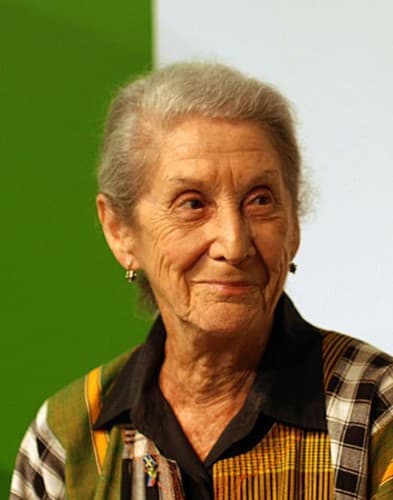
Nadine Gordimer was a South African writer and political activist. She received the Nobel Prize in Literature in 1991, recognized as a writer "who through her magnificent epic writing has ... been of very great benefit to humanity".







