BookBrief
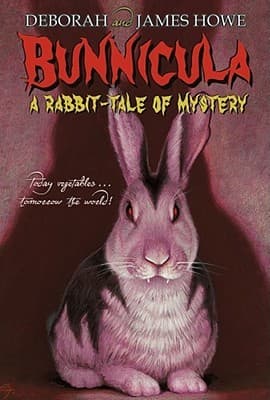
Bunnicula cover
Archivist's Choice

Bunnicula

Deborah Howe (1979)

Genre

Fantasy / Children's / Mystery / Young Adult

Reading Time

60 min

Key Themes

See below

Track Your Reading

Sign in to track this book

A suspicious cat and his loyal dog companion must uncover the truth about their new, fanged bunny housemate before his nocturnal, vegetable-draining habits turn their home into a produce-less wasteland.

Synopsis

The Monroe family brings home a mysterious rabbit, Bunnicula, they found at a movie theater. Soon, strange things begin: vegetables in the house are drained of color and juice, turning white. Chester, the family cat, a well-read and somewhat paranoid feline, immediately suspects Bunnicula is a vampire. He tries to convince Harold, the family dog, of the danger, but Harold is more interested in food and naps. Chester's obsession grows as he attempts methods to expose or ward off Bunnicula, from garlic to a wooden stake. These attempts often backfire, causing chaos and concern for Bunnicula's health among the human family. Eventually, Chester's actions make Bunnicula weak and ill. Harold, despite his initial skepticism, realizes Chester has gone too far. They discover that Bunnicula isn't a traditional vampire; he drains vegetables through an unknown, gentle means. The family veterinarian suggests feeding Bunnicula pureed vegetable baby food, which resolves the mystery and restores Bunnicula's health. Chester eventually accepts this, though reluctantly.
Reading time
60 min
Difficulty
Easy
Pacing
Moderate
Mood
Humorous, Whimsical, Mysterious, Lighthearted
✓ Read this if...
You enjoy lighthearted mysteries, talking animal stories, or want a fun, quick read with a touch of the supernatural for younger readers.
✗ Skip this if...
You prefer complex plots, serious horror, or stories without anthropomorphic animal characters.

Plot Summary

A Mysterious Discovery in the Movie Theater

The story begins with Harold, the Monroe family's shaggy dog, narrating the events that unfolded after the family's visit to a Dracula movie. Mrs. Monroe, known for her soft heart, discovers a small, dark rabbit abandoned in the movie theater. Despite Mr. Monroe's initial reluctance and the children, Toby and Pete, being asleep, Mrs. Monroe insists on bringing the creature home. Harold is intrigued by the new addition, but Chester, the sophisticated Siamese cat, senses something amiss. Chester, an avid reader of mystery novels, views the bunny with suspicion from the moment it enters their home, setting a tense tone for the new pet's arrival.

Bunnicula's Strange Habits Emerge

The newly named Bunnicula, after a family vote, is an unusual pet. He refuses to eat the carrots and lettuce offered to him, confusing everyone. The next morning, the family discovers a peculiar sight: a tomato in the kitchen has been drained of its color, turned completely white, and shriveled. Mrs. Monroe attributes it to a plant disease, but Chester is immediately suspicious. He observes Bunnicula's nocturnal habits and theorizes that the bunny is a vampire, drawing sustenance not from blood, but from vegetables. Harold, though initially skeptical, finds Chester's theories increasingly compelling as more vegetables are found mysteriously whitened.

Chester's Growing Obsession and Research

As more vegetables, including celery and zucchini, are discovered pale and lifeless, Chester becomes obsessed with proving Bunnicula's vampiric nature. He spends his days reading books on vampires and the supernatural, much to Harold's amusement and occasional annoyance. Chester tries to explain his findings to Harold, detailing the characteristics of vampires and how Bunnicula fits the description, particularly his fangs and nocturnal activity. He even tries to show Harold a picture of a vampire in one of his books. Harold, while finding Chester's theories fantastical, cannot deny the mounting evidence of the whitened vegetables and Bunnicula's peculiar behavior.

The First Attempt to Ward Off Evil

Convinced that Bunnicula is a vegetable vampire, Chester decides he must act. His first attempt involves hanging garlic around Bunnicula's cage, believing it will ward off the evil or at least prevent Bunnicula from further draining vegetables. The strong smell of garlic, however, causes discomfort for everyone in the house, particularly Harold, and results in Mrs. Monroe removing it, thinking it is a strange new household odor. Chester's efforts are met with misunderstanding from the human family, who remain unaware of the true nature of their furry pet. This setback only fuels Chester's determination to find a more effective solution.

The Steak-and-Stake Incident

Chester escalates his attempts to confront Bunnicula's vampirism. Remembering a detail from his vampire books, he decides that a stake through the heart is the only way to stop a vampire. Unable to find a wooden stake, he improvises with a steak knife and, in a moment of misguided zeal, tries to 'stake' Bunnicula. Harold intervenes, preventing serious harm, but not before Bunnicula is startled and upset. The commotion draws the attention of the Monroe family, who find Bunnicula visibly distressed and Chester looking suspicious. They interpret Chester's actions as jealousy and take Bunnicula to the vet, believing he is ill, completely missing the true reason for the incident.

Bunnicula's Decline and Chester's Guilt

Following the 'staking' incident and the subsequent vet visit, Bunnicula grows increasingly weak and lethargic. He stops moving much and looks sickly, which deeply concerns the Monroe family. Chester, witnessing Bunnicula's decline, begins to feel guilty. Despite his conviction that Bunnicula is a vampire, he did not intend to cause the bunny actual harm. He watches as the family tries various foods to tempt Bunnicula, all to no avail. Harold observes Chester's conflicted emotions, seeing that the cat's scientific curiosity is now tinged with genuine concern for the little rabbit's well-being.

The Lettuce Leaf Solution

As Bunnicula's condition worsens, the Monroe family considers drastic measures, even calling the vet again. Harold, who has been quietly observing, has a sudden insight. He recalls Bunnicula's fangs and the whitened vegetables. He realizes that Bunnicula does not just eat vegetables; he drains them. Taking a fresh lettuce leaf, Harold gently places it near Bunnicula's fangs. To everyone's astonishment, Bunnicula bites into the leaf, and the leaf quickly shrivels and turns white, while Bunnicula slowly regains some of his color and energy. It becomes clear that Bunnicula needs to sink his fangs directly into the vegetables to feed.

A New Feeding Routine for Bunnicula

With Harold's discovery, the mystery of Bunnicula's health is solved. The Monroe family, though still unaware of the 'vampire' aspect, establishes a new feeding routine for Bunnicula. They learn to leave fresh vegetables in his cage, allowing him to 'drain' them at his leisure. Bunnicula quickly recovers his health and vitality, becoming a lively, if still peculiar, pet once more. Chester, relieved that Bunnicula is no longer suffering, reluctantly accepts the bunny's unique dietary needs. The strange occurrences of whitened vegetables continue, but they are now understood, and the household returns to its usual, albeit slightly more eccentric, rhythm, with Harold continuing to document their adventures.

Principal Figures

Harold

The Protagonist

Harold begins as an amused observer of Chester's antics and ends as the one who solves Bunnicula's mystery, showcasing his underlying intelligence and empathy.

Chester

The Protagonist

Chester starts as a suspicious investigator and evolves into a somewhat chastened but still intellectually curious cat, learning to coexist with the 'vampire' bunny.

Bunnicula

The Supporting

Bunnicula remains largely static in terms of personality, serving as the catalyst for the plot and the object of investigation, ultimately revealing his unique feeding mechanism.

Mrs. Monroe

The Supporting

Mrs. Monroe's character remains consistent as the loving, slightly absent-minded caregiver.

Mr. Monroe

The Supporting

Mr. Monroe's character remains consistent as the pragmatic, slightly weary family man.

Toby

The Supporting

Toby's character remains consistent as a typical child in the background of the main plot.

Pete

The Supporting

Pete's character remains consistent as a typical child, slightly more aware than his younger brother.

Dr. Green

The Mentioned

Dr. Green's brief appearance serves to highlight the human family's conventional thinking regarding Bunnicula's condition.

Themes & Insights

Appearance vs. Reality

This theme is central to 'Bunnicula,' as the Monroe family perceives the rabbit as a cute, normal pet, while Chester, fueled by his literary knowledge, sees him as a terrifying vegetable vampire. The whitened vegetables are reality, but their cause is interpreted vastly differently by the humans versus the pets. Harold navigates between these two extremes, eventually discovering the reality of Bunnicula's unique feeding mechanism that explains the mysterious events without fully confirming Chester's dramatic theories. The humor often comes from the family's unawareness of the true strangeness in their home.

"He was just a harmless little bunny, thought the Monroes. But Chester knew better. Chester knew about things like that."

Harold (narrator)

The Power of Imagination and Interpretation

Chester's active imagination, fueled by his love for Gothic literature, drives much of the plot. He interprets every unusual event through the lens of vampire lore, creating elaborate theories about Bunnicula. While his conclusions are often comically exaggerated, his imaginative approach ultimately leads to observations that are closer to the truth than the humans' mundane explanations. Harold, too, uses his imagination, but in a more grounded, problem-solving way, to piece together the clues about Bunnicula's diet. The book celebrates the creativity of interpretation, even when it leads to absurd situations.

"Chester, on the other hand, was convinced that we had a vampire in the house. A vegetable vampire. And he had a plan."

Harold (narrator)

Friendship and Loyalty

The bond between Harold and Chester is a cornerstone of the story. Despite Chester's often exasperating antics and Harold's more laid-back nature, they are best friends who support each other. Harold often acts as Chester's sounding board and protector, intervening when Chester's plans go too far (like the steak incident). Ultimately, Harold's loyalty to Bunnicula, despite Chester's suspicions, leads him to discover the way to save the rabbit. This theme shows the importance of companionship and looking out for one another, even among very different personalities.

"I'm a dog. I don't read much. But I listen. And I love Chester, even when he's being a cat."

Harold (narrator)

Acceptance of Difference

Bunnicula, with his unique dietary needs and nocturnal habits, is an embodiment of difference. The initial conflict comes from the inability of the other characters (especially Chester) to accept or understand this difference. Chester tries to 'cure' Bunnicula or eliminate his vampiric tendencies. However, by the end of the book, Harold's discovery leads to the family (and eventually Chester) accepting Bunnicula for who he is, adapting their routines to accommodate his needs. The story teaches that differences, even strange ones, can be integrated and accepted, leading to a richer and more interesting life.

"He was a strange bunny, no doubt about it. But he was our strange bunny."

Harold (narrator)

Plot Devices & Literary Techniques

Animal Narration

The story is told from the perspective of the family dog, Harold.

The entire story is narrated by Harold, the family's shaggy dog. This device allows for a unique, humorous, and often insightful perspective on the human world and the unfolding mystery. Harold's voice is distinct, combining dog-like observations (love of food, naps) with surprisingly sophisticated language and wit. His narration provides an immediate connection with the reader, allowing them to experience the events through an innocent yet perceptive lens, and often highlighting the comical gap between animal and human understanding.

Dramatic Irony

The audience and pets know more than the human characters.

Dramatic irony is heavily employed throughout the book. The reader, along with Harold and Chester, is privy to the true nature of Bunnicula's feeding habits and Chester's vampire theories, while the Monroe family remains blissfully unaware. The humor often stems from the humans' mundane explanations for the whitened vegetables or Chester's frantic attempts to 'save' Bunnicula, which they misinterpret as jealousy or illness. This creates a comedic tension and allows the reader to feel a sense of shared secret with the animal protagonists.

Foreshadowing (via Title and Origin)

The bunny's name and discovery location hint at his nature.

The very name 'Bunnicula' is a clear portmanteau of 'bunny' and 'Dracula,' immediately foreshadowing the rabbit's vampiric qualities. Furthermore, the fact that he is found in a movie theater during a showing of a Dracula film provides a strong, early clue about his mysterious nature. These initial details prime the reader for the supernatural elements to come, even as the characters within the story initially struggle to understand the implications.

Red Herring (Chester's Exaggerations)

Chester's over-the-top theories sometimes distract from the simple truth.

While Chester's theories about Bunnicula being a 'vegetable vampire' are ultimately close to the truth, his dramatic interpretations and attempts to 'cure' Bunnicula (like the garlic and steak-and-stake incident) often serve as comedic red herrings. They divert attention from the simpler explanation of Bunnicula's unique feeding mechanism and create humorous misunderstandings. The reader is led to believe Chester's methods are entirely absurd, only for Harold to discover a more practical, yet still strange, solution that aligns with Chester's initial premise.

Critical analysis

Notable Quotes

It was a dark and stormy night. Suddenly, a shot rang out! A door slammed. The maid screamed. Suddenly, a pirate ship appeared on the horizon! While millions of people were starving, the king lived in luxury. Meanwhile, on a small farm in Kansas, a boy was growing up.

Harold the dog's dramatic opening narration, parodying clichéd stories.

I am a dog. I am a writer. I am a dog who writes.

Harold introducing himself as the narrator and author of the story.

He was a vampire. Well, he was a rabbit, but he was a vampire rabbit.

Harold and Chester suspect Bunnicula is a vampire after finding drained vegetables.

The only thing we have to fear is fear itself. And maybe vampires.

Harold reflecting on Chester's escalating fear about Bunnicula.

Cats are not dogs. It's a simple fact of life.

Harold commenting on Chester the cat's different perspective and behavior.

There are more things in heaven and earth, Horatio, than are dreamt of in your philosophy. And some of them are rabbits.

Harold musing on the strange events, paraphrasing Shakespeare.

It is a truth universally acknowledged, that a single rabbit in possession of a good home, must be in want of a vegetable.

Harold humorously adapting Jane Austen to describe Bunnicula's behavior.

We have nothing to fear but fear itself. And possibly that rabbit.

Chester expressing his growing suspicion and anxiety about Bunnicula.

The world is full of obvious things which nobody by any chance ever observes.

Chester acting like a detective, quoting Sherlock Holmes to emphasize his insights.

I'm not saying he's a vampire. I'm just saying he's a rabbit who drains vegetables of their color and leaves them white as ghosts.

Chester presenting evidence to Harold about Bunnicula's unusual habits.

Sometimes the things that are the most ordinary are the most extraordinary.

Harold reflecting on how a seemingly normal pet rabbit causes such intrigue.

A little nonsense now and then is relished by the wisest men. And dogs.

Harold justifying his humorous and sometimes silly narrative style.

The family that reads together, bleeds together. No, that's not right. The family that reads together, leads together.

Harold mixing up phrases while discussing the Monroe family's habits.

It was a rabbit of unusual size and demeanor.

Harold describing Bunnicula when the Monroe family first finds him.

In the end, we're all just animals trying to get along.

Harold's concluding thought on the resolution of the story.

Quiz

Test Your Knowledge

Ready to see how well you understood this book? Take our interactive quiz with 10 questions.

10
Questions
~5
Minutes
?
Best Score

Key Questions (FAQ)

'Bunnicula' follows Harold the dog and Chester the cat as they investigate the mysterious new pet in the Monroe household: a bunny found at a Dracula movie screening, who sleeps all day, has unusual fangs, and drains vegetables of their color. The story centers on Chester's conviction that Bunnicula is a vampire and Harold's more skeptical but concerned perspective as they try to uncover the truth.

About the author

Deborah Howe was an American author best known for co-writing the popular children's book "Bunnicula: A Rabbit-Tale of Mystery" with her sister, James Howe. Published in 1979, the "Bunnicula" series became a staple in early chapter book fiction, celebrated for its humor and engaging narrative. Howe's contributions to children's literature, particularly this beloved series, have left a lasting impact on young readers.






