“The wind howled louder. The teepee poles rattled. Jack pulled his blanket tighter.”
— Jack and Annie are inside a teepee, experiencing a storm.

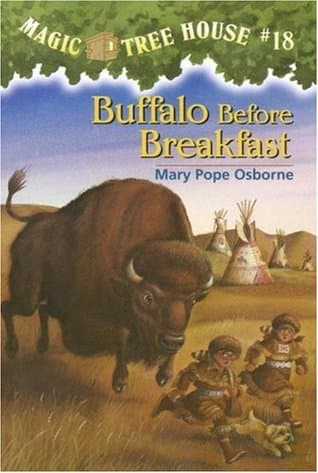
Mary Pope Osborne (1999)
Genre
Fantasy / Children's / Historical Fiction
Reading Time
90 min
Key Themes
See below
Sign in to track this book
Jack, Annie, and their enchanted dog Teddy are whisked to the 1800s Great Plains where a buffalo hunt with a Lakota boy turns into a thrilling race against a thousand stampeding buffalo.
The story begins with Jack and Annie, still on summer vacation, finding a new rhyming riddle from Merlin in the Magic Tree House. The riddle tells them to find a special gift and help someone, hinting at a journey to a time and place where "buffalo roam." They are excited for another adventure, especially since their dog, Teddy, enchanted by Merlin, will join them. As they read the riddle, the tree house spins, transporting them to an unfamiliar environment. Jack, cautious and detail-oriented, grabs his notebook and pencil, ready to document their findings, while Annie, adventurous and impulsive, is eager to explore.
The Magic Tree House lands softly, and Jack and Annie see an immense, grassy plain stretching as far as the eye can see under a bright blue sky. They immediately notice the lack of trees, except for a few along a distant river. The air smells fresh and wild, and they hear nature sounds. Teddy, their dog, barks excitedly, sensing the new adventure. Jack consults a book on the Great Plains he found in the tree house, learning about the vast grasslands and their animals. They realize they've traveled back in time to the 1800s, a period when buffalo were plentiful.
As Jack and Annie explore, they spot a boy in the distance. Annie, with her usual directness, calls out to him. The boy, who introduces himself as Little Star, is a Lakota. He is initially wary but soon becomes friendly, especially when Teddy approaches him. Little Star is on his own, searching for a lost buffalo calf. He explains that his people, the Lakota, depend on the buffalo for almost everything: food, shelter, clothing, and tools. Jack is fascinated by Little Star's knowledge of the land and animals, while Annie is drawn to his gentle nature and his connection to the plains.
Little Star explains that a big buffalo hunt is about to happen, as his people need to gather supplies for the coming winter. He invites Jack and Annie to watch, explaining the hunt's importance to his tribe's survival. Jack is hesitant, worried about the danger and the ethics of hunting, but Annie is excited to see the buffalo up close. Little Star assures them it's a necessary part of life on the plains. They follow Little Star, who skillfully navigates the terrain, leading them towards the hunting grounds where the Lakota warriors are preparing.
As they get closer to the hunting party, Jack, Annie, and Little Star notice a large flock of birds flying erratically and making distressed calls. Jack, remembering something he read in his book, recognizes this as a warning sign. He tries to point it out to Little Star, but the Lakota boy is focused on the approaching buffalo herd. The birds' unusual behavior suggests something is wrong, but the urgency of the hunt means the warriors are not paying attention. Jack feels a growing sense of unease, realizing that the situation might be more dangerous than they initially thought.
Suddenly, a loud, unexpected noise — perhaps a rock falling or a misstep by a horse — echoes across the plains. The sound, amplified by the open space, startles the immense buffalo herd. What was once an orderly gathering of animals quickly becomes chaos. Thousands of buffalo begin to thunder across the plains in a terrifying stampede, their hooves shaking the ground. The Lakota hunters are caught off guard, and the children find themselves in immediate danger, with the massive animals charging directly towards them and Little Star's village.
With the buffalo stampeding directly towards Little Star's village, Jack, Annie, and Little Star know they must act fast. Jack, remembering a detail from his book about how to turn a stampede, suggests they try to create a loud, distracting noise to steer the herd. Annie, always quick to act, starts yelling and waving her arms. Little Star, understanding the urgency, joins in, using his knowledge of the plains to guide their efforts. They run alongside the stampede, making as much noise as possible, trying to create a path for the buffalo to veer away from the tipis and the people.
Their combined efforts succeed. The lead buffalo, confused by the noise and the children's actions, slowly begins to turn, and the rest of the herd follows. The stampede is diverted, thundering past the village without causing harm. The Lakota villagers emerge, relieved and grateful. Little Star, thankful for their quick thinking and bravery, gives Jack and Annie a beautiful buffalo tooth necklace, a significant gift representing courage and the spirit of the buffalo. This gift fulfills Merlin's riddle about finding a 'special gift' and helping someone.
After the excitement, Jack and Annie take a moment to absorb all they've learned. Jack, ever the note-taker, writes down details about the buffalo, the Lakota people, and the importance of respecting nature. Annie, meanwhile, shares a quiet moment with Little Star, solidifying their friendship. They understand the realities and the deep connection the Lakota have with their environment. With their mission accomplished and the special gift in hand, they know it's time to return. They say their goodbyes to Little Star, promising to remember their adventure on the Great Plains.
Jack, Annie, and Teddy climb back into the Magic Tree House. Jack opens the book to the picture of Frog Creek, Pennsylvania, and wishes to go home. The tree house spins, and in a flash, they are back in their familiar woods. They look at the buffalo tooth necklace, a reminder of their journey and the friends they made. They are tired but exhilarated, already looking forward to Merlin's next riddle and where the Magic Tree House will take them next. The adventure has deepened their understanding of history, culture, and the natural world.
The Protagonist
Jack learns to balance his cautious nature with the need for quick action and gains a deeper appreciation for indigenous cultures and the natural world.
The Protagonist
Annie learns the importance of understanding cultural practices and develops a deeper sense of responsibility in dangerous situations.
The Supporting
Teddy continues to prove his loyalty and usefulness, his presence often bridging gaps or sensing key moments.
The Supporting
Little Star learns to trust outsiders and gains a new perspective on problem-solving through his interaction with Jack and Annie.
The Mentioned
N/A (static character, acts as a narrative device)
The book shows the role of nature, especially the buffalo, in the lives of the Lakota people. It highlights how every part of the buffalo was used for survival, from food and shelter to tools and clothing. The Great Plains and its ecosystem are central to the setting, emphasizing the balance between humans and their environment. The stampede is a reminder of nature's power and the respect it commands. Jack's research and Little Star's explanations reinforce this theme, showing how human culture can be intertwined with the natural world.
““The buffalo gives us everything,” said Little Star. “Food, clothes, shelter, tools. Everything.””
Jack and Annie's meeting with Little Star and the Lakota tribe creates understanding and respect for different cultures. They learn about the Lakota's way of life, their reliance on the buffalo, and their customs. Initially, Jack might question the ethics of hunting, but through Little Star, he understands it as a necessary part of survival for the Lakota. The children learn to appreciate a culture different from their own, moving beyond their first ideas. The buffalo tooth necklace symbolizes the bond formed and the mutual respect gained.
“Jack felt a little sad about the buffalo hunt. But he knew it was how the Lakota people lived. It was how they survived.”
Bravery is clear as Jack and Annie face the terrifying buffalo stampede. Despite their fear, they act quickly and decisively, using their combined knowledge and courage to divert the herd. Annie's impulsiveness and Jack's reliance on his book knowledge prove to be a resourceful combination. Little Star's bravery in leading them and his knowledge of the plains also contribute to their success. Standing up to a massive, thundering herd of buffalo shows their courage and ability to think quickly in a life-threatening situation.
““We have to turn them!” cried Jack. “We have to make them go another way!””
Jack's reliance on his research books and his observation skills are important throughout the adventure. He uses information from his Great Plains book to understand the environment, interpret the birds' warning signs, and devise a plan to stop the stampede. His ability to connect what he reads with what he sees highlights the practical use of knowledge. Annie's observations, though less academic, also play a role, such as her ability to quickly befriend Little Star. Together, their different ways of observing and processing information lead to their success.
“Jack remembered something he’d read in his book. Birds sometimes acted strangely before a big storm or a stampede.”
A magical vehicle that transports Jack and Annie through time and space.
The Magic Tree House serves as the primary plot device, enabling Jack and Annie's fantastical journeys. It is the mechanism by which they travel to different historical periods and geographical locations, setting the stage for each adventure. In 'Buffalo Before Breakfast,' it transports them to the 1800s Great Plains, initiating their encounter with the Lakota and the buffalo. Without the tree house, the entire premise of their adventures and the lessons they learn would not be possible, making it a crucial element for both plot progression and world-building.
Mysterious clues that guide Jack and Annie on their specific quests.
Merlin's rhyming riddles act as the catalysts for each adventure and provide the children with their mission. In this story, the riddle instructs them to find a 'special gift' and help someone in need, hinting at the buffalo and the Lakota. These riddles create suspense and give direction to Jack and Annie's explorations, ensuring they have a clear objective. They also add a layer of magical mystery to the narrative, as the children must interpret the clues to complete their task, which is fulfilled by receiving the buffalo tooth necklace from Little Star.
A non-fiction book that provides crucial information for solving problems.
Jack's research book, in this case, a book about the Great Plains, is a recurring and vital plot device. It provides Jack with factual information about the setting, its inhabitants, and potential dangers. He uses it to identify the historical period, understand the significance of the buffalo, interpret the birds' warning, and ultimately formulate a plan to divert the stampede. This device highlights the importance of knowledge and research in problem-solving, often providing the key insight needed to overcome a challenge, especially when combined with Annie's practical actions.
“The wind howled louder. The teepee poles rattled. Jack pulled his blanket tighter.”
— Jack and Annie are inside a teepee, experiencing a storm.
“Suddenly, a giant buffalo appeared at the edge of the woods. It looked as big as a house.”
— Jack and Annie first encounter a buffalo.
“Annie giggled. 'It's a magic tree house!'”
— Annie often exclaims about the tree house's magic.
“He opened the book. The picture showed a vast, grassy plain. Dark shapes moved in the distance.”
— Jack is looking at the book about the American prairie.
“'We have to help them,' said Annie. 'They're in trouble.'”
— Annie sees Native Americans being pursued by buffalo.
“Jack felt a shiver go down his spine. This was real. Really real.”
— Jack realizes the seriousness of their situation on the prairie.
“The earth trembled. A low rumble filled the air. It was the sound of a thousand hooves.”
— Describing the approach of a buffalo stampede.
“He grabbed the book and pointed at the picture of Frog Creek. 'I wish we could go there!'”
— Jack uses the magic of the tree house to return home.
“The buffalo herd thundered past them, a dark, moving river of fur and muscle.”
— Jack and Annie witness the buffalo stampede up close.
“'We learned about the prairie,' said Annie. 'And buffalo!'”
— Annie reflects on what they learned from their adventure.
“The sun beat down, hot and relentless, on the endless grass.”
— Describing the harsh environment of the prairie.
“Jack pulled out his notebook and pencil. He had to write everything down.”
— Jack's habit of taking notes during their adventures.
“A Native American boy, no older than Jack, smiled at them, his eyes bright.”
— Jack and Annie encounter a friendly Native American child.
“The tree house spun faster and faster. The wind whistled through the open window.”
— The tree house is transporting Jack and Annie.
Ready to see how well you understood this book? Take our interactive quiz with 10 questions.

Biography coming soon.







