“Brown Bear, Brown Bear, what do you see?”
— The opening line of the book, repeated throughout.

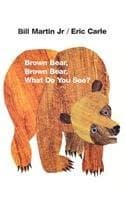
Bill Martin Jr. (1967)
Genre
Children's / Young Adult
Reading Time
3 min
Key Themes
See below
Sign in to track this book
Join a parade of colorful animals, from a big happy frog to a plump purple cat, as they introduce each other through rhythmic text and bold, distinctive collages.
The book starts with a Brown Bear. The narrator, the Brown Bear, asks, 'Brown Bear, Brown Bear, what do you see?' This begins the repetitive call-and-response pattern that defines the story, inviting the reader to guess the next character or object.
The Brown Bear answers its own question: 'I see a Red Bird looking at me.' A Red Bird then appears. This establishes the visual and verbal pattern where one animal sees another, and that second animal becomes the focus for the next question, creating a chain of observations.
The Red Bird, now the narrator, asks, 'Red Bird, Red Bird, what do you see?' The Red Bird replies, 'I see a Yellow Duck looking at me.' A Yellow Duck then appears, continuing the visual and auditory sequence of animal introductions and observations.
The Yellow Duck asks, 'Yellow Duck, Yellow Duck, what do you see?' The duck responds, 'I see a Blue Horse looking at me.' A Blue Horse then appears, adding another color and animal to the procession of characters. The pattern stays consistent, reinforcing learning.
The Blue Horse asks, 'Blue Horse, Blue Horse, what do you see?' Its reply is, 'I see a Green Frog looking at me.' A Green Frog then appears, further expanding the cast of animals and colors. Each new animal looks at the one that previously saw it.
The Green Frog continues the chain by asking, 'Green Frog, Green Frog, what do you see?' The frog answers, 'I see a Purple Cat looking at me.' A Purple Cat then appears, adding another color combination to the animal lineup. The repetitive structure helps with memorization and prediction.
The Purple Cat asks, 'Purple Cat, Purple Cat, what do you see?' The cat's response is, 'I see a White Dog looking at me.' A White Dog then appears, maintaining the consistent pattern of observation and introduction. This helps with color and animal identification.
The White Dog then asks, 'White Dog, White Dog, what do you see?' The dog replies, 'I see a Black Sheep looking at me.' A Black Sheep appears, contrasting with the previous white animal and continuing the rhythmic progression of animals and colors. The story builds as it goes.
The Black Sheep asks, 'Black Sheep, Black Sheep, what do you see?' The sheep answers, 'I see a Goldfish looking at me.' A Goldfish then appears, adding an aquatic animal and a metallic color. The sequence follows its call-and-response format.
The Goldfish asks, 'Goldfish, Goldfish, what do you see?' The goldfish replies, 'I see a Teacher looking at me.' A Teacher then appears, the first human character in the sequence, marking a transition from animals to people. This broadens what can be observed.
The Teacher asks, 'Teacher, Teacher, what do you see?' The Teacher responds, 'I see children looking at me.' A group of Children then appears, representing the implied audience. This inclusion connects the narrative to its readers, making them part of the observational chain.
Finally, the Children ask, 'Children, Children, what do you see?' They answer, 'We see a Brown Bear, a Red Bird, a Yellow Duck, a Blue Horse, a Green Frog, a Purple Cat, a White Dog, a Black Sheep, a Goldfish, and a Teacher looking at us. That's what we see!' All the previously introduced characters then appear together, reinforcing the entire sequence of animals and people.
The Starting Character/Narrator
The Brown Bear begins the observation chain and is ultimately observed by the children, completing a full circle of sight.
The Supporting Character
Serves as a link in the chain of observation, transitioning from being seen to being a seer.
The Supporting Character
Continues the observational chain, linking the Red Bird to the Blue Horse.
The Supporting Character
Adds a unique color-animal combination to the sequence, linking the duck to the frog.
The Supporting Character
Maintains the chain of observation, connecting the Blue Horse to the Purple Cat.
The Supporting Character
Adds another imaginative color-animal pairing, linking the frog to the dog.
The Supporting Character
Continues the observational sequence, linking the Purple Cat to the Black Sheep.
The Supporting Character
Provides a color contrast and links the White Dog to the Goldfish.
The Supporting Character
Introduces an aquatic animal and bridges the gap between animals and human characters.
The Supporting Character
Introduces the human element and links the animal chain to the book's audience (children).
The Protagonists/Audience
The final observers, summarizing all previous observations and completing the narrative loop.
The core of 'Brown Bear, Brown Bear, What Do You See?' uses a simple, predictable pattern: 'X, X, what do you see? I see a Y looking at me.' This repetitive structure is important for the book's appeal and educational value. Each character introduces the next, creating a predictable rhythm that allows young children to anticipate what comes next, helping with memory and language. The consistent phrasing and sequential introduction of characters reinforce the pattern, making it easy for children to follow along and even 'read' portions of the book. For example, after the Brown Bear sees the Red Bird, the Red Bird then asks the same question, solidifying the pattern.
“Brown Bear, Brown Bear, what do you see? I see a Red Bird looking at me.”
A main theme and educational goal of the book is to teach young children about different colors and common animals. Each page introduces a new animal paired with a distinct color, sometimes in an unexpected combination (e.g., a Blue Horse or a Purple Cat). Eric Carle's bold illustrations make each animal and its color easy to tell apart. The repetitive narrative reinforces these associations, allowing children to learn and recall the names of animals and their colors. The final page, where all characters are shown together, is a review of these concepts.
“Yellow Duck, Yellow Duck, what do you see? I see a Blue Horse looking at me.”
The entire narrative is about observation. Each character asks 'what do you see?' and then states what they observe, creating a chain of perspectives. This theme encourages children to pay attention to their surroundings and understand that different entities see different things. It is a simple introduction to the idea of individual viewpoints, even if the observations are sequential rather than simultaneous. The children's final observation, including all the previous characters, brings all these individual perspectives together into a collective whole, showing how observations build.
“Children, Children, what do you see? We see a Brown Bear, a Red Bird, a Yellow Duck, a Blue Horse, a Green Frog, a Purple Cat, a White Dog, a Black Sheep, a Goldfish, and a Teacher looking at us. That's what we see!”
The progression from various animals to a teacher and then to a group of diverse children introduces themes of inclusivity and community. The final page, showing all the characters together, visually represents a community of different beings, all looking at and acknowledging each other. The inclusion of 'children' at the end, representing the readers, makes them feel part of this diverse group. This reinforces the idea that everyone, regardless of their differences, is part of a larger community and can observe and be observed.
“Teacher, Teacher, what do you see? I see children looking at me.”
A predictable verbal pattern that drives the narrative and aids learning.
The book's primary plot device is its consistent call-and-response structure: 'X, X, what do you see? I see a Y looking at me.' This rhythmic, predictable dialogue creates a strong sense of anticipation and engagement for young readers. It allows them to quickly grasp the pattern and participate in 'reading' the story, enhancing language development and memory. Each new character seamlessly picks up the narrative thread from the previous one, maintaining the flow and reinforcing the learning of colors and animals.
Building upon previous elements to create a complete whole.
The story employs a cumulative structure, where each new character is added to a growing list of observed entities. While the direct 'I see' only refers to the immediate next character, the final page explicitly lists and depicts all the characters seen throughout the book. This cumulative effect aids in memory recall and provides a satisfying conclusion where all the learned elements are brought together, demonstrating the sum of all observations made by the individual characters.
Bold, distinct artwork that enhances character and color recognition.
Eric Carle's distinctive collage artwork is a crucial 'plot device' in this picture book. The large, brightly colored, and clearly defined animals and people immediately capture a child's attention. The unique textures and bold colors make each character memorable and distinct. This visual clarity directly supports the book's educational goals of color and animal identification, allowing children to easily associate the text with the corresponding image. The artwork is integral to how the plot unfolds and is perceived.
A conversational format that encourages active participation.
The entire book is framed as a series of questions and answers. This conversational format directly addresses the reader (or listener), inviting them to engage actively with the story. The question 'what do you see?' prompts a moment of anticipation, followed by the answer that reveals the next character. This interactive element makes the reading experience dynamic and participatory, rather than passive, which is highly effective for early childhood literacy and engagement.
“Brown Bear, Brown Bear, what do you see?”
— The opening line of the book, repeated throughout.
“I see a red bird looking at me.”
— Brown Bear's response, introducing the next animal.
“Red Bird, Red Bird, what do you see?”
— The pattern continues with the red bird.
“I see a yellow duck looking at me.”
— Red Bird's response, moving to the next animal.
“Yellow Duck, Yellow Duck, what do you see?”
— Continuing the rhythmic question-and-answer pattern.
“I see a blue horse looking at me.”
— A whimsical animal introduction, surprising for its color.
“Blue Horse, Blue Horse, what do you see?”
— Maintaining the book's predictable structure.
“I see a green frog looking at me.”
— Another colorful animal in the sequence.
“Green Frog, Green Frog, what do you see?”
— The pattern persists, building anticipation.
“I see a purple cat looking at me.”
— An imaginative take on a common animal.
“Purple Cat, Purple Cat, what do you see?”
— Continuing to engage young readers with familiar structure.
“I see a white dog looking at me.”
— Introducing a more traditionally colored animal.
“White Dog, White Dog, what do you see?”
— Nearing the end of the animal sequence.
“I see a black sheep looking at me.”
— A classic animal with a simple color description.
“I see a teacher looking at me.”
— The final response, shifting from animals to people.
Ready to see how well you understood this book? Take our interactive quiz with 10 questions.

Bill Martin Jr. was a prolific American educator and author of over 300 children's books. He is best known for the beloved "Brown Bear, Brown Bear, What Do You See?" and the rhythmic "Chicka Chicka Boom Boom." His work frequently focused on themes of learning, friendship, and the joy of language, making him a significant figure in early childhood literature.
Dan Gemeinhart
4.5
Kate O'Hearn
4.4

Jeanne Birdsall
4.4

Jen Wang
4.4
Wendelin Van Draanen
4.3

John Marsden
4.3

Chris Van Allsburg
4.3
Jennifer A. Nielsen
4.2