“‘What is this life? A drop of water in the ocean, a grain of sand on the shore. What are we but a breath, a fleeting moment?’”
— Nazneen reflecting on her existence and the vastness of life.

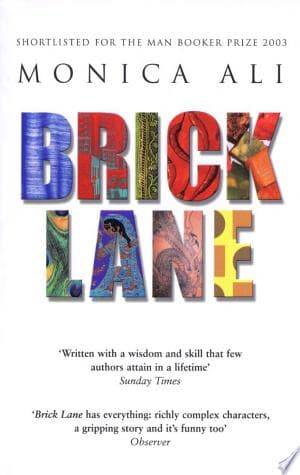
Monica Ali (2008)
Genre
Literary Fiction
Reading Time
1024 min
Key Themes
See below
Sign in to track this book
A Bangladeshi woman in an arranged marriage in London's East End builds a new life through a forbidden affair, challenging tradition amid cultural tension.
In 1980s Bangladesh, teenage Nazneen is married to Chanu, an older, educated, but disappointed man. She leaves her village for a small flat in a council estate on Brick Lane, East London, a world away from her home. Nazneen knows no English and relies completely on Chanu, who often boasts of his past achievements and future plans, few of which happen. Her early days are marked by culture shock, loneliness, and a quiet sense of duty as she deals with the unfamiliar city and her new life as a wife, far from her sister Hasina.
Nazneen soon becomes pregnant and gives birth to a son, Raqib. Her joy is immense, but Raqib tragically dies as an infant. This loss deeply affects Nazneen, strengthening her fatalistic view of life. She later has two daughters, Shahana and Bibi. Shahana, the elder, is intelligent and rebellious, often clashing with Chanu's traditional views. Bibi, the younger, is calmer and more religious. Nazneen finds purpose and quiet happiness raising her daughters, dealing with Chanu's quirks and financial problems with resolve, sewing clothes at home to add to their small income.
Chanu, despite his ambitions, struggles to find stable work that matches his self-perceived intelligence. He starts various failed business ventures, from a taxi business to an internet café, all of which fail, often leaving the family in more debt. He dreams of returning to Bangladesh in triumph, a dream that becomes more of a comfort than a practical plan. His constant statements and perceived intellectual superiority often annoy Shahana, who wants a more modern, English life.
As the girls grow older, Nazneen continues her work as a seamstress. She receives an order from Karim, a young, charismatic Bangladeshi activist who runs a local community group and delivers leaflets for a radical Islamic organization. Karim is modern, passionate, and speaks English fluently, showing a different kind of Bangladeshi identity than Chanu's. Their first interactions are professional, but Nazneen is subtly drawn to his energy and conviction, a sharp contrast to Chanu's resigned fatalism.
Karim starts visiting Nazneen's flat more often, at first to discuss sewing orders. Gradually, their conversations deepen, and a strong attraction grows between them. Nazneen, who has lived a life of quiet submission and duty, finds herself drawn to Karim's intensity and the attention he gives her. Their affair begins, kept secret in her flat. This forbidden relationship awakens a sensuality and independence in Nazneen she never knew she had, challenging her long-held beliefs about marriage and self-worth.
The story often mentions the growing racial tensions and post-9/11 anxieties within the Bangladeshi community in East London. Karim is deeply involved in local activism, protesting against Islamophobia and supporting the rights of the Muslim community. These political currents set a volatile background for Nazneen's personal awakening. She hears news and discussions from Karim and even Chanu, who, despite his detachment, sometimes shares his opinions on the injustices faced by their community, further showing the cultural divide between generations.
Throughout the novel, Nazneen receives letters from her younger sister, Hasina, who stayed in Bangladesh. Hasina's letters tell of a life of increasing hardship and misfortune. She runs away from an abusive husband, endures poverty, works in garment factories, and faces exploitation. Her story contrasts Nazneen's struggles, reminding Nazneen of their different life paths and the relative stability, however imperfect, she found in London. The letters also show the lasting bond between the sisters, despite their physical separation.
Shahana, now a teenager, becomes increasingly rebellious. She resents Chanu's traditionalism, his constant talk of returning to Bangladesh, and his unfulfilled promises. She embraces her English identity, listening to pop music, asking for Western clothes, and openly challenging her father. Her defiance reflects the generational clash in immigrant families, as children born and raised in the UK navigate their dual heritage. Nazneen tries to mediate between Shahana and Chanu, understanding both their views to some extent, but often feels caught in the middle.
After years of discussion, Chanu finally decides to move back to Bangladesh, convinced it will offer him a better life and more respect. He expects Nazneen and the girls to go with him. This decision throws Nazneen's life into chaos. The thought of leaving London, her home for two decades, and more importantly, leaving Karim, fills her with dread. It forces her to seriously consider her own desires and agency for the first time, rather than passively accepting her fate.
Faced with Chanu's upcoming departure, Nazneen finally confronts her feelings for Karim and her own growing sense of self. She realizes she cannot return to Bangladesh and abandon the life she has built, however imperfect, in London. In a quiet but strong act of defiance, she tells Chanu that she and the girls will not be going with him. This decision marks a significant turning point for Nazneen, showing her new independence and willingness to shape her own destiny, even if it means breaking from tradition and her husband.
Chanu returns to Bangladesh alone, leaving Nazneen to manage life as a single mother. She continues her sewing business, now with a greater sense of purpose and control. While her affair with Karim eventually cools and ends, it helped awaken her. Nazneen finds strength in her work and her daughters. She takes on more responsibility, manages her finances, and slowly integrates more into the wider community. The ending shows her at the start of a truly independent life, still in Brick Lane, but with a sense of control and self-possession.
The Protagonist
Nazneen transforms from a submissive, tradition-bound wife into an independent woman capable of making her own choices and forging her own path.
The Supporting
Chanu remains largely static in his personality, but his journey culminates in his return to Bangladesh, leaving Nazneen to forge her own future.
The Supporting
Karim's role is primarily to catalyze Nazneen's transformation; he remains consistent in his activism and eventually moves on from the affair.
The Supporting
Shahana consistently pushes against traditional boundaries, asserting her English identity and independence throughout the novel.
The Supporting
Bibi's character remains consistent, embodying a quieter, more traditional path compared to her sister.
The Supporting
Mrs. Islam serves as a static representative of traditional community values and gossip.
The Supporting
Hasina's life is a continuous struggle, illustrating the harsh realities faced by many women in Bangladesh.
The novel explores the complex layers of identity for immigrants, especially women, caught between two cultures. Nazneen deals with her Bangladeshi heritage and her life in London, at first feeling lost. Her daughters, Shahana and Bibi, show different parts of this struggle, with Shahana embracing her Englishness and Bibi finding comfort in tradition. The characters constantly figure out what it means to be Bangladeshi in Britain, how much of their ancestral culture to keep, and how much to adapt. Nazneen's journey is about finding her own sense of self, independent of either culture's complete embrace.
“She had wanted to be a good daughter, a good wife, a good mother. But when was she going to be a good Nazneen?”
A central theme is Nazneen's slow but deep journey towards self-determination. At first, she passively accepts her fate, defined by her roles as wife and mother. Her affair with Karim, though forbidden, awakens her to her own desires and the possibility of choice. Her decision to stay in London and build an independent life, defying Chanu's expectations, is a strong act of freedom. The novel contrasts this with her sister Hasina's lack of control in Bangladesh, showing the different levels of freedom women can achieve.
“She was a woman. She was a mother. She was a wife. She was a daughter. But she was not a doormat.”
The novel clearly shows the friction between traditional Bangladeshi culture and modern British society, especially as experienced by immigrant families. Chanu represents the older generation holding onto the dream of returning 'home' and following customs. Shahana, on the other hand, embodies the second generation, fully integrated into British life and often rebelling against her parents' expectations. Nazneen is in the middle, slowly bridging this gap as she adapts to her new environment while keeping parts of her heritage. The racial and religious tensions in Brick Lane further highlight these clashes.
“What was the point of coming all this way, if you were going to live as if you'd never left?”
The complexities of love are explored through Nazneen's relationships. Her marriage to Chanu is based on duty and tradition; it lacks passionate love but grows into a form of companionship. Her affair with Karim ignites a powerful, sensual desire that challenges her understanding of herself and her marriage. The novel examines the tension between marital duty and the intoxicating pull of personal desire, suggesting that true love might be found in self-respect and the freedom to choose one's own path, even if that path is solitary.
“Love was not a thing to be searched for, but a thing to be endured.”
Letters from Nazneen's sister in Bangladesh provide a parallel narrative and social commentary.
The letters from Nazneen's sister, Hasina, serve as an intermittent epistolary element. They offer a poignant counterpoint to Nazneen's experiences, revealing a life of escalating hardship, abuse, and poverty in Bangladesh. This device allows the author to broaden the scope of the narrative beyond Nazneen's immediate world, providing a stark comparison of the fates of two sisters and highlighting the socio-economic realities faced by women in their homeland. The letters also underscore the enduring bond between the sisters and Nazneen's deep connection to her past.
The story is primarily told through Nazneen's internal thoughts and perceptions.
The novel is largely told from a third-person limited omniscient perspective, closely following Nazneen's internal world. This allows readers deep access to her thoughts, feelings, and observations, even when her outward demeanor is quiet and submissive. This narrative choice is crucial for portraying her gradual awakening and her internal struggles with identity, desire, and duty. It emphasizes her journey from passive acceptance to active self-determination, making her internal life the primary engine of the plot, despite the seemingly small scale of her external existence.
Nazneen's work as a seamstress symbolizes her constrained life and eventual creativity/independence.
Nazneen's constant sewing, initially a means of income and a quiet activity within her confined flat, becomes a powerful symbol. The fabrics and threads represent the intricate, sometimes restrictive, patterns of her life. Initially, it signifies her domesticity and reliance on others' designs. As she gains agency, her sewing can be seen as an act of creation and control, literally shaping her own livelihood and, metaphorically, her own destiny. It's a quiet craft that anchors her, but also allows for a subtle expression of her inner world.
The vibrant, diverse East London neighborhood acts as a character and cultural backdrop.
Brick Lane itself functions almost as a character in the novel, embodying the vibrant, complex, and sometimes fraught reality of immigrant life in London. It is a microcosm of Bangladeshi culture transplanted to Britain, a place of community, tradition, and change. The sights, sounds, and smells of the market, the curry houses, and the mosque provide a rich sensory backdrop. The racial and political tensions that simmer in the area reflect the broader societal issues affecting the characters, making the setting integral to the themes of identity and belonging.
“‘What is this life? A drop of water in the ocean, a grain of sand on the shore. What are we but a breath, a fleeting moment?’”
— Nazneen reflecting on her existence and the vastness of life.
“‘She saw the city as a series of small, self-contained worlds, each with its own rules and rhythms.’”
— Nazneen's perspective on London, particularly Brick Lane, as she begins to understand it.
“‘It was not a question of wanting more, but of realizing that there could be more.’”
— Nazneen's growing awareness of possibilities beyond her traditional life.
“‘The past was not a foreign country; it was a room in her house, sometimes locked, sometimes open.’”
— Nazneen's relationship with her past experiences and memories.
“‘To be an immigrant was to live in a state of constant translation.’”
— The challenges and experiences of the immigrant community in Brick Lane.
“‘She had come to understand that silence was not always empty; sometimes it was full of unspoken things.’”
— Nazneen's evolving understanding of communication and relationships, particularly with her husband.
“‘Hope was a thing with feathers, but sometimes it felt like a thing with chains.’”
— Nazneen's struggle with hope and the constraints of her circumstances.
“‘She learned that freedom was not a gift, but a muscle that had to be exercised.’”
— Nazneen's journey towards personal liberation and agency.
“‘Love, she thought, was not a grand gesture but a thousand tiny acts of endurance.’”
— Nazneen's mature understanding of love within her arranged marriage.
“‘The smell of curry was the smell of home, even when home was a place she barely recognized.’”
— The sensory experience of Brick Lane and its connection to cultural identity.
“‘Life was not a story with a beginning, middle, and end, but a series of moments, some bright, some dim.’”
— Nazneen's philosophical view on the nature of life and time.
“‘She had lived her life in the shadows, but now she was stepping, hesitantly, into the light.’”
— Nazneen's transition from a passive existence to a more active role in her life.
“‘The world was not waiting for her; she had to go out and find it.’”
— Nazneen's realization that she must actively pursue her own destiny.
Ready to see how well you understood this book? Take our interactive quiz with 10 questions.

Monica Ali FRSL is a British writer of Bangladeshi and English heritage. In 2003, she was selected as one of the "Best of Young British Novelists" by Granta magazine based on her unpublished manuscript; her debut novel, Brick Lane, was published later that year. It was shortlisted for the Man Booker Prize. It was adapted as a 2007 film of the same name. She has also published three other novels. Her fifth novel, Love Marriage, was published by Virago Press in February 2022 and became an instant Sunday Times bestseller.







