“Trout was a man of so many gifts that it was as though God had personally made him a gift-wrapping service.”
— Describing Kilgore Trout's unrecognized genius and prolific output.

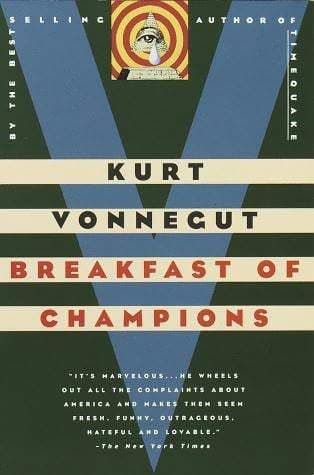
Kurt Vonnegut Jr. (1973)
Genre
Literary Fiction / Science Fiction
Reading Time
240 min
Key Themes
See below
Sign in to track this book
An aging science fiction writer's bizarre tales become unsettling reality for a car dealer, forcing America to confront its own absurdities through Vonnegut's satirical lens.
The novel begins with the narrator, Kurt Vonnegut, explaining his wish to clear his mind of the 'crap' he has collected over his life. He identifies himself as the universe's creator within the book and states his intention to free his characters. He introduces Dwayne Hoover, a wealthy and seemingly successful Pontiac dealer in Midland City, Ohio, who is nearing a mental breakdown. Dwayne's inner turmoil shows in his erratic behavior and growing paranoia, which he attributes to chemical imbalances. The narrator also briefly introduces Kilgore Trout, an obscure science fiction writer, whose path will intersect with Dwayne's.
Midland City is a typical American town, full of consumerism, pollution, and superficiality. The narrator often interjects with crude drawings and explanations of common objects, historical events, and social norms, showing their absurdity. Dwayne Hoover's mental state continues to worsen, marked by violent fantasies and a growing sense of alienation. He confides in his mistress, Francine Pefko, and his son, Bunny, about his anxieties, but finds no real comfort. His wife, Celia, is also unwell, preferring to stay in bed, further isolating Dwayne. The narrator suggests Dwayne's impending madness is a direct result of his environment and his inability to deal with the world around him.
Kilgore Trout, a struggling and unappreciated science fiction writer, receives an unexpected invitation to the first annual 'Festival of the Arts' in Midland City. He is offered a small payment and travel expenses, which he desperately needs. The narrator provides examples of Trout's bizarre and often pessimistic stories, many of which explore themes of human cruelty, environmental destruction, and life's meaninglessness. Trout, living in poverty in Cohoes, New York, views the invitation with cynicism and faint hope. He hitchhikes to Midland City, meeting various eccentric characters and thinking about the world.
The Festival of the Arts in Midland City is a hollow and pretentious event, meant to boost the city's cultural image. Various minor characters, including the festival organizer Eliot Rosewater (a recurring Vonnegut character), appear. Kilgore Trout eventually arrives, disheveled and tired from his journey. He gets a room at the Holiday Inn and prepares for his presentation. The narrator continues his digressions, explaining everything from the American flag to the human anus, showing the arbitrary nature of human conventions. He notes that Trout's arrival is important, though Trout himself does not realize the effect his work will have on one Midland City resident.
During a moment of despair, Dwayne Hoover finds a copy of Kilgore Trout's novel, 'Now It Can Be Told,' which Eliot Rosewater had mistakenly left at the Holiday Inn bar. The book's premise is that everyone in the universe, except for one individual (the reader), is a robot, placed on Earth by the Creator to test that one individual. Dwayne, in his fragile mental state, takes this fiction as absolute truth. This misinterpretation is the final trigger for his complete mental breakdown. The narrator details Dwayne's internal struggle as he deals with this horrifying revelation, believing himself to be the only real person in a world of automatons.
Believing he is the only free-willed being, Dwayne Hoover's paranoia escalates into full-blown psychosis. He attends Kilgore Trout's lecture at the Festival of the Arts, where Trout is reading from 'Now It Can Be Told.' During the lecture, Dwayne's delusion solidifies. He then goes on a violent rampage, attacking several people he now sees as machines. He assaults Francine Pefko, his son Bunny, and even Kilgore Trout, biting off a piece of Trout's finger. The scene is chaotic and horrifying, yet mixed with the narrator's dark humor and detached observations about human nature and violence.
After his violent outburst, Dwayne Hoover is subdued and institutionalized. Midland City is left to deal with the shock and confusion of his actions. The narrator reflects on mental illness and the societal pressures that may have contributed to Dwayne's breakdown. He also highlights the wider world's indifference to such individual tragedies. Kilgore Trout is treated for his injury, and the festival quickly disperses. The incident becomes another strange, forgotten detail in Midland City's history, further showing the fleeting and often meaningless nature of human events.
After the chaos, Kilgore Trout, still reeling from the events and his injury, meets the narrator, Kurt Vonnegut, in a bar. The narrator reveals his identity as Trout's creator, explaining that he brought Trout into existence and controlled his life. He tells Trout he is now freeing him from his authorial control, giving him free will and the ability to make his own choices. This meta-fictional moment is a liberation for both Trout and the narrator, who is also trying to free himself from the 'crap' of his own mind. Trout, overwhelmed, asks, 'Make me young, make me young, make me young!' before crying.
In the concluding sections, the narrator continues his observations and criticisms of American society, touching on themes of war, racism, environmental degradation, and life's absurdity. He reflects on consumer culture's superficiality, unchecked capitalism's destructive nature, and the loneliness many individuals feel. The narrative becomes more philosophical and personal as Vonnegut grapples with his role as a creator and observer. He repeats his desire to cleanse his mind and leave a more honest legacy, free from the illusions and 'crap' he believes fill modern life.
The book ends with the narrator's final farewell. He has freed his characters, especially Kilgore Trout, and has, to some extent, cleansed his own mind. He acknowledges storytelling's arbitrary nature and life's inherent contradictions. The ending is both poignant and darkly humorous, leaving the reader with a sense of liberation and lingering despair. The narrator's journey parallels Trout's, as both seek to escape their realities. Vonnegut expresses a hope that by stripping away the 'crap,' humanity might find a way to live more authentically, even in a world that often seems meaningless.
The Protagonist/Author-as-Character
Starts as a controlling author, but evolves to free his characters and himself from the 'crap' of societal illusions.
The Protagonist/Antagonist (to himself)
Descends from a state of simmering anxiety to full-blown psychosis and violence, ending in institutionalization.
The Protagonist/Author-as-Character
Goes from being a manipulated character to a freed individual, gaining agency and awareness.
The Supporting
Remains largely static, a figure of compassionate but flawed idealism.
The Supporting
Remains static, a victim of Dwayne's mental illness.
The Supporting
Remains static, a symbol of mental illness and isolation.
The Supporting
Remains static, an innocent caught in his father's breakdown.
The Mentioned
Static, a historical reference point.
Vonnegut constantly shows life's and society's inherent absurdity. Through the narrator's frequent digressions, crude drawings, and explanations of everyday objects and historical events, the novel removes any perceived profundity, revealing them as arbitrary and often nonsensical. Dwayne Hoover's descent into madness is partly because he cannot cope with this meaninglessness, while Kilgore Trout's stories often amplify it. The freedom granted to Trout by Vonnegut can be seen as an attempt to find meaning in agency, even if life itself remains absurd. This theme is highlighted by the narrator's repeated statement, 'Hi ho,' which is a dismissive acknowledgment of life's often pointless occurrences.
“''Hi ho,' said Dwayne Hoover, 'What's new?'”
The novel's central conflict hinges on Dwayne Hoover's catastrophic misinterpretation of Kilgore Trout's science fiction novel, 'Now It Can Be Told.' Dwayne's fragile mind takes the satirical premise (that he is the only person with free will in a world of robots) as literal truth. This shows the dangers of failing to distinguish between fiction and reality, especially for those nearing mental collapse. The theme critiques the power of narratives, both fictional and societal, to shape perception and potentially destroy lives. It also comments on the author's responsibility and the reader's role in interpreting literature.
“'You are the only creature in the entire Universe who has free will,' said the Creator. 'Everybody else is a robot, a machine.'”
The novel critiques the American Dream, portraying it as a hollow and destructive pursuit. Midland City, with its consumerism, pollution, and superficiality, embodies this ideal's failures. Dwayne Hoover, a seemingly successful car dealer, shows the individual driven to madness by the dream's pressures and emptiness. His wealth and possessions offer no comfort, only adding to his isolation and paranoia. Vonnegut suggests that the relentless pursuit of material success and conformity to societal norms leads to spiritual emptiness and mental decay, rather than happiness. The widespread environmental degradation and social injustices also show the dream's dark side.
“America was a nation of machines who were designed to make money, and who had no souls.”
Mental illness is a theme, mainly seen through Dwayne Hoover's descent into psychosis and Celia Hoover's reclusive state. The novel explores how societal pressures, isolation, and a lack of genuine connection contribute to mental breakdown. Dwayne's attempts to articulate his suffering are met with misunderstanding or indifference, showing society's inability or unwillingness to address mental health issues. The narrator's detached, almost clinical descriptions of human suffering highlight a broader societal apathy, suggesting that individual tragedies are often absorbed and forgotten within the world's larger, uncaring machinery.
“He was trying to get a grip on himself, but there wasn't anything to grip.”
Vonnegut constantly breaks the fourth wall, making himself a character in the novel and directly addressing the reader. This metafictional approach explores storytelling, authorship, and the relationship between creator and creation. By explicitly stating his control over his characters and then choosing to free them, Vonnegut grapples with his artistic responsibilities and the ethical implications of manipulating fictional lives. Freeing Kilgore Trout is a symbolic gesture of the author's desire to release himself from the 'crap' of his own mind, suggesting a therapeutic aspect to the writing process.
“I am an old man, and I am trying to clear my head.”
The author directly inserts himself into the narrative, commenting on his characters and the creative process.
Vonnegut frequently breaks the fourth wall, appearing as the omniscient narrator and a character within the story. He addresses the reader directly, explains his motivations for writing, and even interacts with his characters, most notably Kilgore Trout. This device highlights the artificiality of the narrative, forcing the reader to constantly acknowledge the book as a constructed artifact. It allows Vonnegut to comment on the nature of storytelling, the author's power, and the relationship between fiction and reality, while also providing a platform for his social and philosophical commentary.
Simple illustrations and explanations of common objects, adding to the satirical and didactic tone.
Throughout the novel, Vonnegut includes crude, childlike drawings and accompanying explanations of everyday objects (e.g., an American flag, a vagina, a human anus, a house). These illustrations serve multiple purposes: they underscore the narrator's intention to reduce complex ideas to their simplest, often absurd, components; they highlight the arbitrary nature of human inventions and conventions; and they contribute to the book's satirical and detached tone. They act as visual digressions, reinforcing the narrator's desire to 'cleanse' his mind of accumulated 'crap' by deconstructing the familiar.
Summaries of Trout's bizarre and pessimistic science fiction tales, used for social commentary.
The narrator frequently summarizes plots from Kilgore Trout's obscure science fiction novels and short stories. These fictional fictions often serve as microcosms for Vonnegut's own social commentary, exploring themes of human cruelty, environmental destruction, and the meaninglessness of existence in a darkly humorous way. They provide a vehicle for Vonnegut to introduce philosophical ideas and critiques without directly lecturing the reader. Crucially, one of these stories, 'Now It Can Be Told,' becomes the catalyst for Dwayne Hoover's mental breakdown, making Trout's fiction integral to the plot.
Recurring words and phrases that emphasize themes and create a distinct narrative rhythm.
Vonnegut employs the repetition of specific phrases, most notably 'Hi ho' and 'And so on,' throughout the narrative. 'Hi ho' often follows a particularly bleak or absurd observation, serving as a dismissive, almost nihilistic shrug at the state of the world. 'And so on' conveys the endless, often meaningless, continuation of events and human endeavors. This repetitive device creates a distinctive narrative rhythm and reinforces the novel's themes of absurdity, meaninglessness, and the narrator's detached perspective on human affairs. It also contributes to the book's unique, almost conversational, voice.
“Trout was a man of so many gifts that it was as though God had personally made him a gift-wrapping service.”
— Describing Kilgore Trout's unrecognized genius and prolific output.
“I will come to a time in my life when I will no longer be able to tell the difference between a human being and a piece of shit.”
— Dwayne Hoover's growing mental instability and his perception of humanity.
“Make sure the world is flat.”
— One of the absurd commandments Trout gives to his characters, reflecting the arbitrary nature of reality.
“This was the highest possible form of praise in the arts: to be told that one's work was like a human being. It was the only praise that mattered.”
— Vonnegut's meta-commentary on the value of art and the artist's goal.
“We are what we pretend to be, so we must be careful about what we pretend to be.”
— A philosophical musing on identity and the self, often attributed to Trout.
“You are a very sentimental man, Mr. Vonnegut. I don't see how you can possibly be a successful writer.”
— Vonnegut's self-deprecating humor and an acknowledgment of his own emotional style.
“The earth was being destroyed by its own inhabitants, and it was a crime. But the inhabitants were too busy with their own petty concerns to notice.”
— Kilgore Trout's cynical view of humanity's self-destructive tendencies.
“Everything was beautiful and nothing hurt.”
— A recurring phrase in Vonnegut's works, often associated with his character Billy Pilgrim, but here reflecting an idealized state.
“It was the best of times, it was the worst of times. It was the only time I had.”
— Vonnegut's reflection on the present moment and the nature of existence.
“I told him I was a novelist. He said, 'Oh, that's nice. What do you do for a living?'”
— Highlighting the common misunderstanding and lack of respect for artists.
“The two most engaging powers of a photograph are to make new things familiar and familiar things new.”
— A general observation on the power of visual media, applicable to storytelling.
“So I went to the window and looked out. The air was clean. The sky was blue. The sun was shining. The trees were green. The birds were singing. And the universe was unfolding as it should.”
— A moment of simple peace and acceptance amidst the chaos of the narrative.
“It was a good thing to be an artist, a creator. It was a good thing to be alive.”
— A rare moment of straightforward optimism and affirmation of life and creativity.
“History is merely a list of surprises. It can only prepare us to be surprised yet again.”
— A philosophical take on the unpredictable nature of history and human events.
Ready to see how well you understood this book? Take our interactive quiz with 10 questions.
Biography coming soon.







