“Every man dies. Not every man truly lives.”
— William Wallace's rallying cry to his men before a battle.

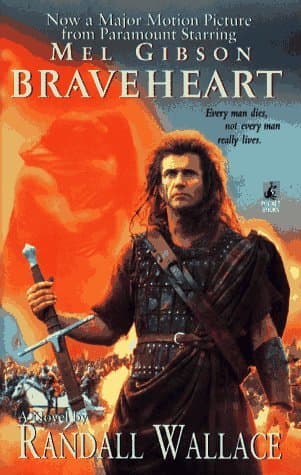
Randall Wallace (1994)
Genre
Historical Fiction / Romance
Reading Time
360 min
Key Themes
See below
Sign in to track this book
After the brutal murder of his true love and a deep desire for Scottish freedom, William Wallace changes from a farmer into a legendary rebel, fighting against the tyrannical English Plantagenet king.
The story begins in 1280, showing a young William Wallace in Scotland, where English King Edward I, 'Longshanks,' rules harshly. Scottish nobles, including Wallace's father and brother, meet to discuss fighting back but are ambushed by English soldiers. Wallace's father and brother die in a fight, leaving him an orphan. His uncle Argyle, a scholar and fighter, takes William in, teaching him languages, history, and sword fighting. Argyle instills in him a love for freedom and a careful approach to violence. William leaves Scotland for many years, growing up in peace, but he never forgets the English oppression.
Years later, an adult William Wallace returns to his village, wanting a simple life as a farmer, away from conflict. He meets his childhood friend Hamish again. Soon, he falls in love with Murron MacClannough, a woman from a nearby clan. They keep their courtship secret because English law, 'Prima Nocte,' allows English lords to claim the first night with any Scottish bride. To avoid this, William and Murron have a private wedding in the woods, symbolizing their commitment and defiance of English power. They try to keep their marriage hidden to protect Murron from English abuse.
Wallace's peaceful life ends when English soldiers assault Murron. She had tried to help Wallace escape a small fight with an English patrol in Lanark. Murron is captured, and the English sheriff, Lord Bottoms, publicly executes her by slitting her throat in front of the villagers. This act serves as a warning against Scottish defiance. Seeing this, Wallace is filled with grief and rage. He attacks the English garrison alone, killing the sheriff and his men to avenge Murron's death. This moment changes Wallace from a farmer into a rebel leader.
After Murron's murder and his revenge, Wallace becomes a hunted man. However, his brave act inspires ordinary Scottish people, who have suffered under English rule. Farmers, villagers, and outcasts, including his friends Hamish and Stephen, join his cause. They are not trained soldiers, but their shared desire for freedom and revenge against the English fuels them. Wallace, at first hesitant to lead, takes on the role, teaching them basic fighting skills and guerrilla tactics. Their first major victory is ambushing and defeating a larger English force, which boosts their morale and attracts more followers to their growing army.
Wallace's rebellion grows, causing King Edward I to send a large English army, led by Lord Chelmsford, to crush the Scots. The armies meet at Stirling Bridge. Outnumbered in a conventional fight, Wallace uses a clever tactic. He orders his men to place sharpened stakes, which they deploy just before the English cavalry charges across the narrow bridge. English knights are impaled, stopping their advance. As English infantry tries to cross, Wallace's forces, including Hamish and Stephen, charge, trapping and destroying the English army. This victory establishes Wallace as a strong military leader and gives hope for Scottish independence.
After the Stirling victory, Scottish nobles, often selfish and divided, acknowledge Wallace's leadership. Robert the Bruce, a noble with a claim to the throne, meets Wallace and expresses admiration, though his own ambitions complicate things. Wallace is knighted 'Guardian of Scotland,' a title he accepts humbly but understanding its responsibility. He then leads his army into northern England, raiding towns and fortresses, bringing the fight to King Edward's territory. These invasions are a symbolic act of defiance and a way to disrupt English supply lines and morale.
King Edward I, angry about the Scottish attacks, personally leads a large English army, including Irish mercenaries, to face Wallace. The armies clash at the Battle of Falkirk. During the battle, the Scottish noble cavalry, led by Lord Mornay and Lord Lochlan, abandon Wallace's infantry, leaving them exposed to English archers and heavy cavalry. This betrayal, motivated by self-preservation and English bribes, cripples Wallace's forces. Despite Wallace's efforts, the Scots suffer a devastating defeat. Wallace is wounded and barely escapes, saved by Robert the Bruce's father, who, despite his son's reservations, has a moment of conscience. The defeat is a crushing blow to the Scottish rebellion.
After Falkirk, Wallace is an outlaw again, fighting a guerrilla war against the English for several years. He continues to inspire common people, but his forces are scattered. Meanwhile, Robert the Bruce struggles with his conscience, torn between wanting the Scottish throne and admiring Wallace's principles. His father, a shrewd man, constantly pushes Robert to ally with England for personal gain. Robert sees his people's suffering and feels conflicted by the nobles' selfish actions and Wallace's commitment to freedom. He grapples with whether to join the English or fully commit to Wallace's cause.
During this time, Princess Isabella, King Edward's daughter-in-law, starts to admire Wallace, seeing his nobility and the justice of his cause, despite being English. She tries to help him and warns him of traps set by her father-in-law. However, Scottish nobles, especially Lord Mornay and Lord Lochlan, are offered land and titles by King Edward for Wallace's capture. They lure Wallace to Edinburgh by pretending to arrange a peace meeting with Robert the Bruce, who does not know about the full extent of the treachery. This setup is a planned betrayal to eliminate the rebel leader.
The trap is sprung in Edinburgh. English soldiers and the treacherous Scottish nobles ambush Wallace. Despite a fierce fight, he is overwhelmed and captured. Robert the Bruce, arriving late, sees Wallace's capture and is horrified by the betrayal, realizing he was a pawn in his father's and the nobles' scheme. Wallace is taken to London, where he is tried for treason against King Edward I. The trial is a sham, meant to publicly disgrace and execute him. Despite the odds, Wallace remains defiant, refusing to pledge allegiance to King Edward, stating he is a free man and a Scot.
Wallace is sentenced to a brutal public execution: hanged, drawn, and quartered. Before the execution, Princess Isabella tries to intervene with King Edward, revealing her pregnancy with Wallace's child in a desperate plea, but it does not work. As he is led to the scaffold, Wallace endures torture and public humiliation. The English crowd demands his submission, but he refuses to recant. In his final moments, as he is about to be decapitated, he cries out 'FREEDOM!' This cry, witnessed by the horrified crowd and a devastated Robert the Bruce, echoes across London, becoming a symbol of Scottish resistance and inspiring future rebellion.
Years after Wallace's death, Scottish nobles gather, ready to surrender to English rule again. Robert the Bruce, now King of Scots, prepares to accept peace with England. However, as he addresses his disheartened army at Bannockburn, he sees the faces of the common soldiers, the same men who fought with Wallace. He remembers Wallace's sacrifice and his defiant final cry. Inspired by Wallace's spirit and shamed by his past compromises, Robert the Bruce gives an impassioned speech, rallying the Scots to fight for true freedom, not just for land or titles. He leads them into battle against the English, fulfilling Wallace's legacy and securing Scotland's independence.
The Protagonist
Transforms from a man seeking peace into a legendary warrior and martyr, inspiring a nation to fight for independence.
The Supporting
Her tragic death serves as the ultimate sacrifice, fueling Wallace's transformation and the Scottish fight for freedom.
The Antagonist
Remains steadfast in his tyrannical ambition, ultimately failing to break the spirit of Scotland despite Wallace's death.
The Supporting
Evolves from a conflicted, ambitious noble to a true leader, inspired by Wallace's sacrifice to fight for Scotland's freedom.
The Supporting
Remains steadfastly loyal to Wallace, fighting alongside him from the beginning to the end, and witnessing the ultimate triumph of his spirit.
The Supporting
Stays loyal to Wallace, providing unwavering support and a unique perspective on the fight for freedom.
The Supporting
Transforms from a passive royal to an active sympathizer and lover of Wallace, carrying his legacy forward.
The Supporting
Remains steadfast in his cynical, self-serving ambitions, ultimately failing to fully corrupt his son's spirit.
The main theme of 'Braveheart' is the fight between the wish for freedom and the weight of tyranny. King Edward I's harsh rule over Scotland, shown by policies like 'Prima Nocte' and Murron's public execution, represents extreme tyranny. William Wallace embodies freedom, fighting not for a crown or land, but for the right of all Scots to live without being controlled. His final cry of 'FREEDOM!' captures this theme, showing that the spirit of liberty cannot be killed, even if the person is.
“Every man dies, not every man truly lives.”
Loyalty and betrayal appear throughout the story. Wallace inspires strong loyalty among common people and close friends like Hamish and Stephen. In contrast, Scottish nobles, like Lord Mornay and Lord Lochlan, repeatedly betray Wallace for personal gain, land, or titles, most notably at Falkirk and his capture. Robert the Bruce's inner struggle shows this theme, as he battles between loyalty to his ambition and loyalty to his country and Wallace's ideas. The film highlights how betrayal can severely impact a nation.
“Your heart is your own. But your father's heart belongs to Longshanks.”
Love, both romantic and for one's country, drives William Wallace's actions. His deep love for Murron MacClannough starts his rebellion; her murder turns his personal grief into a strong desire for justice and freedom for all Scots. This personal love grows into a broader love for his homeland and its people, making him endure great suffering and sacrifice. The film suggests that profound love can inspire extraordinary courage and defiance against great odds.
“I love you. Always have. I want to marry you.”
Wallace's life and death inspire, showing how one person's sacrifice can start a movement and change history. Even after his brutal execution, his spirit and the memory of his fight continue to inspire. Robert the Bruce, at first conflicted, is eventually moved by Wallace's courage and defiant final cry to fully commit to Scottish independence. Wallace's legacy is not just about military wins but about instilling a strong belief in freedom within the hearts of the Scottish people, leading to their eventual liberation.
“You have bled with Wallace. Now bleed with me!”
The brutal killing of Wallace's wife that sparks his rebellion.
Murron MacClannough's public execution by the English sheriff is the pivotal inciting incident. It transforms William Wallace from a man seeking a peaceful life into a vengeful freedom fighter. This single, horrific act serves as a highly emotional and personal catalyst, making Wallace's fight not just about political oppression but also about profound personal loss and justice. It immediately aligns the audience with Wallace's cause and sets the tone for the brutal conflict to follow, justifying his subsequent acts of violence.
Wallace's defiant final cry that becomes a rallying symbol.
Wallace's final, guttural cry of 'FREEDOM!' during his torturous execution is a powerful call to action and a symbolic climax. Despite his physical suffering, his spirit remains unbroken. This cry is witnessed by Robert the Bruce and echoes through history, becoming the rallying cry for the Scottish people. It serves as a narrative device to ensure Wallace's sacrifice is not in vain, directly inspiring Robert the Bruce to lead the Scots to ultimate victory at Bannockburn, thus fulfilling Wallace's legacy.
The repeated treachery of Scottish lords that highlights internal conflict.
The recurring betrayal by the Scottish nobility, particularly at Falkirk and Wallace's capture, serves as a critical plot device. It introduces internal conflict within the Scottish struggle, showing that the enemy is not solely the English but also the self-interest and cowardice of their own leaders. This device elevates Wallace's heroism by contrasting it with the nobles' venality and creates dramatic tension, as Wallace constantly has to contend with both external and internal threats. It also provides Robert the Bruce's arc with a necessary obstacle for his eventual redemption.
Wallace's recurring visions of his deceased wife.
Throughout his journey, Wallace experiences visions of Murron, particularly during moments of despair or intense battle. These visions serve as a constant reminder of his initial motivation and the personal cost of his fight. This device reinforces the theme of love as a catalyst and provides emotional depth to Wallace's character, showing that even amidst the brutality of war, his heart remains connected to his lost love. It also subtly suggests Murron's enduring spiritual presence, guiding and comforting him.
“Every man dies. Not every man truly lives.”
— William Wallace's rallying cry to his men before a battle.
“They may take our lives, but they'll never take our freedom!”
— Wallace's iconic speech to the Scottish army.
“I am William Wallace. And I see a whole army of my countrymen, here, in defiance of tyranny. You have come to fight as free men. And free men you are. What will you do with that freedom? Will you fight?”
— Wallace inspiring his hesitant countrymen to fight for their liberty.
“It's all for nothing if you don't have freedom.”
— Wallace reflecting on the value of life without liberty.
“Your heart is free. Have the courage to follow it.”
— Murron encouraging Wallace to pursue his desires despite the risks.
“The problem with Scotland is that it's full of Scots.”
— King Edward I expressing his disdain for the Scottish people.
“I have been a slave all my life, but I was not a slave in my heart.”
— Hamish reflecting on his internal freedom despite his circumstances.
“We'll fight for our freedom, and for our children's freedom!”
— Wallace broadening the scope of their struggle to future generations.
“You think the people of this country are your possessions! They are not!”
— Wallace confronting English lords about their treatment of Scots.
“I shall not be a slave. I shall be a king.”
— Robert the Bruce declaring his ambition and rejection of subservience.
“It's not enough to be a good man, William. You have to be a wise one.”
— Wallace's father figure offering advice on leadership.
“I know you can fight. But it's our wits that make us human.”
— Wallace emphasizing strategy over brute force.
“Hope is a good thing, maybe the best of things, and no good thing ever dies.”
— Wallace reflecting on enduring hope amidst despair.
“We must unite, or we will surely fall.”
— Wallace urging the Scottish nobles to set aside their differences.
“My love, you will live forever in my heart.”
— Wallace's final thoughts on Murron.
Ready to see how well you understood this book? Take our interactive quiz with 10 questions.







