“Being brave doesn't mean you're not scared. It means you do it anyway.”
— Jensen reflects on facing his fears at school.

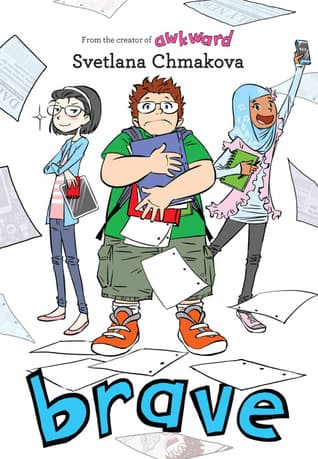
Svetlana Chmakova (2017)
Genre
Children's / Young Adult
Reading Time
90 min
Key Themes
See below
Sign in to track this book
A quiet middle schooler who's a superhero in his daydreams must learn to translate that bravery into navigating the real-life challenges of friendships, school projects, and social drama, all while trying to avoid being picked last.
Jensen, a quiet and anxious middle schooler, often daydreams he is a powerful hero saving his friends and the world. In reality, he struggles with math, feels overlooked, and finds social interactions hard. He often feels like an outsider, especially when it comes to group projects, where he's usually the last to be chosen. His friends, including Akilah and Jenny, are more outgoing, making him feel more inadequate. This conflict between his heroic fantasy self and his hesitant real self sets the stage for his journey through Berrybrook Middle School, as he tries to find his place and handle daily challenges.
Jenny and Akilah, who run the Berrybrook Middle School newspaper, 'The Grapevine', decide to feature Jensen in an article. They see his quiet nature and his tendency to be left out. They create a 'friendship experiment' to help him connect with more people. They encourage him to join school clubs and activities, believing more social interaction will boost his confidence and help him make friends. Jensen, at first hesitant, agrees, seeing it as a way to fit in and overcome his social anxieties, though he is nervous about trying new things.
Following Jenny and Akilah's advice, Jensen tries to join several school clubs. He tries the photography club but feels intimidated by the more experienced members. He also briefly considers the drama club and the debate club, but his shyness and fear of public speaking stop him. During these attempts, he often feels awkward and out of place, which makes him think he is not good at social interactions. Despite these early problems, he keeps trying, hoping to make real connections and complete the 'friendship experiment' for the school newspaper.
A big challenge comes when a math project is assigned, requiring students to work in pairs. Jensen, already having trouble with math, gets more anxious about finding a partner. He watches his classmates quickly form teams. As time runs out, he fears being picked last, or worse, being left alone. This situation increases his feelings of isolation and not being good enough, making him question his social standing and academic skills. The project's pressure weighs on him, a stark contrast to his daydreams where he easily solves problems and is always a valued team member.
Despite his early struggles, Jensen finds a possible connection with Felipe, a quiet and often overlooked classmate. They both like computers and video games, which leads them to consider joining the computer club. Though still a bit awkward, their shared interest gives them a comfortable common ground. This interaction is a small but important step for Jensen. He starts to realize that real connections can form over shared interests, even if they are not the grand heroic gestures of his daydreams. This new friendship offers hope for both the math project and his social life.
As Jenny and Akilah continue to gather material for their 'friendship experiment' article about Jensen, the upcoming publication adds pressure. Jensen feels the weight of expectation, worried that if the experiment fails, he will be publicly shown as a social failure. He tries to act brave, but inside, the thought of the article's release makes him more self-conscious. This external pressure forces him to face his anxieties more directly. He realizes his actions and perceived social success are being watched by his friends and the whole school.
Jensen meets a group of bullies, led by Ian, who often pick on other kids. One time, Ian and his friends make fun of Jensen and Felipe. Jensen, despite his heroic daydreams, at first freezes and struggles to respond well. While he does not physically confront them, he does manage to make a small, internal stand by not letting their words completely hurt him. This moment shows the difference between his imagined bravery and his real-world hesitation. It pushes him to think about what true courage means outside of his fantasy scenarios, and how to use it in tough social situations.
Through his experiences, Jensen slowly begins to understand that 'bravery' is not just about saving the world or doing big, heroic acts. It is also about showing up, trying new things, asking for help, and being kind. He starts to value the small victories: starting conversations, working with Felipe on the project, and simply dealing with social awkwardness. This realization shifts his view from his unrealistic daydreams to the practical courage needed for daily life. He sees that even small acts of courage, like speaking up or trying to connect, are important and help him grow.
Jensen and Felipe, having worked hard together, successfully present their math project. Despite Jensen's lasting anxiety, their teamwork works well, and they get a good grade. This shared success boosts Jensen's confidence, showing him the value of teamwork and persistence. It also strengthens his friendship with Felipe as they celebrate. This experience is a turning point, showing that he can succeed in the real world through effort and collaboration, rather than relying only on his fantasy self. The project's completion shows he can handle challenges better.
The 'Grapevine' article about Jensen and the 'friendship experiment' is finally published. It shows his journey and struggles, but it also celebrates his efforts and the small steps he has taken. Jensen reads it with a mix of embarrassment and pride. He realizes that his experiences, though sometimes hard, have helped him grow. He has not become his daydream hero overnight, but he has learned to be more resilient, to seek connections, and to find his own way of being brave in the real world. The article is a public acknowledgment of his journey, reinforcing his progress and new self-acceptance.
By the end of the school year, Jensen is still Jensen — quiet and prone to daydreams — but he is also more confident and able. He continues his friendship with Felipe and is more willing to talk with his other friends, Akilah and Jenny. He understands that bravery is not about being fearless, but about facing fears and trying anyway. He learns to appreciate his unique qualities and finds strength in his quiet determination. He is now better able to handle the ups and downs of middle school, having found his own, real way of being brave, based on real-life interactions and personal growth rather than just fantasy.
The Protagonist
Jensen transforms from a socially anxious boy reliant on fantasy to one who embraces real-life challenges and finds his own quiet strength and bravery.
The Supporting
Jenny remains consistent in her supportive and proactive role, driving part of Jensen's social experiment.
The Supporting
Akilah consistently supports Jensen's social growth and contributes to the newspaper's narrative.
The Supporting
Felipe finds a friend and gains confidence through his collaboration with Jensen.
The Antagonist
Ian remains a static representation of bullying and social challenge for Jensen.
The Supporting
Mr. Garcia consistently provides a supportive and structured learning environment.
The Supporting
Ms. G. remains a consistent figure of authority and support for the newspaper staff.
The Mentioned
N/A
Jensen's journey is about understanding and accepting who he is, both his daydreaming, heroic self and his quiet, anxious real self. He deals with the difference between his internal fantasies and his external reality. The 'friendship experiment' and his struggles to fit in make him face his insecurities. By the end, he realizes that he does not have to become someone else to be brave; he can find strength in his own qualities and quiet determination. He learns to value his real self rather than trying to fit a heroic ideal.
“"He wasn't a hero, not really. But maybe... maybe brave came in more than one shape."”
The book explores different types of bravery. Jensen at first thinks bravery is grand, heroic acts, like those in his daydreams. However, his real-life experiences, such as trying out for clubs, finding a math partner, and dealing with social awkwardness, teach him that bravery often shows up in small, everyday actions. It is about trying new things, asking for help, being vulnerable, and continuing despite fear. The story redefines bravery not as having no fear, but as being willing to act despite it, in both social and academic situations.
“"Maybe brave wasn't about saving the world, or even saving his friends. Maybe it was just... showing up."”
A main theme is the importance of real connection and the challenges of making friends in middle school. Jensen's fear of being picked last and his struggles to interact show the anxieties many young people face. The 'friendship experiment' started by Jenny and Akilah aims to help him, but it is his natural connection with Felipe over shared interests that truly helps him understand the value of real bonds. The book shows that true friendship is not forced but grows from shared experiences, empathy, and mutual support, helping people feel less alone.
“"It was a strange thing, friendship. Sometimes it just... happened. Like a good game, you just found your co-op partner."”
The story looks at Jensen's struggles with social anxiety and self-consciousness, common experiences for middle schoolers. His internal thoughts show his constant overthinking, fear of judgment, and the overwhelming nature of social situations. The contrast between his confident daydreams and his hesitant real-world interactions clearly shows his internal battle. The book normalizes these feelings, showing how Jensen slowly learns to manage them by taking small steps, finding supportive friends, and realizing that many of his peers share similar insecurities, making his journey relatable to readers.
“"Every conversation felt like a boss battle he wasn't leveled up for."”
Visual and narrative interludes depicting Jensen's heroic fantasies.
Throughout the book, Jensen's internal world of elaborate superhero daydreams is visually depicted, often in a distinct art style. These sequences serve as a stark contrast to his real-life struggles, highlighting his anxieties and his desire for agency and recognition. They function as an escape mechanism for Jensen, but also as a visual representation of the gap between his ideal self and his actual self. This device allows the reader to deeply understand Jensen's inner turmoil and the aspirations he harbors, making his eventual small acts of real bravery more impactful.
A meta-narrative device that frames Jensen's social experiment.
The school newspaper, 'The Grapevine', run by Jenny and Akilah, serves as a meta-narrative device. The 'friendship experiment' article about Jensen provides a framework for much of the plot, pushing Jensen to engage in social activities he might otherwise avoid. The impending publication of the article adds external pressure and a sense of urgency to Jensen's social development. It also allows for the inclusion of other characters' perspectives and observations on Jensen's journey, making his personal growth visible to the wider school community.
Direct access to Jensen's anxieties, hopes, and overthinking.
The graphic novel format effectively uses internal monologues and thought bubbles to provide direct access to Jensen's inner thoughts, anxieties, and self-doubt. These visual elements often overlay the panels, showing his overthinking, his fears of social faux pas, and his constant self-critique. This device is crucial for character development, allowing readers to deeply empathize with Jensen's struggles and understand the contrast between his quiet exterior and his busy, often anxious, interior world, making his small acts of bravery feel significant.
Illustrative representations of Jensen's emotional state.
Svetlana Chmakova frequently uses visual metaphors to convey Jensen's emotional state. For example, when Jensen feels overwhelmed, the panels might become cluttered or dark, or he might appear physically small and insignificant. Conversely, in his daydreams, he is drawn with exaggerated strength and confidence. These visual cues, such as the 'difficulty setting' dial cranked up in his mind, effectively communicate complex emotions and internal experiences without relying solely on dialogue, enhancing the reader's understanding of Jensen's inner world and struggles.
“Being brave doesn't mean you're not scared. It means you do it anyway.”
— Jensen reflects on facing his fears at school.
“Sometimes the bravest thing you can do is ask for help.”
— A character encourages Jensen to reach out to others.
“It's okay to be different. That's what makes you, you.”
— A message about self-acceptance among peers.
“Standing up for someone else is just as important as standing up for yourself.”
— Discussed during a conflict involving bullying.
“Friends are the family you choose.”
— Jensen finds support in his new friends.
“You don't have to be loud to be heard.”
— Quiet characters find their voice in the story.
“Mistakes are just lessons in disguise.”
— After a character learns from a failure.
“Kindness costs nothing, but it means everything.”
— Highlighting small acts of compassion in school.
“The world needs all kinds of minds.”
— Celebrating diverse talents and perspectives.
“Courage is contagious.”
— One character's bravery inspires others.
“Your feelings are valid, no matter what anyone says.”
— Supporting emotional honesty among friends.
“Sometimes the hardest battles are the ones inside your own head.”
— Jensen deals with anxiety and self-doubt.
“True strength is knowing when to walk away.”
— Advice given during a confrontation.
Ready to see how well you understood this book? Take our interactive quiz with 10 questions.
Biography coming soon.

Dan Gemeinhart
4.5

Kate O'Hearn
4.4

Jeanne Birdsall
4.4

Jen Wang
4.4

Wendelin Van Draanen
4.3

John Marsden
4.3

Chris Van Allsburg
4.3

Jennifer A. Nielsen
4.2