“Finn was a boy made of gaps. He had a gap in his memory, a gap in his heart, and a gap in his ability to understand how the world worked.”
— Describing Finn's core traits and his struggles with understanding what happened to Roza.

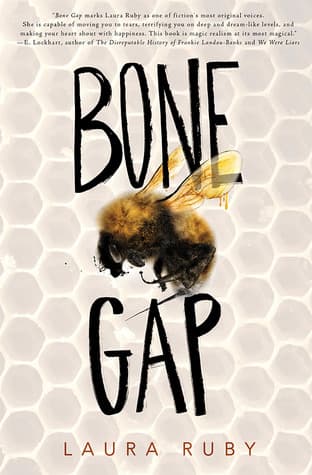
Laura Ruby (2015)
Genre
Fantasy / Mystery / Young Adult / Romance
Reading Time
7-8 hours
Key Themes
See below
Sign in to track this book
In the strange town of Bone Gap, where reality shifts and people disappear, a young man haunted by a forgotten face must convince a skeptical community that his beloved Roza was taken by a mythical force, not just another victim of the town's mysterious 'gaps'.
The story begins with Roza, a beautiful young woman, disappearing from Bone Gap, Illinois. Finn O'Sullivan, a dreamy and often distracted teenager, is the only witness. He claims a man took Roza, but he cannot recall the man's face, only a vague sense of darkness. Because of Finn's reputation for being 'gap-mouthed' and not always grounded, the townspeople, including his older brother Sean, dismiss his story. Sean, who loves Roza, struggles with Finn's lack of details. This creates a rift between the brothers as the search for Roza yields no results.
Finn is troubled by his failure to remember the kidnapper's face, which he calls a 'gap' in his memory. He knows Roza was taken, but his inability to describe the man makes him seem unreliable. This struggle comes from his unique way of seeing the world, where people's inner selves are often more vivid to him than their physical appearance. He tries to explain his vision to Sean and the sheriff, but they are frustrated by his vagueness. Finn's connection to nature and his almost magical perception of Bone Gap's hidden qualities further isolate him.
The story shifts to Roza's perspective. She is held captive in a remote, luxurious house by a man named Jethro. Jethro, a powerful and manipulative person, is obsessed with Roza's beauty and demands her love. He keeps her isolated, giving her material comforts but denying her freedom and real connection. Roza, initially defiant, slowly understands the magical nature of her confinement. Jethro's power prevents her from leaving or truly seeing him as he is, distorting her perception to make him appear perfect.
Sean O'Sullivan, a hardworking young man, is devastated by Roza's disappearance. He loved her deeply and had plans for their future. He struggles to balance his love for Finn with his anger over Finn's inability to prevent Roza's abduction or provide useful information. Sean immerses himself in work and becomes withdrawn, feeling the town's unspoken judgment and his own guilt. He often visits the cornfield where Roza vanished, hoping for a sign, and her memory consumes him.
Finn begins to explore Bone Gap's magical undercurrents, sensing its 'gaps' and how things can slip through them. He learns about the legend of the 'Pooka,' a shapeshifting creature, and other local folklore from elderly residents. He also forms a bond with Petey, a kind and intelligent girl often judged for her perceived plainness. Petey listens to Finn without judgment. Together, they start uncovering clues about Roza's disappearance and Jethro's methods, realizing Bone Gap's magic is more real than anyone admits.
Roza, though initially despairing, refuses to give in to Jethro's demands for love. She subtly tests the limits of her captivity, realizing Jethro's magic makes her unable to see his flaws or her true surroundings. She finds a hidden room and a book of strange symbols, hinting at Jethro's true identity and power. Jethro's control over her perception thwarts her escape attempts, but she remains determined, clinging to the memory of Finn's gentle gaze and the genuine love she shared with Sean.
Finn and Petey explore Bone Gap's history and the stories of other missing women. They learn Jethro is an ancient being who preys on beautiful women, trapping them with illusions and forcing them to love him. He uses the 'gaps' in the world to transport victims and hide his true, monstrous form. Finn realizes his inability to see Jethro's face was not a failing but a protection, a sign of Jethro's magic. Petey's intelligence helps Finn connect his perceptions to concrete actions.
With their knowledge, Finn and Petey plan to rescue Roza. Finn, guided by his unique perception and love for Roza, confronts Jethro. He enters Jethro's magical domain, a beautiful but illusory house in a pocket dimension. Finn's belief in Roza's true self and his ability to see beyond appearances begins to weaken Jethro's power. The confrontation is dangerous, as Jethro tries to ensnare Finn with illusions, but Finn focuses on Roza's freedom.
During the confrontation, Roza, empowered by Finn's presence and her own strength, finally sees Jethro's true, monstrous form. She rejects his false love and breaks his spell, choosing freedom over the gilded cage. Jethro, weakened by Roza's rejection and Finn's gaze, is defeated. Roza is freed, but the experience has changed her. She returns to Bone Gap, marked by her captivity, but stronger and more aware of her value beyond her beauty.
Roza's return to Bone Gap is met with joy and relief, though the town struggles to understand what happened. Sean is overjoyed but also heartbroken by the changes in Roza. The brothers begin to mend their strained relationship, with Sean finally understanding Finn's perceptions. Roza, now free, chooses to forge her own path, no longer defined by others' expectations of her beauty. Finn and Petey's bond deepens, and Finn finds acceptance for his unique way of seeing the world, no longer feeling the need to apologize for his 'gaps'.
The Protagonist
Finn learns to trust his unique perceptions and finds his voice, transforming from a ridiculed dreamer into a courageous hero who saves the woman he cares for.
The Central Figure/Victim
Roza transforms from a beautiful object of desire into a woman who understands and values her inner strength and freedom.
The Supporting Character/Protagonist's Brother
Sean learns to understand and accept his brother's unique way of seeing the world, moving past his anger and grief towards forgiveness and renewed familial connection.
The Supporting Character/Love Interest
Petey finds acceptance and love with Finn, realizing her own worth and contributing significantly to unraveling the mystery.
The Antagonist
Jethro's power and delusion are ultimately broken by genuine love and the ability to see beyond superficiality.
The Supporting/Mentor
Mrs. Jablonski acts as a catalyst, providing crucial information that aids Finn's quest.
The Mentioned/Supporting
The Sheriff remains largely unchanged, representing the world Finn must navigate and eventually prove himself to.
The Supporting
Elmer provides consistent, quiet support to Finn, symbolizing the enduring decency within Bone Gap.
The novel explores how individuals see the world and how those views shape their reality. Finn's inability to remember faces, yet his awareness of people's inner selves, is central. Roza's captivity by Jethro, who manipulates her perception to seem perfect, shows how easily reality can be distorted. The townspeople's dismissal of Finn's story because it doesn't fit their understanding further highlights this theme. The story argues for the importance of inner perception over outward appearance.
“What if the world was a place of gaps? What if there were places you could slip into, or be pushed into, and never be seen again?”
Beauty is a complex theme, examined through Roza's outward perfection and Petey's perceived plainness. Roza's beauty becomes both a gift and a burden, making her a target for Jethro's possessiveness. Jethro's magic relies on forcing others to see him as beautiful, showing the superficial and manipulative aspects of external allure. In contrast, Finn's love for Petey, who is not conventionally beautiful, and his ability to see beyond Roza's physical appearance to her inner strength, champions a deeper, more authentic understanding of beauty rooted in character and spirit.
“Beauty is a thing that can be bought and sold, but a true thing, a beautiful thing, is something that must be earned.”
The novel contrasts different forms of love. Sean's love for Roza is deep and romantic, but also includes a desire for ownership and a traditional future. Jethro's 'love' is purely possessive and coercive, a demand for admiration rather than genuine affection. Finn's love for Roza is selfless and protective, focused on her freedom and well-being, without any desire to possess her. The story ultimately champions a love that respects autonomy and sees the beloved for who they truly are, rather than what they represent.
“He didn't want to own her. He wanted to set her free.”
Finn's journey is about finding acceptance for his unique way of seeing the world. He is often ostracized and misunderstood by the townspeople and his brother, making him feel like an outsider. Petey's unconditional acceptance of him, and his eventual heroic act, allows him to find a sense of belonging. The theme also extends to Roza, who, after her ordeal, must find a way to belong in Bone Gap again, not as an object of beauty but as a whole person. The town itself, with its 'gaps,' symbolizes places where people can feel disconnected or lost.
“Bone Gap was a place that held you close, or let you go. And sometimes, you just slipped through the cracks.”
Memory plays a role, especially Finn's inability to recall the kidnapper's face, which is initially seen as a flaw but later as a protection. The subjective nature of memory, and how it can be manipulated or incomplete, is explored through Finn's struggle and Roza's experience under Jethro's spell. The search for truth is about what happened to Roza, understanding the deeper, magical reality beneath Bone Gap, and reconciling different versions of events to uncover the ultimate truth.
“The truth was, sometimes it was easier to see things when you didn't look too hard.”
Metaphorical and literal portals for disappearance and unique perception.
The 'gaps' are a central plot device, representing both literal spaces where people can vanish and metaphorical disconnects in understanding or memory. They are the magical fabric of Bone Gap, allowing Jethro to abduct Roza and hide his true form. For Finn, his 'gap-mouthed' nature and inability to recall faces is a personal gap, which paradoxically allows him to see deeper truths. The gaps blur the lines between reality and magic, providing a constant source of mystery and danger, while also hinting at hidden potential.
The integration of fantastical elements into a realistic setting.
The entire narrative is steeped in magical realism, where supernatural elements like Jethro's illusions, the Pooka, and Finn's unique perception are presented as everyday occurrences within the world of Bone Gap. This device allows the story to explore complex themes of perception, beauty, and love in a heightened, symbolic way. It normalizes the extraordinary, making Finn's struggles and Roza's captivity feel both fantastical and deeply human, challenging the reader's own understanding of what is possible.
Alternating viewpoints between Finn's present and Roza's captivity.
The story alternates between Finn's present-day search for Roza in Bone Gap and Roza's experience of captivity in Jethro's magical house. This dual perspective builds suspense, gradually revealing pieces of the puzzle from both sides. It allows the reader to understand the emotional impact of Roza's disappearance on Finn and the town, while simultaneously experiencing the terror and resilience of Roza. This structure keeps the mystery alive and deepens the emotional connection to both main characters.
Finn's unique, non-literal way of seeing the world makes him a seemingly unreliable witness.
Finn's inability to accurately describe faces or events in a conventional manner makes him an unreliable narrator in the eyes of the townspeople and even his brother. He sees 'gaps' and 'inner truths' rather than concrete details. This device initially creates doubt and frustration, but as the story progresses, his 'unreliability' is revealed to be a form of heightened perception, making him the only one who can truly understand and combat Jethro's magic. It challenges the reader to question conventional notions of truth and reliability.
“Finn was a boy made of gaps. He had a gap in his memory, a gap in his heart, and a gap in his ability to understand how the world worked.”
— Describing Finn's core traits and his struggles with understanding what happened to Roza.
“You can't save someone who doesn't want to be saved. You can't even save someone who does want to be saved, not if they don't help you do it.”
— Petey's pragmatic advice to Finn about the limitations of helping others.
“Stories are like people. They can be beautiful and terrible, and they can be true or they can be lies.”
— Exploring the nature of storytelling and its relationship to truth.
“Bone Gap was a place where things went missing and sometimes came back, but never quite the same.”
— Introducing the magical and mysterious nature of the town itself.
“He knew that the world was full of terrible things, but he also knew that it was full of magic, and sometimes the two were the same.”
— Finn grappling with the duality of good and evil, and the magic in both.
“Beauty isn't a thing that you possess. It's a thing that possesses you.”
— Roza reflecting on the nature of her beauty and how it has shaped her life.
“Love was a complicated thing, full of sharp edges and soft places, and it could cut you or cradle you, depending on how you held it.”
— Finn's internal thoughts on the complexities of love.
“The truth was a slippery thing, always changing shape, always hiding in plain sight.”
— Finn's ongoing struggle to uncover the truth about Roza's disappearance.
“Sometimes you have to break a few rules to save the people you love.”
— Finn contemplating the sacrifices and risks involved in protecting others.
“There were two kinds of magic in Bone Gap: the kind that happened and the kind that you made happen.”
— Distinguishing between inherent magic and intentional magic within the town.
“He understood then that some people were like stars, bright and beautiful and always just out of reach.”
— Finn's realization about the elusive nature of some individuals, particularly Roza.
“You can't cage a wild thing. It'll just break itself trying to get free.”
— A character's observation about the futility of trying to control someone's spirit.
“Grief was a thing with teeth, and it could bite you when you least expected it.”
— Finn experiencing the sudden and painful resurgence of grief.
“What if the monster wasn't a monster at all, but just a man who had forgotten how to be kind?”
— Finn's empathy leading him to question the nature of evil and its origins.
Ready to see how well you understood this book? Take our interactive quiz with 10 questions.







