“Little Sal went with her mother to pick blueberries.”
— Opening line, setting the scene for Sal's adventure.

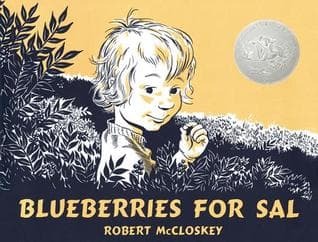
Robert McCloskey (1948)
Genre
Children's
Reading Time
10 min
Key Themes
See below
Sign in to track this book
A curious little girl and a hungry bear cub get hilariously mixed up with each other's mothers while foraging for blueberries on a sun-drenched hill.
Little Sal and her mother set off from their house to Blueberry Hill, each carrying an empty pail. Sal's mother plans to pick enough blueberries to can for the winter. Sal is more interested in eating the berries than putting them in her pail. As they walk, Sal continually drops berries into her own mouth, making a 'kuplink, kuplank, kuplunk' sound. Her mother reminds her to put some in the pail, but Sal's focus stays on the delicious taste of the fresh blueberries. They climb the hill, expecting many berries.
Meanwhile, on the other side of Blueberry Hill, a Mama Bear and her Little Bear Cub are also beginning their day. Mama Bear wants to eat as many blueberries as possible to get fat for the long winter ahead, knowing she needs to store energy. Her Little Bear Cub, like Sal, wants to eat the berries directly from the bushes rather than follow his mother's example of gathering them. He copies his mother's movements, but his main goal is to fill his own tummy with the sweet fruit, making similar 'kuplink, kuplank, kuplunk' sounds.
Sal, still wanting to eat berries, wanders further from her mother. She finds a good spot with big, fat blueberries and sits down to enjoy them. Her mother, busy picking and dropping berries into her own pail, does not immediately notice Sal's absence. Sal continues her 'kuplink, kuplank, kuplunk' routine, moving from bush to bush, completely focused on her blueberry feast. The sounds of her mother's picking gradually fade as Sal explores new patches of berries, unaware of how far she is from her mother.
Just like Sal, the Little Bear Cub also begins to wander from his Mama Bear. He is drawn by the sounds of rustling bushes and the appeal of more blueberries. He follows the 'kuplink, kuplank, kuplunk' sounds, thinking they belong to his own mother. He moves through the dense blueberry bushes, his small paws making soft thuds, eagerly looking for the ripest berries. Mama Bear, like Sal's mother, is focused on her own picking and does not notice her cub's departure right away, continuing her efforts to prepare for winter.
As Sal continues to eat berries, she hears a 'kuplink, kuplank, kuplunk' sound and, assuming it is her mother, follows it. However, it is actually Mama Bear she is following, who is also busy picking. On the other side of the hill, Little Bear also hears a 'kuplink, kuplank, kuplunk' and, thinking it is his mother, begins to follow Sal's mother. Both mothers, focused on their picking, initially mistake the wrong 'little one' for their own, only realizing the mix-up when they look down to see an unfamiliar child or cub.
Sal's mother, looking down at her pail, sees a small, furry head with beady eyes and realizes it is not Sal, but a Little Bear Cub. She gasps and quickly backs away. At the same time, Mama Bear, looking down, sees a small human girl with a small, empty pail. She too is startled and backs away with a woof. The two mothers, each confused and alarmed for a moment, quickly recognize they have the wrong 'child' and immediately move to find their own, causing a brief but intense moment of separation and realization on the hill.
After the brief scare, Sal's mother quickly searches for her daughter. She calls out 'Sal!' and soon finds Sal, who is still busily eating blueberries. Sal's mother scoops her up, relieved to have found her. They share a moment of comfort and reassurance. Sal, despite her earlier wandering, is now happy to be back with her mother. The incident is a gentle reminder to stay close.
Similarly, Mama Bear, after her encounter with Sal, quickly finds her Little Bear Cub. Little Bear is still busy eating berries, unaware of the recent mix-up. Mama Bear nudges him gently, and they continue eating berries together. The reunion is quick and natural, showing the strong bond between the bear mother and cub. Both are now back to their main task of preparing for winter by eating as many blueberries as possible.
With the mix-up resolved and everyone reunited, Sal and her mother continue picking berries, this time staying closer together. Sal's pail is now fuller, and her mother's is nearly brimming. On the other side of the hill, Mama Bear and Little Bear also have full bellies and are ready to leave. They all go down the hill, each family satisfied with their day's work. Sal and her mother go home to can their blueberries, while Mama Bear and Little Bear go home to prepare for their long winter's nap. Both families achieved their goals on Blueberry Hill.
The Protagonist
Sal starts as a playful, distracted child and ends up reunited with her mother, having learned a subtle lesson about staying close.
The Supporting
She begins focused on a task, experiences a moment of alarm, and finds relief in reuniting with Sal.
The Supporting
Mama Bear is focused on survival, experiences a surprise, and then successfully reunites with her cub.
The Supporting
Little Bear innocently wanders and then returns to his mother, having fulfilled his desire for berries.
The book shows the natural world and the instincts of both humans and animals. Sal's mother and Mama Bear are both driven by the instinct to prepare for winter – one by canning, the other by eating. The children, Sal and Little Bear, are driven by the simpler instinct to eat the delicious berries. Blueberry Hill shows nature's abundance and how different species interact with it. The bears' actions are natural and not threatening, showing a peaceful coexistence.
“Mama Bear ate berries with her Little Bear and Sal's mother ate berries with Sal. And they all had berries in their pails and in their stomachs and on their faces and everywhere.”
A main theme is the universal bond between a mother and her child, whether human or animal. Sal's mother and Mama Bear both show deep care and a protective instinct for their children. When the mix-up happens, their immediate reaction is alarm and an urgent need to find their own child. The relief both mothers feel upon reunion shows the strength of this bond. It emphasizes that despite differences in species, maternal love is the same.
“Sal's mother held Sal's hand and Sal held her mother's hand and they walked along together.”
Sal and Little Bear both show the curiosity and growing independence of young children and cubs. Their wandering from their mothers is not bad but driven by a desire to explore and satisfy their immediate desires (eating berries). This natural inclination leads to the central conflict, but it is presented as a normal part of growing up, not as misbehavior. Their innocent actions show the joy and sometimes slight danger that comes with youthful exploration.
“Sal went off to a little hill of her own and picked berries and put them in her own small pail.”
The story's structure shows the similar experiences of the human and bear families. Both mothers and children go on similar missions on Blueberry Hill, driven by similar needs and desires. The 'kuplink, kuplank, kuplunk' sound of berries falling, the act of picking, and the children's tendency to eat rather than gather, all create a strong parallel. This device highlights the commonalities of life and nature's shared rhythms, despite the differences between species.
“And on the other side of Blueberry Hill lived a Mama Bear and her own Little Bear. Little Bear was eating berries and Mama Bear was eating berries.”
Two distinct stories unfold concurrently, mirroring each other
The book employs a parallel narrative structure, presenting the actions of Sal and her mother alongside those of Mama Bear and Little Bear. The story alternates between the two families, showing them engaged in similar activities (picking/eating blueberries) and making similar sounds ('kuplink, kuplank, kuplunk'). This device builds anticipation for their eventual accidental interaction and highlights the shared natural instincts between humans and animals. It underscores the theme of commonality in the natural world.
The use of sound words to enhance sensory experience
The repeated use of 'kuplink, kuplank, kuplunk' is a prominent onomatopoeic device. This sound effect describes the blueberries falling into the pails (or mouths). It serves multiple purposes: it creates an auditory rhythm for the story, immerses the reader in the act of berry picking, and acts as a key identifier. Both Sal and Little Bear make this sound, inadvertently leading to the mistaken identity plot point, making it a crucial element for both atmosphere and plot progression.
The mix-up of Sal and Little Bear by their respective mothers
The central conflict arises from the plot device of mistaken identity. Sal accidentally follows Mama Bear, and Little Bear accidentally follows Sal's mother. This mix-up is facilitated by the children's wandering and the mothers' focused attention on picking. It creates a moment of gentle suspense and humor, leading to the brief but memorable interaction between the species. This device allows for the exploration of parental bonds and the subtle humor of the situation without introducing genuine danger.
Blueberries represent sustenance, nature's bounty, and the cycle of life
Blueberries are more than just a plot element; they act as a central symbol. They represent nature's bounty, providing sustenance for both human and animal families. For Sal's mother, they symbolize preparation for winter (canning); for Mama Bear, they symbolize the necessary fat for hibernation. For the children, they symbolize immediate gratification and the simple joys of nature. Their abundance on Blueberry Hill drives the entire narrative, connecting all the characters and their motivations to the natural world and its cycles.
“Little Sal went with her mother to pick blueberries.”
— Opening line, setting the scene for Sal's adventure.
“Sal's mother picked blueberries and put them in her pail.”
— Describing the mother's purposeful blueberry picking.
“Little Sal picked three blueberries and dropped them in her little pail.”
— Sal's initial, less productive attempt at picking.
“Then she picked three more blueberries and ate them.”
— Sal's immediate gratification while picking.
“Then she picked up a tiny green grasshopper.”
— Sal's distraction from picking, showing her curiosity.
“She heard a noise behind a big rock and she thought it was her mother.”
— Sal beginning to wander and misidentify sounds.
“But it was a bear.”
— The reveal of the bear, a moment of gentle surprise.
“Little Bear's mother picked blueberries and ate them.”
— Parallel action of the bear family, mirroring Sal's mother.
“Little Bear picked three blueberries and ate them.”
— Little Bear's actions, mirroring Sal's.
“Little Sal followed Little Bear's mother.”
— Sal's accidental following of the wrong 'mother'.
“And Little Bear followed Sal's mother.”
— The humorous switch where the bear follows Sal's mother.
“Sal's mother looked down and saw not Sal, but a small, black bear.”
— The mother's startled realization of the mix-up.
“Little Sal and Little Bear came with their mothers to pick blueberries.”
— The concluding line, emphasizing the shared experience and resolution.
“They walked along together, Sal and her mother and the three bears.”
— The peaceful resolution and unexpected camaraderie.
Ready to see how well you understood this book? Take our interactive quiz with 10 questions.

Biography coming soon.

Dan Gemeinhart
4.5

Kate O'Hearn
4.4

Jeanne Birdsall
4.4

Jen Wang
4.4

Wendelin Van Draanen
4.3

John Marsden
4.3

Chris Van Allsburg
4.3

Jennifer A. Nielsen
4.2