“There are some things you can't undo, no matter how many other things you do.”
— Cal is reflecting on the irreversible nature of certain choices and events.

Scott Westerfeld (2005)
Genre
Fantasy / Science Fiction / Young Adult
Reading Time
300-360 min
Key Themes
See below
Sign in to track this book
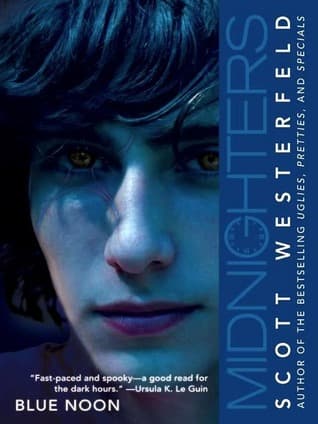
When the predictable midnight hour of frozen time bleeds into the blinding light of noon, five teenagers must race against the collapse of reality to stop ancient, hungry creatures from devouring their unsuspecting world.
The story opens in Bixby, Oklahoma, with Dess, Rex, Melissa, Jonathan, and Jessica — the Midnighters — experiencing a normal secret hour. However, a horrifying new phenomenon strikes: a 'blue noon' descends during the school day, freezing everyone but them. This daylight secret hour is far more dangerous than the midnight one, as the darklings are stronger and the Midnighters are caught off guard. Jessica struggles to adapt to the sudden, unpredictable shifts, feeling overwhelmed by the constant threat. The group quickly realizes that this is not a fluke but a systematic breakdown of the barriers between their world and the secret hour.
The Midnighters begin to investigate the source of the blue noon. They believe the 'veil' – the barrier separating their world from the darkling dimension – is weakening, allowing the secret hour to bleed into normal time. Their theories are supported by increased darkling activity and strange occurrences even outside the blue noon. Jonathan, with his knowledge of lore, researches ancient texts and local legends, trying to find any explanation for this event. Dess's ability to see patterns helps them connect the seemingly random occurrences, while Rex's mathematical mind tries to understand the phenomenon.
While searching for answers, the Midnighters find evidence of previous generations of Midnighters. They discover hidden journals and artifacts, showing they are not the first to fight the darklings. These historical accounts detail similar struggles and the desperate measures taken by their predecessors to protect Bixby. This discovery gives them both hope and dread, as it suggests the problem is ancient and deeply rooted, not just a recent issue. Jessica feels a connection to these past heroes, strengthening her resolve, while Melissa uses her technopathy to try and access old, corrupted data.
The historical research leads the Midnighters to the town's founders, a group of individuals who first established Bixby. They learn that these founders were not ordinary settlers but were deeply involved with the secret hour and the darklings. It becomes clear that Bixby was intentionally founded on a 'thin place' where the veil between dimensions was weak, possibly for a specific, sinister purpose. This revelation casts a shadow over the town's history, suggesting that the very foundations of their home are tied to the darkling threat. Jonathan pieces together the puzzle, realizing the founders were trying to contain or exploit the secret hour.
As the blue noons become more frequent and prolonged, the Midnighters realize the darklings are not just passively responding to a weakening veil; they are actively working to exploit it. The darklings are attempting to fully breach the barrier, seeking to permanently merge their dimension with the human world. This would mean an endless secret hour, where humanity would be trapped and preyed upon without end. Dess's insights into darkling behavior help them understand their strategy, while Rex tries to predict their next moves using complex calculations, though the unpredictable nature of the blue noon makes it difficult.
The Midnighters uncover the darklings' ultimate goal: to establish a 'permanent hour' where the secret hour never ends, giving them eternal control over Bixby and potentially beyond. This terrifying prospect motivates the group, showing the urgency of their mission. They realize that if they fail, not only will Bixby be lost, but the entire world could be at risk. Jessica, initially hesitant, finds new determination in the face of this threat, pushing her powers to their limits. Melissa works frantically to find any technological solution to counter the encroaching darkness.
Faced with the darklings' overwhelming power and the accelerating collapse of the veil, the Midnighters realize that ordinary solutions will not work. They begin to discuss the possibility of making a significant sacrifice, drawing parallels to the cryptic notes left by previous Midnighters. The idea of personal loss and the weight of their responsibility weigh heavily on them. Jonathan struggles with the moral implications of such a decision, while Dess, with her pragmatic view, tries to assess the most effective, though painful, course of action to save their world.
After much deliberation and research, the Midnighters create a daring and dangerous plan to seal the breach between dimensions. This plan involves a complex ritual or action that requires all their unique abilities to be synchronized perfectly. They learn that the founders had a similar plan, but it ultimately failed or was incomplete. Their strategy focuses on exploiting a specific point of weakness in the veil, hoping to reinforce it permanently. Rex's understanding of spatial geometry, Dess's pattern recognition, and Melissa's ability to manipulate technology are all critical parts.
The Midnighters put their plan into action, converging on the epicenter of the dimensional breach, which is a significant landmark within Bixby. This location is swarming with darklings, who are actively working to expand the rift. A fierce confrontation ensues, with the Midnighters battling hordes of darklings while simultaneously attempting to complete their intricate ritual. Jessica's agility and combat skills are pushed to their limits as she defends the others, while Jonathan uses his knowledge to guide their actions and counter darkling magic.
In the main moments of their battle, it becomes clear that their initial plan is not enough. A greater sacrifice is needed to fully seal the breach and prevent the permanent hour. One of the Midnighters, understanding the dire consequences of failure, makes the ultimate sacrifice, using their unique connection to the secret hour to complete the ritual. This act is both heroic and heartbreaking, ensuring the veil is reinforced and the darklings are pushed back, but at a deep personal cost to the group. The blue noon dissipates, and normal time resumes, but the memory of the sacrifice lingers.
With the veil sealed and the blue noons stopped, Bixby returns to a semblance of normalcy, but the Midnighters are changed. They mourn their loss and deal with the trauma of their experience. While they have saved their town, the victory feels bittersweet, and the question of whether the veil will hold permanently remains. The experience has forged an even stronger bond between the remaining Midnighters, but it has also left them with a deeper understanding of the secret hour's ancient and dangerous nature. They know their fight is not over, even if the immediate threat has passed.
The Protagonist
Jessica evolves from a hesitant newcomer to a determined and capable Midnighter, fully embracing her role and powers in the face of existential threat.
The Protagonist
Jonathan moves from solely intellectual analysis to active participation in the fight, balancing his knowledge with the need for decisive action.
The Protagonist
Dess's leadership is tested and solidified as she navigates unprecedented threats, making tough calls to protect her team and her town.
The Protagonist
Rex grows in his ability to apply his intellect to real-world, high-stakes problems, finding a balance between logic and the urgent need for action.
The Protagonist
Melissa's confidence in her unique technological abilities grows, proving their relevance even in a world of ancient magic and dark forces.
The Antagonist
The darklings evolve from opportunistic predators to a more organized and aggressive force, actively working to breach the veil.
The Mentioned
Their past actions are revealed to be the foundation of the current crisis, showing the long-term consequences of tampering with powerful forces.
The Mentioned
Their history is revealed, providing context and guidance for the current Midnighters' struggle.
The blue noon deeply disrupts the Midnighters' understanding of reality, blurring the lines between the mundane and the supernatural. The unpredictable nature of the daylight secret hour shows how easily their normal world can be shattered. This theme is clear in scenes where cheerleaders are frozen mid-air and teachers are caught mid-sentence, highlighting the sudden intrusion of the secret hour into everyday life. It forces the characters to question what is truly real and stable, creating a constant sense of unease and emphasizing the thinness of the barrier between dimensions.
“The world was coming apart at the seams, and we were the only ones who saw the threads fraying.”
As the stakes grow, the theme of sacrifice becomes central. The Midnighters learn that previous generations made significant sacrifices to protect Bixby, and they face similar, agonizing choices. This is especially clear in the climax where one of them makes the ultimate sacrifice to seal the veil. The constant threat of the darklings and the potential for a 'permanent hour' force the characters to confront their personal limits and the great responsibility they have for their town's safety. Their individual desires often conflict with the needs of the greater good, leading to difficult moral dilemmas.
“Some battles can only be won with a piece of yourself left behind.”
The discovery of previous Midnighters and the true origins of Bixby shows how the past directly impacts the present. The actions of the town's founders and the struggles of earlier generations set the stage for the current crisis. Jonathan's research into ancient lore and the founders' intentions reveals that Bixby's 'thin place' was not an accident, but a deliberate act with long-term consequences. This theme shows that current generations are often shaped by the choices and legacies of those who came before them, and that understanding history is key to solving present-day problems, even supernatural ones.
“We weren't just fighting a battle; we were fighting an echo.”
The Midnighters are teenagers forced to confront adult-level responsibilities and existential threats. The blue noon speeds up their personal growth, pushing them to mature quickly and make life-or-death decisions. Jessica, as the newest member, shows this as she changes from a hesitant newcomer into a vital, determined fighter. Each character must find inner strengths they did not know they had, dealing with fear, loss, and the immense pressure of saving their world. Their youth contrasts sharply with the ancient evil they face, highlighting their courage and resilience.
“We were just kids, but the world demanded we be more.”
A spontaneous, daylight occurrence of the secret hour, signaling a catastrophic breakdown of dimensional barriers.
The blue noon is the central plot device, a terrifying anomaly where the secret hour strikes during the day, freezing everyone but the Midnighters. Unlike the predictable midnight hour, blue noons are sporadic, more dangerous, and signify a severe weakening of the 'veil' between dimensions. This device creates immense urgency and raises the stakes, as the Midnighters are constantly caught off guard and the darklings become more powerful. It forces the characters to adapt quickly and pushes the narrative forward into uncharted territory, transforming a familiar threat into an existential crisis.
The invisible barrier separating the human world from the darkling dimension.
The Veil is the metaphorical and literal barrier that separates normal time from the secret hour, where darklings reside. Its weakening and eventual breaching are the primary conflict drivers. The concept of the veil provides a concrete goal for the Midnighters (to reinforce it) and for the darklings (to tear it down). It's not just a physical barrier but also represents the boundary between order and chaos, safety and danger. The Midnighters' powers are intrinsically linked to their ability to perceive and navigate this veil, making its integrity crucial to their survival and the world's safety.
Ancient journals, artifacts, and local legends that provide clues to the secret hour's origins and solutions.
Historical records and lore serve as a critical plot device for exposition and problem-solving. Jonathan's research into the town's founders, previous Midnighters' journals, and cryptic legends provides the current group with vital information about the secret hour's true nature, the darklings' goals, and potential ways to combat them. This device allows the author to reveal backstory organically and build a rich mythology without resorting to infodumps. It also creates a sense of legacy and continuity, connecting the present Midnighters to a long line of predecessors who faced similar struggles.
The ultimate personal cost paid by a Midnighter to achieve a crucial victory or seal a major threat.
The Sacrifice is a recurring plot device, foreshadowed by the histories of previous Midnighters and culminating in a significant event in 'Blue Noon.' This device raises the emotional stakes, showing that victory against the darklings often comes at a profound personal cost. It forces the characters to confront the moral weight of their mission and the potential for loss. The ultimate sacrifice made in this book is pivotal to sealing the breach, providing a powerful and tragic resolution to the immediate threat while leaving a lasting impact on the remaining characters and highlighting the grave nature of their ongoing fight.
“There are some things you can't undo, no matter how many other things you do.”
— Cal is reflecting on the irreversible nature of certain choices and events.
“The past is a story we tell ourselves. The future is a story we hope to tell.”
— Cal considers the fluid and subjective nature of time and memory.
“Sometimes you have to break things to make them better.”
— Cal and his friends are discussing drastic measures needed to fix a problem.
“Magic isn't about power. It's about perception.”
— A character explains the true nature of the magical abilities in their world.
“The greatest prison is a mind that won't change.”
— One of the older characters offers wisdom to Cal about mental flexibility.
“Every lie we tell creates a debt to the truth.”
— Cal grapples with the repercussions of his deceptions.
“Fear can make you do things you never thought you would.”
— Cal observes the behavior of others under duress.
“You can't save everyone, but you can try.”
— Cal faces a difficult choice about who to help and who he might have to leave behind.
“The world is full of things we don't understand, and that's okay.”
— A moment of acceptance regarding the mysteries of their world.
“Sometimes the hardest battles are the ones you fight with yourself.”
— Cal struggles with internal conflict and self-doubt.
“Hope is a dangerous thing, but it's all we have sometimes.”
— The characters cling to hope in a dire situation.
“Power doesn't corrupt. It reveals.”
— A discussion about how power affects individuals.
“You can't outrun your past, not really. It always catches up.”
— Cal reflects on the inescapable nature of his history and its impact.
“The future isn't written. We write it, every day, with our choices.”
— An encouraging thought about agency and free will.
Ready to see how well you understood this book? Take our interactive quiz with 10 questions.
Biography coming soon.







