“I was of age, but I was not ready.”
— From 'Bloodchild', Gan speaking about his impending impregnation.

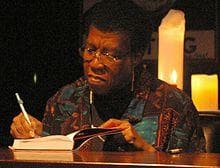
Octavia E. Butler (1995)
Genre
Fantasy / Science Fiction
Reading Time
360 min
Key Themes
See below
Sign in to track this book
Symbiotic alien overlords, divine mandates to save humanity, and the struggle for communication in a world without speech reveal unsettling truths about our existence.
On the Tlic Preserve, a human colony on an alien planet, Gan, a young Terran male, lives under the protection of the Tlic, an insect-like alien species. He is chosen to host the eggs of T'Gatoi, a high-ranking Tlic. The story begins with Gan's growing fear as the time for his 'joining' nears. He sees another male Terran, Bram Lomas, suffering greatly during childbirth, which makes his own fear stronger. T'Gatoi, Gan's protector, tries to reassure him, stressing the honor and need for their shared relationship. Gan's sister, Qui, also prepares for her role as a host, though with less fear than her brother. The Terrans depend on the Tlic for survival, having been saved from a dying Earth, but this comes at the cost of their reproductive freedom.
The day for Gan's implantation arrives. He watches Lomas, a male Terran, in extreme pain as T'Gatoi removes the mature larvae from his body. The sight of the moving larvae and the open wound deeply traumatizes Gan, increasing his resistance. He briefly considers suicide to escape his fate. T'Gatoi, sensing his distress, offers him a choice: she will implant him, or she will implant his younger sister, Qui, instead. This manipulation forces Gan to face his responsibilities and his love for his family. In the end, he chooses to accept the implantation himself, driven by a desire to protect Qui and maintain their delicate balance with the Tlic. He understands this is a necessary sacrifice for his people's survival.
In a post-apocalyptic Los Angeles, a mysterious illness has left most of humanity unable to speak, read, or write, reducing communication to gestures and grunts. Rye, a woman who still understands some language, lives alone, always cautious of the random, violent outbursts that mark human interaction. The lack of communication has caused widespread aggression and a breakdown of social rules. She longs for connection and information, but the world offers little of either. Her days are spent isolated, broken by brief, tense meetings with others, where misunderstandings often turn violent. She carries a gun for self-defense, a necessity in this brutal new world where simple interactions can become deadly.
While on a bus, Rye meets Obsidian, a man who, like her, seems to have a higher level of thought than most. He can communicate with some complexity, though still limited, and shows a surprising gentleness. Their shared ability to understand and express themselves, even imperfectly, sparks a careful hope in Rye. They find comfort in each other's presence, a rare thing in their silent world. Obsidian offers her protection and a feeling of belonging she hasn't had in years. This meeting is a turning point for Rye, as she begins to believe that real human connection might still be possible, even amid the widespread devastation of their society. They begin to travel together, seeking a safer place.
Rye and Obsidian's journey together ends tragically when they see a violent fight between two other people. Obsidian tries to stop the situation but is fatally wounded. Rye, heartbroken by his loss, is left alone again. However, she then finds two children who seem to be Obsidian's, also affected by the disease but showing some clarity. Despite her grief, Rye feels an immediate urge to protect them. She decides to take them in, seeing the potential for a new kind of family and a renewed sense of purpose. This act of kindness offers a small sign of hope for the future, suggesting that even with great loss, humanity's ability to care remains.
Noah, a human woman, is being questioned by representatives of a human corporation, the Corporate, who are suspicious of her close ties to the alien Gaal. The Gaal are an insect-like species who have settled on Earth, offering humans a symbiotic, though controlling, existence. Noah explains that the Gaal took her as a child and raised her, teaching her their language and customs. This experience has given her a unique understanding of their motives and biology, making her a valuable, yet mistrusted, go-between. The Corporate sees the Gaal as invaders and Noah as a possible traitor, questioning her loyalty and the true nature of her relationship with the aliens. Noah's testimony is a defense of her choices and a plea for understanding between the two species.
Noah describes how the Gaal bring humans into their society. Humans are 'paired' with a Gaal, forming a deep mental and emotional bond. This bond offers humans protection, food, and a sense of belonging, but at the cost of some individual freedom. Humans are also physically changed, gaining better senses and abilities, but becoming dependent on the Gaal. Noah stresses that the Gaal, though alien, are not evil; they are driven by a strong instinct for survival and expansion. She argues that the Gaal's presence gives humanity a chance to adapt and evolve, rather than face extinction. Her story challenges the human view of the Gaal as purely hostile, highlighting the complex, co-dependent nature of their relationship. She explains the good and bad parts of this partnership.
Noah, now a respected leader among the humans who live with the Gaal, acts as a link between the two species. She understands that both humans and Gaal are vulnerable and that their survival is connected. She advocates for mutual understanding and respect, arguing that continued conflict will only cause more suffering. Her experiences allow her to see the humanity in the Gaal and the alienness in some human reactions. She highlights the Gaal's ability to offer a unique form of healing and connection that humans cannot provide for themselves. The story ends with her efforts to create lasting peace, one that recognizes the sacrifices made by both sides and embraces the possibility of a shared future, despite their deep differences. She works to prevent more human-Gaal conflict.
Martha, a solitary writer, is visited by God, who gives her an extraordinary and difficult task: to save humanity from its self-destructive ways. God explains that humanity is headed for unavoidable destruction, driven by its flaws, and Martha is chosen to create a plan to stop this. Martha is at first overwhelmed and doubtful, asking why she, an ordinary person, has been chosen for such an impossible mission. God assures her that she has the unique perspective and empathy needed. This divine intervention forces Martha to confront not only the huge problems facing humanity but also her own beliefs about good, evil, and free will. She has a limited time to come up with a workable solution.
Martha struggles with the huge responsibility given to her. She considers different approaches, from subtle changes to more drastic actions, each with its own ethical problems. She questions whether 'saving' humanity means keeping it in its current form, or if a more drastic change is needed. She debates the morality of taking away human free will, even if it leads to a more peaceful existence. Martha also wrestles with her own biases and limits, realizing that any solution she creates will be subjective. Her inner conflict shows the complexities of large-scale altruism and the difficulty of defining universal good. She spends days and nights agonizing over her decision, consulting her own moral compass.
After much thought, Martha presents her plan to God. Instead of a grand, sweeping change, she suggests a more subtle, yet deep, intervention: to gently improve humanity's capacity for empathy and connection. Her plan involves a gradual, almost unnoticeable shift in human psychology, encouraging people to understand and value each other more deeply. She believes that true salvation comes not from forced obedience, but from fostering real compassion and a shared sense of responsibility. God accepts her proposal, acknowledging its elegance and its respect for human choice. Martha's solution shows her belief in humanity's potential for good, even with its flaws, and her understanding that lasting change comes from within.
Lynn, a young woman, lives with 'Duryea-Gode Disease' (DGD), a genetic condition that causes sufferers to compulsively mutilate themselves. The disease appears in late adolescence, leading to a life of pain, isolation, and constant watchfulness against self-harm. Lynn's parents, who are carriers, struggle with guilt and the burden of caring for their afflicted daughter. Society views DGD sufferers with fear, often separating them. Lynn and other 'Duryeas' are often institutionalized or live in special communities, constantly monitored to prevent them from harming themselves. Lynn tries to find meaning and control in her life despite the constant threat of the disease, seeking ways to manage her impulses and connect with others who understand her struggle.
Lynn works at a facility nicknamed the 'Slaughterhouse,' a place where advanced DGD sufferers, unable to control their urges, are cared for. Despite the grim reality of her job, Lynn finds a strange sense of belonging among those who share her illness. She learns to cope with the disturbing sights and sounds, finding empathy for the residents. Through her work, she gains a deeper understanding of the disease's progression and its devastating impact. The facility also acts as a community for those with DGD, offering a shared experience and solidarity that is missing in the outside world. Lynn's work is a form of self-therapy, allowing her to face her own fears about the future of her disease.
Despite the bleakness of DGD, Lynn discovers that some sufferers, especially those in advanced stages, can turn their compulsive urges into a unique form of abstract, self-referential art. This unexpected development offers a deep sense of hope and beauty amid the suffering. Lynn recognizes the artistic value and emotional depth in these creations, seeing them as a sign of the enduring human spirit. She begins to advocate for the recognition and preservation of this art, believing it can offer a new understanding of DGD and a way for sufferers to express themselves beyond their disease. This discovery gives Lynn a new purpose, changing her view of DGD from a purely destructive force to one that can, surprisingly, encourage creativity.
The Protagonist
Gan transforms from a fearful boy into a man who accepts his difficult duty for the sake of his community, finding a complex love and understanding for his Tlic partner.
The Supporting
T'Gatoi remains a constant, ancient force, but her interactions reveal the depth of her unique, alien form of love and responsibility.
The Protagonist
Rye evolves from an isolated survivor to someone willing to form new bonds and take on the responsibility of protecting others, finding purpose in connection.
The Supporting
Obsidian serves as a catalyst for Rye's emotional reawakening, demonstrating the power of connection before his tragic death.
The Protagonist
Noah grows from an individual shaped by alien contact into a powerful advocate for interspecies understanding and a leader of a new way of life.
The Protagonist
Martha moves from disbelief and anxiety about her divine task to a confident and nuanced understanding of how to genuinely help humanity, demonstrating wisdom and empathy.
The Protagonist
Lynn evolves from managing her own DGD to finding a profound purpose in advocating for and understanding the unique artistic expression of others with the disease.
The Supporting
The collective Duryeas demonstrate the complex spectrum of living with a devastating disease, revealing both the depths of suffering and unexpected forms of human expression.
This theme explores the complex, often uncomfortable, relationships where two species or individuals rely on each other for survival. It blurs the lines between protector and dependent, highlighting the sacrifices needed for mutual existence. In 'Bloodchild,' the Terrans' survival on the Tlic Preserve depends entirely on their agreement to host Tlic eggs, a gruesome but necessary exchange. Noah in 'Amnesty' shows this, having been 'paired' with a Gaal, gaining benefits but losing some control. These stories question if such relationships are true partnerships or a form of kind control, and if a species can truly be free when its existence is tied to another.
“You are my family. You are my children. You are my people. I am your Tlic. And you are my Terran.”
Butler often examines what defines humanity, especially when facing extreme situations or alien contact. The loss or change of communication is a key part. In 'Speech Sounds,' the inability to speak or read takes away humans' basic tools for connection, leading to widespread violence and a return to primal instincts. Rye's struggle to connect and her bond with Obsidian highlight the basic human need for understanding. Noah in 'Amnesty' represents a new kind of human, one able to bridge large communication and biological gaps, suggesting that humanity's definition is flexible and adaptable.
“Sometimes I wonder if it isn't better to be one of the silent ones. At least they don't know what they're missing.”
A repeated theme is the strong drive to survive and the often drastic changes needed to do so. Whether it's the Terrans in 'Bloodchild' accepting a parasitic relationship, or humanity in 'Speech Sounds' turning to primal communication and violence, Butler shows how far life will go to continue. Noah in 'Amnesty' represents an extreme change, becoming a hybrid being to ensure her people's future. These stories highlight that survival often demands compromises, moral uncertainties, and transformations that challenge old ideas of self and species. It is about evolving, not just enduring.
“We are a people who have survived by becoming something new.”
Despite the darkness, Butler consistently explores the potential for empathy and understanding, even across big biological or psychological differences. Gan's complex relationship with T'Gatoi, where fear slowly gives way to a form of love and understanding, is central to 'Bloodchild.' Rye's brief but deep connection with Obsidian in 'Speech Sounds' offers a glimmer of hope in a world without it. Martha's solution in 'The Book of Martha' is specifically to improve human empathy. This theme suggests that real connection, even with those very different, is humanity's greatest strength and perhaps its only path to salvation.
“It was as though she had always known him, had always been waiting for him.”
Butler's stories often look at the moral complexities of controlling or interfering in the lives of others, whether for their 'own good' or for a species' survival. In 'Bloodchild,' the Tlic control the Terrans' reproduction and existence, a kind but absolute power. Martha in 'The Book of Martha' deals with the ultimate ethical problem of interfering with humanity's free will to save it. The Corporate in 'Amnesty' tries to control Noah and the Gaal-human relationship. These stories make readers consider the reasons for, and results of, using power over others, even with good intentions.
“Who are you to decide what is good for all of humanity?”
A mutually beneficial, yet often unsettling, co-existence between different species.
This device is central to 'Bloodchild' and 'Amnesty.' In 'Bloodchild,' the Terrans provide hosts for Tlic eggs, while the Tlic provide protection and a home. This is framed as a necessary survival mechanism but is deeply unsettling due to the Tlic's parasitic nature. In 'Amnesty,' humans 'pair' with the Gaal, gaining enhanced abilities and protection but becoming dependent. This device allows Butler to explore themes of co-dependence, sacrifice, and the blurring lines between freedom and subjugation, forcing characters and readers to question the true nature of 'mutual benefit' when one party holds significantly more power.
A world ravaged by a catastrophic event, forcing humanity to adapt or perish.
Used prominently in 'Speech Sounds,' the post-apocalyptic setting, brought about by a mysterious plague that destroys language, serves to strip humanity down to its most basic elements. This allows Butler to examine fundamental questions about communication, social order, and the human capacity for both violence and connection when societal structures collapse. The ravaged landscape and the constant threat of violence amplify the characters' struggles and make any glimmer of hope or connection profoundly impactful, highlighting the fragility of civilization and the enduring strength of the human spirit.
A biological alteration that profoundly impacts individuals and society.
In 'The Evening and the Morning and the Night,' the Duryea-Gode Disease (DGD) is a genetic condition causing compulsive self-mutilation. This device creates immediate conflict for the protagonist, Lynn, and for society's perception of those afflicted. It allows Butler to explore themes of bodily autonomy, societal stigma, the search for dignity amidst suffering, and the unexpected ways in which people can find meaning and even art within their affliction. The disease acts as both a literal and metaphorical barrier, forcing characters to confront the limits of control over their own bodies and destinies.
A supernatural force directly influences human affairs, often with a specific task.
This device is the core of 'The Book of Martha,' where God appears to Martha and tasks her with saving humanity. It allows Butler to explore grand philosophical and ethical questions about free will, destiny, and the nature of good and evil on a cosmic scale. By giving an ordinary individual such immense power and responsibility, the story delves into the psychological burden of playing God and the complexities of defining and achieving 'salvation' for an entire species. It provides a unique lens through which to examine humanity's flaws and potential for redemption.
“I was of age, but I was not ready.”
— From 'Bloodchild', Gan speaking about his impending impregnation.
“We were not meant to be free. We were meant to be useful.”
— From 'Speech Sounds', describing the societal shift after a plague.
“Love is a drug, and I am an addict.”
— From 'The Evening and the Morning and the Night', concerning the protagonist's relationship.
“Embrace difference. Embrace change. But do not embrace violence.”
— From 'Fledgling', a core teaching of the Ina species.
“Nothing ever goes away until it teaches us what we need to know.”
— From 'Speech Sounds', a character reflecting on past experiences.
“To survive, you must be able to adapt. To adapt, you must be able to think.”
— From 'Bloodchild', a lesson passed down from mother to child.
“Power always thinks it has a great soul and vast views beyond the comprehension of the weak.”
— From 'Amnesty', a character's observation on power dynamics.
“We are a questioning species, always asking 'why?'”
— From 'The Evening and the Morning and the Night', contemplating human nature.
“Knowledge is a deadly weapon, if you use it wrong.”
— From 'Bloodchild', a warning about the misuse of information.
“The only way to make a new world is to break the old one.”
— From 'Speech Sounds', a character's radical view on societal change.
“We're all just trying to make sense of the chaos, one way or another.”
— From 'The Evening and the Morning and the Night', a moment of shared understanding.
“There are no monsters, only people who are afraid.”
— From 'Fledgling', challenging the perception of fear and otherness.
“The past is a ghost that haunts the present.”
— From 'Amnesty', reflecting on lingering trauma and history.
“To deny what you are is to deny life itself.”
— From 'Bloodchild', a character accepting their destiny.
Ready to see how well you understood this book? Take our interactive quiz with 10 questions.
Biography coming soon.







