“Whatever in creation exists without my knowledge exists without my consent.”
— Judge Holden's chilling declaration of his worldview and desire for absolute dominion.


Cormac McCarthy (1985)
Genre
Literary Fiction / Historical Fiction
Reading Time
10-12 hours
Key Themes
See below
Sign in to track this book
In 1850s Texas, a runaway teen joins a scalp-hunting gang, embarking on a violent journey that redefines the American West.
The novel opens with 'the kid,' a fourteen-year-old runaway from Tennessee, leaving his abusive home. He travels through the South, doing small crimes and fighting, eventually reaching Texas. He sees and takes part in casual violence. In Nacogdoches, he meets Judge Holden, a large, hairless, mysterious man who is very smart and has disturbing ideas. The Judge quickly shows his powerful presence. The kid later joins an expedition led by Captain White, aiming to take over Sonora, Mexico. This poorly organized group goes into the Chihuahua desert, where Comanche warriors ambush and kill most of them. The kid is one of the few survivors, left alone and without possessions in the harsh wilderness.
After the Comanche attack, the Kid wanders, near death, into Chihuahua. Mexican authorities imprison him, mistaking him for an American invader. In prison, he meets members of a scalp-hunting gang led by John Joel Glanton, a historical figure. This group, hired by the Mexican government to kill Apaches, includes Judge Holden, who is an important intellectual and strategic force in the group. The Kid, seeing no other way to survive, joins Glanton's gang, starting a journey of violence and moral decline. His joining the gang marks a deeper entry into the brutal frontier.
Glanton's gang, first hired to kill Apaches, quickly starts killing without distinction. They kill Apaches, peaceful Coahuiltecans, and eventually, any Mexican villagers or travelers they meet, scalping everyone for bounty regardless of their tribal group or innocence. The bounties for Indian scalps are high, and the gang's greed and bloodlust become endless. The Judge, with his wide knowledge and chilling statements on war and human nature, often guides their decisions and justifies their crimes. The Kid, though involved, often watches with detached horror, a silent witness to the growing cruelty around him. Their path through Sonora and Chihuahua is marked by death and destruction.
The growing brutality and random killings by Glanton's gang eventually cause widespread anger among the Mexican people and authorities. The governor of Chihuahua cancels their contract and sends soldiers to arrest them. Glanton's group, now hunted, flees north toward the United States border. During their escape, they commit more violence, including killing a group of Mexican soldiers sent to stop them. The pursuit is constant, forcing the gang to give up their original goal and focus only on survival, making them outlaws in both Mexico and the United States.
The rest of Glanton's gang, now smaller and more paranoid, arrive at a ferry crossing on the Gila River, run by a Yuma Indian named Caballo en Pelo. They decide to take over the ferry, seizing control from the Yumas and using it for money, robbing and killing many travelers who try to cross. This act of aggression leads to their downfall. The Yuma Indians, at first tolerant, become more hostile and plan an attack to take back their ferry and get revenge. The Kid and Tobin, a former priest who joined the gang, see the growing tension.
The Yuma Indians launch a surprise attack on Glanton's camp at the ferry crossing. The massacre is quick and brutal. Many of Glanton's men, including Glanton himself, are killed at the start. The Kid, Tobin, and a few others manage to escape the immediate slaughter, but they are wounded and chased by the angry Yumas. This event ends Glanton's scalp-hunting group, bringing a violent finish to their bloody campaign. The Kid and Tobin, badly injured, must now travel the hostile desert alone, their former allies dead or scattered.
Wounded and chased by the Yumas, the Kid and Tobin flee across the harsh desert. Tobin, with a bullet in his neck, suffers greatly, and the Kid, despite his own injuries, helps him. They meet other survivors of the massacre, but these meetings often end in more violence or betrayal. Their bond is tested by the extreme conditions and their shared trauma. Eventually, after a difficult journey and facing starvation and thirst, they are separated. The Kid continues his solitary journey, now completely alone and bearing the physical and mental scars of his experiences with Glanton's gang.
Years pass. The Kid, now an adult, works as a buffalo hunter in the American West. He meets various people, some reminding him of his past, others new. He crosses paths with Glanton's former lieutenant, David Brown, who also survived. These meetings are often short and filled with lingering dread and the unspoken weight of their shared, violent history. The Kid carries the mark of his experiences, a quiet, watchful figure in a world still defined by violence. He remains a wanderer, unable to settle, always on the edge of society.
The Kid eventually arrives in a small frontier town, entering a saloon. There, he again meets Judge Holden, many years after the Yuma massacre. The Judge, seemingly unchanged, is dancing and talking about philosophy, representing an eternal, evil force. The reunion has an unspoken history and a sense of what is bound to happen. The Judge, recognizing the Kid, starts a chilling, one-sided conversation about war, dance, and the lasting presence of violence, hinting that the Kid cannot escape his past or the Judge's influence.
After their meeting in the saloon, the Kid goes to an outhouse. The Judge follows him. Inside, the Judge brutally kills the Kid, sexually assaulting him before his death. The exact details of the murder are somewhat unclear but suggested by the Judge's later actions and the discovery of the body. This final, horrifying act confirms the Judge's triumph and the futility of the Kid's attempts to escape the pervasive violence and evil he witnessed and took part in. The Judge then reappears, dancing among the revelers, a monstrous, eternal figure of destruction, his power undiminished.
The Protagonist
From an innocent runaway, he becomes a hardened, silent participant in atrocities, eventually succumbing to the very violence he witnessed.
The Antagonist
He is presented as an unchanging, eternal force of evil, with no discernible arc, only a consistent manifestation of his terrifying philosophy.
The Supporting
He begins as a brutal but functional leader, descending into madness and indiscriminate violence, leading to his demise.
The Supporting
From a man of God who has fallen, he struggles to retain his humanity amidst the gang's depravity, becoming a survivor haunted by his past.
The Supporting
He remains consistently violent and unrepentant, meeting his inevitable violent end with the rest of the gang.
The Supporting
From an ambitious but delusional leader, he meets a swift and brutal end, exposing the futility of his grand ambitions.
The Supporting
He participates in the gang's violence, survives the initial massacre, only to eventually be hanged, showing that justice, however delayed, can still come.
The Mentioned
He attempts to uphold a semblance of morality within the gang, but is quickly silenced and likely killed, demonstrating the futility of such efforts.
The main idea in *Blood Meridian* is the constant and inherent nature of violence. McCarthy shows violence not as an error, but as a basic, primal part of human existence, especially on the frontier. The Judge represents this idea, saying that war is the highest form of human expression and that violence is a dance, a sacred act. The gang's random killing, the Comanche raids, and the constant threat of death all contribute to a world where violence is the main way people interact and survive. The novel suggests that evil is not just the absence of good, but an active, intelligent, and eternal force.
“War is the ultimate game because war is at last a forcing of the unity of existence. War is god.”
The question of choice is important in the novel. The Kid often seems carried along by events, a passive watcher rather than an active participant, suggesting that his fate is determined. The Judge, with his statements on the inevitability of certain actions and the cyclical nature of violence, supports this idea. Characters seem driven by forces beyond their control, whether it is the land, their own brutality, or the Judge's manipulation. The frontier itself acts as a test, removing individual choice and reducing men to their most basic, violent instincts. This implies their destiny is set by their environment and their own dark nature.
“The truth about the world, he said, is that anything is possible. Ideologies of chance, he said, are the refuge of the ignorant.”
*Blood Meridian* thoroughly rethinks the romanticized myth of the American West. Instead of heroic cowboys and noble pioneers, McCarthy shows a landscape of brutal opportunism, genocide, and moral decay. The novel removes any idea of heroism, showing westward expansion as a bloody conquest fueled by greed, racism, and uncontrolled violence. The historical Glanton gang, often ignored in popular stories, is brought to the forefront to expose the dark side of frontier history. This idea challenges readers to face the true, savage cost of Manifest Destiny, replacing celebratory stories with a stark, unflinching account of historical horror.
“He'd hear the voice of the judge and know it to be right. That whatever in creation exists without my knowledge exists without my consent.”
The Kid's journey explores the loss of innocence. Starting as a fourteen-year-old runaway, he is quickly exposed to, and then immersed in, extreme brutality. The novel tracks his gradual desensitization and his change from a boy into a hardened, silent man who is involved in atrocities. The corrupting effect of power, especially the power to take life without consequence, is clear in Glanton's gang. As they gain power over life and death, their actions become more depraved, showing how uncontrolled authority and the absence of moral limits can lead to complete corruption, consuming even those who first resist.
“He saw that the judge was right. That there was no such thing as a good man or a bad man. That there was only the will to do.”
A detached, omniscient narrator often withholds crucial information or moral judgment.
The novel employs a highly stylized, detached omniscient narrator who often describes horrific events with an almost biblical solemnity, but without explicit moral condemnation. This narrative voice rarely delves into the characters' inner thoughts, particularly the Kid's, leaving their motivations and feelings ambiguous. This ambiguity forces the reader to confront the events directly and form their own interpretations of the violence and its meaning. The lack of clear moral guidance from the narrator mirrors the moral void of the world depicted, making the reader a silent, often uncomfortable, witness to the unfolding atrocities and enhancing the sense of existential dread.
Language and imagery evocative of Old Testament wrath and apocalypse.
McCarthy's prose is highly stylized, often employing archaic language, long sentences, and a rhythmic, almost prophetic tone reminiscent of the Old Testament. The landscape descriptions often evoke a sense of desolate grandeur, akin to a biblical wasteland. Characters like the Judge, with his seemingly supernatural qualities and pronouncements, take on a demonic, almost divine, aura. This device elevates the narrative beyond a simple historical account, imbuing the violence with a sense of mythological or archetypal significance, suggesting that the events unfold within a timeless, cosmic struggle between good and evil, or simply the eternal reign of evil.
An embodiment of eternal evil, war, and destructive intellect.
Judge Holden transcends a mere character to become a powerful symbolic figure. He represents pure, unadulterated evil, a force of nature rather than a man. His agelessness, immense knowledge, and philosophical pronouncements on violence, war, and the human will suggest he is an archetypal figure, perhaps even a demonic entity. He is the intellectual architect of the gang's depravity, giving voice to the darkest impulses of humanity. His presence symbolizes the pervasive, eternal nature of violence and the idea that some forms of evil are not merely human but transcendent, an inherent part of the cosmos that presides over and thrives on destruction. He is a constant, terrifying presence that the Kid can never truly escape.
The harsh, indifferent desert reflecting and influencing the human condition.
The vast, desolate, and indifferent landscape of the American Southwest and Northern Mexico is not merely a setting but an active force in *Blood Meridian*. McCarthy describes the desert with meticulous detail, emphasizing its harshness, its beauty, and its capacity for cruelty. The landscape acts as a crucible, stripping away human artifice and exposing primal instincts. It mirrors the moral desolation of the characters and contributes to their brutality, forcing them into a constant struggle for survival that justifies, in their minds, extreme violence. The land is unforgiving, reflecting the unforgiving nature of the men who traverse it, and often seems to mock their human endeavors.
“Whatever in creation exists without my knowledge exists without my consent.”
— Judge Holden's chilling declaration of his worldview and desire for absolute dominion.
“War is god.”
— Judge Holden's stark pronouncement on the nature of violence and existence.
“He never sleeps, the judge. He is dancing, dancing. He says that he will never die.”
— Final description of Judge Holden's eternal, malevolent presence.
“The way of the world is to bloom and to flower and die but in the affairs of men there is no waning and the noon of his expression signals the onset of night.”
— Narrative reflection on the cyclical nature of life versus human violence.
“Your heart's desire is to be told some mystery. The mystery is that there is no mystery.”
— Judge Holden dismissing the boy's search for meaning in the brutal world.
“Only that man who has offered up himself entire to the blood of war, who has been to the floor of the pit and seen horror in the round and learned at last that it speaks to his inmost heart, only that man can dance.”
— Judge Holden describing his philosophy of embracing violence as essential to existence.
“The truth about the world, he said, is that anything is possible. Had you not seen it all from birth and thereby bled it of its strangeness it would appear to you for what it is, a hat trick in a medicine show, a fevered dream, a trance bepopulate with chimeras having neither analogue nor precedent, an itinerant carnival, a migratory tentshow whose ultimate destination after many a pitch in many a mudded field is unspeakable and calamitous beyond reckoning.”
— Judge Holden's monologue on the chaotic, meaningless nature of reality.
“Men are born for games. Nothing else. Every child knows that play is nobler than work.”
— Judge Holden asserting his belief that life is fundamentally about contest and violence.
“The freedom of birds is an insult to me. I'd have them all in zoos.”
— Judge Holden expressing his desire to control and dominate all of nature.
“It makes no difference what men think of war, said the judge. War endures. As well ask men what they think of stone. War was always here. Before man was, war waited for him.”
— Judge Holden's argument that violence is an eternal, fundamental aspect of existence.
“The universe is no narrow thing and the order within it is not constrained by any latitude in its conception to repeat what exists in one part in any other part.”
— Judge Holden discussing the vast, indifferent nature of existence.
“They rode on and the sun in the east flushed pale streaks of light and then a deeper run of color like blood seeping up in sudden reaches flaring planewise and where the earth drained up into the sky at the edge of creation the top of the sun rose out of nothing like the head of a great red phallus until it cleared the unseen rim and sat squat and pulsing and malevolent behind them.”
— Vivid, ominous description of a sunrise during the gang's journey.
“He says that he will never die.”
— Repeated refrain about Judge Holden's seemingly supernatural immortality.
“The mother dead these fourteen years did incubate in her own bosom the creature who would carry her off. The father never speaks her name, the child does not know it.”
— Narrative reflection on the boy's tragic, violent origins and lost identity.
Ready to see how well you understood this book? Take our interactive quiz with 10 questions.
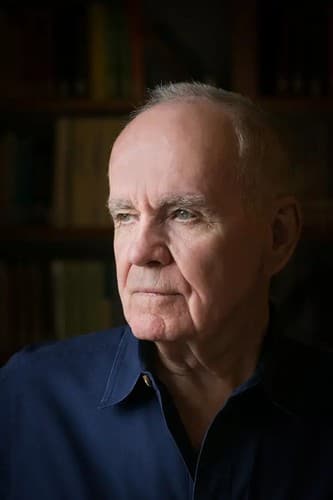
Cormac McCarthy was an American writer who authored twelve novels, two plays, five screenplays, and three short stories, spanning the Western and postapocalyptic genres. He was known for his graphic depictions of violence and his unique writing style, recognizable by a sparse use of punctuation and attribution. McCarthy is widely regarded as one of the greatest American novelists.







