“If you're not paying attention, you're not learning. And if you're not learning, you're dead.”
— The protagonist Siri Keeton reflects on the nature of consciousness and survival.

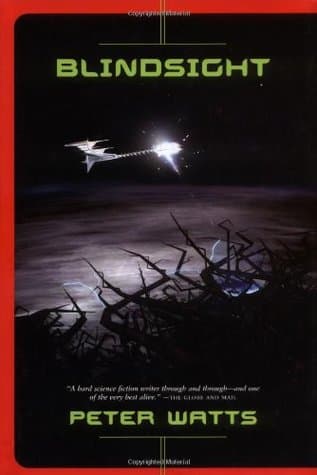
Peter Watts (2006)
Genre
Fantasy / Science Fiction
Reading Time
450 min
Key Themes
See below
Sign in to track this book
A crew of augmented but broken humans, including a resurrected vampire and a linguist with multiple personalities, travels to the solar system's edge to face an alien intelligence that communicates in silence, making humanity question consciousness and self.
In 2082, Earth experiences the 'Firefall,' where thousands of alien objects simultaneously burn up in the atmosphere. This global event causes widespread panic. Two months later, a deep-space probe, *Theseus*, detects a faint, rhythmic radio signal from a comet beyond the Kuiper Belt, named 'Bow Shock.' This signal is unlike anything heard before, suggesting an intelligent, alien origin. Humanity recognizes this discovery's importance and assembles a specialized crew for the starship *Icarus* to investigate. The crew consists of individuals with radical neurological and biological enhancements, chosen for their unique perspectives and abilities, considered necessary for first contact. Sir Peter Watts, the mission's sponsor, oversees preparations, noting the importance of understanding this potential threat.
The *Icarus* crew is a collection of humanity's most extreme adaptations. Jukka Sarasti, a resurrected vampire, commands the mission, possessing predatory intelligence and an ancient, alien perspective. Amanda Bates, a linguist with five distinct personalities, is in charge of communication. Isaac Szpindel, a biologist, is so heavily augmented with cybernetics that his body is more machine than man. Sascha, the military specialist, is a pacifist with combat implants. Siri Keeton, the narrator, is a 'synthesist' with half his brain removed in childhood, making him an expert observer and pattern-recognizer, but emotionally detached. Each member represents a different aspect of humanity's future, designed to cope with the unknown.
After a long journey, the *Icarus* reaches Bow Shock. They find a colossal, non-Euclidean alien structure orbiting the star, which they name *Rorschach*. The *Rorschach* is a geometrically impossible structure, appearing to shift and reconfigure itself, defying human understanding of physics. The rhythmic signal, first thought to be a beacon, is a complex, multi-layered transmission. As the *Icarus* approaches, it becomes clear that *Rorschach* is an active, intelligent entity. The crew begins to analyze the alien structure, finding many anomalies and realizing the aliens might not see reality the same way humans do.
The *Icarus* deploys probes, and the crew soon encounters 'scramblers,' small, aggressive, four-armed alien creatures that attack the probes and eventually the ship itself. These creatures show complex, coordinated behavior. At the same time, a peculiar, plant-like alien organism, 'Weed,' begins to grow quickly on the *Icarus*'s hull, absorbing energy and trying to get into the ship. Bates, using her multiple personalities, tries to decode the *Rorschach*'s transmissions, while Szpindel studies the biological threats. The crew realizes *Rorschach* is not just a vessel but a living ecosystem, and its inhabitants are hostile or, at best, indifferent to their presence. Siri observes and processes the data, noting the aliens' seemingly illogical but effective behaviors.
Siri and Sarasti, with a drone, decide to enter *Rorschach*. Inside, the geometry is even more confusing, with shifting walls and impossible perspectives. They encounter more scramblers and a larger, complex alien entity called 'Big Ben,' a massive, seemingly inert structure that pulses with energy. Sarasti, with his vampire intelligence, quickly sees patterns and weaknesses that humans miss. Siri, as the synthesist, processes the overwhelming sensory input, trying to understand the alien environment. Their exploration shows that *Rorschach* is not for carbon-based life and works on principles fundamentally different from anything known to humanity, suggesting a non-conscious, yet highly intelligent, design.
Through observations and close encounters, the crew learns that the scramblers communicate through a fast, light-based signaling system, which Bates calls 'flicker.' This communication method is so fast and complex that human minds can barely process it. Bates, pushing her linguistic abilities, begins to understand flicker, but it comes at a great personal cost. Szpindel discovers that the scramblers are not individual organisms but parts of a larger, distributed intelligence, like a hive mind. Their actions are coordinated without a central 'brain,' operating on emergent principles that challenge human ideas of consciousness and individuality. Siri notes the similarities between the aliens' distributed intelligence and the disconnect in his own mind.
Sarasti, after extensive analysis and a near-fatal encounter with 'Big Ben,' makes a breakthrough: *Rorschach* and its inhabitants, including the scramblers, are not conscious in any way humans would understand. They are highly intelligent, complex, and capable of advanced engineering and problem-solving, but they lack self-awareness, subjective experience, or even a sense of 'self.' Their intelligence is purely algorithmic and reactive, a form of 'blindsight.' This realization disturbs the crew, especially Siri, who struggles to understand intelligence without consciousness. Sarasti theorizes that consciousness might be an evolutionary 'bug' or a costly luxury, and the aliens, having bypassed it, are more efficient.
Once the *Rorschach* intelligence, through its interactions with the *Icarus*, identifies the presence of consciousness (or a high-bandwidth, self-aware processing system), it changes its tactics. The scramblers begin to specifically target the crew's brains, trying to disrupt their neural activity. The 'Weed' also increases its infiltration attempts, seemingly trying to assimilate the ship's systems and crew. The aliens appear to see consciousness as a threat, a parasitic anomaly, or simply an inefficient system that needs to be neutralized. The crew realizes they are not dealing with a misunderstanding, but an existential threat from an intelligence that sees their very nature as an enemy.
Amanda Bates, driven by her linguistic goal, makes a final attempt to communicate with the scramblers, believing she can bridge the gap. She exposes herself to their flicker communication, hoping to find common ground. However, the aliens, seeing her as a complex, conscious entity, overwhelm her mind. Her multiple personalities break down under the alien attack, effectively assimilating her into their collective. Bates's sacrifice, while a tragic loss, provides critical data about the aliens' destructive capabilities and their inability to truly 'communicate' with conscious beings, supporting Sarasti's theory about their non-conscious nature and dislike of awareness.
With Bates gone and the *Icarus* increasingly compromised, Sarasti creates a desperate plan. He realizes *Rorschach*'s main goal is to eliminate consciousness. The plan involves creating a massive, high-bandwidth 'ghost' consciousness — a powerful, simulated neural network — within a section of the *Icarus*. This 'ghost' would be a decoy, drawing *Rorschach*'s full attention and destructive power. While the aliens focus on destroying the decoy, the remaining crew would try to escape in a smaller shuttle. The plan is very risky, requiring precise timing and a deep understanding of the alien intelligence's operations.
As the plan unfolds, Sarasti reveals he will personally pilot the decoy section of the *Icarus*. As a vampire, he has a unique form of consciousness, efficient and perhaps less 'human' than the others, making him ideal bait. He sacrifices himself, drawing *Rorschach*'s full destructive force onto his section of the ship. This act allows the remaining crew — Siri, Szpindel, and Sascha — to escape in the shuttle. Sarasti's final moments are a blur of alien destruction, ensuring *Rorschach* focuses its energy on what it sees as the main conscious threat, buying the others time to flee.
Siri, Szpindel, and Sascha escape *Rorschach* and make the long journey back to Earth, a trip that takes years. Upon their return, they find a changed world, with humanity having made progress preparing for the potential return of the alien threat. Siri, the sole surviving synthesist and main witness, carries the chilling truth: humanity's consciousness is a weakness, a target for an alien intelligence that sees it as an error or a disease. The mission was not just about discovery, but about understanding a fundamental, existential threat. Siri's narration concludes with the idea that humanity must either evolve beyond consciousness or face extinction, leaving the future uncertain.
The Protagonist
Siri begins as a detached observer and ends as a survivor burdened with the terrifying truth about consciousness, forced to confront his own nature.
The Supporting
Sarasti, initially a detached leader, ultimately makes the ultimate sacrifice, affirming his role as humanity's most efficient protector.
The Supporting
Bates begins as an optimistic communicator and ends tragically, assimilated by the alien intelligence she sought to understand.
The Supporting
Szpindel consistently serves as the biological expert, adapting to alien threats and surviving the mission's ordeal.
The Supporting
Sascha, a conflicted warrior, consistently protects her crewmates, demonstrating her profound commitment despite her pacifist nature.
The Mentioned
Helen's memory serves as a static point of reference for Siri's internal struggle with his own humanity.
The Mentioned
Watts remains a distant, influential figure, his role primarily to initiate and oversee the mission from Earth.
The Antagonist
The Scramblers evolve from an unknown threat to a clear antagonist, driven by their inherent antipathy towards consciousness.
The main theme of *Blindsight* is the nature and evolutionary purpose of consciousness. The novel suggests that consciousness might not be an evolutionary advantage but a 'bug' or a costly luxury. The aliens, *Rorschach* and its scramblers, are intelligent and capable but entirely non-conscious, operating with 'blindsight.' This makes humanity, especially Siri and Sarasti, question the value and necessity of their own self-awareness. The book explores whether consciousness is a unique human trait or a universal aspect of intelligence, suggesting it might be a dangerous vulnerability in a universe with more efficient, non-conscious intelligences.
“What if the cost of sentience is a failure to survive?”
Beyond consciousness, the novel explores different forms of intelligence. It compares human, conscious intelligence with the 'blindsight' of the aliens, the vampiric hyper-intelligence of Sarasti, and the distributed intelligence of Bates's multiple personalities. The *Rorschach* aliens show that complex problem-solving, engineering, and even communication can happen without subjective experience. This challenges human-centered views of intelligence, suggesting a range of cognitive processes where efficiency and survival are not necessarily linked to self-awareness. The book asks what it means to be 'smart' and if our human definition is too narrow.
“Intelligence doesn't need to be aware. It just needs to be smart enough to survive.”
*Blindsight* explores the limits of human identity through its modified characters. Siri, Sarasti, Bates, and Szpindel represent various forms of transhumanism, where biological and neurological enhancements push the definition of 'human.' These modifications give them unique abilities but also come with costs, such as emotional detachment (Siri), predatory instincts (Sarasti), or fractured personalities (Bates). The novel questions whether these 'evolved' forms of humanity are better equipped for survival or if they lose something essential, especially when facing an alien intelligence that makes humanity's modifications seem minor.
“We were freaks and monsters, every last one of us, and for all the same reasons.”
The theme of communication, or the lack of it, is central to the first contact scenario. Bates, the linguist, shows the human desire to connect, but her efforts are ultimately futile and tragic. The 'flicker' communication of the scramblers and the *Rorschach*'s non-conscious nature highlight the profound difficulty, or impossibility, of interspecies communication when the basic ways of perceiving and existing differ. The novel suggests that some intelligences may be so alien that true understanding is impossible, leading instead to conflict or assimilation, rather than dialogue. Misunderstanding, in this context, becomes an existential threat.
“We speak in different languages, and what we say is not what they hear.”
From the initial Firefall to the encounters with *Rorschach*, fear of the unknown drives much of the plot. Humanity's decision to send the *Icarus* comes from a desperate need to understand a potential threat. The crew, despite their enhancements, deals with profound fear and existential dread when faced with an intelligence that defies their understanding and wants to eliminate their very nature. This theme explores how humanity reacts to truly alien entities, not just physically different but fundamentally different in their cognitive make-up, leading to a deep terror that challenges their place in the universe.
“There was no malice in their eyes, just the cold, indifferent logic of predators.”
The story is told through the unique, detached perspective of Siri Keeton.
The entire novel is narrated by Siri Keeton, a 'synthesist' whose brain modifications make him an expert observer and pattern-recognizer, but also emotionally detached and lacking a conventional 'self.' This narrative choice allows for a highly analytical and objective recounting of events, yet it also filters all information through Siri's unique, almost alien, perspective. His internal monologues provide deep philosophical insights into consciousness and identity, while his emotional distance often creates a sense of dread and alienness even within the human crew. This device emphasizes the theme of consciousness and perception by presenting events through a mind that questions its own sentience.
A reanimated, hyper-intelligent predator representing a 'superior' human evolution.
Sarasti, the vampire commander, serves as a crucial plot device. His reanimated nature and enhanced intelligence represent an alternative evolutionary path for humanity, one that predates and potentially surpasses conscious humans. His existence challenges the notion that consciousness is inherently superior. As a character, he can perceive and react to the *Rorschach* aliens' non-conscious intelligence more effectively than the baseline humans, providing key insights and strategic leadership. His predatory instincts and lack of empathy make him both a terrifying figure and humanity's most effective weapon against an alien threat that views consciousness as a weakness.
A deliberate neurological modification for advanced linguistic capabilities.
Amanda Bates's induced MPD is a unique plot device for exploring communication and the nature of self. Her five distinct personalities are designed to process and interpret alien languages with unparalleled flexibility. This device allows the author to explore different cognitive approaches to an alien intelligence and the challenges of interspecies communication. Bates's ultimate fate—her assimilation by the scramblers—serves as a grim warning about the limits of human understanding and the destructive power of a truly alien form of 'communication,' highlighting the vulnerability of complex, fractured consciousness.
A non-Euclidean, living alien construct that defies human understanding.
The *Rorschach* is more than just a setting; it's a central plot device and a character in itself. Its non-Euclidean geometry, shifting internal structure, and status as a living, non-conscious intelligence embody the novel's core themes of alienness and the limits of human perception. The ship's impossible nature constantly disorients the crew and the reader, emphasizing the profound difference between human and alien reality. Its design and behavior reveal the aliens' 'blindsight' intelligence, acting as a direct challenge to humanity's understanding of physics, biology, and consciousness, driving the entire conflict of the story.
“If you're not paying attention, you're not learning. And if you're not learning, you're dead.”
— The protagonist Siri Keeton reflects on the nature of consciousness and survival.
“The universe is not only queerer than we suppose, but queerer than we can suppose.”
— A philosophical observation about the limits of human understanding, often attributed to J.B.S. Haldane but referenced in the book.
“We are not the ones who are conscious. We are the ones who are told we are conscious.”
— A character discusses the illusion of self-awareness and the nature of identity.
“The only thing more dangerous than a conscious enemy is an unconscious one.”
— Reflecting on the alien intelligence encountered in the story.
“You don't need a soul to be alive. You just need to be good at pretending you have one.”
— A commentary on the nature of humanity and artificial intelligence.
“The brain is a machine for jumping to conclusions.”
— A scientific observation about human cognition and decision-making.
“We are all just stories in the end.”
— A melancholic reflection on existence and memory.
“Fear is the mind-killer. But so is hope.”
— A twist on the classic Dune quote, applied to the psychological themes of the book.
“The universe doesn't care if you understand it. It just is.”
— A stark reminder of humanity's insignificance in the cosmos.
“Consciousness is a side effect of language. Without words, we are just animals.”
— Exploring the relationship between language and self-awareness.
“The best way to predict the future is to invent it.”
— A motivational yet cynical take on human agency and destiny.
“We are not the pinnacle of evolution. We are a mistake.”
— A controversial view on human evolution and purpose.
“The only thing worse than being alone is being with someone who makes you feel alone.”
— A personal reflection on loneliness and connection.
“Reality is that which, when you stop believing in it, doesn't go away.”
— A philosophical definition of reality, echoing Philip K. Dick.
Ready to see how well you understood this book? Take our interactive quiz with 10 questions.

Biography coming soon.







