“I'm not a fraction. I'm a whole person.”
— Isabella reflects on her identity as a biracial child.

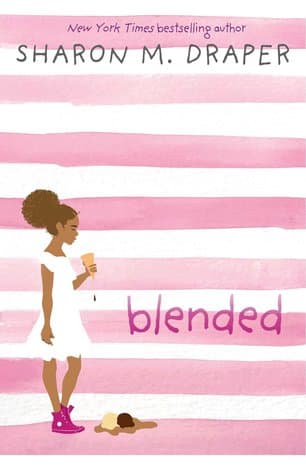
Sharon M. Draper (2018)
Genre
Children's / Young Adult
Reading Time
360 min
Key Themes
See below
Sign in to track this book
An eleven-year-old girl, caught between two homes, two names, and two racial identities, navigates her parents' divorce while looking for a sense of wholeness in a world that constantly categorizes her.
Eleven-year-old Isabella lives a life split between two different worlds. One week, she is 'Isabella' at her wealthy Black father's house with his new girlfriend, Anastasia, and her son, Darren. Here, she experiences a mostly Black environment, often feeling out of place among the rich Black families. The next week, she is 'Izzy' at her White mother's more modest home with her mother's boyfriend, John-Mark. This constant shift is not just about where she lives but also about changing her identity, language, and even her sense of self to fit each parent's expectations and environment. She struggles with feeling 'half' of two different races and cultures, made worse by insensitive comments from others about how she looks.
Isabella deals with subtle and clear pressures from both her parents and their partners. Her father, a successful businessman, is often busy and sometimes dismissive of her feelings, while Anastasia tries to force a bond with Isabella that feels fake. At her mother's house, John-Mark is kind but sometimes overbearing, and her mother struggles with money problems from the divorce. Isabella feels like a rope in a tug-of-war, always trying to please everyone while her own needs and feelings are ignored. She finds comfort in her friendships and her piano lessons, which give her a short break from the tension at home.
Isabella's eleventh birthday approaches, causing tension as her parents argue over party plans. Her father wants a big party, while her mother prefers a simpler, smaller gathering. This conflict shows their basic differences and Isabella's position in the middle. During this time, Isabella continues to experience small racial slights, such as people asking 'what she is' or commenting on her 'exotic' looks. These events make her feel even more like an outsider, always reminded of her biracial identity in ways that are often uncomfortable and isolating, further complicating her sense of belonging in either world.
Isabella's piano lessons with Mr. Fabiano are a way for her to express her emotions. The music helps her show the frustrations, confusion, and joy she struggles to say out loud. Mr. Fabiano, a kind teacher, sees her talent and encourages her, giving her a stable and supportive presence in her often messy life. Through the piano, Isabella starts to find a part of herself that is whole and uniquely hers, a place where her blended identity is a strength instead of a problem. She prepares for an upcoming recital, finding a sense of purpose and achievement.
While shopping at the mall with Darren, Anastasia's son, Isabella experiences a shocking event of racial profiling. A store employee falsely accuses them of shoplifting, only because of their race. This event is very upsetting for Isabella, making her very aware of the unfairness people of color face. Darren, who is Black, is more used to such treatment, but for Isabella, it's a clear and painful realization of how society sees her, no matter her White mother. The event leaves her feeling angry, scared, and even more confused about where she truly belongs.
After the mall incident, Isabella's father, initially not taking it seriously, becomes angry and acts, contacting lawyers and demanding an apology from the store. This shared experience, though painful, makes her parents set aside some of their differences and work together to support Isabella and Darren. The event also starts important talks about race, unfairness, and justice in both homes. Isabella begins to understand that her biracial identity means she experiences both the advantages and disadvantages of being Black in America, and that these experiences shape her reality.
Isabella's piano recital happens, and both her parents, Anastasia, John-Mark, and Darren attend, creating an unusual but supportive blended family gathering. Isabella performs well, putting her heart into the music. Her performance shows her ability to bounce back and find harmony despite problems. The shared experience of watching her perform, and the pride they all feel, briefly closes the gap between her parents. It's a moment where Isabella feels truly seen and valued for who she is, not just for the 'halves' that make her up.
Later, while walking home from school, Isabella and Darren are stopped by police officers who question them aggressively, seemingly for no reason. The officers are rude and scary, and the situation quickly gets worse, making Isabella very afraid. Darren, more used to such encounters, tries to calm things down. This event is even more terrifying than the mall incident, as it involves possible physical danger and misuse of authority. It shows the widespread racial bias in law enforcement and leaves Isabella deeply shaken and aware of the constant threat faced by Black individuals.
The repeated incidents of racial profiling, along with the ongoing tension between her parents, push Isabella to speak up. She starts to say how she feels about being 'blended' and the challenges of living in two worlds. She talks more openly with her parents about her experiences and her wish to be seen as a whole person, not just a sum of parts. While her parents don't magically solve all their problems, they start to listen more carefully to Isabella's struggles, realizing the emotional impact their separation and her biracial identity have had on her.
By the end of the book, Isabella has not found a perfect solution to her family's issues, but she has found a stronger sense of self. She understands that her blended identity is not a weakness but a unique strength. She learns to appreciate the different parts of her heritage and the love she gets from both sides of her family, despite their flaws. She realizes that being 'blended' means she has a rich and complex identity, and she starts to accept it as her own. She is no longer just 'half' of this or 'half' of that, but a complete person who is both Isabella and Izzy, whole and unique.
The Protagonist
Isabella evolves from feeling split and confused about her identity to embracing her blended self as a unique strength, finding her voice in the process.
The Supporting
She learns to better communicate with Isabella and her ex-husband, recognizing the impact their conflict has on their daughter.
The Supporting
He becomes more attuned to Isabella's emotional needs and the realities of racial prejudice after the mall and police incidents.
The Supporting
He helps Isabella understand and cope with racial profiling, sharing his own experiences.
The Supporting
She learns to give Isabella space while still being a supportive presence.
The Supporting
Remains a consistent, positive influence, offering quiet support to Isabella and her mother.
The Supporting
Provides consistent friendship and a safe space for Isabella to express herself.
The Supporting
Guides Isabella in using music as an emotional outlet, fostering her self-expression and confidence.
The main theme is Isabella's struggle to define her identity as a biracial girl. She always feels 'half' of two different worlds and cultures, made worse by her Black father and White mother's divorce. Comments like 'What are you?' show her inner conflict and the outside pressure to label her. Through her experiences with family life and racial prejudice, Isabella learns to accept her 'blended' identity as a unique and whole person, not a divided one.
“I was Black and White. Not half and half, but both, all the way through.”
The novel clearly shows how divorce affects Isabella emotionally. She is caught between her parents' ongoing fights, feeling like a 'push-me-pull-me toy.' The constant switching between two different homes, lifestyles, and even nicknames ('Isabella' vs. 'Izzy') creates instability and emotional stress. The story looks at how parents' disagreements, even when not aimed at the child, deeply affect a child's sense of safety, belonging, and self-worth, making Isabella adapt to two different environments.
“My parents were a tug-of-war, and I was the rope.”
A major theme is Isabella's direct experience with racial prejudice, from small slights to open profiling. Comments about her 'exotic' look, the false accusation of shoplifting at the mall, and the scary police stop all show what it means to be Black in America. These events make Isabella, who is biracial, face the racial biases in society and understand that her identity is seen differently depending on the situation, often leading to fear and unfairness.
“It was like a switch. One minute I was just a kid in a store. The next, I was a suspect.”
Isabella's piano lessons and her love for music are a way for her to express her emotions and find herself. When she struggles to say how she feels about her blended identity and family problems, the piano lets her express herself truly. Mr. Fabiano, her teacher, tells her to put her heart into her playing, helping her find a sense of wholeness and confidence that goes beyond her daily struggles. Music becomes a place where her identity feels united and strong.
“The music was like a secret language, one that only I understood, and it spoke to all the parts of me.”
The novel explores the complexities of modern family structures, especially blended families. Isabella deals not only with her divorced parents but also their new partners and their children (Anastasia and Darren, John-Mark). While these new relationships add layers of complexity and sometimes conflict, they also offer new kinds of support and connection. The story shows how families, despite their flaws and unusual structures, can still find ways to love and support each other, even if it's not always smooth.
“We were a family, messy and complicated, but a family nonetheless.”
Alternating perspectives through Isabella's two homes.
While not explicitly told from two different narrators, the narrative effectively creates a 'dual' structure by alternating between Isabella's week at her father's house and her week at her mother's house. Each 'world' has its own distinct atmosphere, rules, and set of characters. This device vividly illustrates Isabella's feeling of being split and the constant adjustment required of her, emphasizing the central theme of her blended identity. The reader experiences the jarring transitions alongside Isabella.
Represents harmony, self-expression, and wholeness.
The piano and music serve as a powerful symbol throughout the novel. For Isabella, playing the piano is an escape and a way to express emotions she cannot articulate verbally. It represents harmony in her otherwise discordant life, a place where her 'blended' identity can create something beautiful and whole. Her progress in music parallels her journey toward self-acceptance, and her recital becomes a moment of unified family support, symbolizing a potential for harmony in her family life as well.
Illustrates systemic racism and its personal impact.
The repeated incidents of microaggressions (e.g., questions about 'what she is') and overt racial profiling (the mall incident, the police stop) are crucial plot devices. They are not isolated events but rather serve to highlight the pervasive nature of racism and its profound impact on Isabella's developing identity. These incidents force Isabella to confront the realities of being Black in America, shaping her understanding of herself and her place in the world, and driving the plot towards her eventual self-advocacy.
Symbolizes the split in Isabella's identity.
The use of two different names, 'Isabella' at her father's house and 'Izzy' at her mother's, is a subtle yet effective plot device. It symbolizes the internal and external split Isabella experiences. Each name carries different expectations and associations, reinforcing her feeling of having to be a different person in each environment. As she grows, the blurring of these names (or her acceptance of both) signifies her journey towards integrating her identity and feeling whole.
“I'm not a fraction. I'm a whole person.”
— Isabella reflects on her identity as a biracial child.
“Sometimes I feel like a human seesaw.”
— Isabella describes her experience navigating her parents' divorce and different households.
“My life is a blender, and I'm the smoothie.”
— Isabella uses a metaphor to explain her mixed-race heritage and blended family.
“Why do people see color before they see me?”
— Isabella questions racial prejudice and stereotyping.
“Home isn't a place. It's a feeling.”
— Isabella realizes home is about love and security, not physical location.
“I have two of everything: two houses, two families, two sets of rules.”
— Isabella explains the challenges of her parents' shared custody arrangement.
“Music is the one thing that makes sense when nothing else does.”
— Isabella finds solace in playing the piano during difficult times.
“Being biracial means I get to see the world from two different windows.”
— Isabella finds a positive perspective on her racial identity.
“Sometimes the hardest part of being blended is feeling like you don't fit in anywhere.”
— Isabella expresses loneliness and the search for belonging.
“Love doesn't come in fractions either.”
— Isabella realizes love from her parents isn't divided by their separation.
“I'm not half anything. I'm twice everything.”
— Isabella asserts her wholeness and rejects being seen as incomplete.
“Change is the only thing that stays the same in my life.”
— Isabella reflects on the constant transitions between her parents' homes.
“My heart has two addresses, but it's still one heart.”
— Isabella poetically describes loving both her parents despite their separation.
“We're all a little blended, if you think about it.”
— Isabella finds common ground in the idea that everyone has mixed experiences.
Ready to see how well you understood this book? Take our interactive quiz with 10 questions.

Biography coming soon.

Dan Gemeinhart
4.5

Kate O'Hearn
4.4

Jeanne Birdsall
4.4

Jen Wang
4.4
Wendelin Van Draanen
4.3

John Marsden
4.3

Chris Van Allsburg
4.3
Jennifer A. Nielsen
4.2