“The house was built by a man who loved his wife, and that love was baked into every brick.”
— Describing the enduring, almost magical quality of Blackbird House itself.

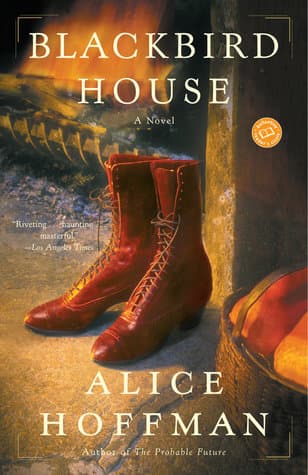
Alice Hoffman (2004)
Genre
Fantasy / Historical Fiction
Reading Time
225 min
Key Themes
See below
Sign in to track this book
Over two centuries, Blackbird House on Cape Cod sees the lives of its many residents, whose stories of love, loss, and secrets intertwine with the house's lasting spirit.
Violet, a young girl in Blackbird House during the early 1800s, loves the apple orchard her family cares for. She reads a lot and dreams. Her family faces difficulties, especially after her father dies, leaving her and her mother to manage the farm. Violet falls in love with Aaron, a charming but unreliable man who works for her family. Despite her mother's warnings, Violet lets herself get carried away by Aaron's promises. This leads to heartbreak and the realization that her true connection is to the land and the house, not a fleeting romance.
Lydia, a descendant of the first residents, is seen as an outsider and a 'witch' by some in the community. This is because she has an unusual connection to animals and herbs, and she is independent. She lives in Blackbird House, often alone, growing a garden and caring for injured creatures. Despite gossip and suspicion, Lydia finds peace in her solitude and her connection to the nature around the house. Her story explores loneliness, strength, and the power of being true to oneself, even when others don't understand her. She embodies the lasting spirit of the house and its land.
David, a sensitive young boy, lives in Blackbird House with his parents. He is deeply affected by his younger brother's death, which casts a long shadow over his family. David often dreams of flying and wants to escape his sad home. He becomes fascinated with the blackbirds that visit the property, seeing them as a symbol of freedom. His story explores childhood grief, the desire to escape, and the complex ways families handle loss, all within the lasting presence of the house.
Stella is the wife of a fisherman, Lysander Wynn, who lives in Blackbird House. Her life is filled with worry for her husband, who faces dangers at sea every day. Lysander is attacked by a giant halibut, an event that scars him and changes their lives. Stella, a practical and strong woman, struggles with the fear of losing him and her lonely life. She finds unexpected connection and self-discovery, especially when a mysterious boarder in red boots arrives. This subtly changes her view of her marriage and her own desires.
Elias, an astronomer, moves into Blackbird House to find quiet and clear night skies on Cape Cod for his observations. He is a man of science but also has a deep appreciation for the cosmos. During his time in the house, Elias forms a unique bond with its history and the land. He observes not only the stars but also the house's subtle magic and lasting presence. His story explores how science and wonder meet, and how a place can inspire deep thought and a sense of belonging, even for someone who seems detached.
William, an architect, buys Blackbird House with big plans for renovation and modernization. He sees the house as a project, a structure to be changed to fit his ideas. However, as he starts his work, he slowly becomes aware of the house's long history and the spirits of its past residents. He experiences strange things and feels an undeniable presence, challenging his scientific view. William learns to respect the house's character and memories, realizing that some things are meant to last as they are.
Rose, a woman dealing with personal loss and feeling out of place, starts restoring the neglected gardens of Blackbird House. She puts her grief and energy into the soil, finding a healing connection with the living earth. As she cares for the plants, she also begins to heal herself, finding purpose and belonging. Rose's story shows how nature can restore, and how caring for something beautiful can mend a broken spirit, like the house's own lasting strength.
Maya Cooper grows up in Blackbird House, seeing the complex love between her parents. She struggles to understand their deep connection until she experiences her own losses and relationships. The house watches her family's joys and sorrows, shaping her understanding of love, strength, and time. Maya's story brings the narrative closer to the present, reflecting on how the house's history and its love stories continue to influence the lives of its residents, helping her understand her parents' bond.
A woman, called the Bird Keeper, spends her life rescuing and helping injured birds on the Blackbird House property. She has an almost mystical connection to the birds, understanding their needs and finding peace in their presence. Her quiet life is one of devotion and gentle care, showing the house's lasting ability to shelter and nurture. Her story highlights compassion, the connection of all living things, and the simple beauty in selfless acts of love and protection within the house's unique setting.
In the final story, the last known resident of Blackbird House thinks about its long history and the many lives lived within its walls. This character, often a sensitive observer, feels the echoes of past residents and understands the house not just as a building, but as a living thing full of memories, love, and loss. The story reflects on how a place endures, how it holds the essence of human experience, and how love, in its many forms, is the true, lasting legacy of Blackbird House, continuing through time.
The Protagonist
Violet learns that true love and belonging are not always found in romantic attachments, but can be rooted in one's connection to place and self-reliance.
The Supporting
Lydia embraces her individuality and unique gifts, finding a quiet strength and connection to the land that transcends societal judgment.
The Supporting
Lysander's near-death experience forces him to re-evaluate his life and find new purpose beyond his physical capabilities.
The Protagonist
Stella discovers her own inner strength and desires beyond her role as a wife, finding a quiet path to self-fulfillment.
The Protagonist
David grapples with his grief, finding solace in imagination and the natural world, slowly beginning to understand the cyclical nature of life and loss.
The Protagonist
Elias's scientific pursuit broadens to include a spiritual connection to the house and the cycles of life, blurring the lines between the tangible and intangible.
The Protagonist
William transitions from seeing the house as a mere structure to understanding and respecting its deep, living history and inherent spirit.
The Protagonist
Rose finds solace and a renewed sense of purpose by channeling her grief into the act of creation and care for the garden.
The Protagonist
Maya gains a deeper understanding of love and family legacy, realizing the enduring impact of the house on her own life and her parents' relationship.
The Supporting
Serves as a catalyst for change in others, embodying a sense of freedom and the unexpected.
Across generations, the stories consistently show love as the most enduring and changing force. Whether it's the romantic love between Violet and Aaron, Stella's steady devotion to Lysander, or the complex family love Maya observes, the book shows how love shapes lives, heals, and lasts beyond death. The house itself becomes a container for these loves, echoing them through time, as seen when Maya finally understands her parents' bond.
“Love was the one thing that never left, even when the people who held it did.”
Blackbird House is not just a setting but a character, filled with the memories and spirits of its past residents. Each story shows how the house deeply affects those who live there, shaping their lives and offering comfort or challenge. From Violet's strong connection to the orchard to William the architect learning to respect its history, the house acts as a silent witness and an active part in the lives that unfold there, offering a sense of belonging or a place to heal.
“Some houses remember everything, even the forgotten names of those who once lived inside.”
Many characters in 'Blackbird House' experience deep loss—the death of a parent, a child, or a loved one. The book explores how people cope with grief, from David's imaginative escape to Rose's healing through gardening. Yet, with loss, there is always a strong sense of resilience. Characters find strength to endure, adapt, and even do well, showing the human ability to recover and the cycles of life, death, and renewal.
“Even after the deepest sorrow, there was always a way to begin again, if only you looked for it.”
Nature plays a key role, often blurring with the supernatural. The apple orchard, the sea, the blackbirds, and the garden are not just backgrounds but active forces that reflect and influence human emotions. Characters like Lydia and the Bird Keeper have almost magical connections to nature. The house itself seems to have a magical quality, with its history and the lingering presences of past residents hinting at a world beyond the purely rational, as William the architect experiences.
“The wind could tell stories, if you only knew how to listen.”
The novel spans two hundred years, showing how time passes and changes, yet memories and echoes of the past remain within Blackbird House. Each story builds on the last, creating a woven picture of connected lives and experiences. The past is not forgotten but is woven into the present, influencing future generations and reminding them of the lasting legacies of love, loss, and human connection. The final resident thinks about this accumulated memory.
“Time was not a river, but a house, where all moments existed at once.”
Individual narratives linked by a common setting and recurring themes.
The novel is structured as a collection of standalone short stories, each focusing on different inhabitants of Blackbird House across various time periods. While each story has its own plot and characters, they are subtly linked by recurring themes, symbols (like the blackbirds or the apple orchard), and the overarching presence of the house itself. This device allows for a comprehensive exploration of the house's history and the enduring nature of human experience.
Blackbird House is an active entity, influencing and remembering its occupants.
Blackbird House functions as much more than a setting; it is a living entity, a silent witness, and a repository of memories. It subtly influences the lives of its inhabitants, sometimes offering solace, sometimes challenging them. Its enduring presence connects all the narratives, embodying the themes of time, love, and resilience. The house 'remembers' events and feelings, imbuing the atmosphere with a sense of lingering history and magic.
The blending of ordinary life with subtle, unexplained magical elements.
Throughout the stories, ordinary events are infused with subtle magical elements that are never explicitly explained but are accepted as part of the world. Examples include the almost sentient quality of the house, characters with unusual connections to nature (Lydia, the Bird Keeper), and the lingering spirits or echoes of past residents. This device creates an atmosphere of wonder and allows for a deeper exploration of themes beyond the purely rational.
Recurring natural elements that carry thematic weight.
Blackbirds frequently appear, often symbolizing freedom, transformation, or the presence of spirits. The apple orchard, particularly in Violet's story, represents fertility, growth, temptation, and the cyclical nature of life and death. These natural elements are not just scenery but are deeply intertwined with the characters' emotional journeys and the overarching themes of the book, adding layers of meaning to the narratives.
“The house was built by a man who loved his wife, and that love was baked into every brick.”
— Describing the enduring, almost magical quality of Blackbird House itself.
“Sometimes you have to lose everything to find yourself.”
— A recurring theme in several stories, where characters face significant loss.
“The past is not a place you can visit, but a ghost that follows you.”
— Reflecting on the inescapable influence of history and memory on the characters.
“There are always two stories: the one you tell, and the one that is true.”
— Highlighting the difference between outward appearances and inner realities.
“Love was not a choice, but a storm that swept you away.”
— Describing the powerful, often uncontrollable nature of romantic love.
“Some secrets are meant to stay buried, like seeds waiting for the right season to bloom.”
— Referring to long-held family secrets that eventually come to light.
“Grief was a house with too many rooms, and you could get lost in any one of them.”
— A poignant description of the overwhelming nature of sorrow.
“The world was full of magic, if only you knew where to look.”
— An underlying message throughout the book, emphasizing the presence of enchantment in everyday life.
“A garden was a place where miracles happened, if you had the patience to wait.”
— Often associated with characters who find solace or new beginnings in gardening.
“Even in the darkest times, there was always a thread of light, if you were brave enough to find it.”
— Offering a message of hope amidst adversity faced by various characters.
“Home wasn't a place, but a feeling, a memory, a scent that lingered.”
— Exploring the deeper meaning of 'home' beyond its physical structure.
“The heart, like a bird, could always find its way back, no matter how far it flew.”
— Symbolizing the enduring nature of love and connection.
“Every life was a story, and every house held a thousand of them.”
— Emphasizing the rich history and narratives embedded within the house and its inhabitants.
“Sometimes the greatest strength was in letting go.”
— A lesson learned by characters who cling to the past or impossible dreams.
Ready to see how well you understood this book? Take our interactive quiz with 10 questions.

Alice Hoffman is a celebrated American novelist known for her magical realism and explorations of family, love, and loss. Her notable works include the bestselling 'Practical Magic' series, 'The Museum of Extraordinary Things,' and 'The Rules of Magic.' Hoffman's poignant storytelling and vivid imagery have earned her widespread critical acclaim and a dedicated readership.







