“The thing about people who are good at talking is, they don't stop.”
— Jason observing the way some people dominate conversations.

David Mitchell (2006)
Genre
Literary Fiction / Historical Fiction / Young Adult
Reading Time
360 min
Key Themes
See below
Sign in to track this book
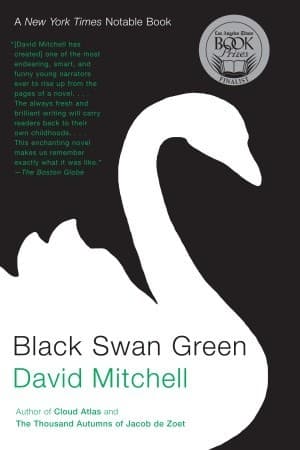
In the English village of Black Swan Green, thirteen-year-old Jason Taylor experiences a year of Cold War worries, first loves, and his parents' crumbling marriage, all while secretly writing poetry about life and change.
Thirteen-year-old Jason Taylor appears in the first chapter, 'Hangman,' set in January 1982. During a game of Hangman, Jason struggles to say 'gnome' because of his bad stammer, which he calls his 'Hooky.' This public problem makes him feel ashamed, especially in front of his classmates, including the scary Ross Wilcox and pretty Dawn Madden. The event shows Jason's deep worry and self-consciousness about his stammer, a constant issue that affects his social life and thoughts. He often feels alone, thinking to himself and watching the world in the quiet village of Black Swan Green.
In February, Jason and his friends, Dean Moran and Ant, play on a dangerously thin frozen lake. Their game, which involves daring each other to go further onto the ice, gets worse when Ant falls through. Jason, despite being scared, helps pull Ant from the icy water. This scary experience makes Jason think about dying and what happens when friends pressure you. The event also quietly introduces the idea of childhood innocence meeting the harsh dangers of the world, like the larger political situation of the Falklands War.
March brings a first step into being a teenager for Jason when he shares his first kiss with Dawn Madden. The kiss, however, is not perfect but a somewhat forced and awkward moment started by Dawn, who is known for being tricky and for her on-again, off-again relationship with Ross Wilcox. Despite not having true feelings, the kiss leaves a big mark on Jason, causing confusion and a new awareness of attraction and social rules. He deals with mixed feelings of excitement and the thought that Dawn's reasons might not match his own growing romantic ideas.
April brings the start of the Falklands War, which becomes a constant background to Jason's life. The conflict is always talked about on TV and by adults, creating a mood of national pride and quiet worry. Jason's father, a former soldier, becomes very interested in the news, and the war shows the differences between generations and views within the Taylor family. The war's distant violence fills the seemingly peaceful Black Swan Green, making Jason aware of bigger world events and their possible effects, even as he tries to understand what war means.
In May, a group of Romani (Gypsy) travelers sets up camp near Black Swan Green, causing fear and bias among some villagers. Jason sees the hostility and unfair attitudes firsthand, especially from characters like Ross Wilcox and some adults. He notices how easily fear can turn into hate, and the event makes him question if his community is as kind as it seems. This chapter looks at themes of fear of outsiders and social unfairness, as Jason deals with the different stories told by adults and his own observations of the travelers.
June introduces Jason to Madame Eva van Outryve de Crommelynck, an old, mysterious Belgian woman living in a big, run-down house. He first meets her while 'nightcreeping' (a game where he and his friends sneak through people's gardens). Madame Eva, a former journalist, sees Jason's sensitivity and intelligence, and despite being strict at first, she becomes a mentor. She challenges his ideas, encourages his writing, and helps him see past the simple life of his village, offering a look into a more educated and worldly existence. Their talks often involve language, books, and how people see things.
During the summer, Jason accidentally breaks his dead grandfather's valuable watch, a family item. Very scared of his parents' reaction, especially his father's, he starts a secret search to find a replacement. This leads him to various shops and meetings, showing his desperation and growing guilt. The broken watch stands for his fear of letting his family down and the weight of keeping secrets, as well as how fragile memory and the past are. His struggle to replace it shows his wish to seem in control and avoid trouble.
Inspired by his talks with Madame Eva and his own observations, Jason starts writing poetry under the name 'Eliot Bolivar.' In July, he secretly enters a poem into a local contest, surprisingly winning a prize. This secret win is a big moment for Jason, as it lets him show his true self and his inner world without his stammer getting in the way. Writing becomes a strong way for him to be creative and gain confidence, even if he cannot openly claim his win. It shows the difference between his outer problems and his rich inner life.
Throughout the year, especially in autumn, the strained relationship between Jason's parents becomes clearer. Quiet arguments, silences, and a general feeling of unhappiness fill the house. Jason, who notices things, picks up on these clues, though he doesn't fully understand what they mean at first. The slow breakdown of his parents' marriage is a main underlying issue, like the larger changes and uncertainties of the 1980s. This family trouble adds to Jason's inner worries and feeling of instability, as his seemingly stable family starts to break apart.
In a final confrontation, Jason finally stands up to Ross Wilcox, the school bully who has bothered him and others all year. The meeting is driven by anger, frustration, and a new sense of self-worth, partly from his secret poetry success and Madame Eva's encouragement. While the fight doesn't result in a clear 'win,' Jason's act of defiance marks a turning point for him. It shows his growing bravery and his refusal to be a quiet victim, taking control even when intimidated.
Towards the end of the year, Jason's inner struggle with his stammer, 'Hooky,' changes. Through his experiences, his talks with Madame Eva, and his growing self-awareness, he begins to see Hooky not as an enemy to beat, but as a part of himself. This subtle but deep change in view is a big step towards accepting himself. He realizes that while Hooky causes problems, it doesn't define him, and he can still find ways to express himself and connect with the world, especially through his writing. This acceptance is a key part of his growth.
Christmas Eve arrives, and the Taylor family gathers, but the tension from his parents' marriage problems is clear. Jason watches the traditions and interactions with a more grown-up view, thinking about the past year's big events: his first kiss, the Falklands War, the Gypsy camp, his friendship with Madame Eva, his poetry win, and his confrontations. He sees how much he has changed and grown, even if the things around him, like his parents' relationship, are not fixed. This chapter is a moment to reflect, bringing his experiences together and hinting at future difficulties.
As the year turns to 1983, Jason looks ahead with quiet hope. His parents' divorce is now an open secret, but he has found comfort and strength in his writing and in his friendship with Madame Eva. He has a stronger sense of self, understanding his stammer better and finding his voice through poetry. The last chapter shows Jason accepting his identity as 'Eliot Bolivar' and as himself, ready to face the uncertainties of being a teenager and the future. He has gone through a difficult year, coming out with more self-awareness and strength, ready for the next part of his life.
The Protagonist
Jason transforms from a self-conscious, stuttering boy into a more self-aware and confident young man who begins to accept his 'Hooky' and finds his voice through poetry.
The Supporting
She remains a consistent source of wisdom and encouragement, helping Jason come to terms with himself.
The Antagonist
He remains a static symbol of intimidation, though Jason's growing confidence diminishes his power.
The Supporting
She remains largely static, serving as a catalyst for Jason's early romantic experiences and disillusionment.
The Supporting
He remains a steadfast friend, providing support and companionship to Jason.
The Supporting
Her character arc reflects the slow, painful dissolution of her marriage.
The Supporting
His character arc mirrors the disintegration of his marriage and his struggle to cope with personal and external pressures.
The Mentioned
Jason's relationship with Hooky evolves from an internal battle to a form of acceptance and integration.
Jason's main challenge is to define himself while dealing with being a teenager, especially his stammer. His thoughts, his pen name 'Eliot Bolivar,' and his secret poetry help him find a voice that his spoken words often deny him. Madame Eva supports this self-discovery by valuing his observations and intelligence. The theme shows as Jason learns to accept his 'Hooky' not as a weakness, but as part of his unique self, finally embracing who he is through creative writing. This is clear in his anonymous poem entry and his increased confidence by the end of the year.
“''If you can't say it, write it.'”
The novel shows Jason moving from childhood innocence to a more complex understanding of the world. He sees his parents' marriage fall apart, experiences the fakeness and bias of adults (e.g., towards the Gypsies), and deals with the harsh realities of bullying and a distant war. His first kiss with Dawn Madden is more about manipulation than romance, and breaking his grandfather's watch by accident represents how fragile the past is. These experiences together remove his naive view of the world, replacing it with a more detailed, and sometimes painful, understanding of human nature and society's flaws.
“'The world wasn't a fair place. That was the first rule of the world.'”
Language is both a problem and a solution for Jason: his stammer causes deep pain, but writing saves him. Madame Eva, a former journalist, stresses the importance of exact language and observation, helping Jason improve his natural talent. His creation of 'Eliot Bolivar' lets him express himself freely and strongly through poetry, winning a local contest. This theme highlights how language can both trap and free, and how telling stories, whether in one's head or on paper, is important for understanding and shaping one's reality.
“'Words are like coins, Jason. Some are shiny and new, some are worn smooth, but all have a value.'”
Set in 1982, the novel carefully weaves the social and political situation of Cold War England and the Falklands War into Jason's personal story. The war, Thatcher's economic downturn, and local biases (like those against the Gypsy camp) create a background of uncertainty and change that reflects the instability in Jason's own life, especially his parents' coming divorce. These bigger events are not just background; they affect the adults' moods, the community's worries, and Jason's growing awareness of a world beyond Black Swan Green, making him place his personal struggles within a larger historical time.
“'The war was like a fog, sometimes thick, sometimes thin, but always there.'”
The effects of bullying are a constant part of the story, mainly through Ross Wilcox. The novel looks at how social ranks are formed and kept among teenagers, often through threats, fear, and manipulation. Jason's inner struggle with his stammer makes him a frequent target, but his eventual confrontation with Ross marks a key step in his personal growth. The theme highlights the emotional cost of bullying and the bravery needed to stand up to it, showing how even small acts of defiance can lead to big personal development.
“'Ross Wilcox was like a king, and Black Swan Green was his kingdom.'”
The entire story is told through the eyes and internal monologue of 13-year-old Jason Taylor.
This device immerses the reader directly into Jason's subjective experience, allowing for deep insight into his thoughts, fears, and observations, particularly his struggle with his stutter ('Hooky'). The narrative voice is authentic to a 13-year-old, blending youthful naivety with surprising moments of profound insight. It highlights the contrast between his articulate inner world and his difficult outward communication, making his journey of self-discovery highly personal and relatable. This perspective is crucial for understanding his emotional growth and the nuances of his interactions.
The novel is divided into thirteen distinct chapters, each representing a month in 1982, functioning almost as interconnected short stories.
This structure allows Mitchell to explore various facets of Jason's life and the community of Black Swan Green without a rigidly linear plot. Each 'episode' highlights a specific event, character interaction, or theme, building a cumulative portrait of Jason's year. It mirrors the fragmented, yet continuous, nature of memory and adolescent experience, where individual moments can feel like complete stories. This allows for a broad scope of events, from the personal to the political, all filtered through Jason's developing consciousness.
Jason's inner thoughts are extensively detailed, and his stutter is personified as 'Hooky,' an internal antagonist.
Jason's rich internal monologue provides direct access to his anxieties, observations, and burgeoning intellect, often contrasting sharply with his difficulty speaking aloud. The personification of his stutter as 'Hooky' externalizes his internal struggle, making it a tangible force he battles. This device effectively communicates the profound psychological impact of his speech impediment and allows the reader to understand the constant vigilance and fear he experiences. His evolving relationship with 'Hooky' charts his journey towards self-acceptance and finding his voice.
The seemingly idyllic village of Black Swan Green symbolizes both innocence and underlying societal tensions.
The village itself functions as a microcosm of larger societal issues in 1980s England. Its name, 'Black Swan Green,' hints at hidden darkness within a seemingly peaceful setting, reflecting the underlying prejudices, social hierarchies, and domestic strife that Jason observes. The 'green' suggests nature and innocence, while 'black swan' implies rarity, unexpectedness, and perhaps a darker truth. The village serves as a contained world where personal and political changes are keenly felt by Jason, making it a symbolic stage for his coming-of-age.
“The thing about people who are good at talking is, they don't stop.”
— Jason observing the way some people dominate conversations.
“Words are also things, and things cast shadows. Words are also a form of action, and actions have consequences.”
— Jason reflecting on the power and impact of language.
“If you don't know what you want, you end up with a lot of what you don't.”
— Madam Eva, a fortune teller, giving advice to Jason.
“Adulthood is a sham. There's no such thing. Everyone's just making it up as they go along.”
— Jason's cynical view of maturity, often voiced by his alter ego, 'Hangman'.
“Sometimes you choose your words, and sometimes your words choose you.”
— Jason's internal struggle with his stutter and the words he can or cannot speak.
“Life’s a war. You don’t get to choose your battles, but you do get to choose your weapons.”
— Jason's reflection on navigating the challenges of life.
“Being a grown-up just means you're good at hiding your childhood.”
— Another of Jason's cynical observations about adulthood.
“The past is a foreign country; they do things differently there.”
— Jason's thoughts on the historical setting and the changes over time, echoing L.P. Hartley.
“The trick to being a poet is to keep your eyes open, and your mouth shut.”
— Jason's early understanding of what it means to be a writer.
“Small towns are like families: they know your secrets before you do.”
— Jason reflecting on the insular nature of Black Swan Green.
“Every secret has a shelf life.”
— Jason contemplating the eventual revelation of hidden truths.
“The world is full of people who don't know they're poets.”
— Jason's realization that creativity exists in many forms and people.
“Growing up is just a series of letting go, isn't it?”
— Jason's melancholic reflection on the process of maturation and loss.
“Some truths are like boomerangs. You throw them away, but they always come back.”
— Jason's understanding of inescapable realities.
Ready to see how well you understood this book? Take our interactive quiz with 10 questions.
David or Dave Mitchell may refer to:







