“The devil has been here before us, Monseigneur, and has planted his seeds.”
— Chomina, an Algonquin, speaks to Father Laforgue about the challenges of converting his people.

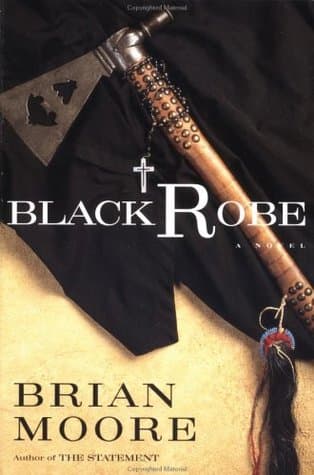
Brian Moore (1985)
Genre
Historical Fiction / Spirituality
Reading Time
250 min
Key Themes
See below
Sign in to track this book
In 17th-century New France, a young Jesuit priest's dangerous journey to convert a distant Huron tribe becomes a struggle with pagan beliefs, brutal survival, and spiritual doubt that threatens his faith.
In 1634, Father Laforgue, a young Jesuit priest, arrives in Quebec, New France, after years of study in France. Governor Champlain immediately calls him and gives him a dangerous mission: to travel to a faraway Huron village deep in the wilderness to replace Father Jerome, a sick missionary. Laforgue is worried, having heard stories of the 'savages' and the harsh conditions. Champlain gives him a small group of Algonkin guides, including Chomina and his family, to lead Laforgue and his young assistant, Daniel, upriver. The trip is full of danger, as winter is coming and the journey is long and hard, through land where hostile Iroquois might live. Laforgue struggles with his own fears and the huge spiritual challenge ahead.
The journey begins, with Laforgue and Daniel traveling by canoe with Chomina, his wife Anuka, his son Ougebmat, and his daughter Annuka, who is Daniel's lover. Laforgue immediately sees the clear differences between his European ways and the Algonkin way of life. He is disgusted by their perceived lack of cleanliness, their open sexuality, and their pagan rituals. He tries to keep his spiritual discipline among their constant talking, storytelling, and apparent disinterest in Christian teachings. Daniel, having spent more time with them, is more comfortable, which further isolates Laforgue. The priest tries to teach them catechism, but his efforts are met with confusion or amusement, making him feel more alone and doubtful.
As the journey goes on, Laforgue is increasingly bothered by vivid, disturbing dreams, often with sexual images that challenge his vows of celibacy. He sees these as temptations from the devil, which makes his inner struggle worse. One night, he finds Daniel and Annuka having sex, confirming his suspicions about their relationship. Laforgue is horrified and confronts Daniel, condemning his sin. Daniel, torn between his loyalty to the priest and his love for Annuka, admits he wants to stay with the Algonkins. This news breaks Laforgue's trust and sense of friendship, leaving him feeling completely alone and questioning his mission's effectiveness and his own faith.
The danger of the trip becomes clear when they are ambushed by Iroquois warriors. In the confusion, several Algonkins are killed, and Laforgue, Daniel, Chomina, and Ougebmat are captured. The Iroquois, fierce enemies of the Huron and French allies, torture their prisoners. Laforgue endures physical pain and mental suffering, watching his companions suffer. He tries to minister to them, offering prayers and comfort, but his words seem empty in the face of such cruelty. This experience makes Laforgue face the depths of human cruelty and the fragility of his own life and beliefs.
Through a clever plan by Chomina, the remaining captives escape from the Iroquois. They run into the thick forest, wounded and tired, constantly fearing recapture. Their supplies are low, and the harsh wilderness tests their endurance. During this desperate escape, Laforgue's physical strength weakens, and his spiritual resolve is severely tested. He relies heavily on Chomina's knowledge of the land for survival, showing his dependence on the very people he had first disliked. The escape, while a relief, does not end their suffering, but simply changes it.
As they continue their desperate journey, Ougebmat, weakened by his injuries, becomes a burden. Chomina, knowing the group needs to move faster to survive, makes the painful decision to kill his own son, a common act in their culture to prevent the group's capture. Laforgue is horrified by this, seeing it as barbaric murder, a direct violation of God's law. Chomina, however, sees it as a necessary sacrifice for the group's survival. This event deeply shakes Laforgue, forcing him to question good and evil, and the sharp difference between his morals and those of the Algonkins. He feels a huge weight of despair and spiritual isolation.
Near death from exhaustion and hunger, Laforgue has a vivid spiritual vision, a moment of deep connection with God that renews his purpose. He believes he has been given a sign to continue his mission. Soon after, Annuka tells him she is pregnant with Daniel's child and desperately asks Laforgue to baptize her and her unborn child, believing it will protect them from evil spirits. Laforgue, despite his earlier disapproval of her relationship with Daniel, sees her plea as a true act of faith, a small hope in the wilderness. He performs the baptism, an act that subtly changes his view of the 'savages'.
After months of hardship, Laforgue, Daniel, Chomina, and Annuka finally reach the remote Huron mission. The sight that greets them is terrible. The village is destroyed by smallpox, a European disease, and the few surviving Huron are weak, scared, and very suspicious. Father Jerome, whom Laforgue was sent to relieve, is dead. The Huron blame the 'blackrobes' for the plague, believing their rituals and presence are a curse. Laforgue faces the immediate failure of his mission and the devastating impact of his own culture on these people, further deepening his inner conflict about his faith and its role.
The surviving Huron, ravaged by disease and superstition, do not trust Laforgue. They see him as a bringer of death, not salvation. Their shamans accuse him of witchcraft, and the villagers' fear is clear. Laforgue, despite his own physical and spiritual exhaustion, tries to explain his mission and offer comfort, but his words are met with hostility. At a key moment, a group of dying Huron elders, desperate for any hope, approach him. They have heard that baptism can grant access to the 'heaven' the blackrobes speak of and ask to be baptized, believing it will save them from their suffering and the anger of their own spirits.
Faced with the dying Huron's request, Laforgue is filled with deep doubt. He wonders if their request is a true act of faith or just a desperate attempt to escape death, a misunderstanding of his sacrament. He questions if he is simply using their fear. Yet, seeing their raw humanity and suffering, he makes a choice. He baptizes the dying Huron, one by one, not with the intellectual certainty he once had, but with a new, deep understanding of compassion and shared humanity. He realizes that his God is not just in abstract rules, but in the simple act of offering hope and comfort in despair. He has found his faith again, changed.
The Protagonist
Laforgue transforms from a dogmatic, fearful priest into a man who finds a more compassionate and humanistic understanding of his faith, moving beyond rigid doctrine.
The Supporting
Daniel's arc shows him choosing a life with the native people over his European origins, finding love and belonging, but also experiencing loss.
The Supporting
Chomina remains steadfast in his cultural identity, demonstrating the strength and sacrifice inherent in his traditions, even as he witnesses the encroaching European influence.
The Supporting
Annuka's journey reflects the impact of European contact, leading her to seek protection and hope through Christian rituals, despite her native upbringing.
The Supporting
Champlain's arc is less about personal transformation and more about his role as a driving force for the mission, embodying the colonial imperative.
The Supporting
Anuka maintains her role as a nurturing figure within her family, enduring tragedy with resilience.
The Supporting
Ougebmat's arc is tragically cut short, serving as a catalyst for Laforgue's internal conflict and a demonstration of native survival ethics.
The Mentioned
Father Jerome's story is a cautionary tale, representing the failure and ultimate sacrifice of early missionary efforts.
The main theme is Father Laforgue's difficult spiritual journey, which constantly challenges his strong Catholic faith. From his first firm beliefs, he must face deep doubts about God's presence, his mission's effectiveness, and salvation when he sees the Algonkins' 'pagan' practices, the Iroquois' brutality, and disease's devastating effects. His vivid, disturbing dreams and moral problems (e.g., Daniel's relationship, Chomina's sacrifice) push him to his limits. In the end, his faith is not destroyed but changed, becoming more compassionate and less rigid. This culminates in his act of baptizing the dying Huron, driven by deep human empathy rather than strict rules.
“How could a God of love permit such suffering? And how could these savages, who knew nothing of Christ, be condemned to eternal damnation?”
The novel clearly shows the sharp and often violent conflict between European Christian civilization and the native cultures of North America. Laforgue first sees the Algonkins as 'savages,' defined by their perceived barbarism, open sexuality, and animistic beliefs, which he thinks are morally inferior. The native peoples, in turn, find the 'blackrobes' strange, their rituals odd, and their God hard to understand. They often blame them for the diseases they bring. This clash appears in language differences, different moral codes (e.g., Chomina's sacrifice versus Laforgue's horror), and the devastating impact of European diseases. The story explores the sad results of one culture trying to force its views on another, leading to misunderstanding, exploitation, and destruction.
“He saw now that their faces were not those of devils, but of men. Men who, in their own way, sought to understand the mysteries of life and death.”
The harsh Canadian wilderness acts as a strong test for both physical and spiritual endurance. The vast, untamed land, with its cold winters, dangerous rivers, and hidden threats (both natural and human, like the Iroquois), removes Laforgue's European comforts and shows his weaknesses. It forces him to rely on the very 'savages' he first disliked for survival, showing his dependence on their knowledge and strength. The wilderness is not just a background but an active force that tests his physical limits, his mental strength, and ultimately, his spiritual resolve, pushing him to face his deepest fears and biases. It is in this raw, natural setting that his change happens.
“The forest was a dark cathedral, but one where God seemed to have abandoned his altar.”
The novel explores the complex and often unclear nature of good and evil, questioning simple definitions. Laforgue first sees good as strictly aligned with Christian doctrine and evil with 'pagan' practices. However, he sees acts of deep cruelty (Iroquois torture) and selfless sacrifice (Chomina killing his son for the group's survival) from the native peoples, forcing him to rethink his ideas. He also faces his own ability to judge, fear, and even lust, recognizing the 'evil' within himself. The story suggests that good and evil are not unique to one culture or another, but are complex parts of the human condition, often tied to survival, customs, and belief systems. Laforgue's final act of baptism is an act of 'good' that comes from a place beyond traditional rules.
“He had come to save souls, but what if their salvation lay not in his God, but in their own?”
A physical and spiritual odyssey through a challenging wilderness.
The entire novel is structured around a perilous journey upriver into the Canadian wilderness. This physical trek serves as a powerful metaphor for Father Laforgue's internal spiritual and psychological journey. As he navigates treacherous rapids, hostile territories, and the harsh elements, he is simultaneously forced to confront his own prejudices, doubts, and fears. The external challenges directly mirror and catalyze his internal transformation, stripping away his preconceived notions and forcing him to adapt and re-evaluate his core beliefs.
Unsettling dreams and native omens hint at future trials and spiritual conflicts.
Moore uses foreshadowing through Laforgue's unsettling dreams and the native characters' belief in omens. Laforgue's dreams, often sexual or violent, hint at the temptations and horrors he will face, and the internal battles he must fight against his own desires and fears. The Algonkins' interpretations of signs and spirits also foreshadow dangers, such as the Iroquois attack or the spread of disease. This device builds suspense and emphasizes the spiritual and supernatural dimensions of the native worldview, contrasting with Laforgue's rational, Christian perspective.
Juxtaposition of European and native customs to highlight differences and challenges.
The novel constantly employs cultural contrast to highlight the profound differences between European and native ways of life. This includes differing views on sexuality, spirituality, morality, hygiene, and social customs. For example, Laforgue's horror at Daniel and Annuka's relationship contrasts with the Algonkin's open approach to sexuality, and Chomina's pragmatic sacrifice of his son clashes with Laforgue's Christian condemnation of murder. This device serves to challenge the reader's own assumptions and to illustrate the immense difficulty of cross-cultural understanding and the tragic consequences of cultural imposition.
Smallpox acts as a devastating force, driving the plot and challenging beliefs.
The smallpox epidemic, brought by Europeans, is a critical plot device. It is the reason Laforgue is sent on his mission (to relieve Father Jerome, who dies from it), and its devastating impact on the Huron village creates the ultimate crisis and moral dilemma for Laforgue. The disease is seen by the natives as a curse, often attributed to the 'blackrobes,' directly linking European presence with death and destruction. It forces Laforgue to confront the unintended consequences of his mission and ultimately pushes the dying Huron to seek baptism, creating the climactic moment of his transformed faith.
“The devil has been here before us, Monseigneur, and has planted his seeds.”
— Chomina, an Algonquin, speaks to Father Laforgue about the challenges of converting his people.
“They were children, yes, but children of the forest, whose wisdom was of the earth and the river, not of books and churches.”
— Father Laforgue reflects on his perception of the Algonquin people.
“He knew now that he would never understand them, nor they him. He was a blackrobe, and they were the people of the forest.”
— Father Laforgue's growing realization of the insurmountable cultural gap.
“How could he explain the miracle of the Mass to people who saw miracles in every sunrise, every animal, every leaf?”
— Father Laforgue struggles to convey Christian concepts to the Algonquin.
“Sometimes, he thought, silence was the truest form of prayer.”
— Father Laforgue finds solace in quiet contemplation amidst the wilderness.
“There was no God in this place, only the forest, immense and indifferent.”
— Father Laforgue's crisis of faith in the face of the vast, unforgiving Canadian wilderness.
“His God was a God of suffering, theirs a God of joy and plenty. How could they ever meet?”
— Father Laforgue contrasts Christian theology with Indigenous spiritual beliefs.
“He remembered the words of his superior: 'To save one soul is worth a thousand deaths.' But whose soul was he saving?”
— Father Laforgue questions the ultimate purpose and cost of his mission.
“They had their own way of knowing, a way that did not depend on words or books, but on feeling, on intuition.”
— Father Laforgue observes the Algonquin's deep connection to their environment.
“The world was a place of spirits, good and bad, and the blackrobe's God was just one more spirit, perhaps a powerful one, but not the only one.”
— Chomina's perspective on the Christian God within the Algonquin worldview.
“He was a stranger here, and would always be, no matter how long he stayed, no matter how many souls he saved.”
— Father Laforgue's enduring sense of otherness and isolation.
“The forest had a voice, if you only knew how to listen.”
— Chomina tries to explain the spiritual connection to nature to Father Laforgue.
“He had come to save them, but perhaps they had something to teach him.”
— Father Laforgue's dawning realization of the value of Indigenous perspectives.
“The blackrobe's God demanded suffering. Our spirits give us joy.”
— Chomina contrasts the perceived nature of the Christian God with Algonquin spirits.
Ready to see how well you understood this book? Take our interactive quiz with 10 questions.

Brian Moore was a critically acclaimed novelist known for his gripping narratives and exploration of complex moral and spiritual themes. His novel "Black Robe" is a powerful historical fiction work set in 17th-century New France, lauded for its vivid portrayal of cultural collision and religious conflict. Moore's extensive body of work earned him numerous awards and international recognition for his contributions to literature.







